Bend, Oregon

Thursday, August 29, 2019

Monday morning we picked up, jacks up, hooked up the toad and headed south on Cascade Highway NE. At Sublimity (2600 souls) we turn east on OR 22. The 22 follows the Santiam River by Mehama (283 souls), through Mill City (1800 souls). Part way up a steep walled volcanic rock dominated canyon we come to two dams, the Cliff and the larger Detroit which holds back Detroit Lake.
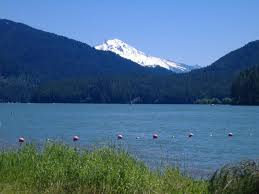
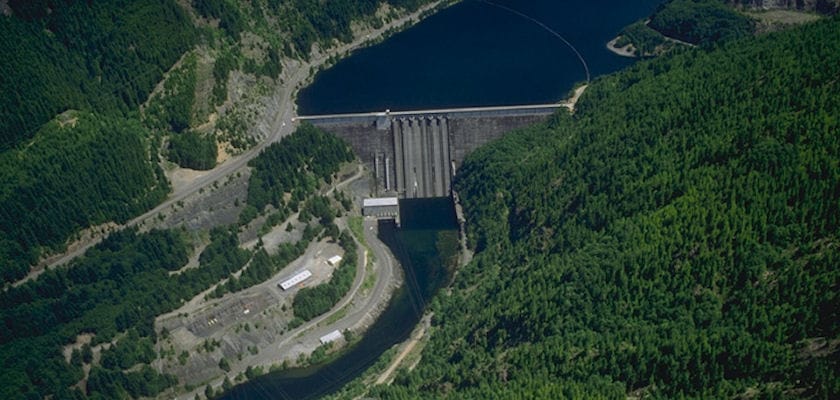
Detroit Lake and Detroit Dam

We pass Detroit Lake State Recreation Area and the town of Detroit (202 souls). It was named for Detroit Michigan in the 1890s because of the large number of people from Michigan in the community. From there OR 22 runs through deep forests mostly following the Santiam River.

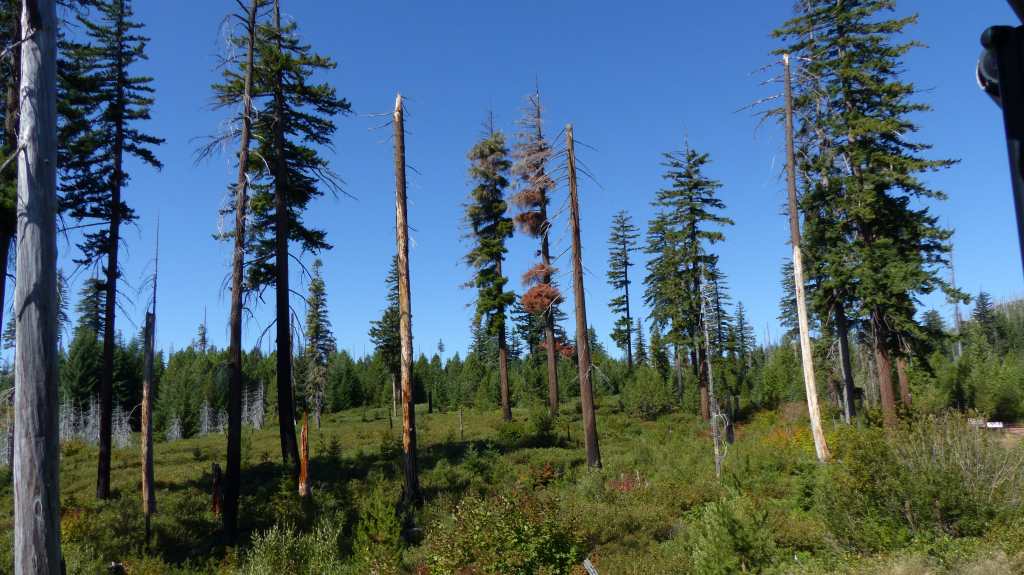
Oregon Route 22 merges on to US Highway 20 and steadily climb until we reach Santiam Pass (elevaton 4817), then a long downhill grade until the road flattens out a few miles from the town of Sisters (2100 souls).

Mt. Washington as Seen from Highway 20

Sisters was named after the nearby Three Sisters mountain peaks. Navigating Sisters is a giant P.I.A. as US 20 runs right through the quaint, touristy commercial district. On any given day the narrow route is packed with jay walking people and bumper to bumper vehicles- including big rig trucks. Side traffic darts in and out. Stop and go, really slow traffic is a given. A downtown bypass route is needed.

Sisters- Traffic is Relatively Light Today!

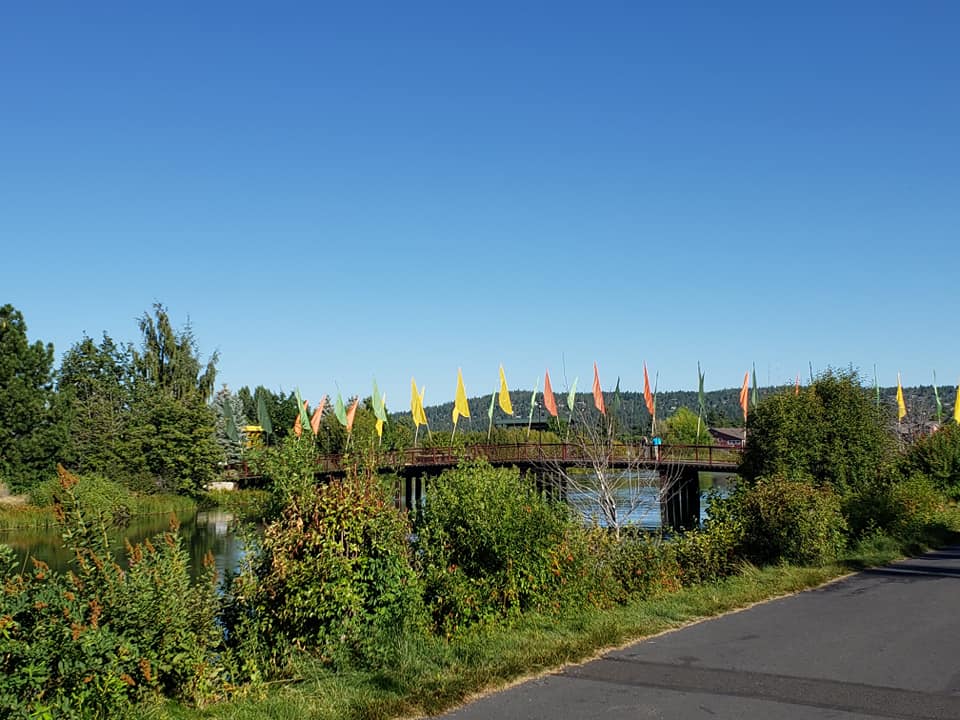
Just east of town tall conifers give way to open sage, ranch and farm country. We get a great view of the local volcanic peaks, seven are within sight. US 20 takes us into the north side of Bend where we pick up US 97, traveling to the south side of town. Crown Villa RV Resort is where we will stay for four nights.

Bend is the seat of Deschutes County and the principal city of the Bend-Redmond metropolitan statistical area. It is located on the eastern edge of the Cascades Range along the Deschutes River. Ponderosa Pine forest transitions into the high desert, characterized by junipers, sagebrush, and bitterbrush. Bend is also Central Oregon’s largest city. The 2000 census recorded 52,000 souls living here. The current estimate is 100,000, nearly double from that of 20 years ago. This place is growing like gang busters! The Bend-Redmond metro population is estimated at over 197,000 making it the fifth largest metro area in Oregon.
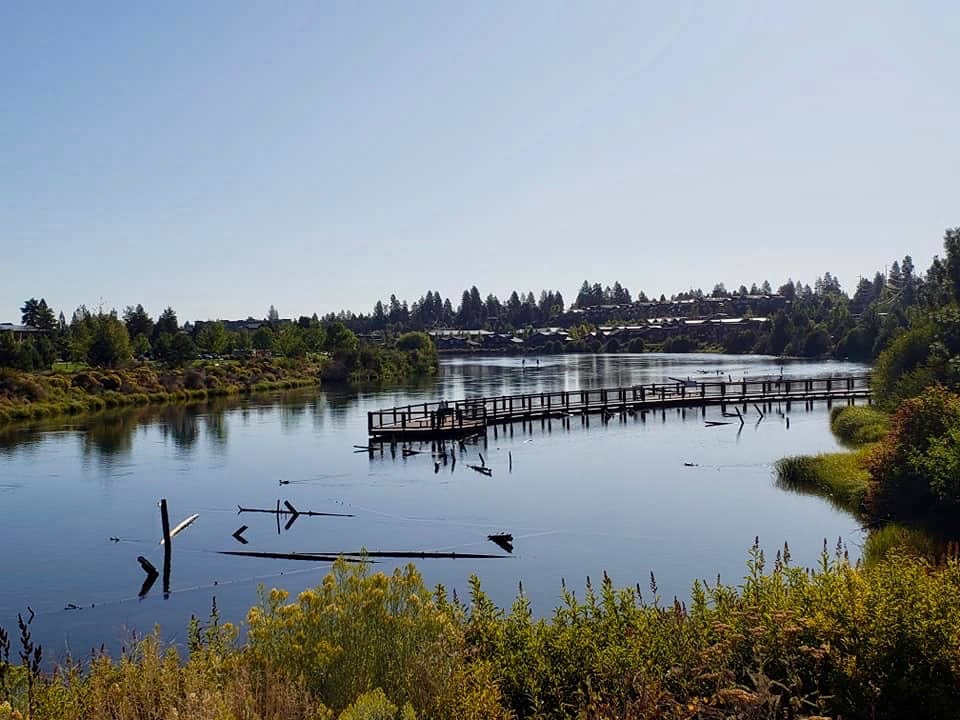
Deschutes River at Farewell Bend Park

Bend was named after one of the few fordable locations on the Deschutes River, Farewell Bend. The area was first visited by a fur trapping party in 1824 followed by John C. Fremont and other U.S. Army survey parties. Next came pioneers who forded the Deschutes at Farewell Bend.

The first sawmill was operational in 1901, the next, a water driven sawmill, became operational in 1903. A dam built in 1910 provided the city with its initial source of electricity. It is still produces electricity today supplying nearly 200 households.

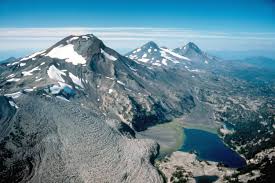
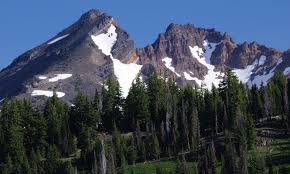
The Cascade Range has a string of volcanic peaks that line up like soldiers from south to north beginning in California and ending in British Columbia. Several of those peaks can be seen from Bend.

The best viewing from town is from 500 foot Pilot Butte, itself an extinct volcano. Three Sisters, Broken Top and Mount Bachelor are easily seen from the butte. Three Fingered Jack, Mt. Jefferson and Mt. Washington are also close by.
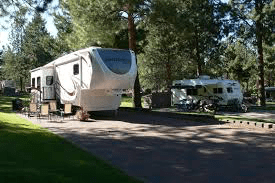
We usually stay at the Crown Villa RV Resort. It is one of the few self proclaimed resort parks that we consider an actual resort. It was originally advertised as purchase your own lot. However sales were slow so that idea was nixed. Amenities include an fitness center, a gathering room, a lounge, a patio with fire pits and a BBQ, tennis/pickleball court, horseshoe court, pool table, hot tub, steam rooms and a very nice laundry facility. Whew! As a plus the staff is incredibly courteous, helpful and friendly.
Old Mill District- Smoke Stacked Building Was A Lumber Mill, Now A Mall

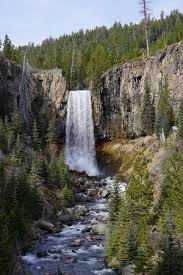
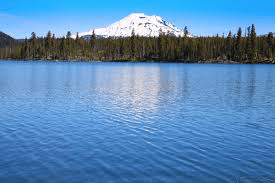
One place we always go while in Bend is the shopping mall at the Old Mill District. One of us likes to shop at JJill! Sometimes we take the Cascades Lakes Scenic Byway and loop through a portion that beautiful country. Little Lava Lake is one of our favorites. Picture a small alpine lake surrounded by fresh smelling pines with Mt. Bachelor looming large in the background. Sometimes we take a drive up to 97 foot Tumalo Falls.
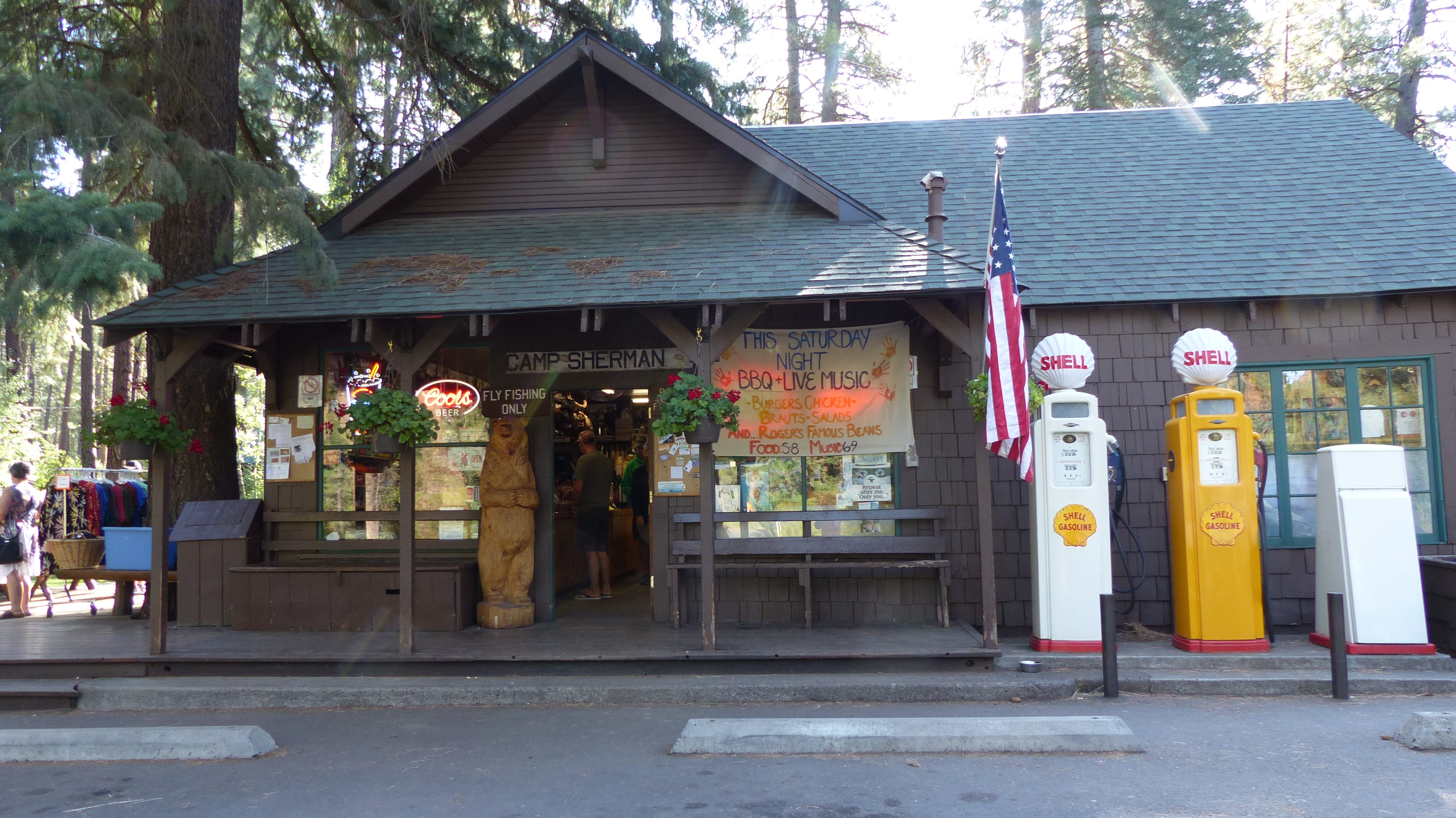
On this visit we decide to go to another one of our haunts, Camp Sherman even though that requires driving through Sisters- ugh! Camp Sherman is a tiny community of 230 souls located very near the headwaters of the Metolius River. That population swells to three or four times that during high season.
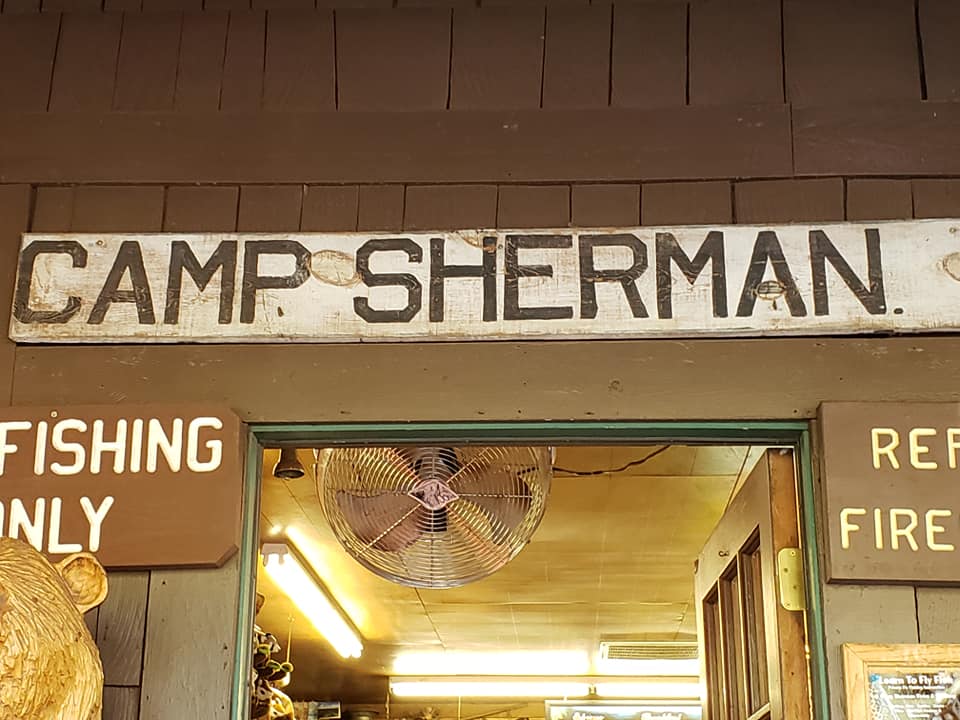
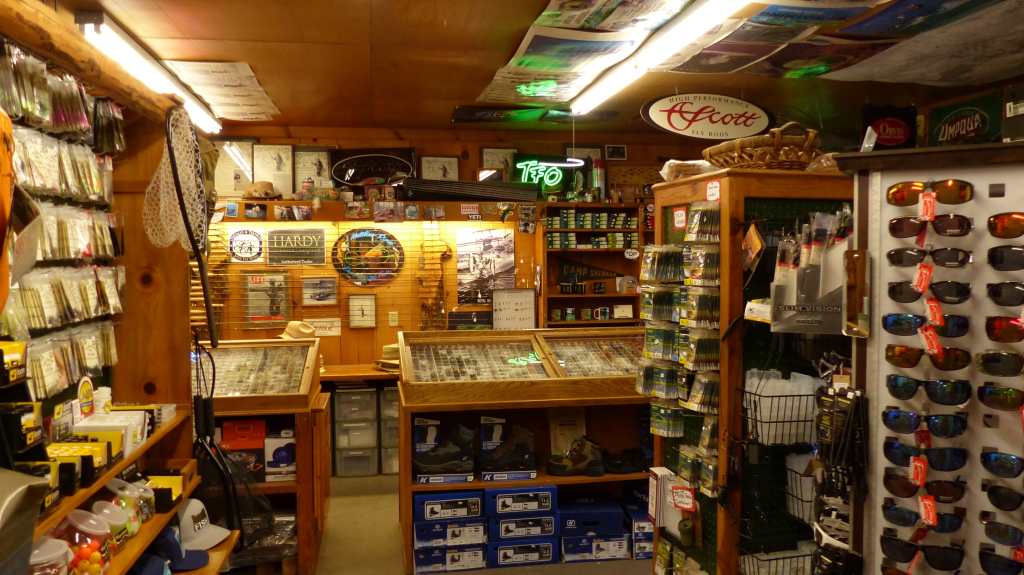
It’s a fisherman’s haven, however only fly fishing is allowed and much of the river is catch and release. The folks of the little Camp Sherman Store realize the importance of fishermen to the Camp as they devoted one entire section to fly fishing supplies. Coincidently, the tiny Post Office is attached to the tiny but well stocked store.
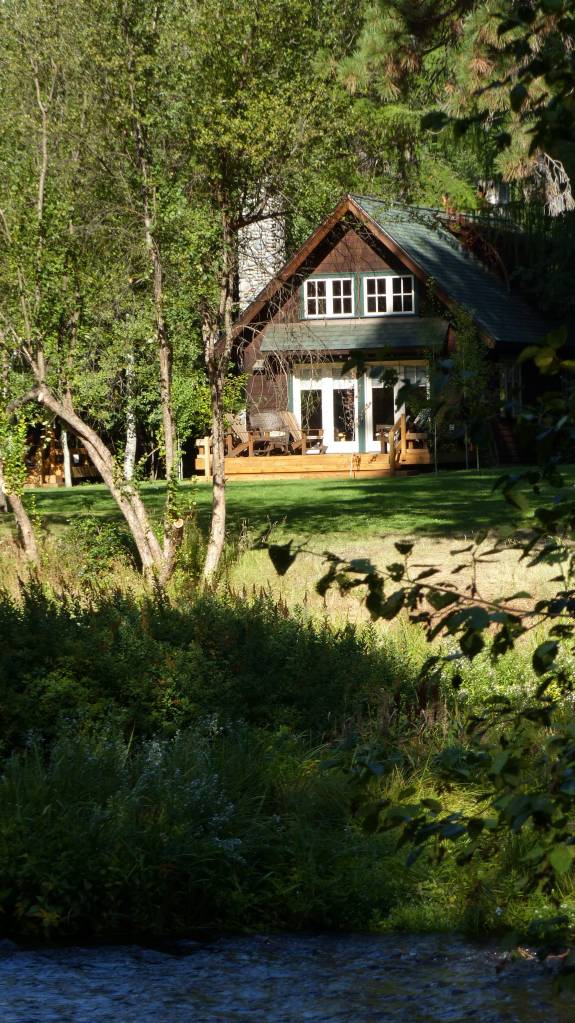
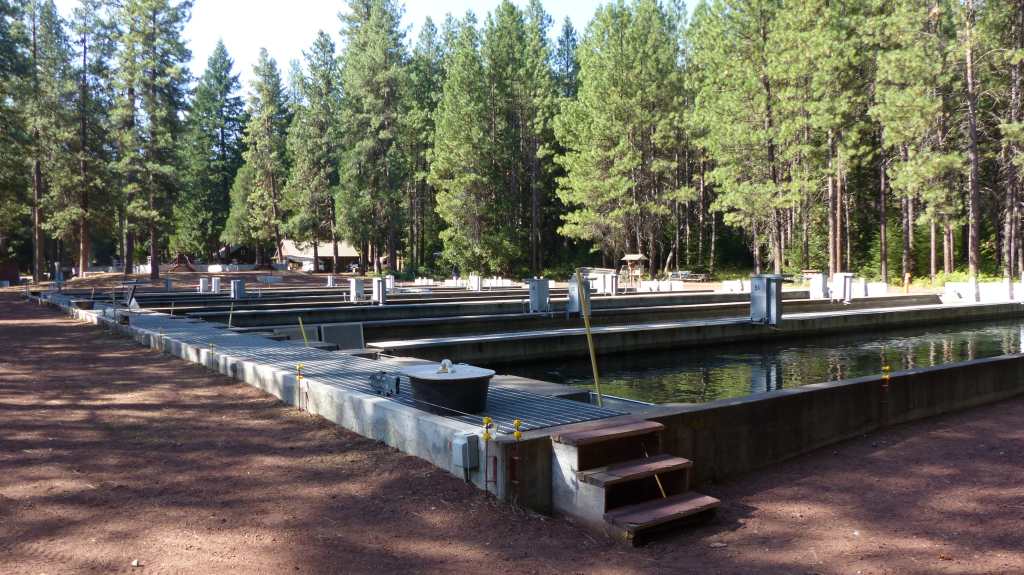
Five Miles downstream is the delightful Wizard Falls Fish Hatchery. The water supplying the hatchery does not come from the nearby Metolius but from the spring that fed Wizard Falls.

The water is just the right temperature and is pure- perfect for raising fish. Since our last visit several new ponds have been added indicating that they plan on raising more trout and salmon.
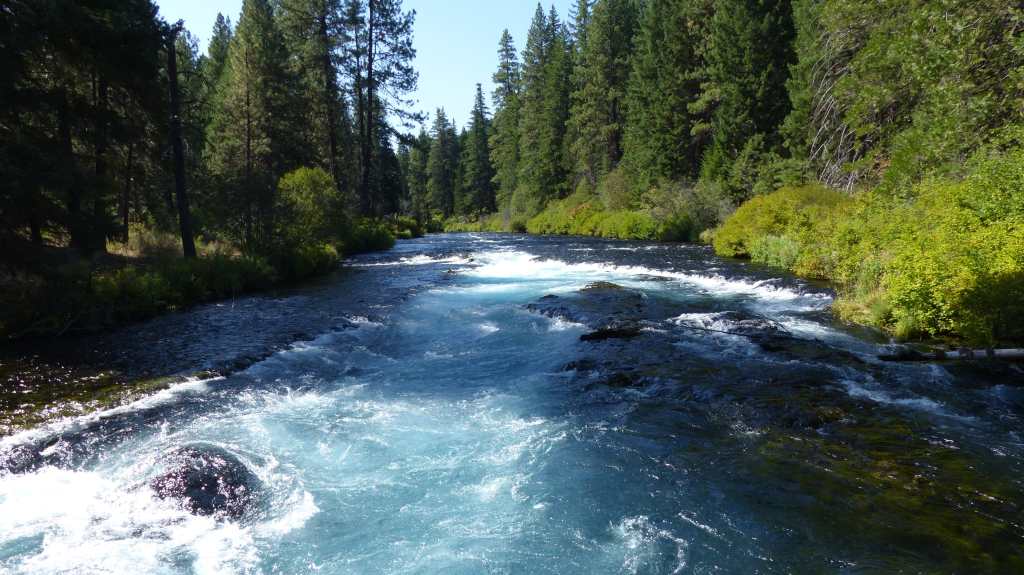
The Beautiful Metolius River Runs By Wizard Falls Hatchery

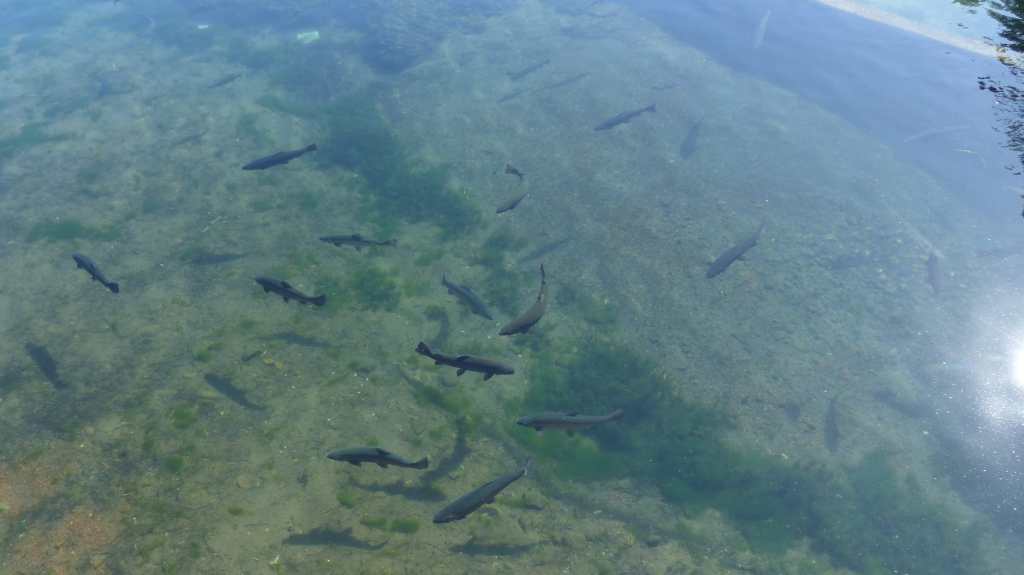
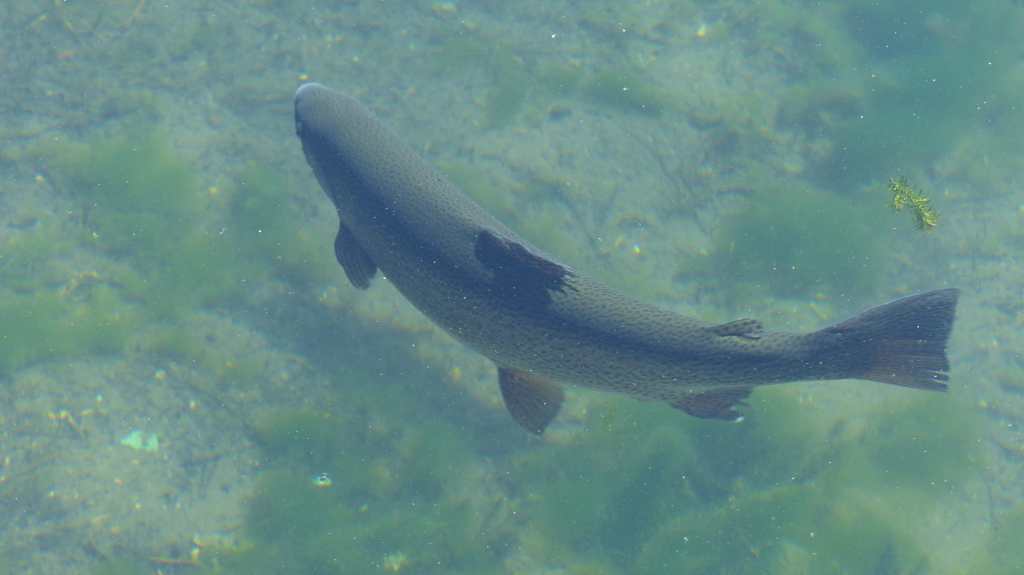
A large settling pond contains the largest fish. I understand that these fish were “escapees” from the rearing ponds at one time. The hatchery employees leave them be, but have added a few fish food machines for those who wish to feed them.

We visit the headwaters of the Metolius on our way back to camp. It’s almost unbelievable that this river originates from springs that magically appear at the edge of a hill. It’s not possible to get a good photo of the springs as lush growth obscures the view, but I gave it a whirl just to contrast the size of the river not 100 feet downstream.

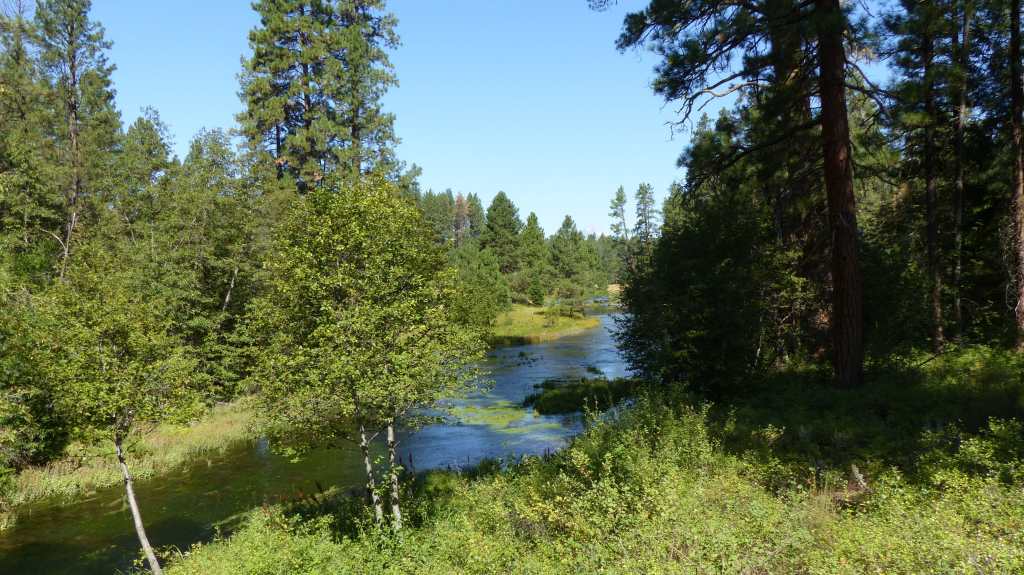
Top Photo: Headwater Spring; 100 Feet From Spring- The Metolius River

That concludes our visit to Bend. We enjoy this diverse area so I suspect we will visit again and again. We’ll be pushing on to the Bonneville Fish Hatchery tomorrow. See you there!

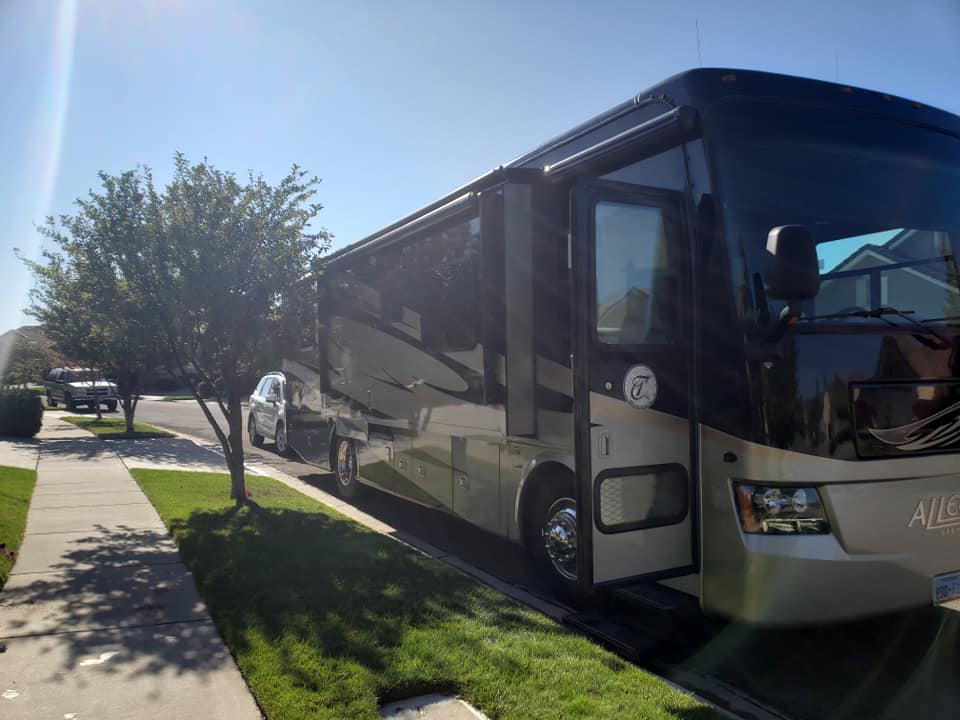
Just When You Think You’ve Seen It All-Your Neighbor Shows Up In His 2.3 Million Dollar Coach!

Four Days in Silverton, Oregon- Part Two

Sunday, August 25, 2019

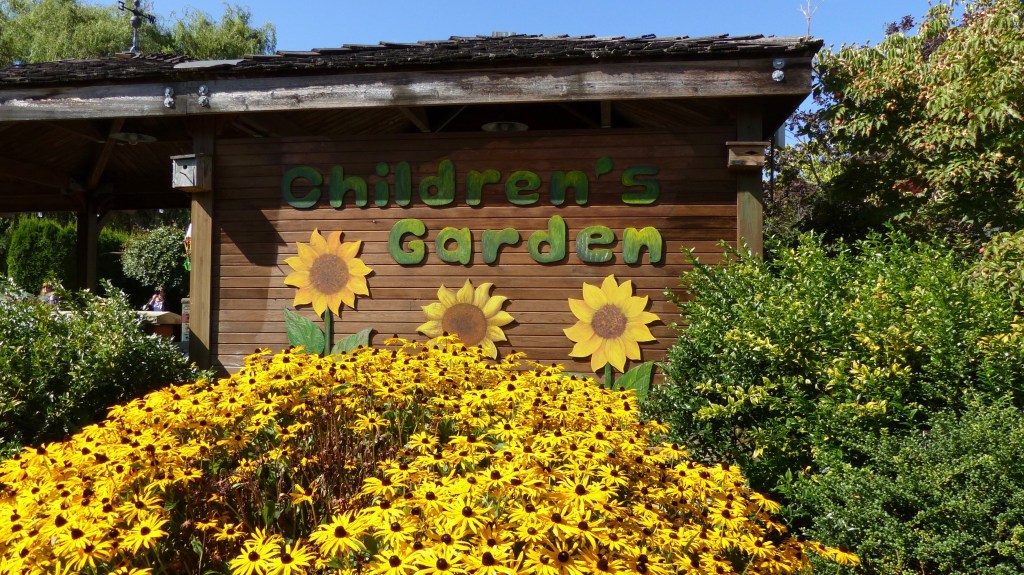
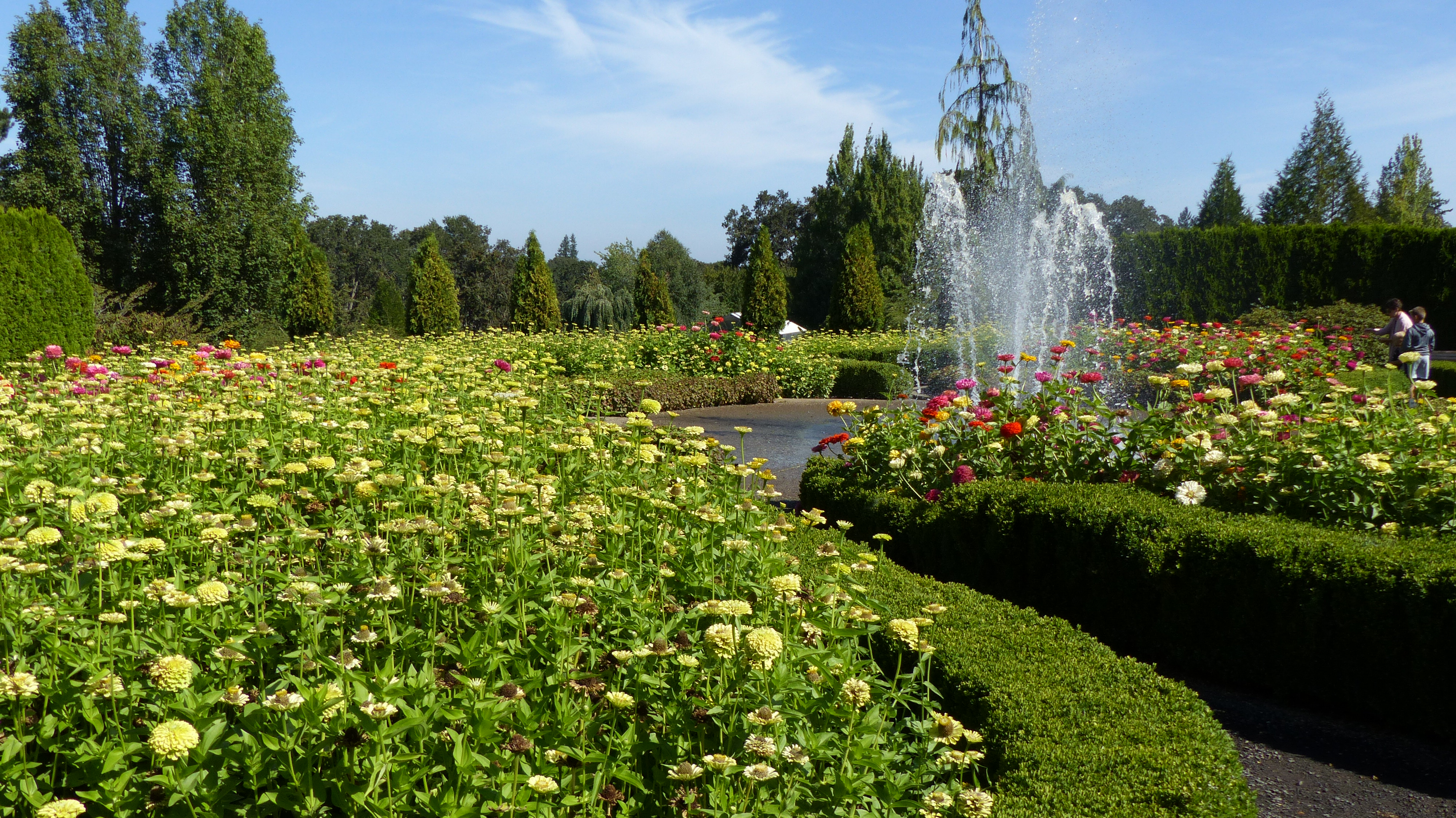
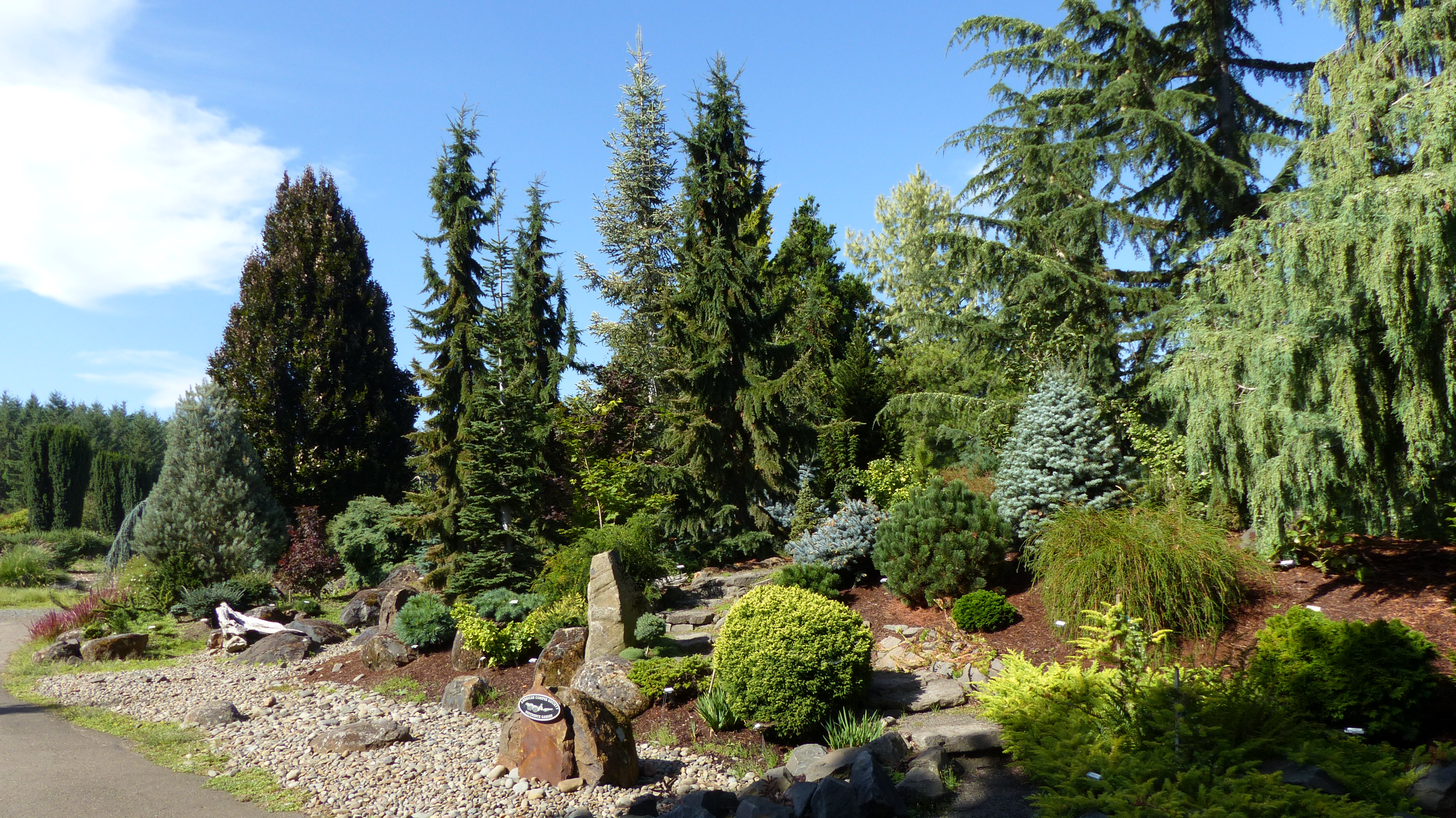
The Oregon Garden is an 80-acre botanical and tourist attraction in Silverton. Opened in 1999, it is home to over 20 gardens including the Rose Garden, Children’s Garden and Silverton Market Garden.

It is open 365 days a year and hosts both public and private events. The Garden is also home to the Gordon House, Oregon’s only Frank Lloyd Wright home, and The Oregon Garden Resort.

The Children’s Garden

It’s dog friendly so all four of us take a walking tour. It’s a must see place if one appreciates a diverse garden as we do.

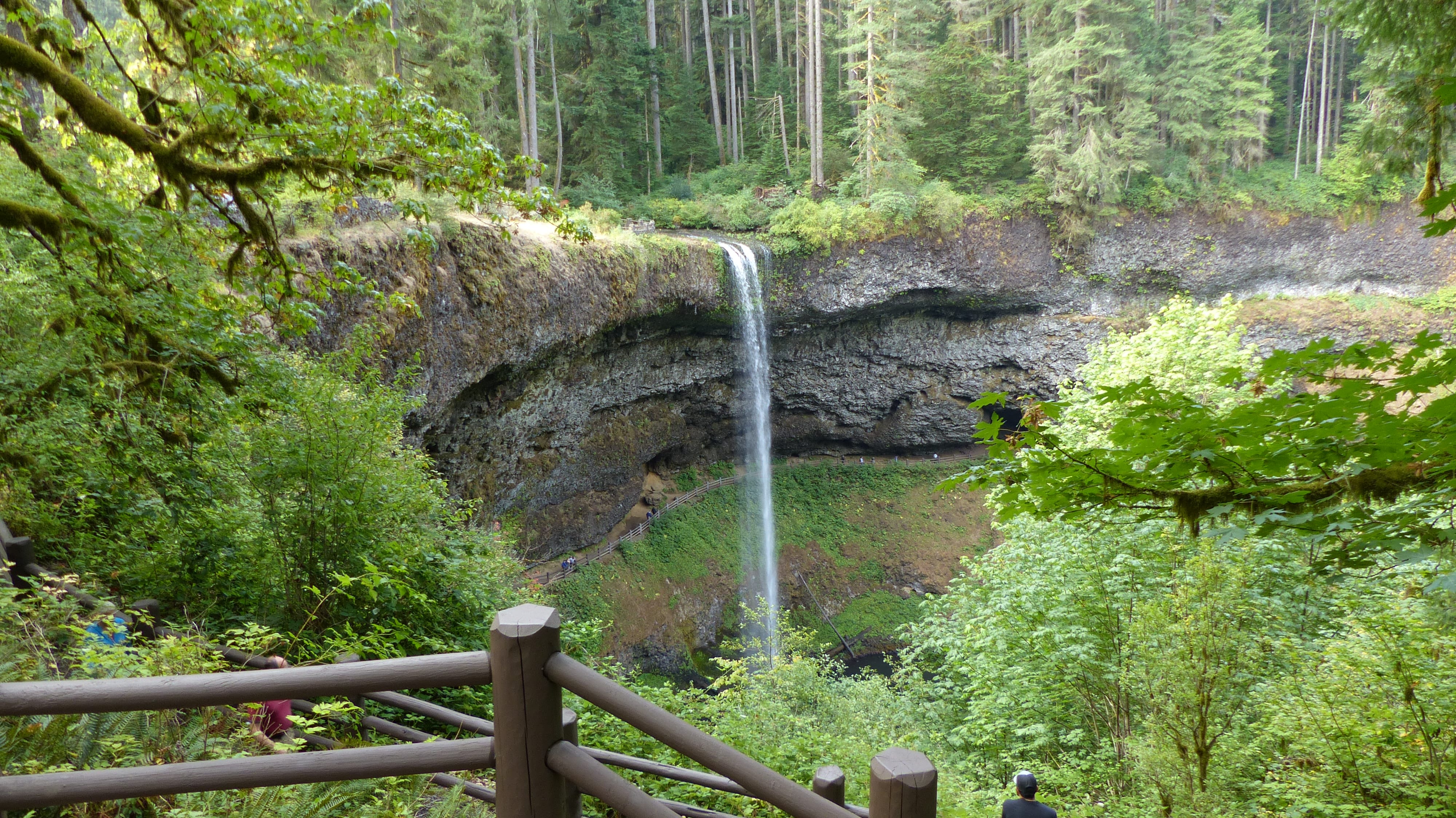
Silver Falls State Park has quite a history. In 1888 the lumber community of Silver Falls City sat near South Falls. As the land was cleared admission was sold to view the falls. That included attractions such as pushing a car over the falls and even a daredevil riding over it in a canoe. June D. Drake was local photographer who began campaigning for park status, using his photos to gain support.

The National Park Service rejected the area because of the proliferation of unattractive stumps after years of logging. Drake was successful in that Silver Falls became an Oregon State Park in 1933. In 1935 F.D.R. announced that it would become a Recreational Demonstration Area, and sent in the C.C.C. to develop the park’s facilities.

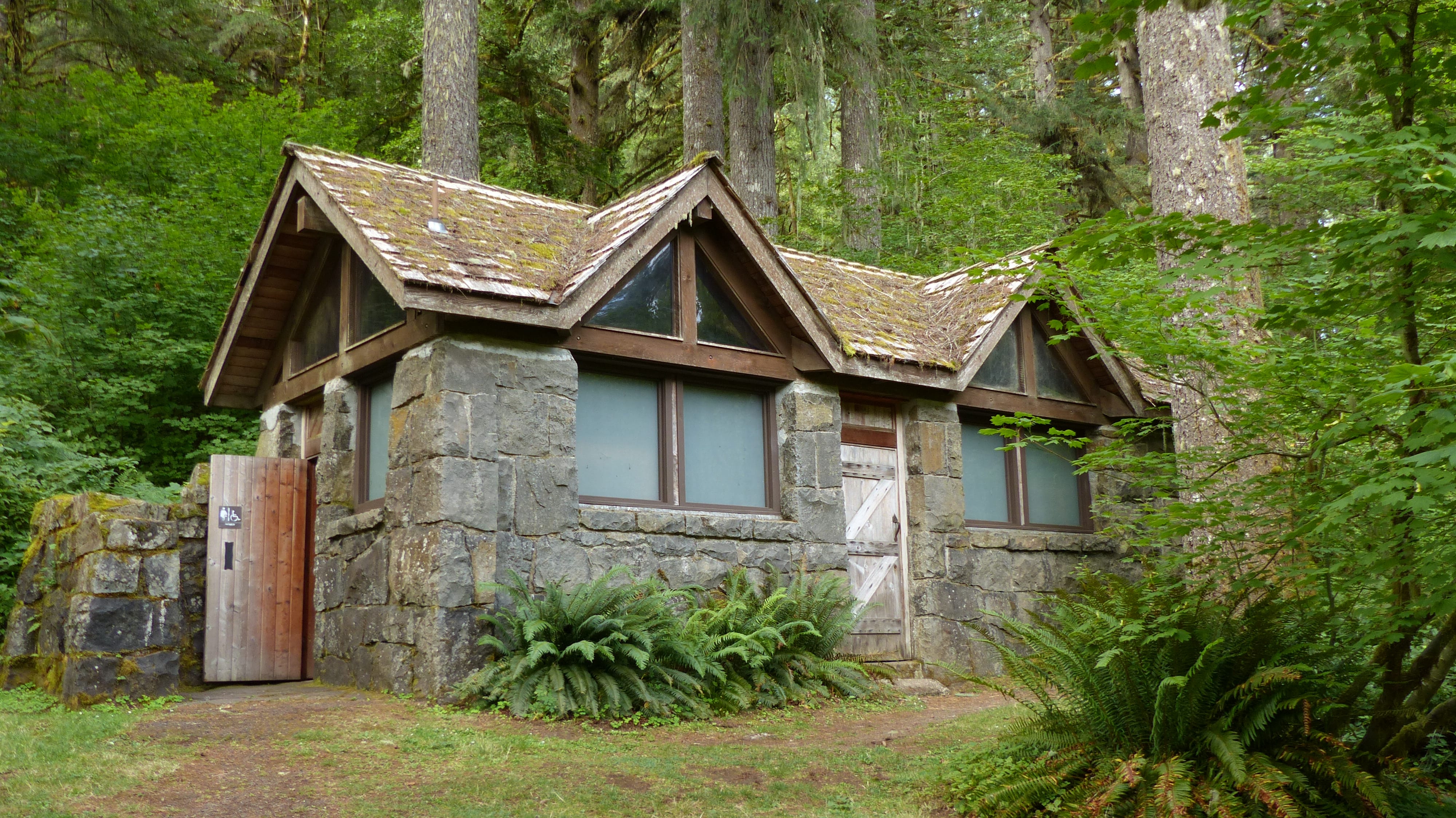
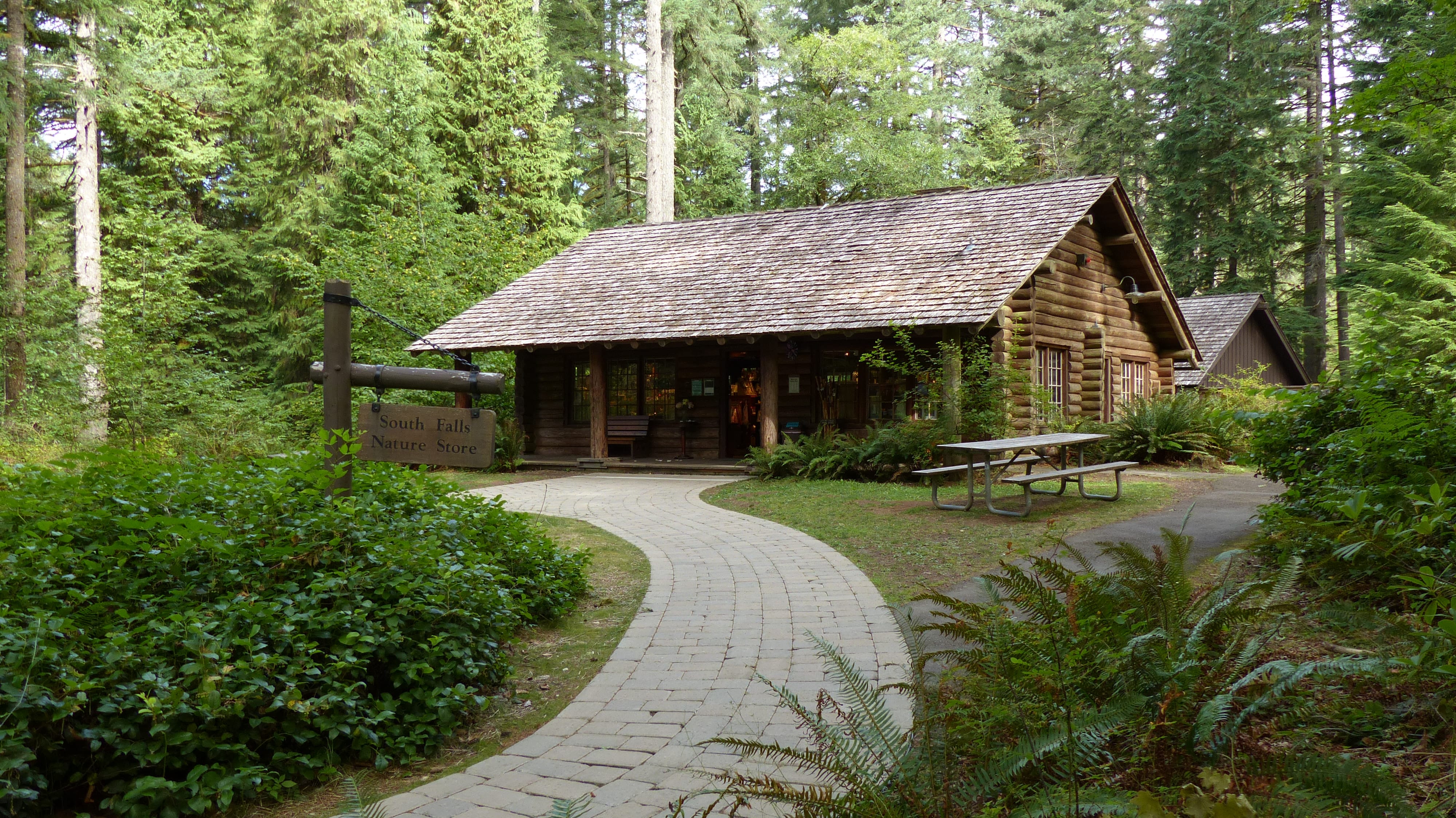
Thanks to the efforts Mr Drake and of the Civilian Conservation Corps the park has a beautiful campground, rustic lodge and assorted out buildings. Silver Creek is dammed above South Falls to form a swimming pond. A convention center is on premises. Evidence of bygone logging has disappeared. Ten beautiful water falls are accessed by trail- some of which can be viewed from the canyon rim. This area is just drop dead gorgeous!

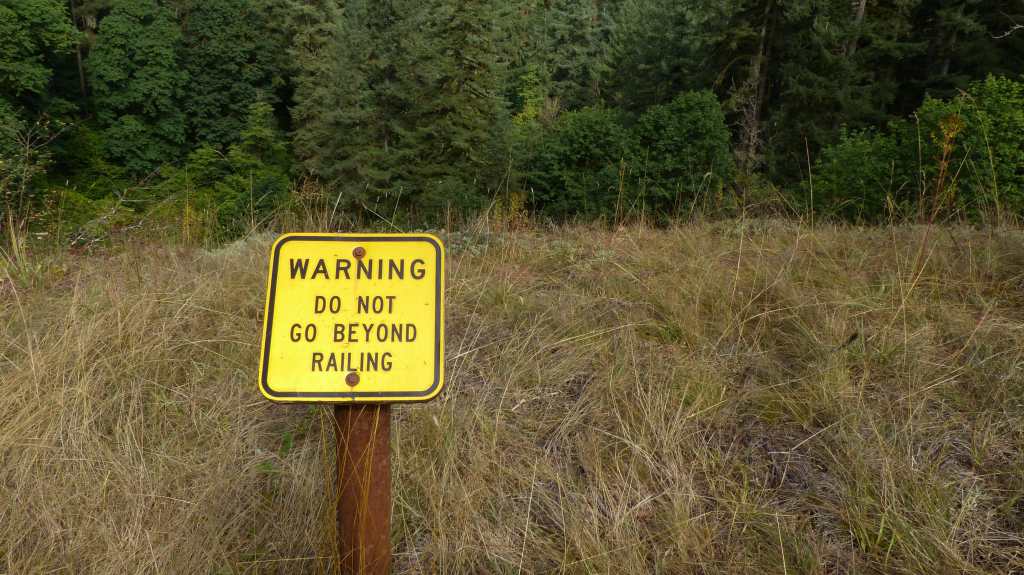
Warning Sign at South Falls (duh)- Precipice of 170 Foot Drop on Right

Like many small towns major roadways converge in the downtown business district and Silverton is no exception. Two major country roads from the north, one country road leading from Salem to the west and the road to Stayton to the south. Boy, traffic can really get heavy!

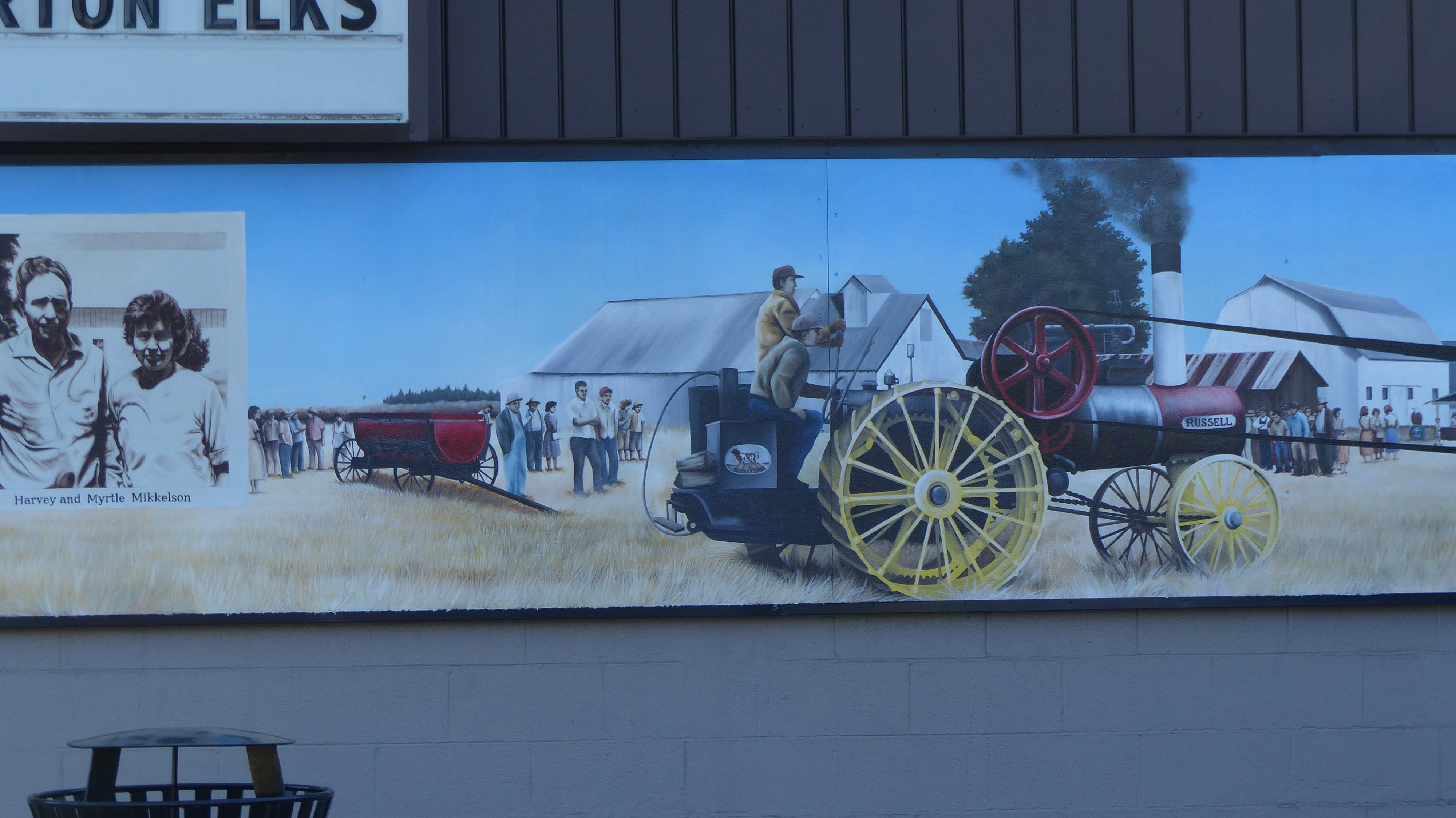
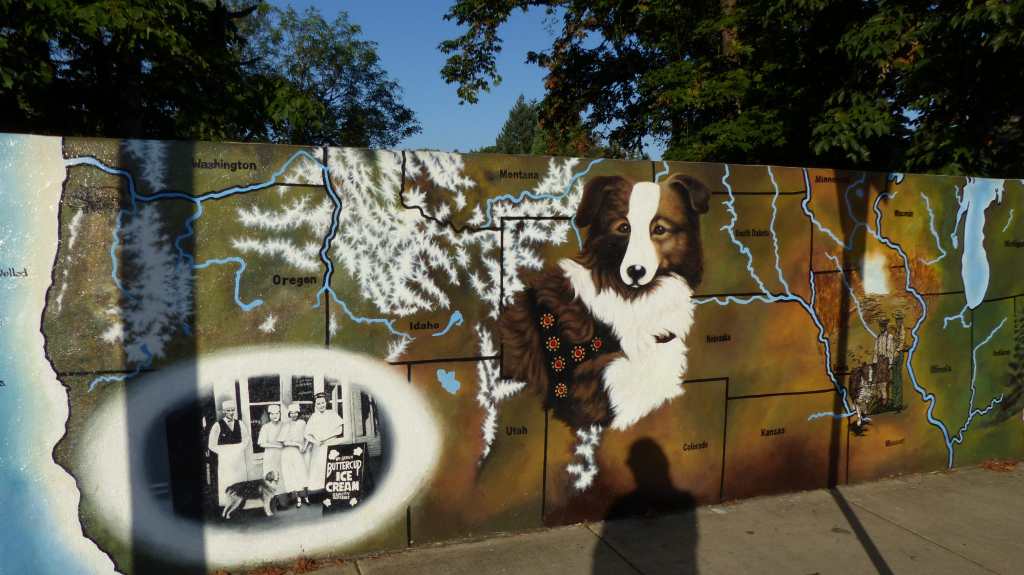
We chose to walk around the handsome downtown of Silverton one morning before the crowds arrived and before all stores except the restaurants opened. We found quite a few murals painted on the side of its buildings. Murals are thing here in Silverton.

New Sign in Progress

One multi part mural told the story of Bobbie the Wonderdog. He became lost (attacked by 3 dogs and fled) while his owners, the Braziers visited family in Indiana. The family could not find him so it returned to Silverton. Six months later Bobbie returned to Silverton mangy, dirty, scrawny, with evidence he walked all the way home, a distance of over 2500 miles in the dead of winter. After his story was published folks who had fed and sheltered Bobbie wrote to the family about their time with him. The Humane Society of Portland was able use the stories to assemble a fairly precise route that Bobbie traveled.

Bobbie the Wonder Dog

Jil and I have made a command decision. Originally we were going to head into southern Washington and visit Mt. St. Helens. We would have to travel through Portland to do that. We’ve already had a good snootful of heavy traffic. If we don’t go north through Portland, where shall we go? Let’s go to Bend!

Four Days in Silverton, Oregon- Part 1

Saturday, August 24, 2019

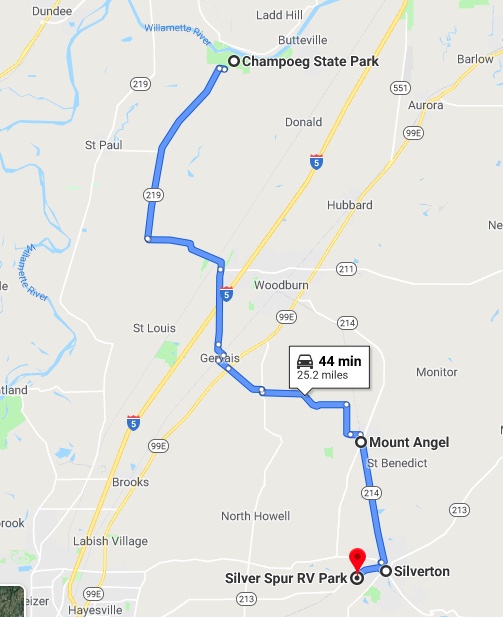
As you can see on the map above our travel day is really short. A lot of RV park management don’t appreciate early arrivers so we did our best to not come into Silver Spur RV Park in Silverton too early. We took the dogs over to the big field which is designated as a dog exercise area and let them run and sniff, cleaned up the inside of the RV twice, rotated the air in all ten tires, and waxed the armadillo before we left and still arrived an hour and a half early. Yep, we were chastised for coming in early. We took our punishment and settled in to site B6.

Our route Thursday morning was all country roads- just the way we like it. Interesting to me is the fact that we came in from the south on I-5, exited at the Gervais offramp and took country roads to Champoeg. On the way to Silverton we backtracked to Gervais but on a completely different set of roads. From Gervais we were on virgin roads to us as we had never traveled on them until we got to familiar territory in Mt. Angel.

There are many reasons to visit the Silverton (9200+ souls) area. The Oregon Garden is in town and Silver Falls State Park with its spectacular display of 10 waterfalls is a half hour up the hill. We like to visit Mt. Angel Abbey, a Catholic Benedictine monastery and seminary. Downtown Silverton is straight out of the early 20th century and might take up a couple of square blocks of real estate. The farmland nearby is beautiful.

Mt. Angel Abbey:” The monks of Mount Angel Abbey in Oregon form a Benedictine community founded in 1882 from the Abbey of Engelberg in Switzerland. We maintain a monastic tradition that has been a vital part of the Roman Catholic Church for more than 1,500 years.”

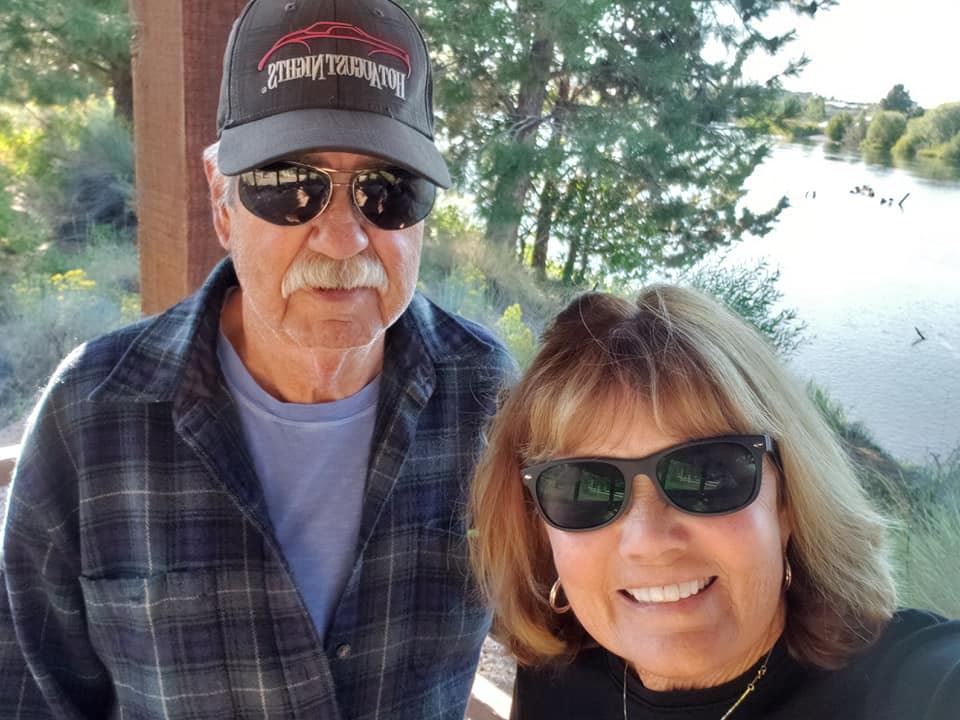
Honest Folks, Our Selfies Are Getting Better……..

The Abbey includes a seminary, a guest and retreat house, a library, its own post office. Mass is celebrated once a day and the Liturgy of the Hours 5 times. The church has the largest bells in the west.

New since 2018 is the Benedictine Brewery. Hey, Trappists brew beer, why not Benedictines? This complex sits on top of Mt. Angel, a 450 foot hill, encompasses 340 acres and lies next to the town of Mt. Angel. The grounds are beautiful and so are the services.

Mt. Angel (3200 souls) was founded the same year as the monastery in 1882 by German settlers. The townsfolk built a church which was outgrown after three years. The parish moved into the church built by the monastery but it burned down. A third church was built and outgrown within 17 years.

St. Mary’s Catholic Church, Mt. Angel OR

The fourth church and current church was completed in 1912. Its soaring 200′ bell tower can be seen for miles. Everything in this town oozes German- the architecture of its buildings, the glockenspiel, the food- everything. During Oktoberfest the population swells to over 350,000!

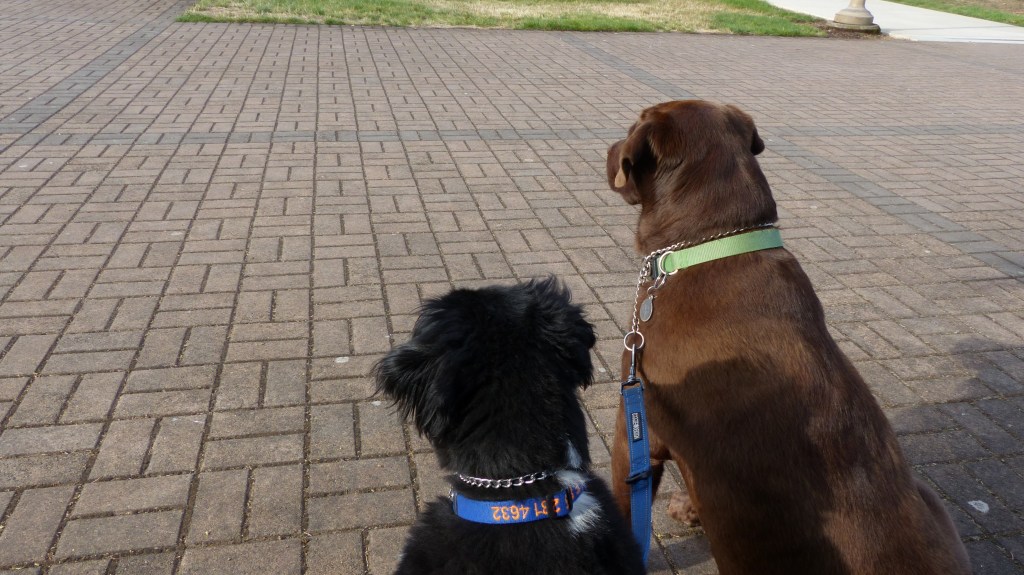
Nope, the mutzos are not admiring the view of the Willamette Valley from Mt. Angel, they are waiting for their Mom to come out of the retreat office.

Our next blog will focus on downtown Silverton and the Oregon Garden. Until then, Safe Travels!

OK, How Do You Pronounce Champoeg, Eh?

Wednesday, August 21, 2019

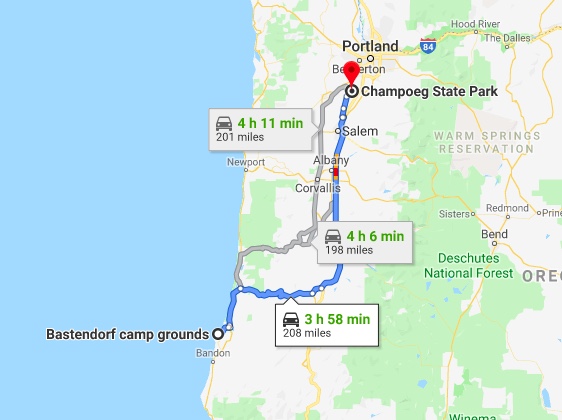
Planning our route from Bastendorff Camp Ground in Coos Bay to Champoeg State Park located a few miles off of I-5 and halfway between Salem and Portland appeared to be easy. We could go up the coast and go inland from Newport or Florence- or could we? I stumbled on to some information that indicated that the Suislaw Bridge in Florence and the Yaquina Bay Bridge in Newport have had 20,000 pound vehicle limits for several years now. To cross them with our motorhome we’d have to enlist flaggers to block traffic at each end of the bridge and drive slowly down the center. That was not going to happen. I read that Oregon 38 was a good route to take inland so that’s the way we went.

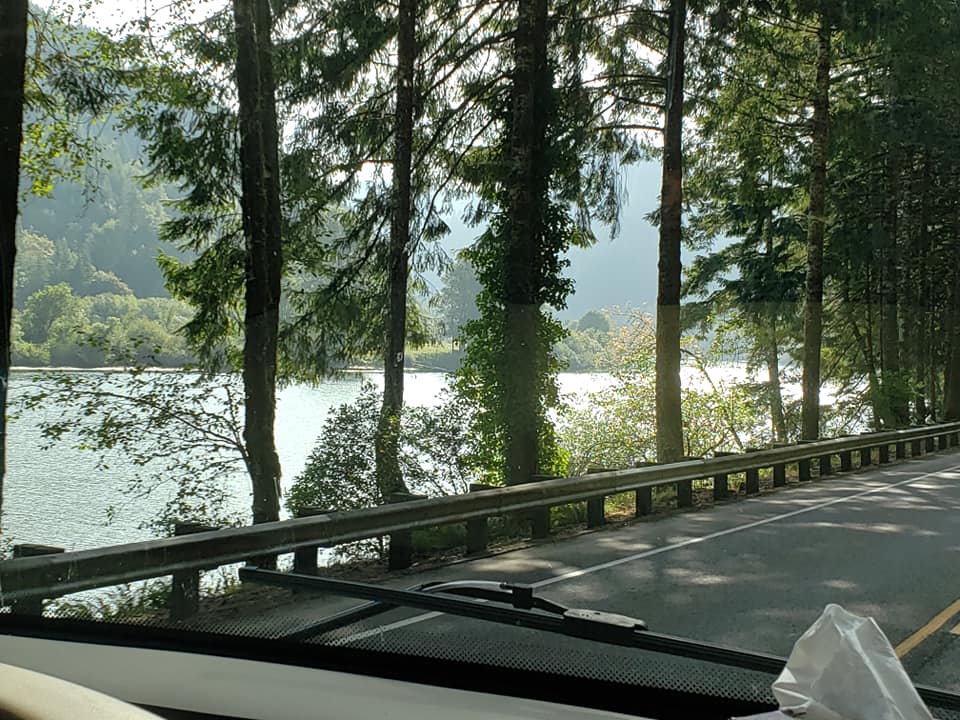
On our way out we bypass the chaotic downtown Coos Bay traffic in favor of taking a more direct route to US 101 through North Bend. We cross the Coos Bay Bridge and continue on to Reedsport (4100 souls) bypassing the Umpqua Light (been there, done that), and Winchester Bay.. Reedsport was developed when the railroad (circa 1912) was extended south to Coos Bay. The flood of 1964 caused the small mouth bass fish hatchery to lose hundreds of thousands of fish to the river. Bass are now the most common fish in the Umpqua. We turn east on Oregon 38. The 38 follows the Umpqua River for many miles so the road is pretty flat. It’s a nice relaxing and scenic drive.

Cruising Along Oregon 38 on the Bank of the Umpqua River

Scottsburg’s (327 souls) importance came and went in the mid-1800’s. It was the location where stage coach travelers coming from Drain transitioned onto riverboats to continue their journey to the coast. It was a seaport located 20 miles from the ocean that serviced the interior of Southern Oregon. The town declined after the 1861 flood.

Downtown Elkton (pop. 195) looks like a good place to stretch our legs. The town was founded in 1850 by the Klamath Exploring Expedition near Fort Umpqua. The purpose of the Expedition was centered around discovering gold in Oregon Territory along the Klamath River as well as possible areas favorable for agriculture and commercial enterprises and the site of a harbor on the coast. After all, California was going through a gold driven boom so why not Oregon? Maps in those days were not always accurate. They sailed by schooner from Sausalito CA overshooting the Klamath, stopping at the Rogue River instead. The Rogue was unsuitable so they headed north, wound up in the more inviting Winchester Bay where they explored many miles along the Umpqua River. What they probably didn’t know was land suitable for a townsite in Winchester Bay was already owned by two fellas, so the Klamath Exploration Expedition bought those fellas out. And the area now known as Elkton was established by the Hudson Bay Company (Fort Umpqua) as well as other emigrants. They did establish the townsite of Elkton, however.

Downtown Elkton Oregon

Elkton’s

The city park is right on the bank of the Umpqua and it includes a really nice RV park. It’s nickname is “Bass Capitol of Oregon”. I wonder if that flood in 1964 had anything to do with that motto………

The Umpqua River at Elkton Oregon

One can tell when folks take pride in their community and the folks of Elkton show a lot of it. Downtown is small, inviting and neatly kept. The homes are well maintained with beautiful gardens. Wow!

The last town we come to on Oregon 38 is Drain (1151 souls), named for Charles Drain who donated 60 acres of land to the Oregon and California Railroad in 1871. Drain was the starting point for the Drain-Coos Bay stage line, established in 1876 which ran by road to Scottsburg then by river steamer to Gardiner. We turn onto northbound Oregon 99, then northbound I-5.

North of Salem we turn off onto country roads that take us through beautiful Willamette Valley farmland. Some farmers grow hops, others row crops, some alfalfa some nursery plants.

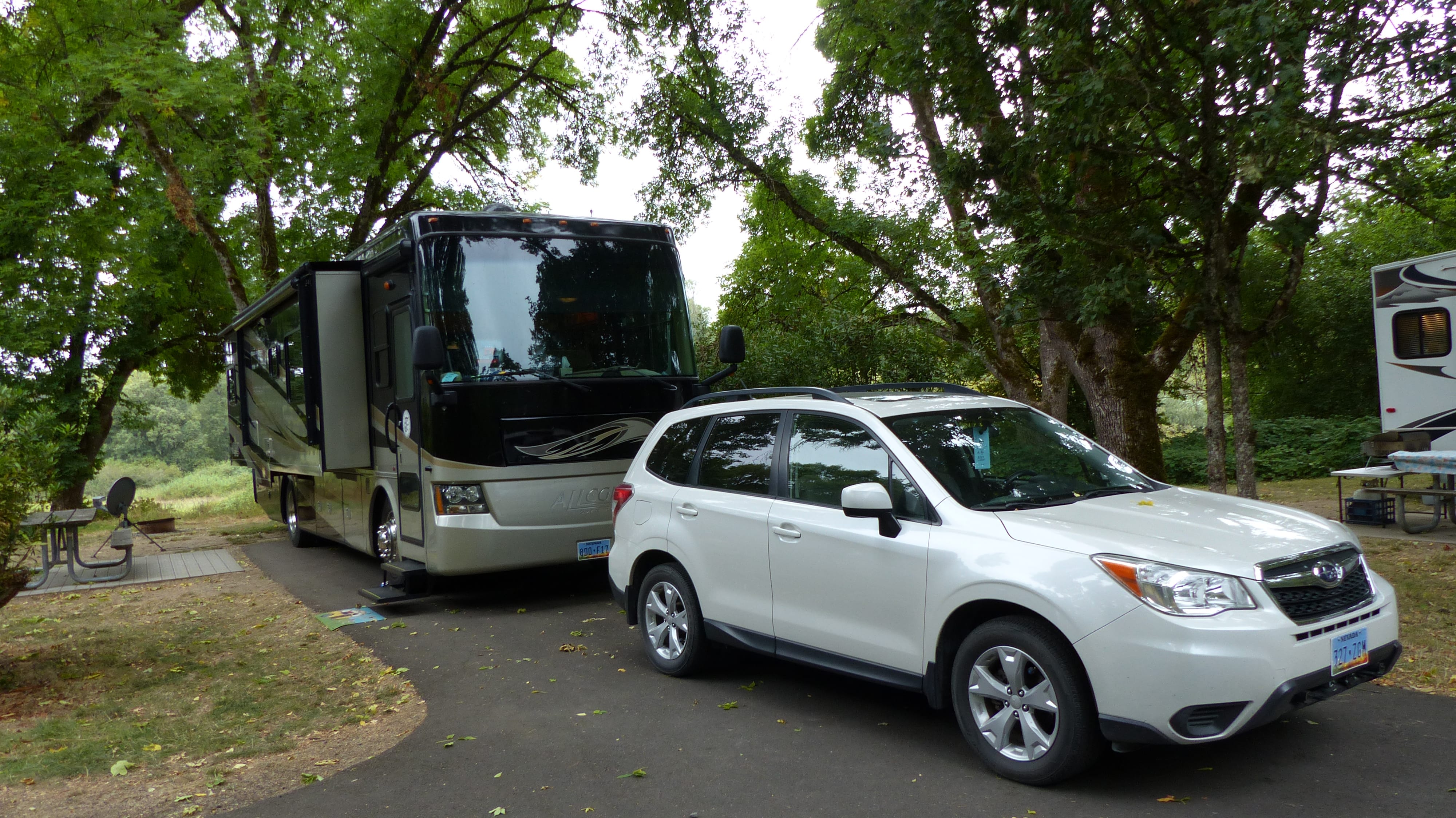
Ten miles more and we pull into Champoeg State Heritage Area. The heritage area has several historic buildings, the Historic Butteville Store (1863) that is still open for business, wide open fields, forests and wetlands- all on the bank of the mighty Willamette River. Interdispersed with all of that is a huge picnic area, frisbee golf course and a nice campground.

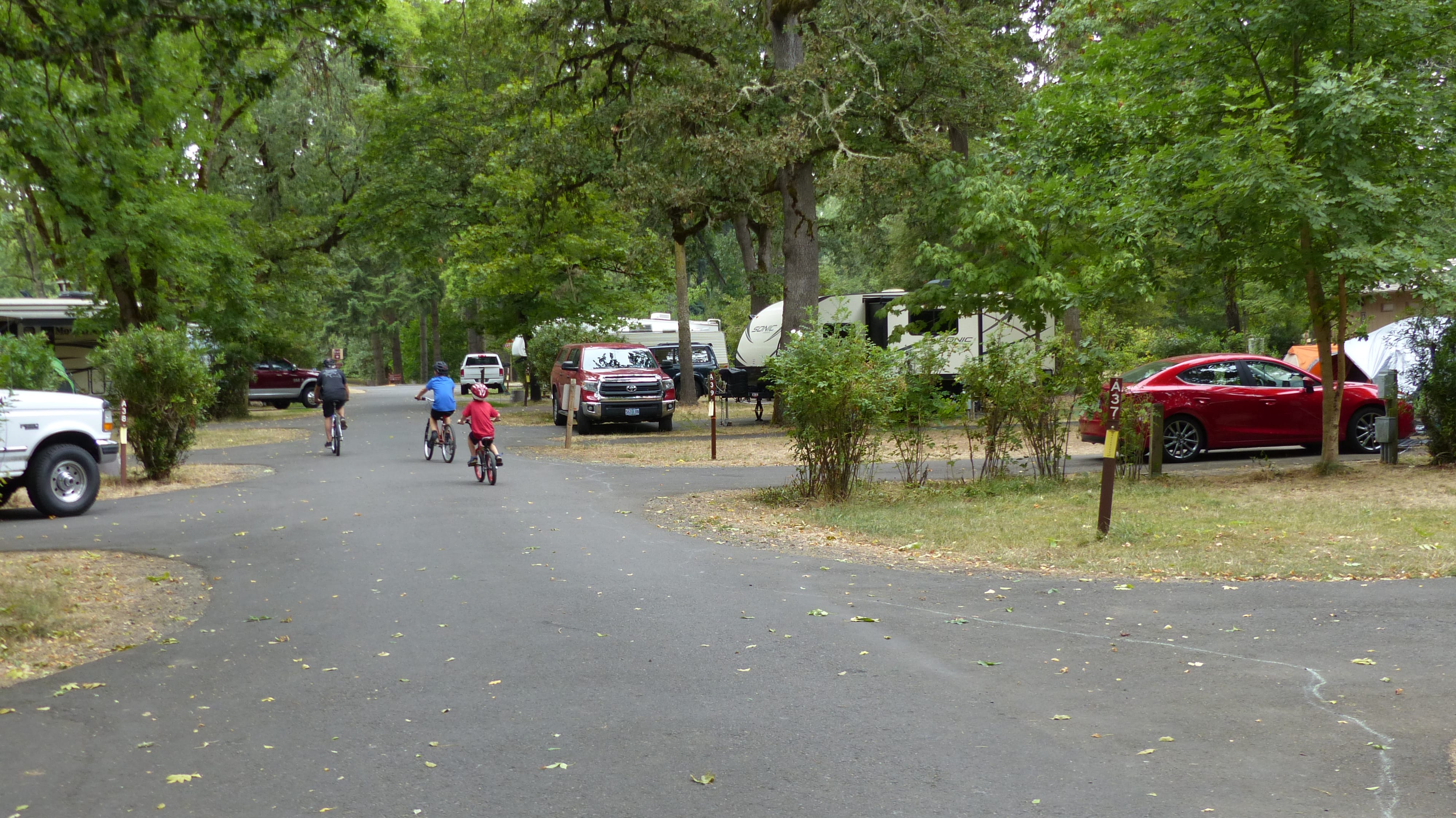
Although the park is a must see we were a little dismayed as to the condition of the campgrounds. The grass at each site was browned out. It didn’t appear that it was irrigated relying on rainfall alone. Obviously no rain has fallen for a while. Nice green grass is a plus in our book. The dump stations were out of order and it didn’t look like the park ranger was in any hurry to have it repaired. Maybe it’s not his call…… We survived.

The most disturbing thing to us was the two unsupervised 2 and maybe four year old children play dangerously close to and sometimes in the roadway. Those kids were all over the campground and mom was no where to be seen 99% of the time. Many of the neighbors did what the mom should have been doing- watching out for the kids safety………

Rows of These Steel Rings Embedded in the Concrete Curb- Horse Tie Outs?

While at the state park we had an opportunity to do some cruising. We shopped in nearby Newburg. (23,000 souls). We also visited St. Paul (431 souls). St. Paul is a farming community established in 1836. A church was built the same year out of logs. On January 6, 1839 Father Blanchet celebrated the first Catholic Mass in Oregon at St. Paul. St. Paul Roman Catholic Church was built in 1846 and is the oldest brick building in the Pacific Northwest. In St. Paul Cemetery lies William Cannon, the only authenticated Revolutionary War veteran buried in Oregon. Two members of the Lewis and Clark Expedition are purportedly buried there. Also of note is the St. Paul Rodeo, one of the 20 largest rodeos in the U.S. and voted by the Professional Rodeo Cowboys Association as the finest rodeo in the Pacific Northwest in 1991.

OK, back to Champoeg. The town was built on the bank of the Willamette River. It grew to be a sizable town. In the 1840’s the question of the disputed possession of Oregon Country between the U.S. and the U.K. began to loom large. A meeting was held at the town to determine if a provisional government should be established. The vote was 52 to 50 in favor. This is the site where Oregon’s first provisional government was formed by a historical vote in 1843. The town continued to grow after Oregon became a state in 1859. But in 1861 disaster struck when the Willamette River rose 55 feet flooding the town with seven feet of water, destroying most of the structures in town. The town was never rebuilt.

OK, ok, back to the title of this post. How do you pronounce Champoeg? Champoeg is not pronounced Sham-poge, nor Cham-pog. The correct pronunciation is Shampooie, like shampoo with a “y” or “ie” on the end.

Doyle- the Captain of the Ship…….

Oh My! This and That and That and That are Beautiful!

Monday, August 20, 2019

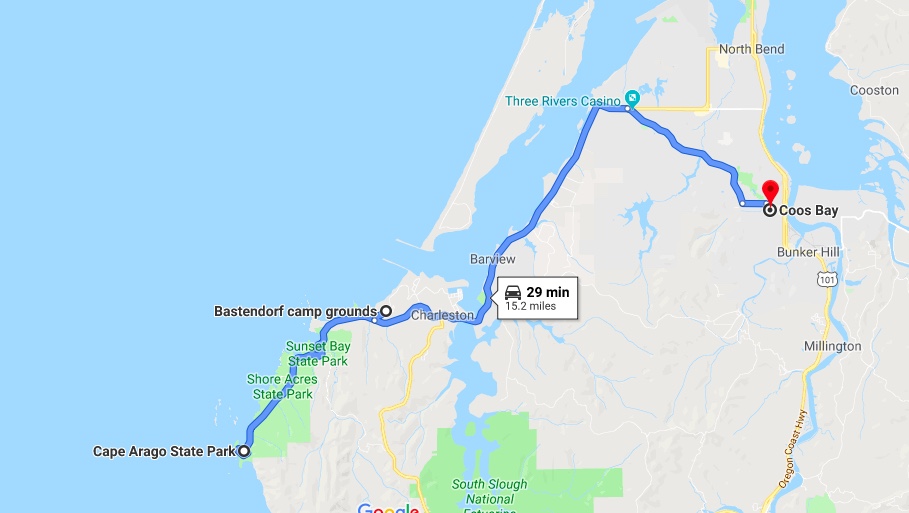
Our stay at Bastendorff Campground is fabulous. We are far enough away from the bustling city of Coos Bay-North Bend metropolis and just a few miles from the sites we want to see. Coos Bay, along with nearby Charleston and North Bend at 34,000 souls is the most populous area on the Oregon coast.

There’s not a lot of traffic in the downtown Coos Bay commercial district. An exception is the main thoroughfares leading to the crazy busy US 101. US 101 is the main coast road that extends from the US/Mexico border all the way around the Olympic Peninsula terminating in Olympia, Washington, a distance of nearly 1550 miles.

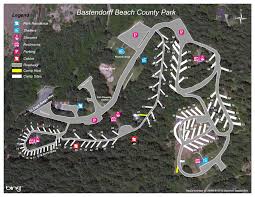
Bastendorff Beach and Campground- Coos County Parks and Recreation

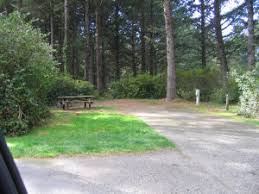
The campground at Bastendorff, a Coos County Park, is really a nice place to stay. There are lots of trees, RV friendly nicely sized sites, clean and has a beach down the hill from the campground. It’s dog friendly. It has nice views of the ocean. It’s $120 a night cheaper than staying in the RV park next door. What more can I say?

Nearby are three Oregon State Parks, the South Slough National Estuarine Research Reserve and the Cape Arago Light which are really the draw to the area. Shore Acres, Sunset Bay and Cape Arago State Parks adjoin one another.

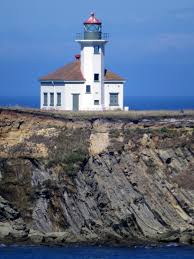
The Cape Arago Light stands on an island just off shore between Cape Arago and Coos Bay. The current light is Number 3. The light was moved twice due to erosion of the bluff caused by the sea. This light is no longer active.

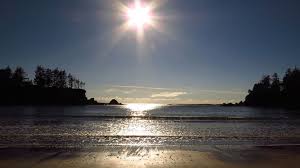
Sunset Bay is a beautiful little bay that offers beach access, a day use area and a nice campground. I first tent camped here when I was eight years old. The most obvious change since then is the campground has been improved to include nice RV sites.

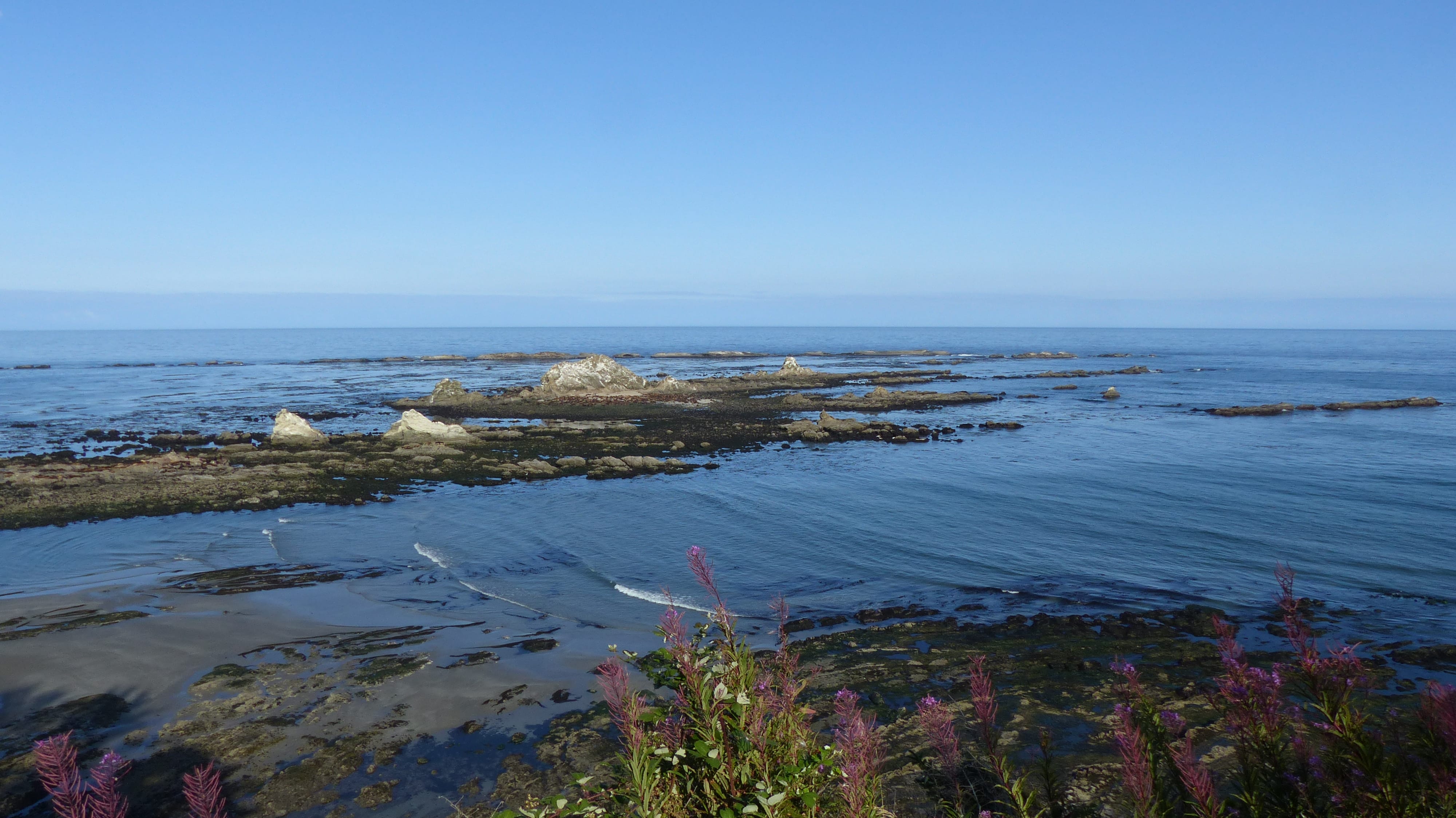
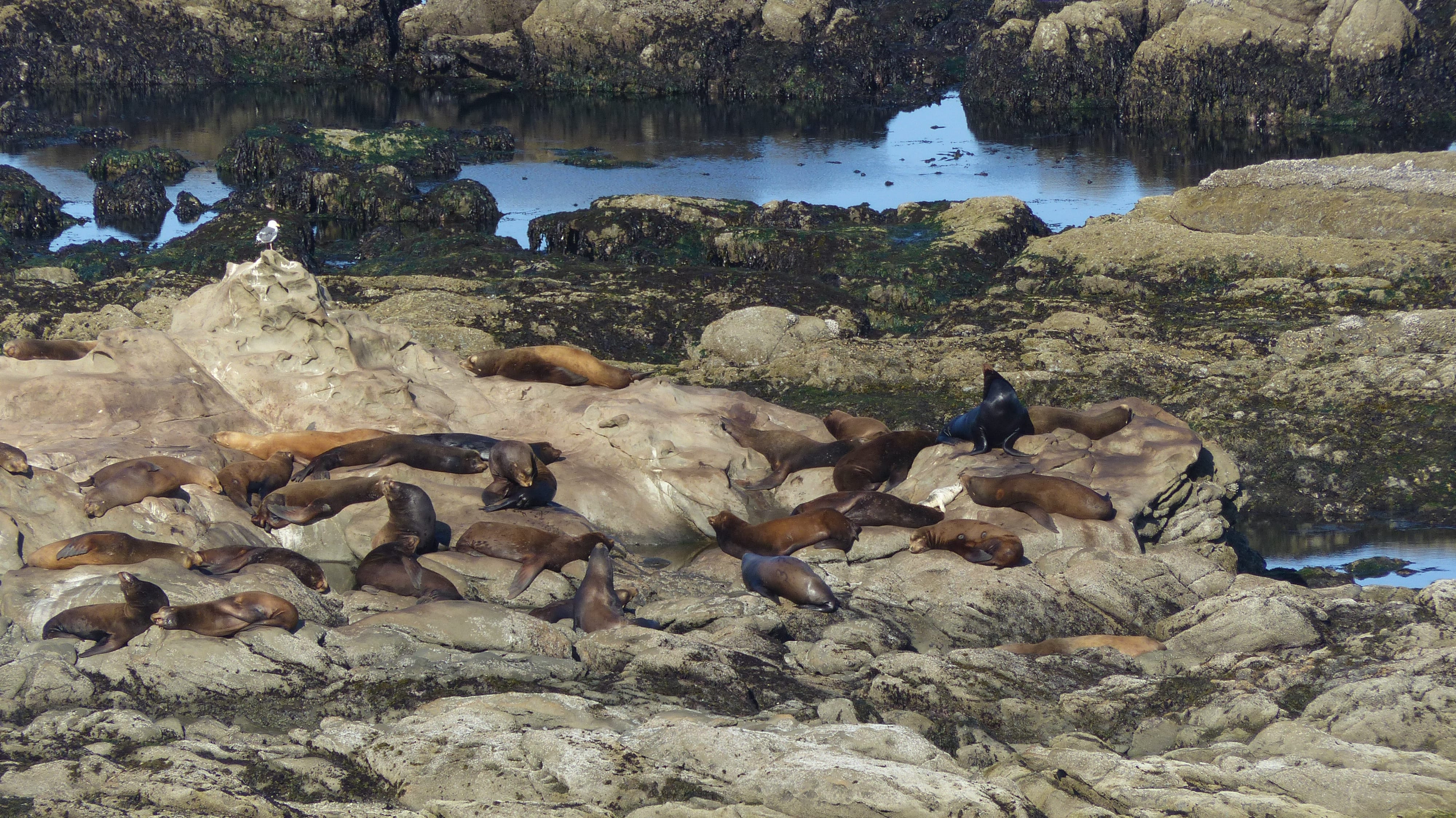
On the way to Cape Arago we stop at the Simpson Reef and Shell Island viewpoint. Four species of pinnipeds (seals and sea lions) haul out regularly on Shell Island . One can also observe grey whales as they migrate to and from Baja California and Alaska.

Shell Island with Simpson Reef in the Background
Pinnipeds, Possibly California Sea Lions Lounging on Shell Island

Shore Acres State Park has quite a history. Louis Simpson was sort of a party boy when young. Dad sent him to Holquiam OR to learn the business but the partying and gambling continued. He fell in love with Cassandra Stearns who divorced her husband in 1899 to marry him. Dad, Asa Simpson, gave the young couple a new start at his company town of North Bend.

Simpson worked hard, eventually changing the company town into the city of North Bend. To spur growth he gave away waterfront sites for manufacturing plants and other lots for hospitals and churches. He also invested in new businesses. He enticed the railroad to build a line to Coos Bay.

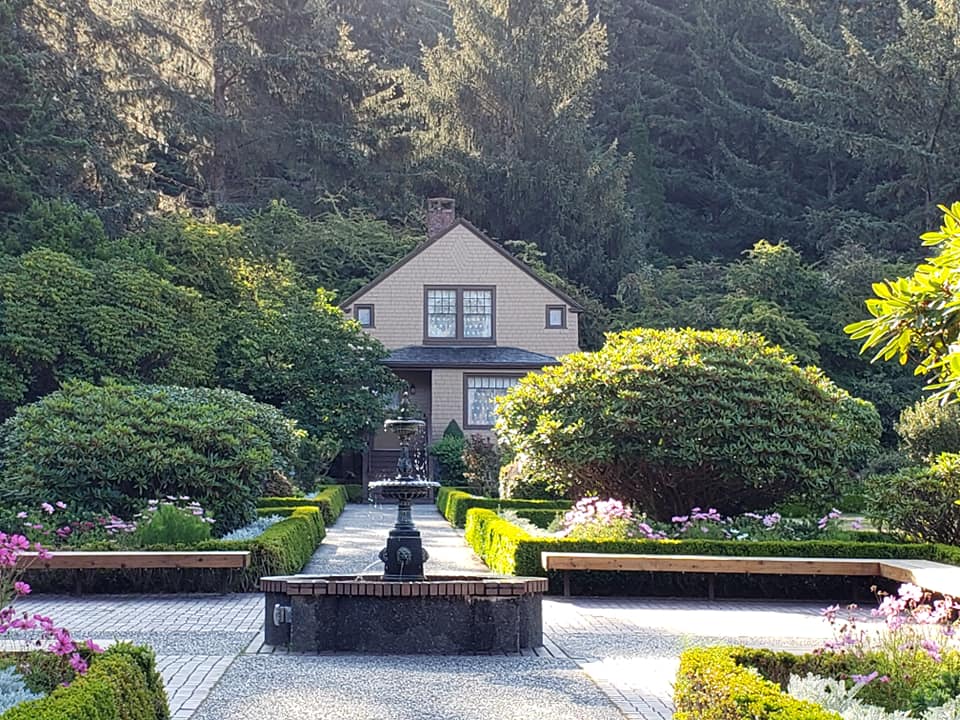
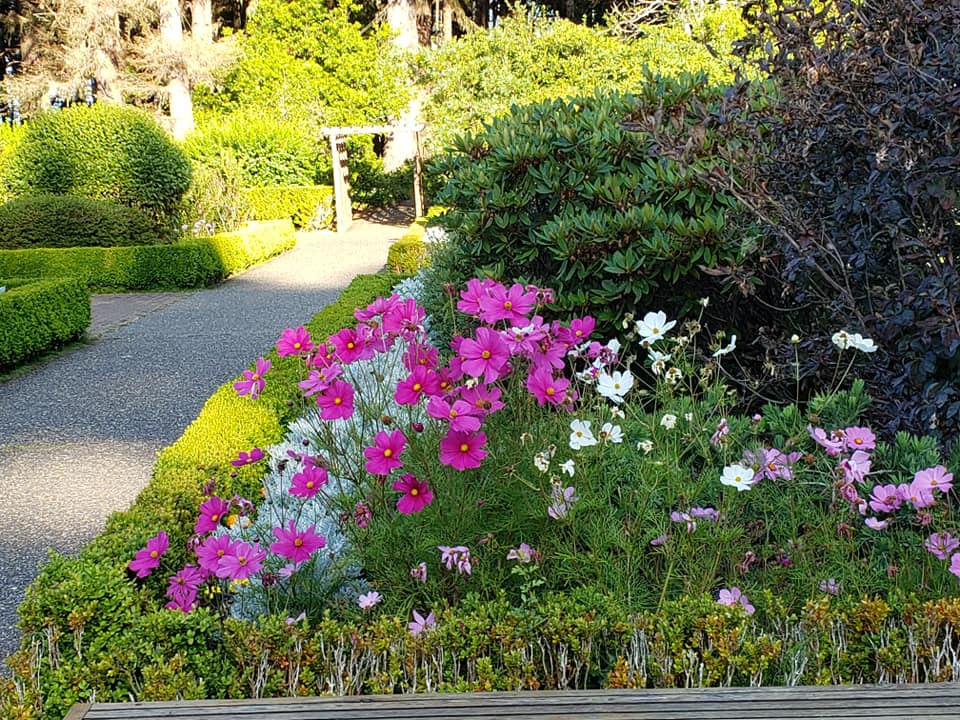
Entry Walk at Shore Acres Garden
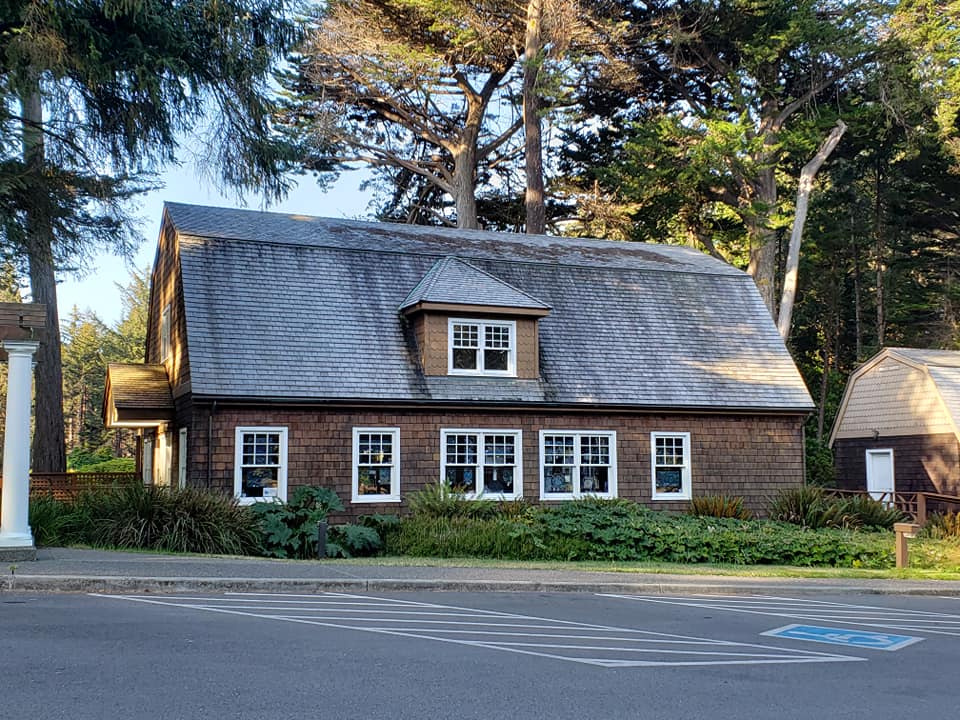
Garderner’s Cottage

In 1906-1907, Simpson built a large seaside home for his wife Cassandra. Shoreacres (Cassandra preferred “Shore Acres”), on the ocean about fourteen miles from Coos Bay-North Bend, eventually included an indoor swimming pool, spacious gardens, a modern farm, and a dairy herd. The Simpsons moved to Shoreacres in 1915. Cassandra died in April 1921, the house burned in July. The newly remarried Simpson moved into the gardener’s cottage while the new house was being built.

The Great Depression took its toll on a lot of folks including Simpson who lost business after business to bankruptcy. He lost Shore Acres which was sold to the State of Oregon. The house was in disrepair and was razed. After his death in 1949 his coastal properties became popular state parks: Sunset Beach, Shore Acres and Cape Arago.

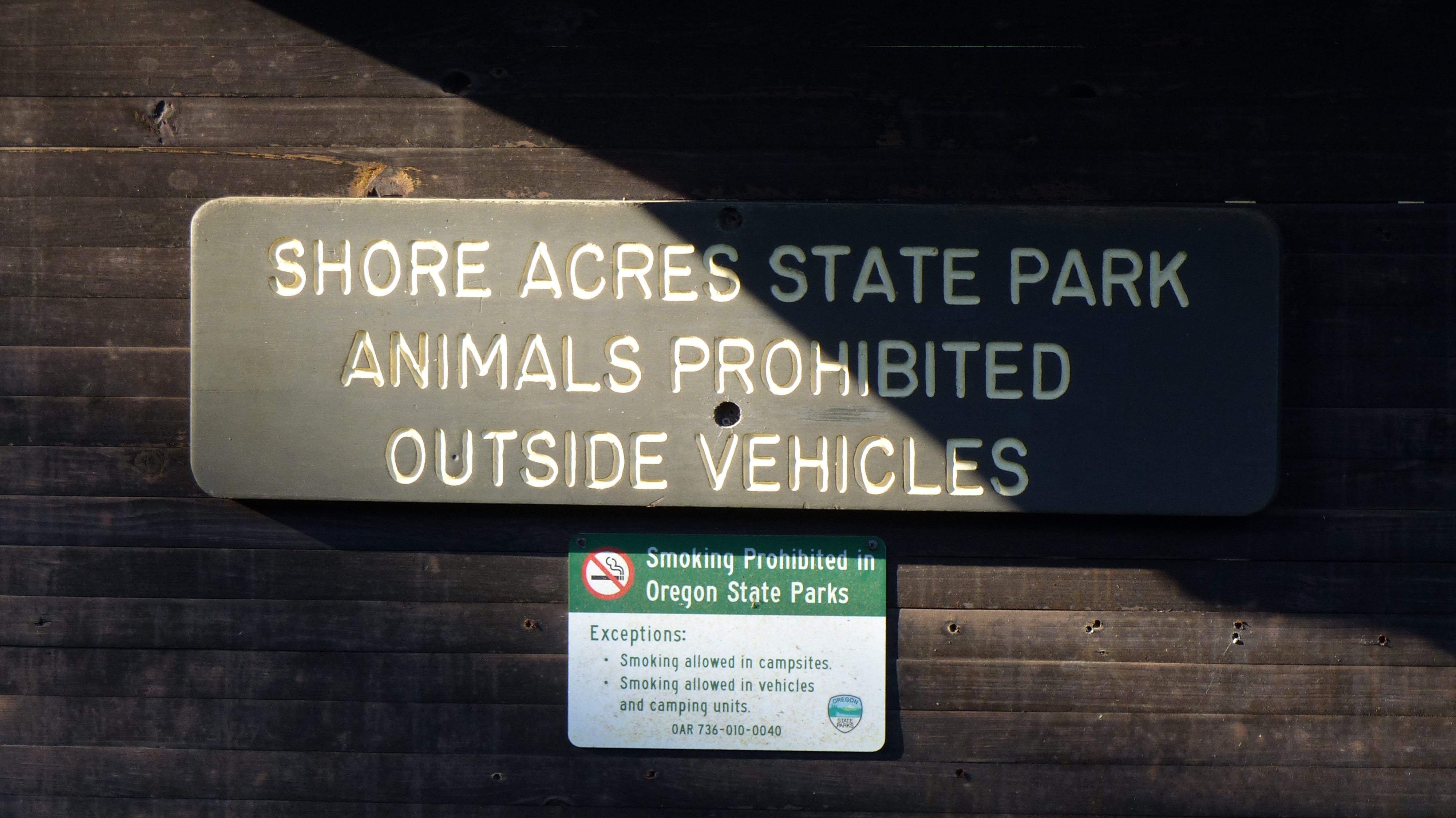
The house may be gone but the original gardens thrive and the gardeners cottage is still there. What a great location for a home with acres of trees, a large meadow out front and the rocky seashore for a back yard. One change that we did not anticipate when visiting- dogs are not allowed out of vehicles anywhere in the park, not just the gardens- and there’s plenty of room for them to exercise without entering them. We had to cut our visit to the gardens a little short and find another place where mutzos are more appreciated. Even so the gardens are well worth the visit.

Sir Francis Drake purportedly sought shelter for his ship, the Golden Hinde, around Cape Arago. The headland was originally named Cape Gregory by James Cook on March 12, 1778 after Saint Gregory, the saint of that day; it was renamed Cape Arago after François Arago.

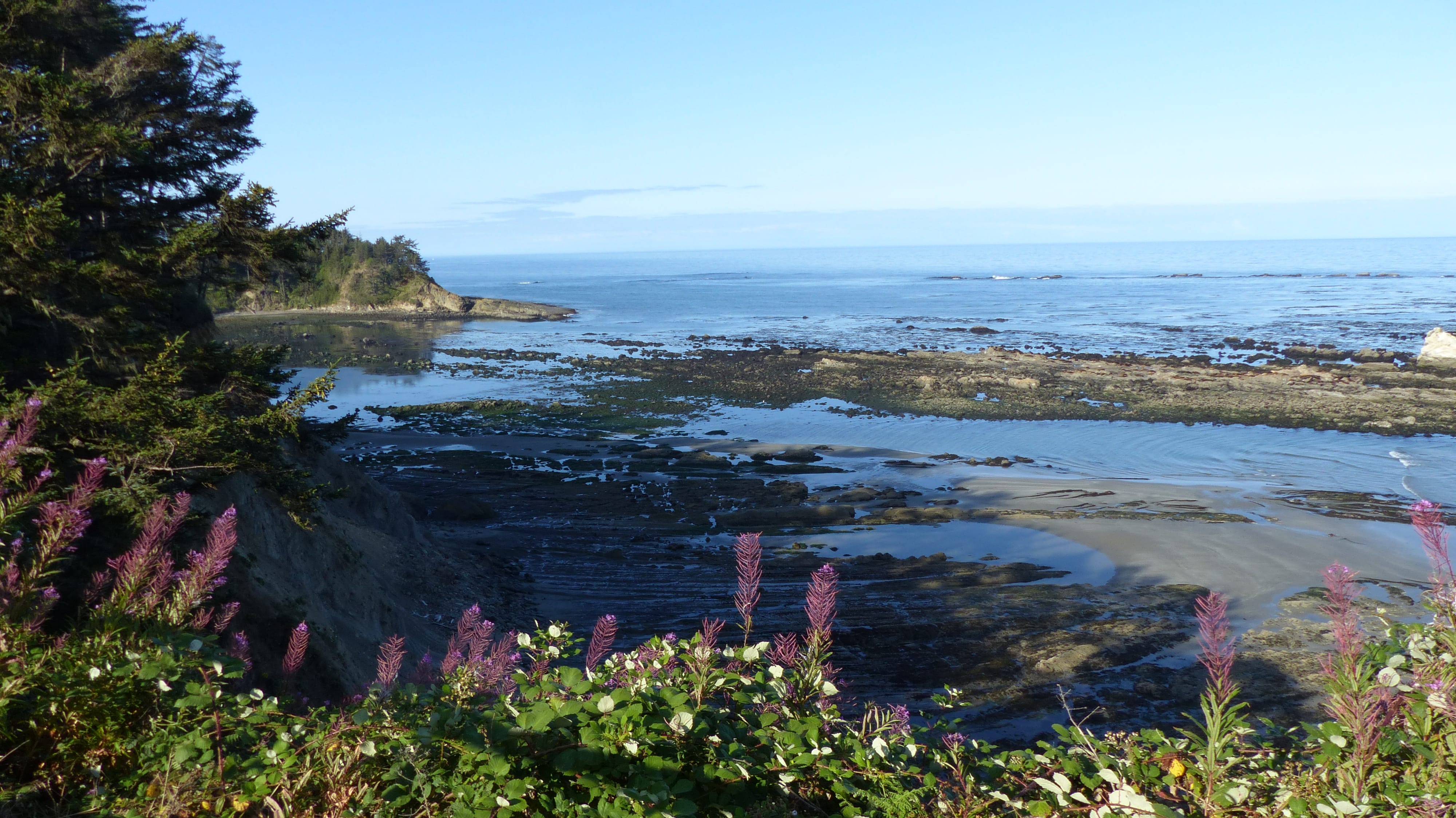
The park road ends at Cape Arago. Several trailheads are located here, a few lead down to the beach. One beach trail even allows dogs but we didn’t want to chance it- a sign stated the trail was steep with drop offs and uneven footing. There is also a picnic area. The views of waves crashing on the rugged, rocky coast are outstanding. There’s enough room on top of the cliffs to walk our mutzos. They appreciate the fresh smell of the sea air and the mowed grass adjacent to the parking lot.

All things considered we enjoyed Bastendorff Park a lot. There’s plenty of room to walk the dogs, great views of the ocean and a friendly staff. The only downside may be the location of the sanitary dump facility. We didn’t use it.

The eye candy along this portion of the Oregon Coast is an equal to any we’ve seen. What’s not to enjoy? We even heard that the seafood served at local restaurants is outstanding. We move on tomorrow………

Off To The Coast!

Monday, August 19, 2019

One of the many chores associated with RV’ing to empty the waste water tanks. Most RV’s have two waste water tanks, one for sink/shower water and one for the toilet. We are not sure when we’ll have the opportunity again. We visit the sanitary dump site located in the park. While the tanks are being emptied we hook up the car to the RV which magically changes the Subaru into a Toad (towed vehicle).

We head north on I-5, turn off on exit 112 and take a meandering path to Oregon 42 near Dillard and proceed on to the Oregon coast. Google Maps made the route from I-5 to OR42 sound a lot more complicated than it was. The Coos Bay-Roseburg highway is rather narrow and “turny” as one youngster aptly described a winding road to Jil and I. We are in no hurry, preferring to slow down a little in order to drink in the beautiful scenery.

Many of the settlements in the less populated areas of Oregon have interesting names. The hamlet of Remote (pop. unknown) was named by pioneers for its distance from other settlements. Drain (1150 souls) was named after its founder Charles J. Drain. Bridge (pop. unknown), named after that structure on which one crosses a river had 40 people living there in 1940- I surmise it is less now as most of the businesses that existed back then have dried up. The towns of Myrtle Point (2500 souls) seems to be thriving but tiny Norway is only a name on the map. Other interestingly named places are Prosper, Cranberry Corners, Riverton and Winterville.

Downtown Coquille, Oregon

We stop and stretch our legs by walking around downtown Coquille (3800 souls), the seat of Coos County. The town lies on the banks of the Coquille River. Both the town and the river are pronounce Ko-keel yet the Indian tribe pronounce their name Ko-qwel. Indians name Ko-qwel was the original and White Eyes changed the pronunciation to suit their fancy.

At one time river boats ran the river carrying cargo and passengers. One story has it that one boat carried 400 passengers from Coquille to Bandon so they could attend a baseball game. Right behind it came another river boat that carried another 150 folks to the same game! As the river ran inland, it became so narrow it was said that passengers could amuse themselves by leaning out the windows to pick wildflowers.

We took a longer route to Coos Bay via Bandon in order to avoid a sketchy route that Google Maps had made for us. Google Maps via Jil’s Miss Smarty Pants phone has cause us grief in the past- like trying to send us under a low bridge that would have taken the roof off of our RV and the infamous “squeeze” a tunnel built for pedestrians that if we would have proceeded would have reduced the volume of our rig by two thirds. The “long cut” didn’t turn out to be so good either. The roads were not big rig friendly being very narrow and “turny” but we made it to Bastendorff County Park Campground in one piece.

Two Days in Gold Hill

Saturday, August 17, 2019

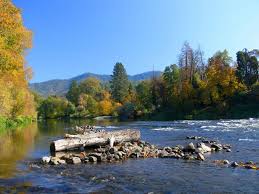
The Rogue River has long been a source of food and water for indigenous people and emigrants. Today it is also a recreational paradise. Fishing for salmon, steelhead and trout is popular as is rafting, canoeing/kayaking, and birding. In the lake below Grants Pass all kinds of water sports are available. One can ride one of the Hellgate jet boats for a super fast thrill ride.

Rafting on the Rogue River

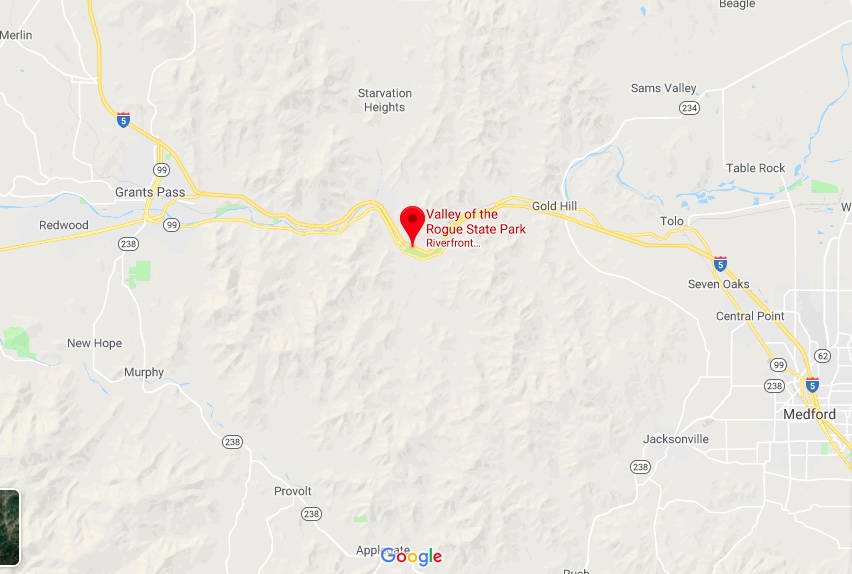
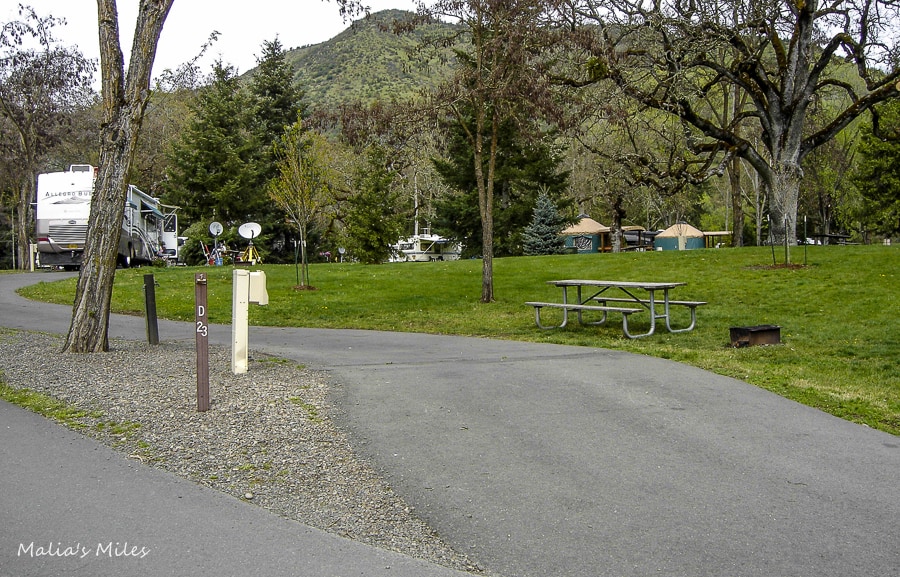
We arrived at Valley of the Rogue State Park shortly after the check out time of 1300 hrs and was promptly informed by the ranger at the entrance station that we weren’t guaranteed that our site was yet available. I said we’d chance it…… Our site, F14 is in the back loop of the park. It has great access to the path that parallels the Rogue River that’s not more than 100 yards from our back door. The sites are wide and deep….. and lush.

Entrance Station Valley of the Rogue State Park

We find our site vacant and back in, set the brakes-pshhhhh, activate the leveling jacks- wrrrrrr, plug in the power cord and we are set. Looking around all the “lush” has turned yellow.

Campground before irrigation withheld from lawns

Normally the mowed grass between and behind the campsites is green- but not this time. Our site has a large field behind that separates us from the river. It’s full of needle like one inch long stickers that are not mutzo friendly. Our normal access to the river is cut off and we are limited to taking a paved path that adds quite a distance to river access. It’s not nearly as pleasurable as walking on a dirt path through that big field.

Out of curiosity I ask one of the camp host volunteers why the grass is yellowed out- is there a drought here in Oregon? The reply- no drought, the water source for the park is that big ol’ Rogue River that flows on the western border of the park. The answer was the Head Ranger didn’t want to get the RV’s wet. Lordie! Heaven forbid that my RV should get wet…… They said that they could only water when a site was vacant and only with permission from the Head Ranger. The Head Ranger is off on weekends so the volunteers can never water on Saturdays and Sundays even if the entire campground is empty….. gads…. The kicker is a mile long access road that joins the entrance to all the camping/picnic loops and the amphitheater. Along that road is a greenbelt consisting of lawn a conifers- and it is irrigated and is greener than green.

We drove over to Gold Hill (1200 souls) just to browse. As the name implies gold was discovered on a nearby hill around 1851. As usual not there’s not much going on in town except that a couple of farmers appear to be growing CBD oil based plants-hemp maybe?The Oregon Vortex House of Mystery located a few miles outside of town sports gravity defying illusions, and may be enhanced by that CBD oil. Del Rio Vineyards is also in the area.

Hemp Plants?

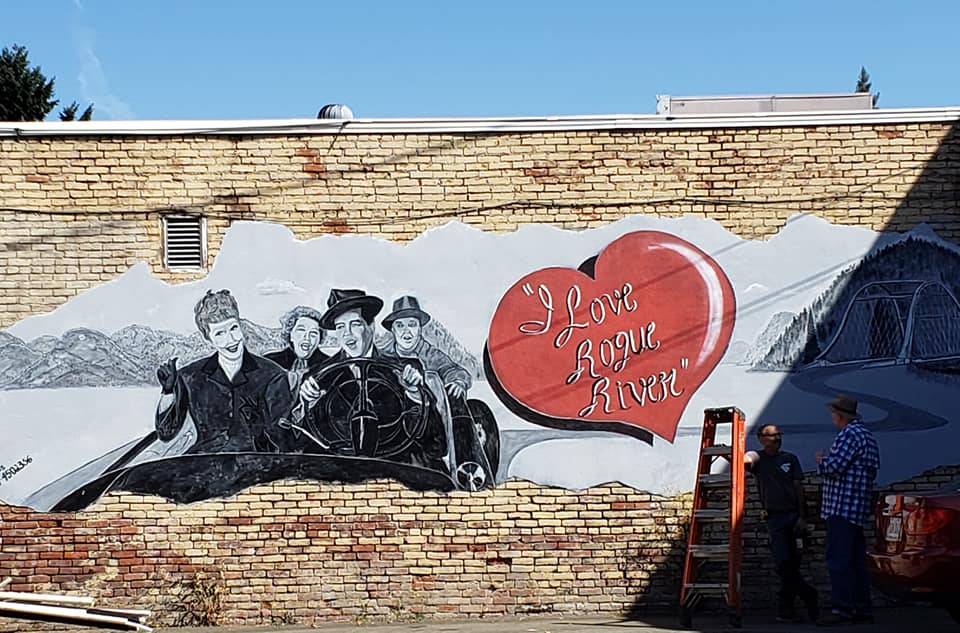
It is said that the town of Rogue River (2100 souls) was established in 1831 by French fur traders. We drove through the tiny downtown and spent some time at Palmerton Park walking the pretty grounds with Doyle and Megan. We also enjoyed the wall art.

Images From City of Rogue River

Grants Pass (35,000 souls) is the seat of Josephine County. The city has beautifully maintained parks along the banks of the Rogue River. The clean downtown is bustling with foot and vehicular traffic.

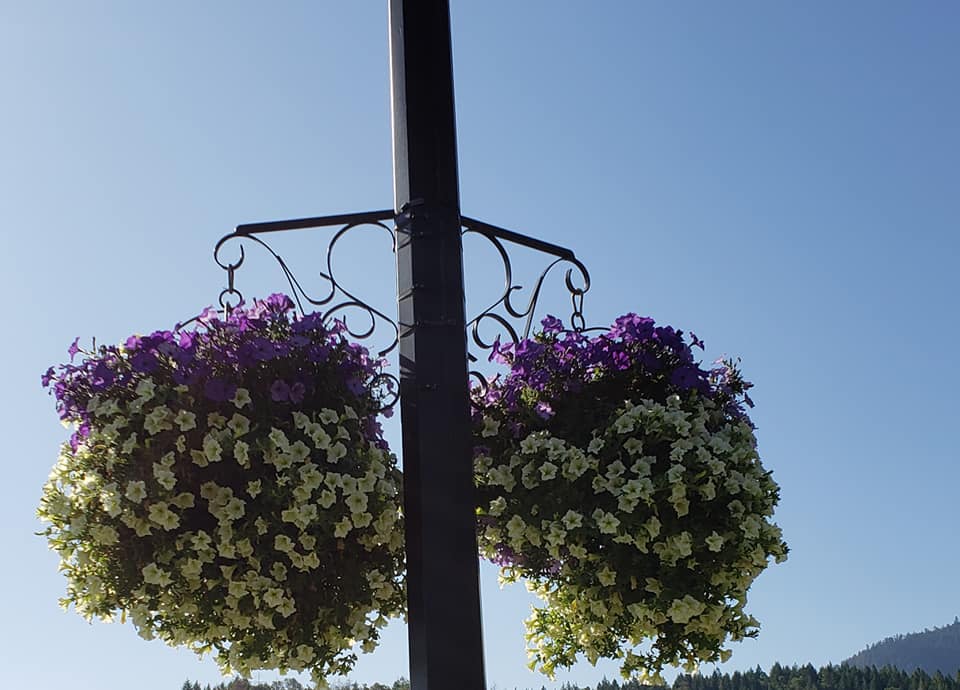
Flower pots hanging from light standards are everywhere. Just a ways ways from the scenic downtown are your typical big box stores such as Lowe’s, and Fred Myers. Freddie’s is like Walmart in that it sells practically anything one wishes to purchase for the home including a huge grocery department. We shopped at Freddie’s for a few needed items and went back to camp.

Valley of the Rogue was somewhat of a disappointment for us. Apparently water is available to irrigate. It’s a shame that the beautifully manicured lawns in the campground are all but gone in the summertime. I blame that on the Head Ranger who doesn’t want to get my rig wet.

On the Road to Valley of the Rogue State Park

Friday, August 16, 2019

We had a short drive today, less than 130 miles. Check out time at Oregon State Parks is 1:00pm. If we get to the park before that time we’ll probably have to sit in a parking lot and twiddle our thumbs. After packing up we take the dogs for a nice walk but it’s still pretty early, like 0700 hrs early. Tired of waiting to leave for no good reason we head out.

Jacksonville, OR isn’t far off of our path- let’s go! We pull out of the RV park and head west on CA 89 and go over that steep hill that the lumberman’s oxen had trouble pulling wagons over back in the 1890’s. It’s a grunt but we catch a slow logging truck half way up the grade. It’s having trouble pulling the hill just as the oxen. We transition on to north bound I-5 at the little town of Mount Shasta (2600 souls).

This part of Northern Kali-Fornia is beautiful. The majestic Mt. Shasta looms large on our right, Black Butte, a black volcanic cinder cone is at 12 o’clock and pine trees everywhere. We pass the quaint town of Weed (2900 souls) named for Abner Weed, a Civil War soldier and lumber man who settled in the area (https://en.wikipedia.org/wiki/Abner_Weed).

We drive past Yreka (7800 souls), the seat of Siskiyou County. The town gets it’s name from the Shasta language for North Mountain or White Mountain in reference to Mt. Shasta. The infamous Mark Twain had another take on it. His rendition is that a bake shop was opening, had a “BAKERY”sign painted, the sign was hung backwards to dry with all but the “B” showing through. It was read by a miner wrong end first, supposed that it was the name of the camp, the campers were satisfied with it and adopted the name. Ya gotta love Mark Twain’s wit.

The road takes us over hill and dale until it we reach a valley north of Mt. Shasta. We are now in “Jefferson County”, cow country pocked by mini volcanic cinder cones, an area that wants/wanted to secede from the state of California. Now we are in the Siskiyou Mountains, cross the Oregon border, eventually cresting Siskiyou Summit, elevation 4310′, highest elevation on Interstate 5. We take the long downhill grade towards Ashland (21,000 souls), a tourist mega offering the Oregon Shakespeare Festival, art galleries and restaurants. We are now in rolling hill country. Near Phoenix (4100 souls) we turn towards Jacksonville.

Oregon Welcome Sign Located Halfway Up Siskiyou Pass

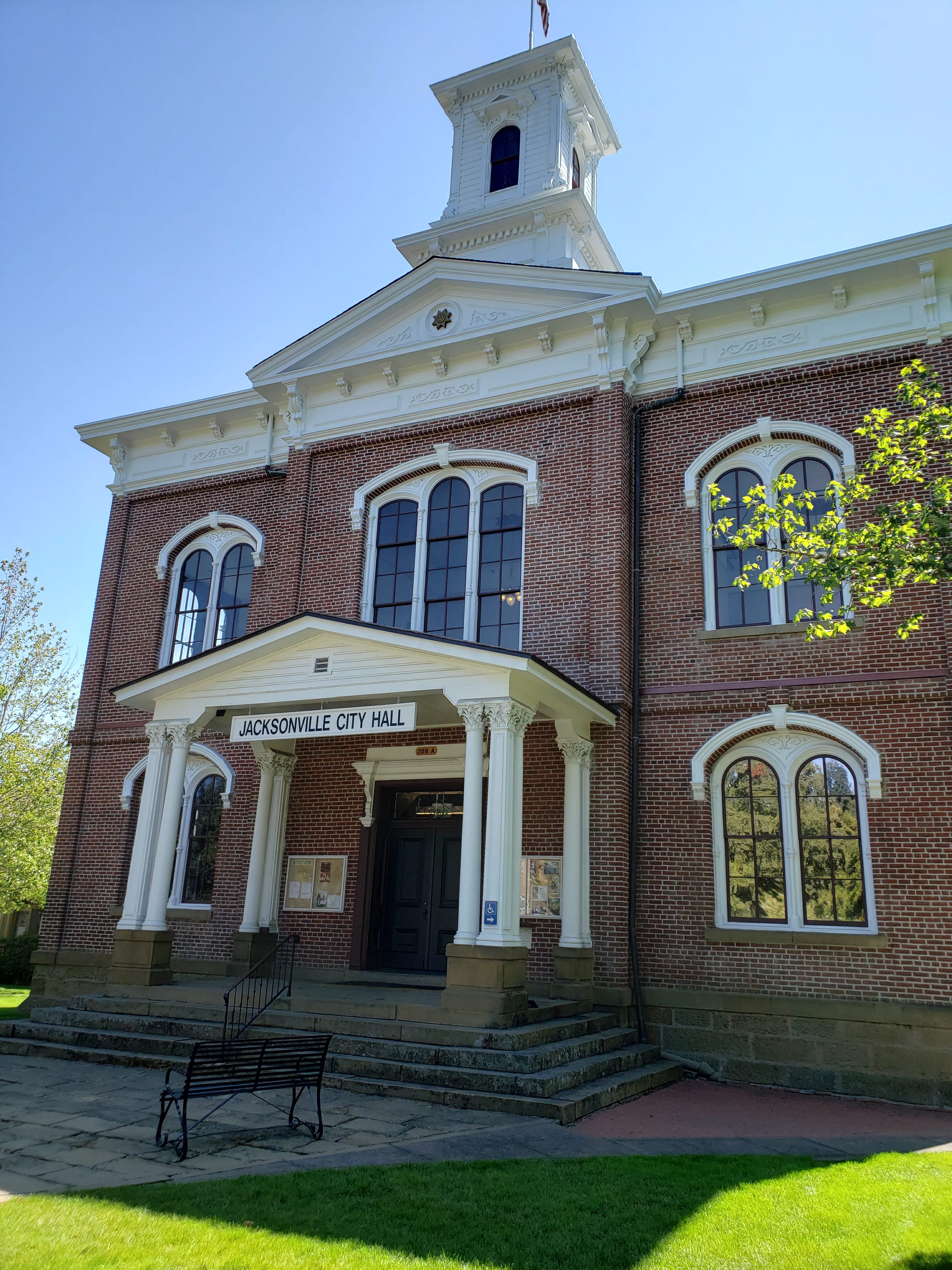
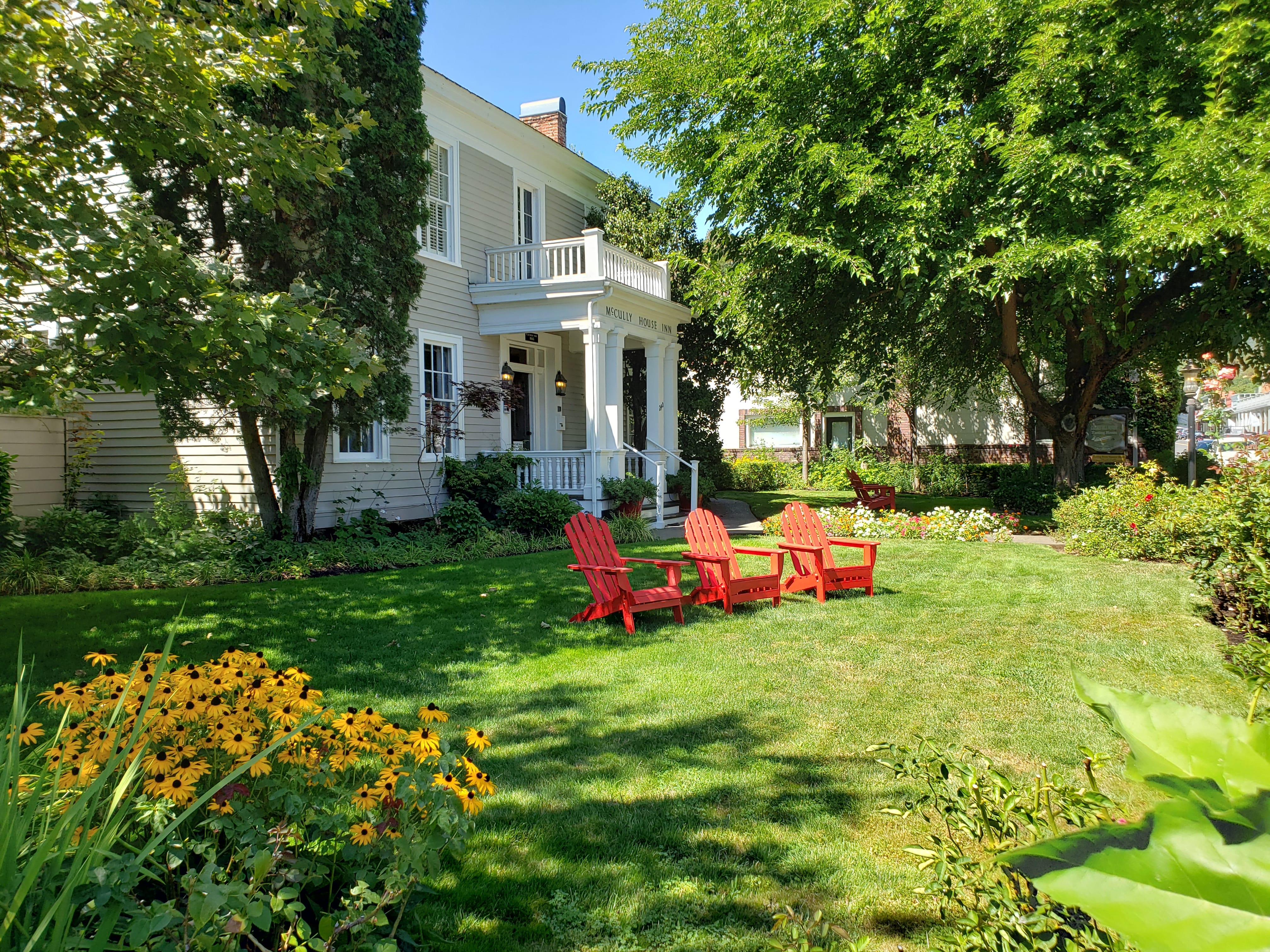
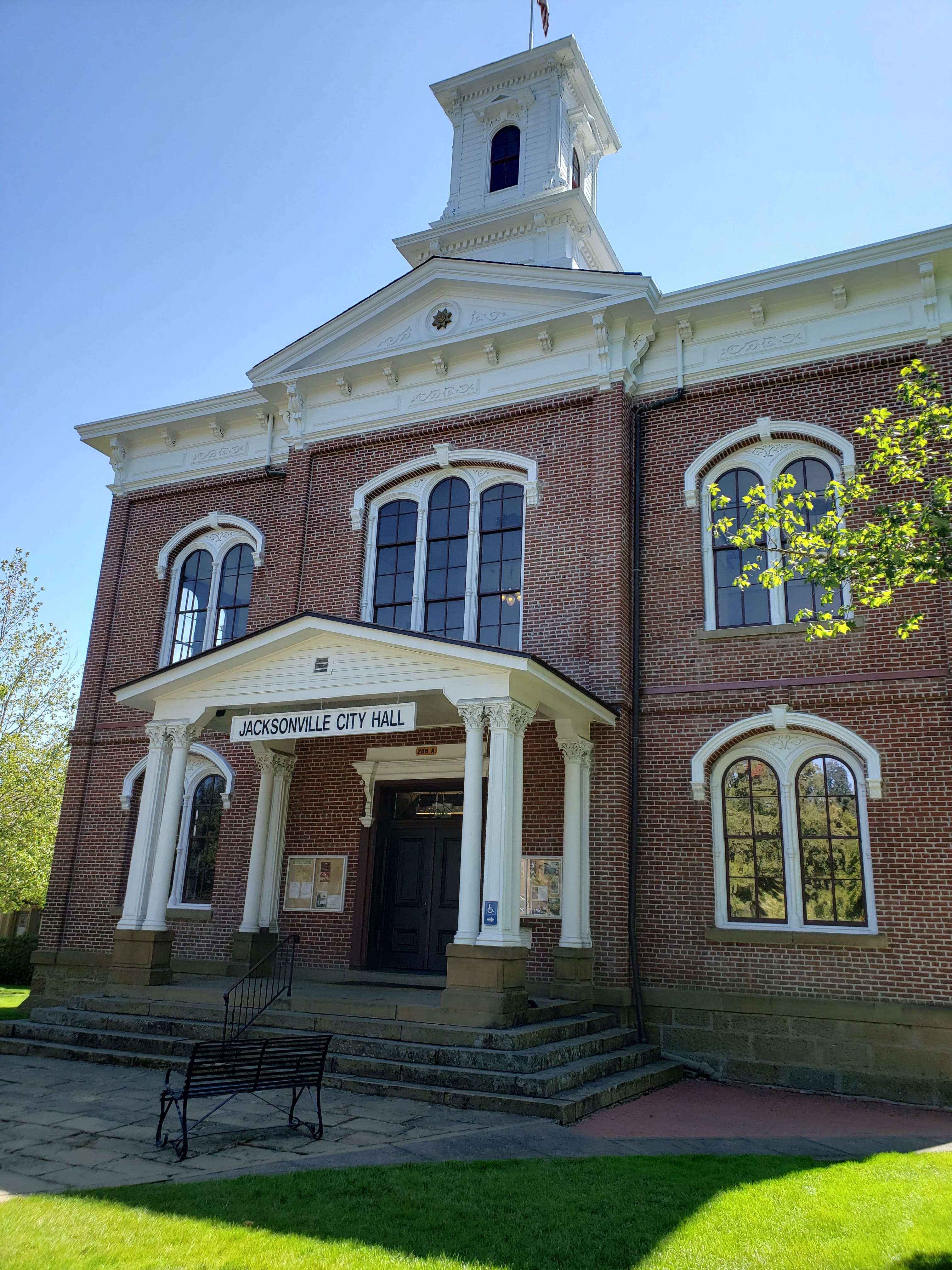
Jacksonville’s (pop.2800) historic district, a U.S. National Historic Landmark, was founded following the discovery of gold deposits in 1851-52. It was the original seat of Jackson County, now at Medford. It was also home to the first Chinatown in Oregon. The city was the principal financial center of Souther Oregon until the railroad was rerouted to Klamath Falls due to the severity of the grades of Siskiyou Pass.

Downtown Jacksonville Covered Sidewalk

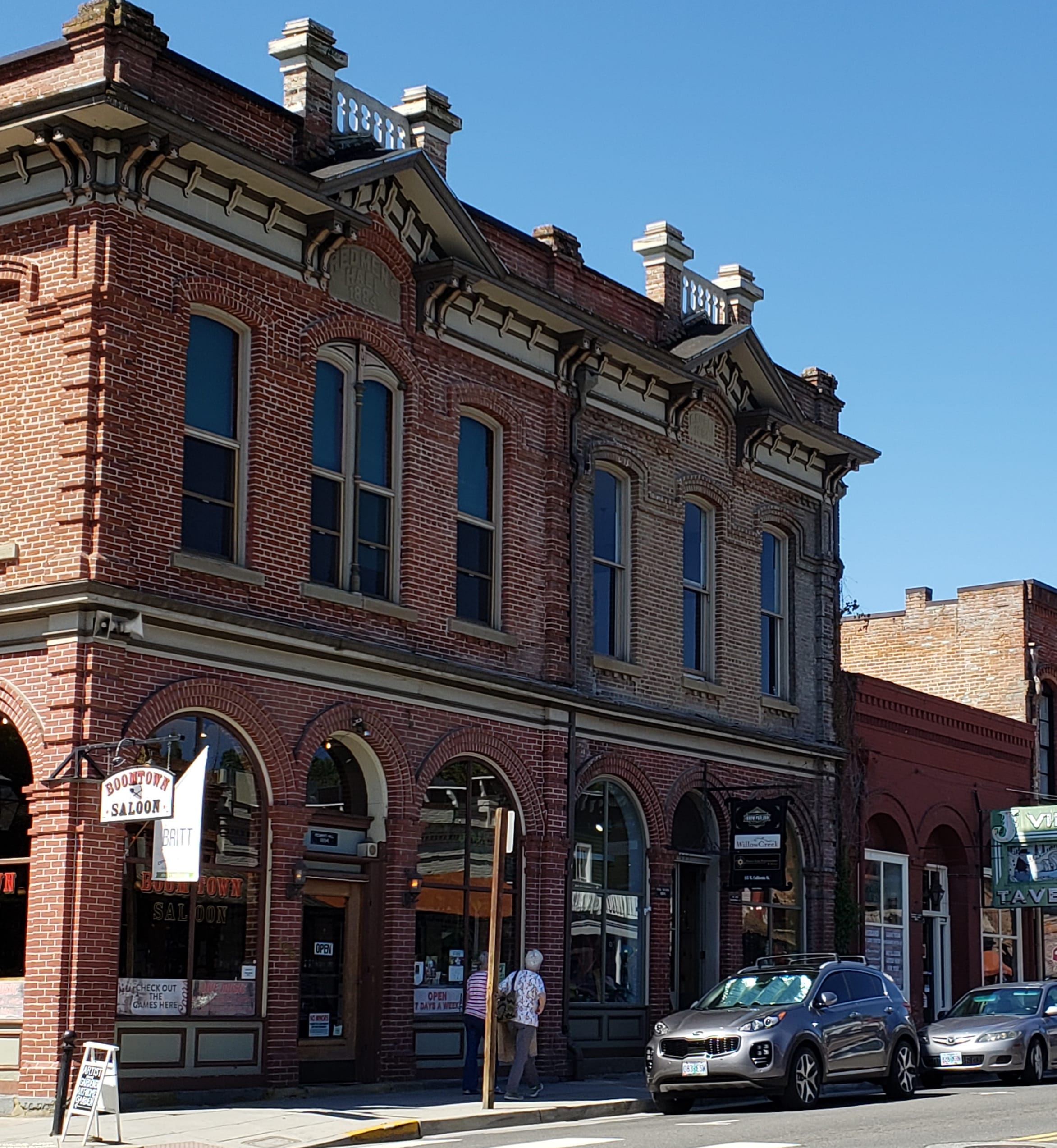
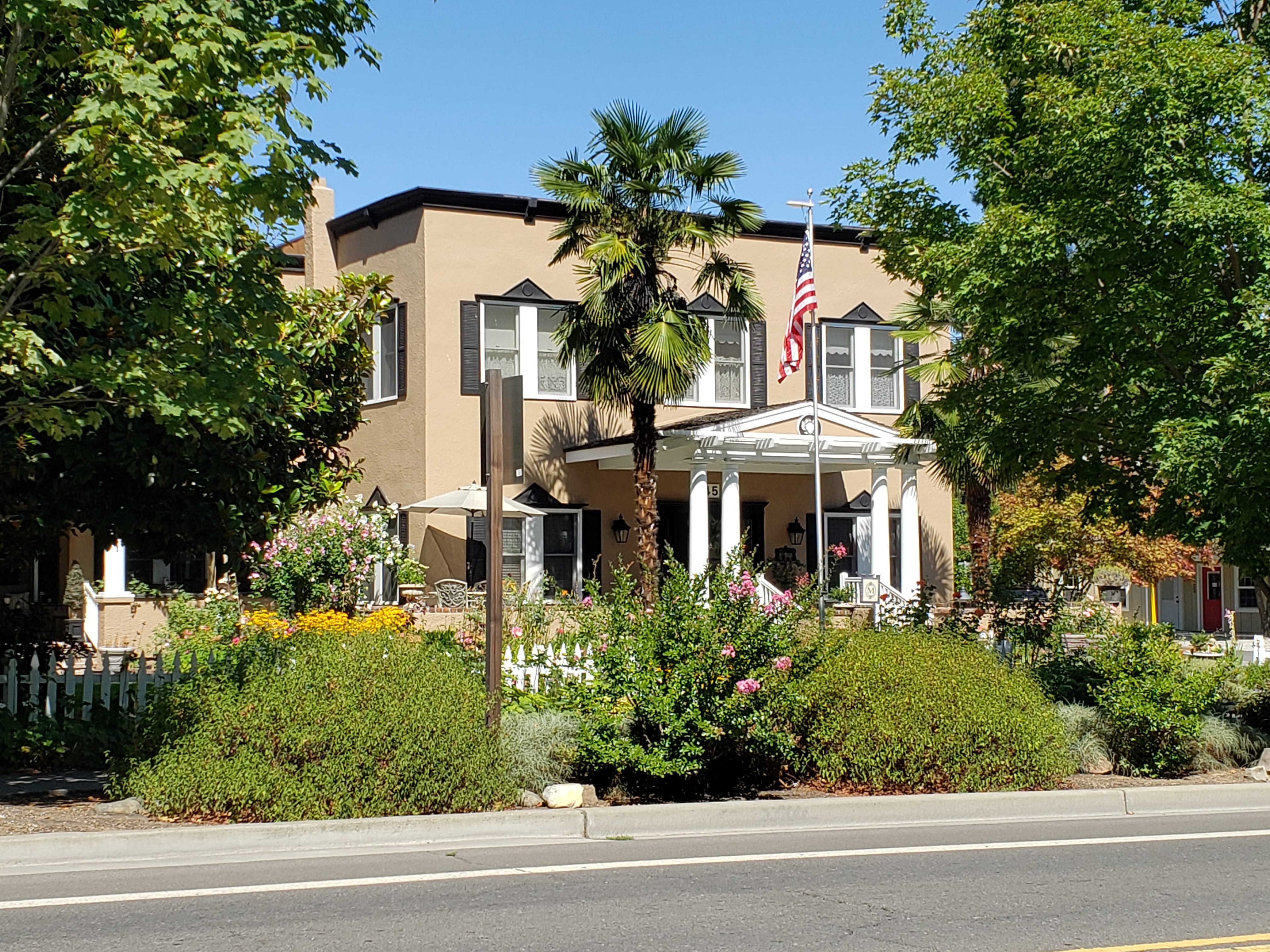
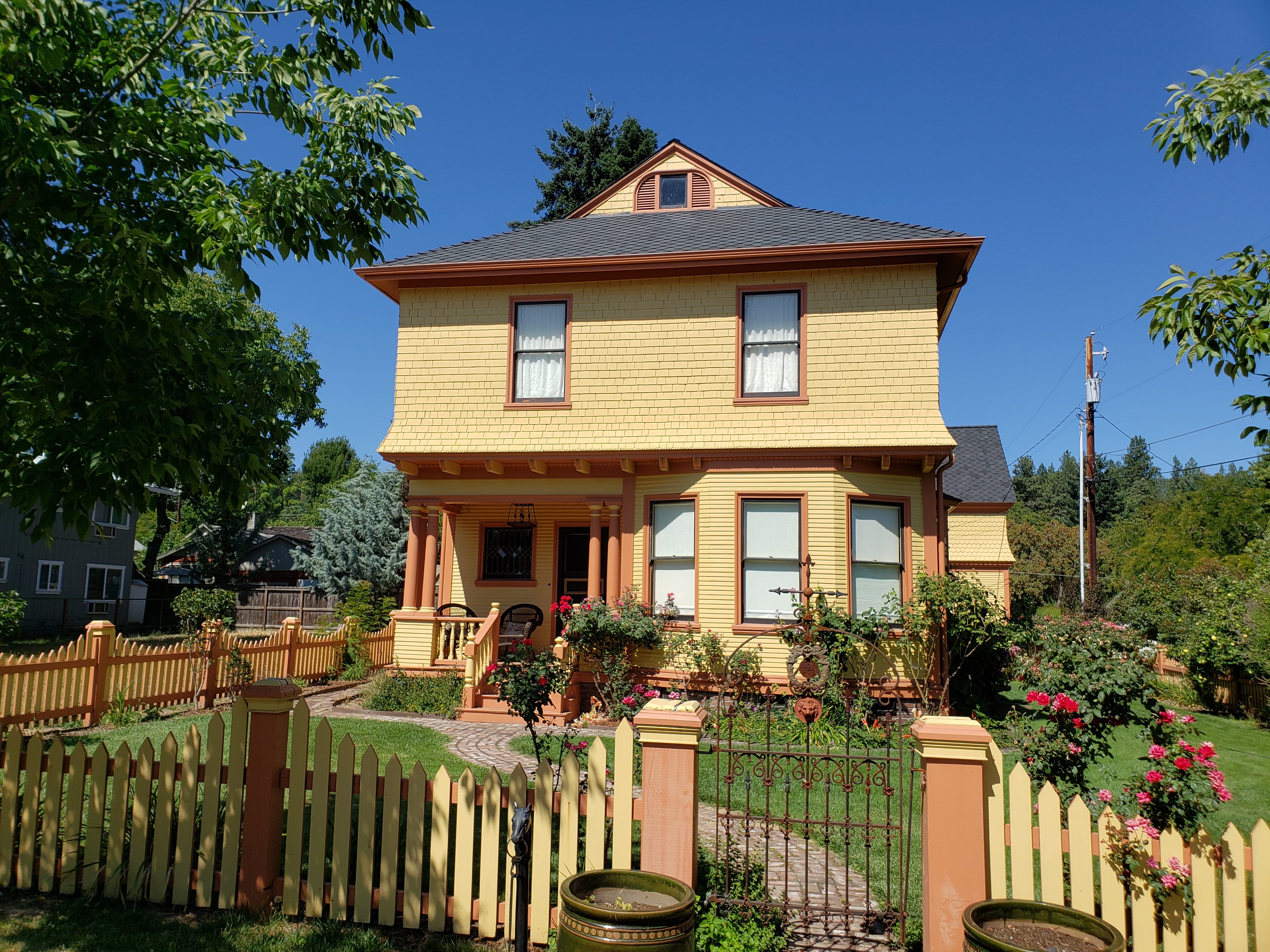
Over 100 buildings are on the National Register. Walking downtown is like walking into the Old West. The experience is diminished by vehicular traffic. I wonder aloud what it would have been like when the horse was the principal mode of transportation. Jacksonville is a popular place to visit. B&B’s, restaurants, breweries and saloons are a daily draw.

The Britt Festival is a popular seasonal music festival and the town has several museums, an arboretum and beautifully landscaped homes adorned with colorful flowers.

After a pleasant visit it’s time to head towards Valley of the Rogue State Park. We are staying in the F loop in Site 14. No sewer hookups in this loop but the site offers water and 50 amp power…….. and a clear view of the southern sky for our satellite dish. We check in and set up for a two night stay. Tomorrow we’ll visit Nearby Gold Hill, Rogue River and Grants Pass where we’ll do a little shopping at Freddie’s, i.e. Fred Meyer big box store.

We Have Lift Off! Or Something Like That…..

Day 1- Sunday August 18, 2019

We’ve been planning this trip for quite some time- ever since we got back from our winter trip last March. We are taking a round about course back to the Bonneville Fish Hatchery where we’ll spend the months of September and October as volunteer hosts once again.

Ten Minutes to Blast Off!

I think this is our number 4, maybe number 5 stint at the hatchery. As in the past our friends Jim and Nancy are occupying our home in our absence.

We headed up US 395 to Susanville, CA (pop. 17,000) . This is a pretty stretch of road once out of Reno. It follows the Sierra Front with it’s rugged pine covered hills north through beautifully colored hills, vertical sided creek beds cut by flash floods, and terminal lakes that have no outlet. Honey Lake is one such lake. It’s an important wildlife refuge for migrating birds. Alfalfa and hay are farmed and cattle are a raised in the area.

Susanville’s (elevation 4100′) main industries were mining, lumber and farming but the first two are no more. The main industry now is the two state prisons located nearby which employ approximately 6000 folks. Driving down main street we noticed an upswing in the commercial district.

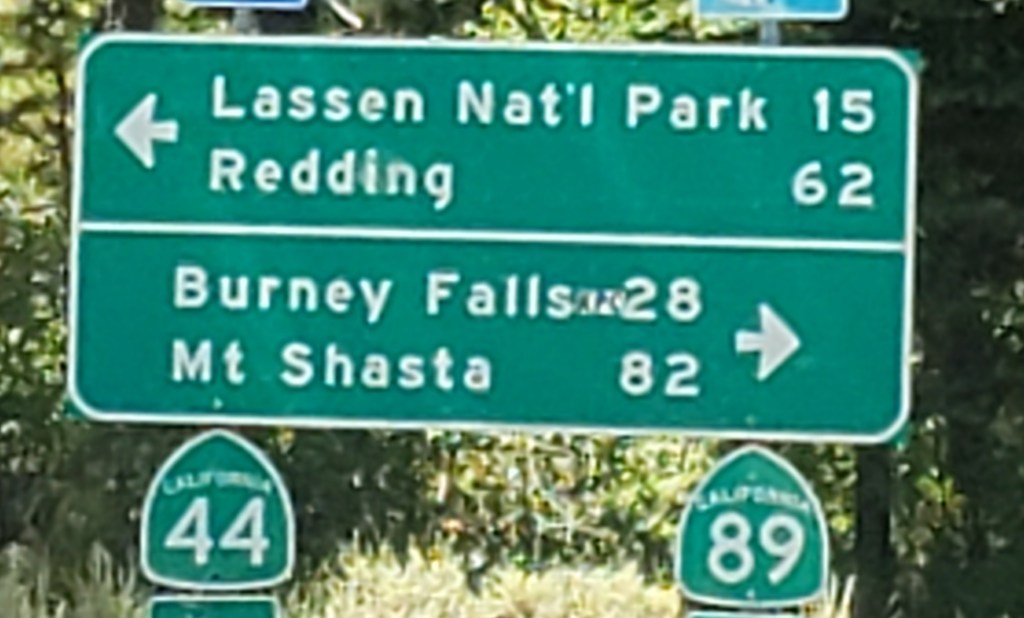
We continued on CA 44 through pine dominated hills occasionally opening to large meadowlands. Cattle seemed to be enjoying the rich grasses growing in those flatlands. We come to Old Station, a former stagecoach stop back in the day, now a traveler services oriented community of 51 souls. where we pick up CA 89 but not before viewing the star of Lassen Volcanic National Park.

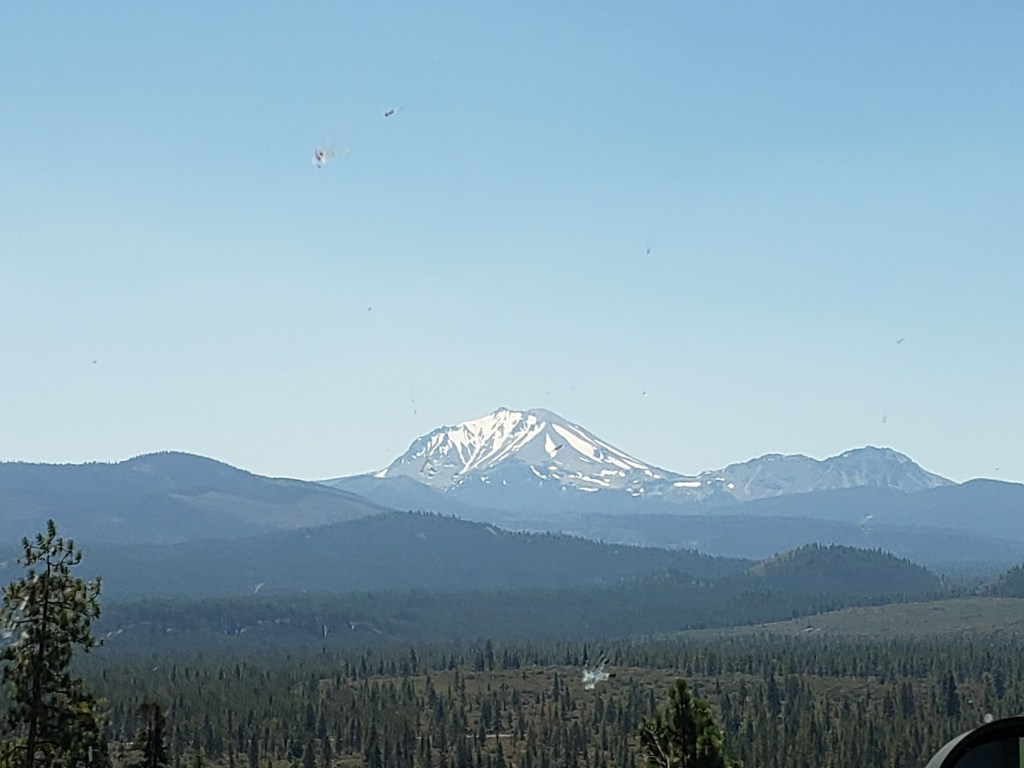
Lassen Peak stands majestically at an elevation of 10,470′. I climbed to it’s summit when I was a pup. On the way up I was anticipating staring down at a boiling caldera of boiling lava. Boy was I disappointed-nothing but a little steam up there! It’s last major eruption was in 1914- the year my mother was born.
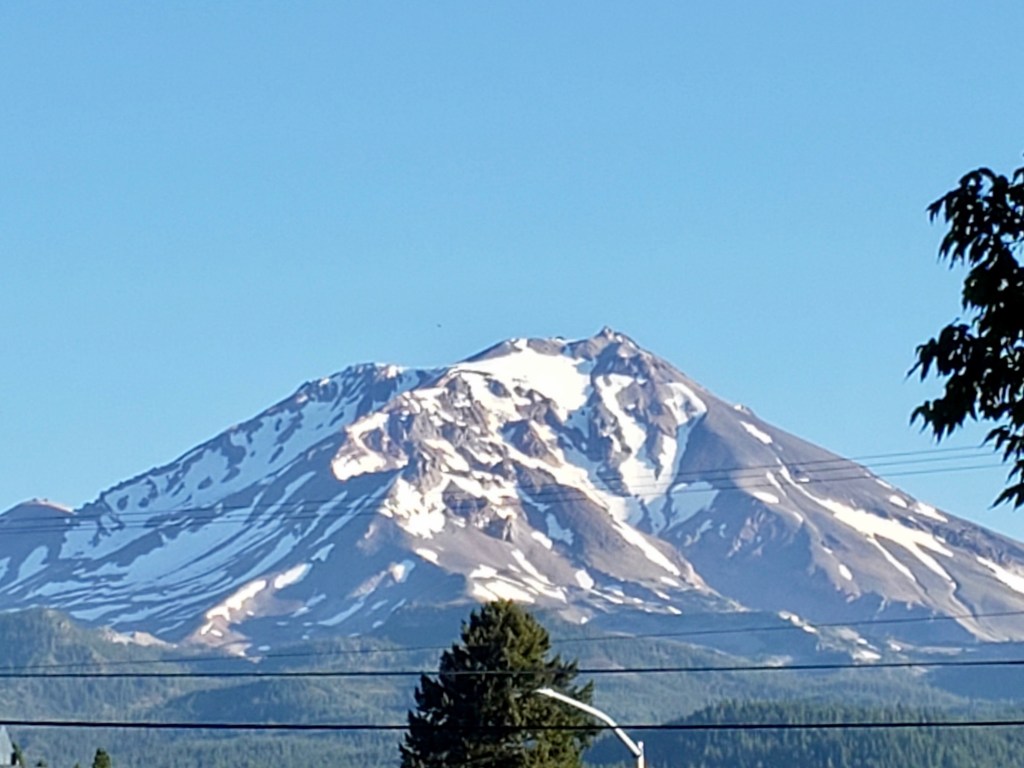
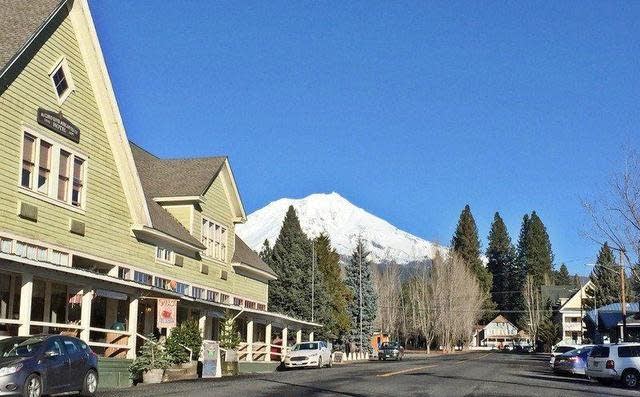
At Old Station we transition on to Highway 89 and travel on to McCloud, CA. (1100 souls). At times the highway lines up like a gun site aimed squarely at the majestic snow covered Mount Shasta (elevation 14,179′), the tall conifers framing the mountain on either side of the road. It’s a very picturesque drive.

A little history is in order: The town was named after Alexander McCloud who led a party of Hudson Bay Company trappers into the valley where McCloud now stands. In 1892, A.F. Friday George built the first mill located in what is now McCloud, but it failed because of the difficulty of hauling the lumber over the hill by oxen. In 1897, the town of McCloud was finally established by George W. Scott and William VanArsdale, founders of the McCloud River Railroad Company. The railroad made it economically feasible to transport the lumber to more populated areas. 

The McCloud River Lumber Company (known as Mother McCloud) kept the town secure and prosperous. The homes were steam heated and electricity was supplied by the mill. When your faucet leaked or a light burned out, “you’d just call Mother McCloud and a crew would be over to fix it for you” recalled a third-generation McCloud native. Those days ended in 1963 when U.S. Plywood Company purchased the mill, the railroad and the town.

In 1965, U.S. Plywood transferred town properties to John W. Galbreath and Co. whose job was to help company towns make the transition to privatization. The houses were then sold to the people living in them. The McCloud Community Services District was formed and the utilities, such as water, sewer and street lighting, were turned over to the district. They also assumed responsibilities for fire and police protection, library services and some road maintenance. U.S. Plywood promised that there would be years of employment and a good economic future for the town as there were 50 years of timber to be cut. But, after privatization the economy of the town began to deteriorate due to the diminishing timber industry. U.S. Plywood, who had since merged with Champion International Corp., tried hard to keep going, but the days of the big timber companies were gone. In 1979 the lumber mill was closed.

The lands once held by Champion International are today owned by the John Hancock Mutual Life Insurance Company and managed by Campbell Timberland Management. Land management companies see their role as one of stewardship over the forests making sure that they survive in a healthy diverse way. The mill closed for good in 2002 when it was determined that it would be too expensive to modernize the WWI vintage machinery.

The McCloud River Railroad ran as the Shasta Sunset dinner train for several yards but that too came to an end. Two working steam locomotives were sold, one to Oregon Coast Scenic Railroad located in Garibaldi, OR and the other to the  Virginia and Truckee Railroad located in Virginia City, NV.

Many homes are being purchased and renovated to serve as vacation housing. The area is still a haven to fishermen as the area is nationally known for it’s trout fishery. Even though McCloud is once again facing an uncertain future, it’s unique architecture, the beauty of the surrounding countryside, the purity and taste of the water, and the friendliness of the local townspeople, insure that McCloud will retain it’s charming and attractive atmosphere well into the 21st Century.

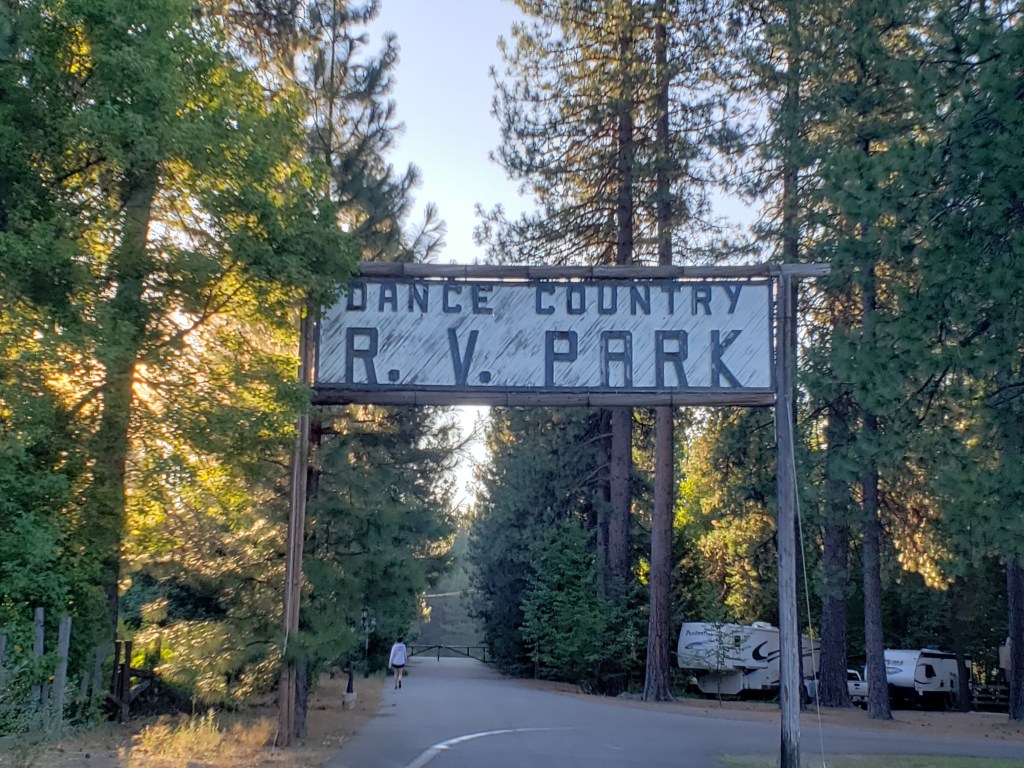
Original Entrance to the RV Park

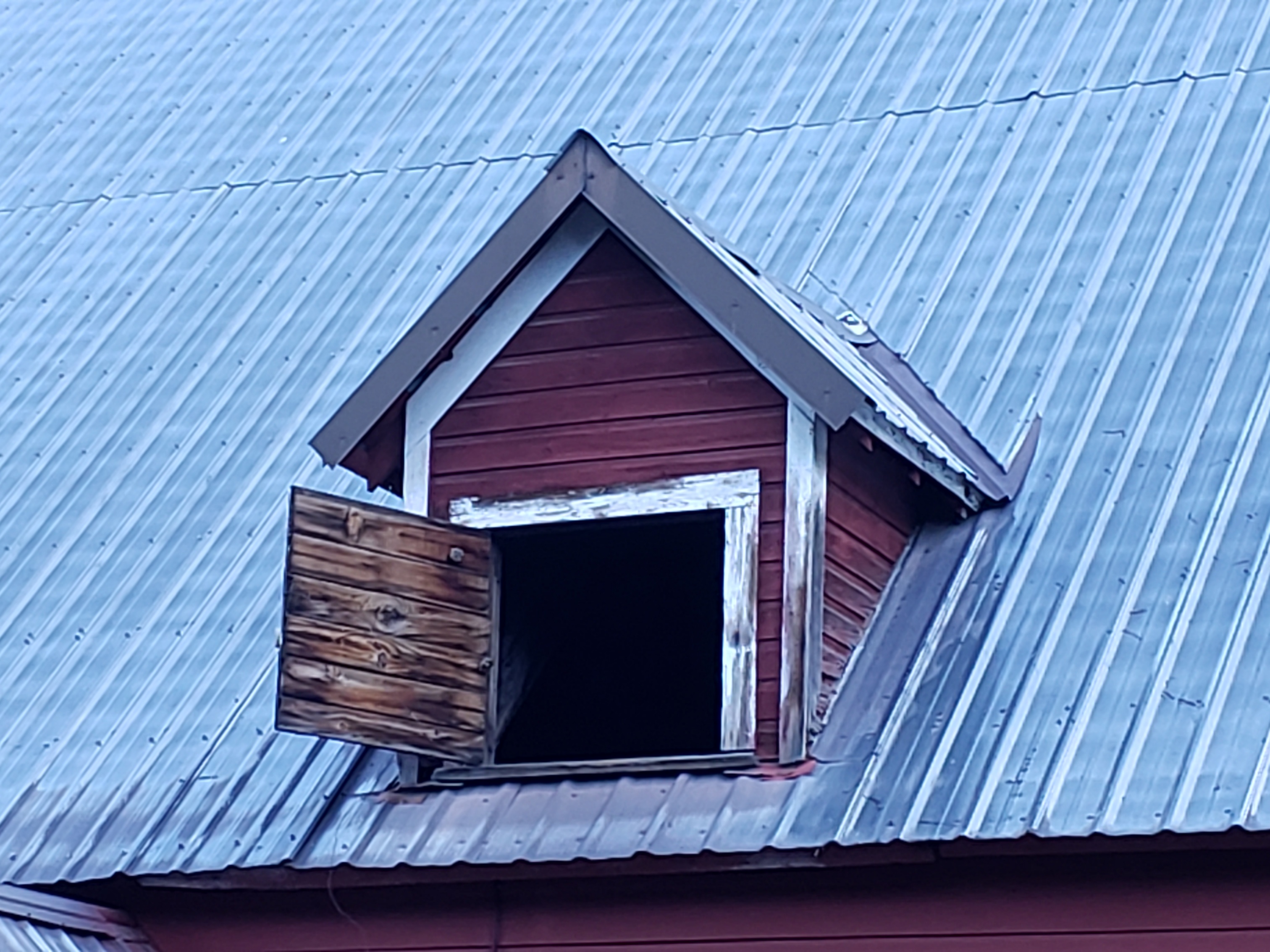
Old Dairy Barn on McCloud RV Resort Property

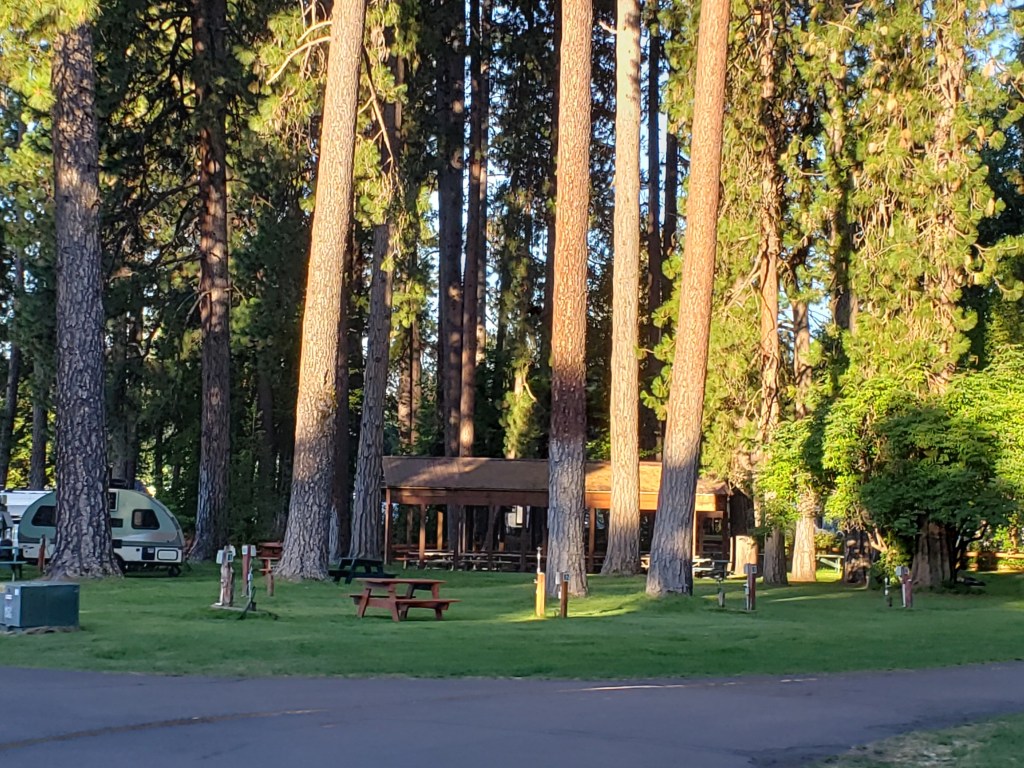
Beautiful Grounds of the McCloud RV Resort

We pulled into McCloud RV Resort after traveling 216 miles- a perfect distance for the first day on the road. The park’s previous name was the McCloud Dance Country RV Park named in honor of the McCloud Dance Country Ballroom, a venue since 1906-” Your Northern California venue for Ballroom Dance, Square Dance, Round Dance, Weddings, Conferences & Events – Dance Packages.” The park is very nice aesthetically- lots of mowed grass, beautiful tall pine trees but not laid out as well as it could have been. But heck, it’s been here for a long time, rigs have changed from 16 foot travel trailers to the largest of all RV’s- the 45 foot diesel pusher motorhome. All in all its still a nice park- but not a resort……..