Monday March 23, 2026
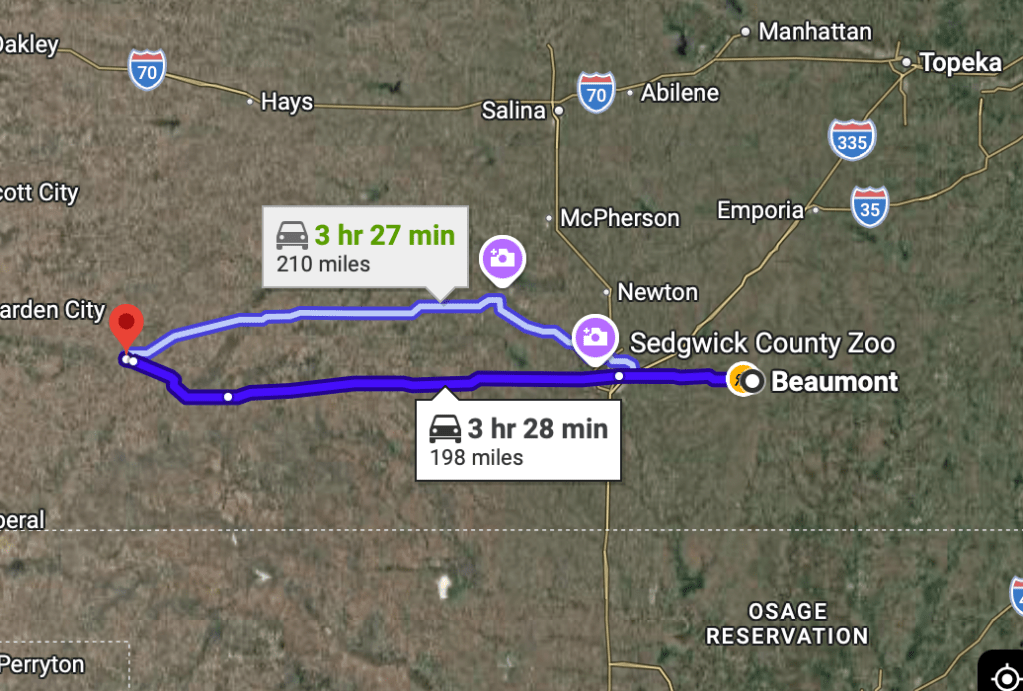
We left Dodge City having around 800 miles to home. We are sneaking up on our destination 200 miles at a time. We enjoy traveling much more when we are on the road 5 hours rather than more. And if the wind is blowing I don’t enjoy countersteering into the wind to keep the RV pointed straight down the road. It’s just tiring to do that 4 to 5 hours at a time.
Anyhoo, we are on US 400 which is a very nice two lane road. It’s smooth with wide shoulders and the annoying rumble strip is placed outside the fog line. I like because when the wind blows it may push the rig over a little and onto the fog line where a lot of rumble strips are placed…… brrrrrrp goes the tires on the strip.
We reach Wichita. We’ve been cringing to cross this city as we have no idea if we have to do it on surface streets or something better. It turns out Kansas has a better idea and supplies us with a roadway similar to a West Coast Freeway. We cross through Wichita with little problem and not much traffic which is quite wonderful considering this city’s population is 397,532 souls. In fact, the major annoyance was the multiple traffic signals before and after reaching the “freeway” section of US 400.
We are out in the country and wondering who would build a hotel this far away from a city. We pull into Beaumont, an almost ghost town feeling place. The hotel is located in a two story building with a cafe on the first. The “town” has 36 souls living there.

The town site was first a stop on the stagecoach route between Fredonia and Wichita. In 1879 Edwin and Emma Russell built the Summit Hotel, later renamed as the Beaumont Hotel. I

n 1885 the St. Louis and San Francisco Railroad, better known as the Frisco, established Beaumont as a railroad town. One line of tracks ran east and west, connecting St. Louis with Wichita. A spur was added later going south from Beaumont though Latham and on to the Oklahoma border.]
Sometimes its easier tell a story with pictures, so here goes………..

A roundhouse was built in 1890 across from the Summit Hotel, and employed 90 people. The water tower, built in 1885, stands across from the hotel and is on the National Register of Historic Places. Because of the rich bluestem grass, the area was used as staging area to ship cattle back east.

\


 Travel With Jil and Mike