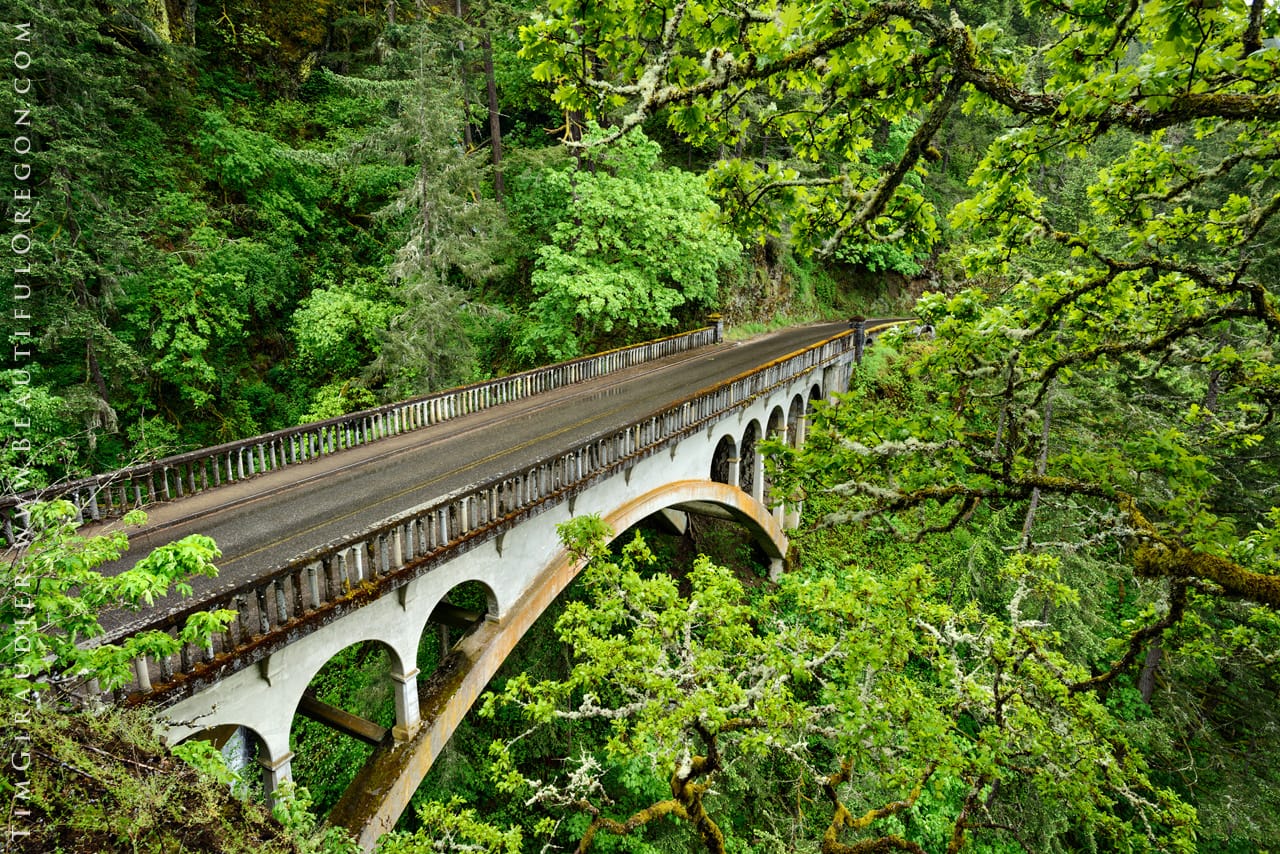
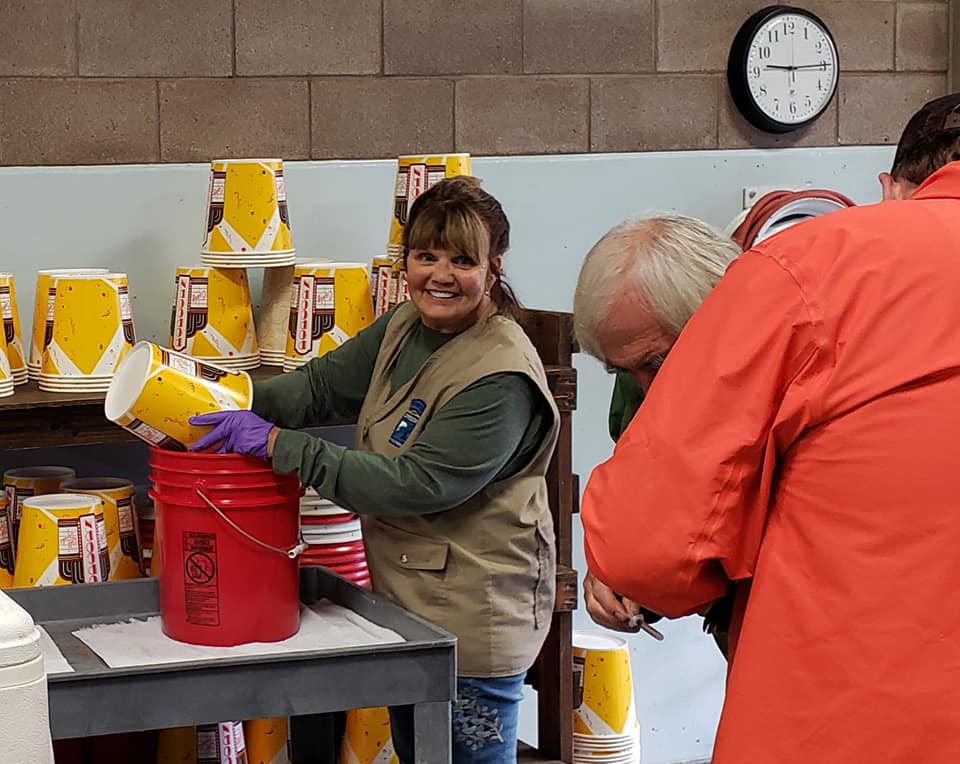
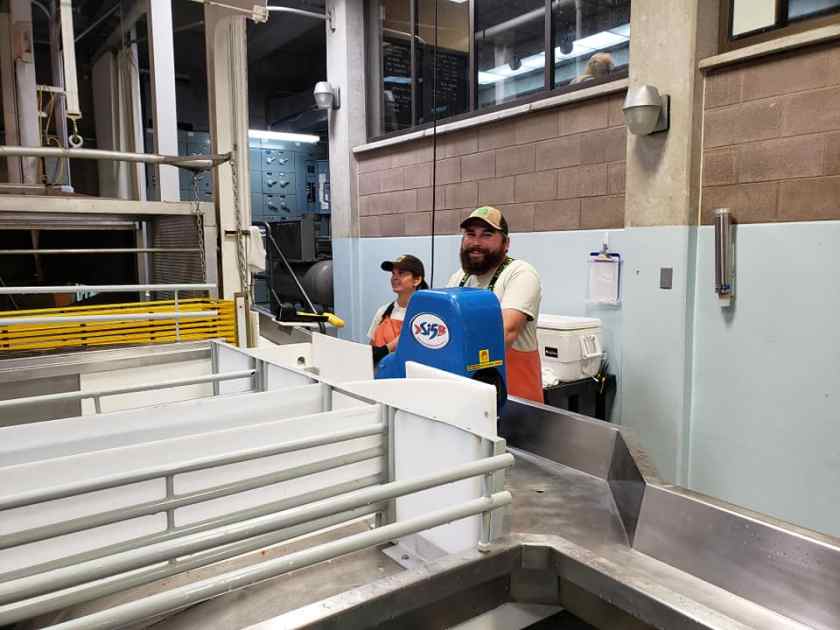
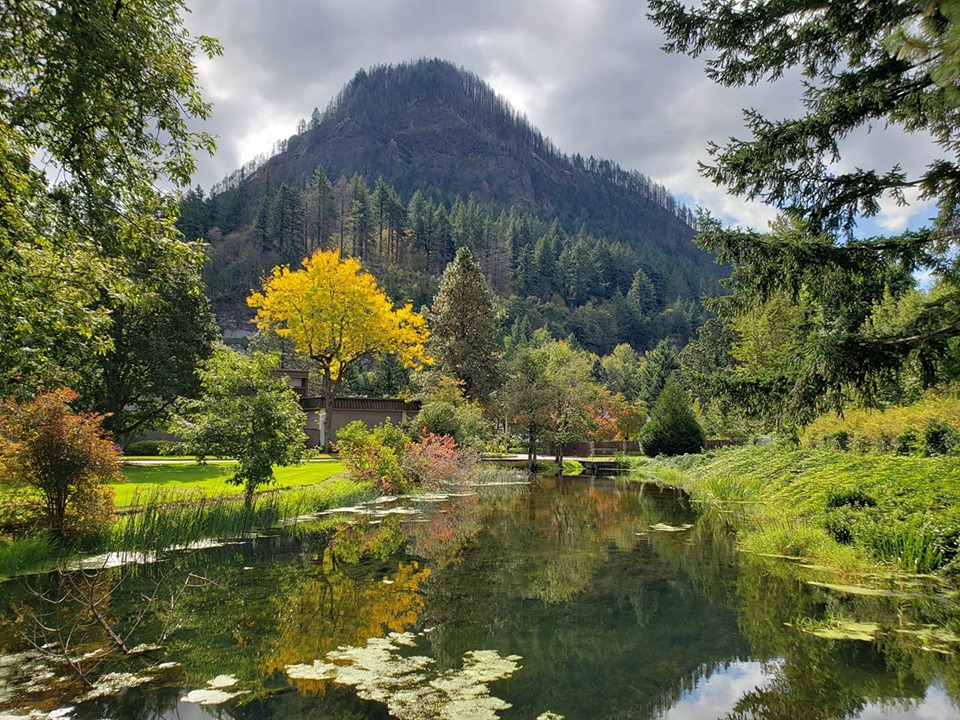
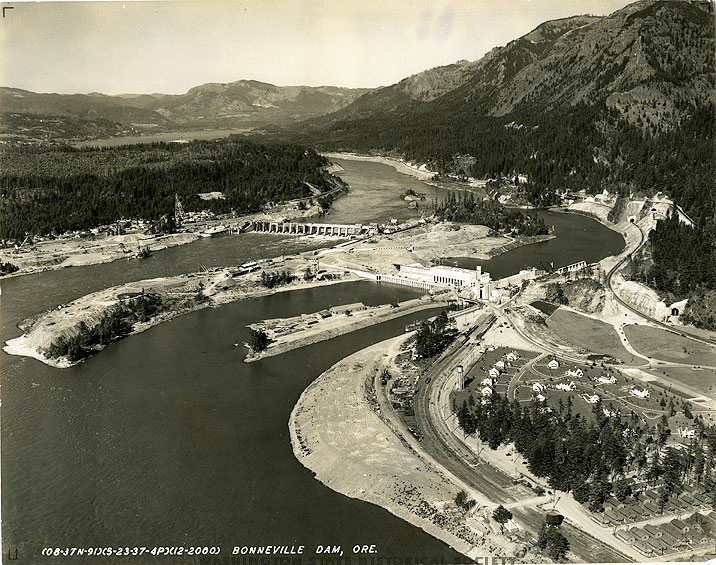
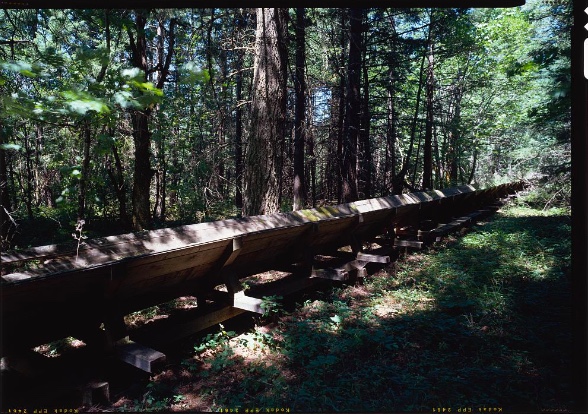
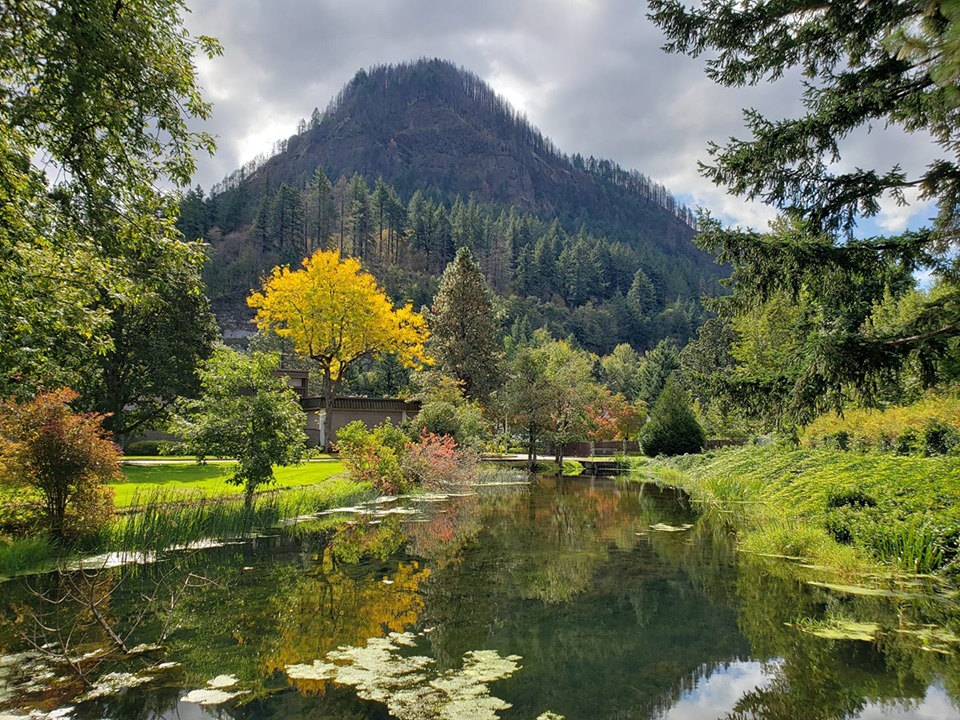
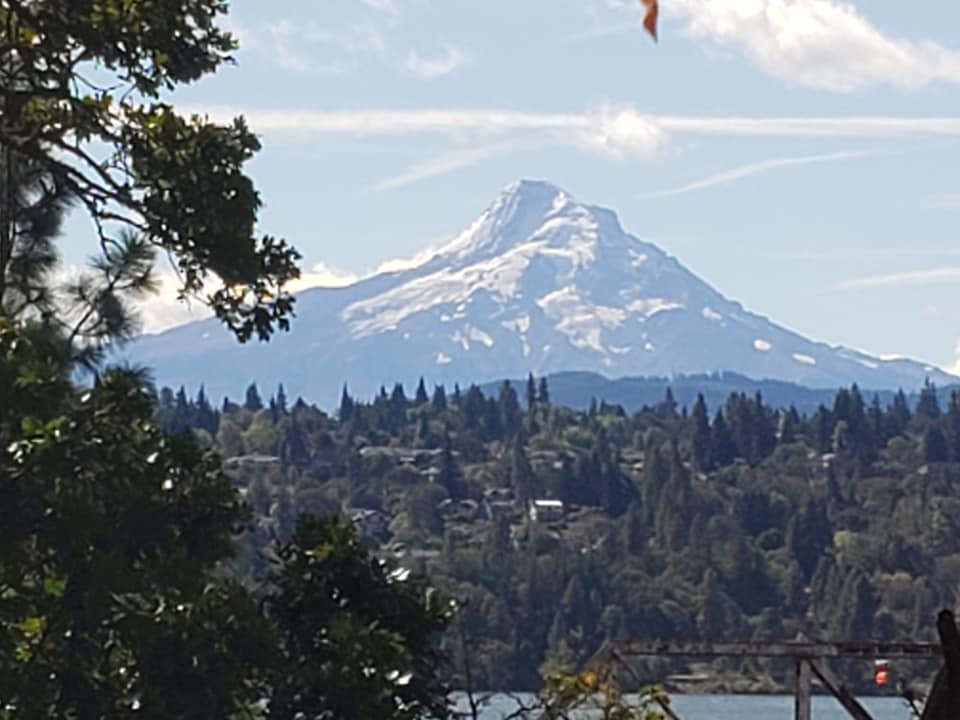
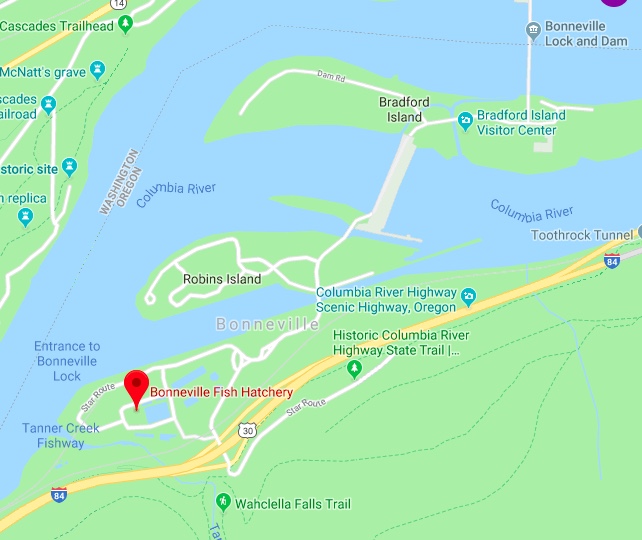
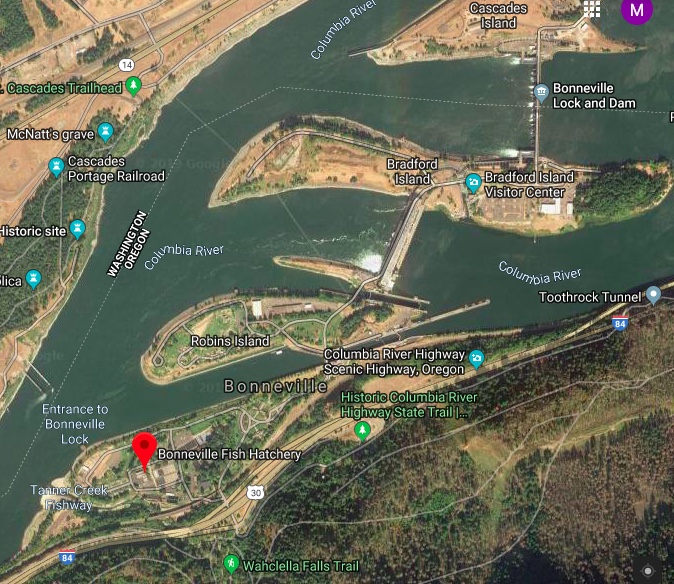
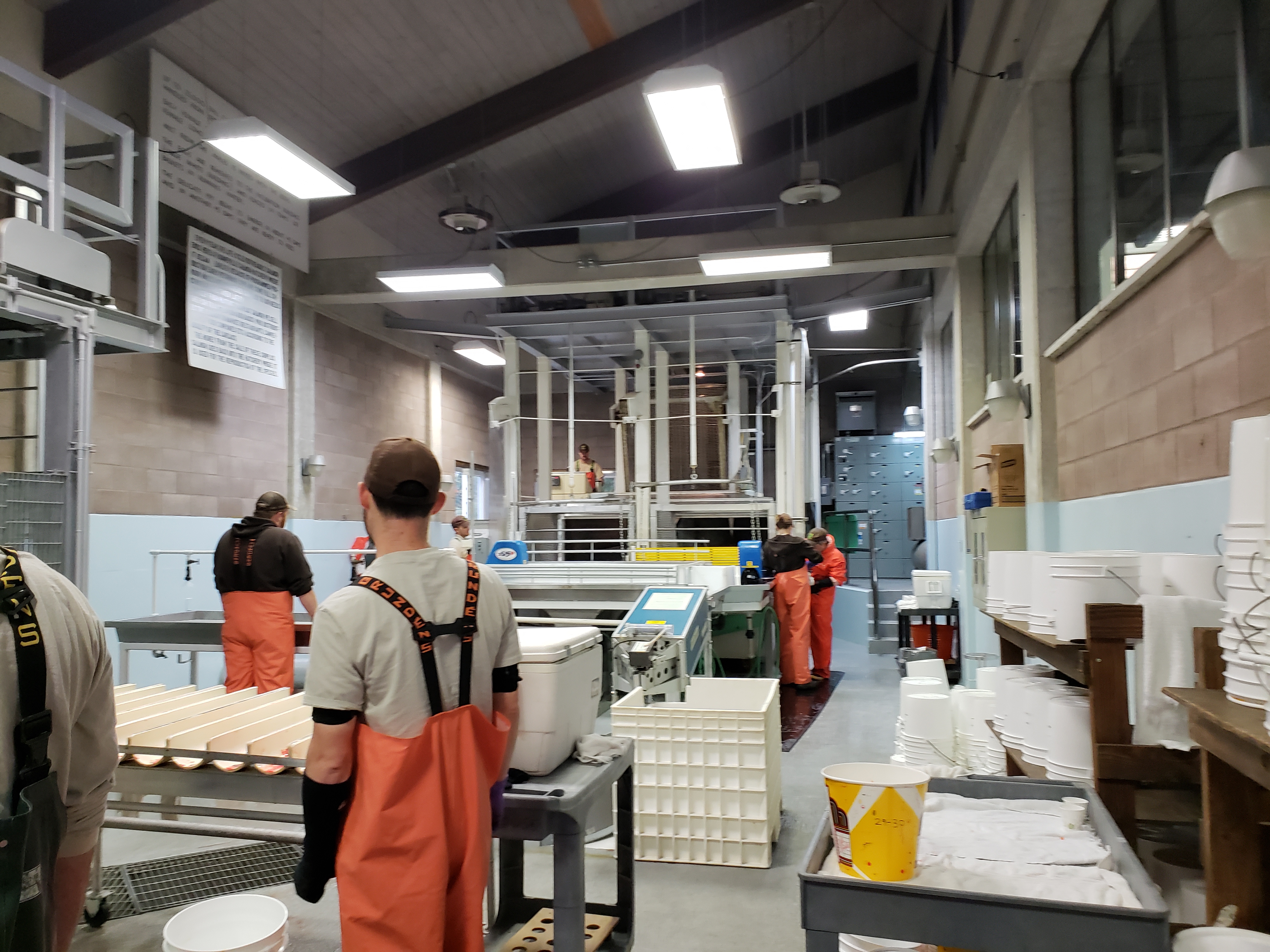
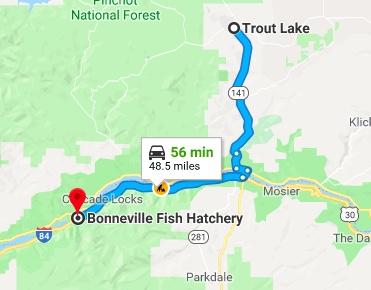
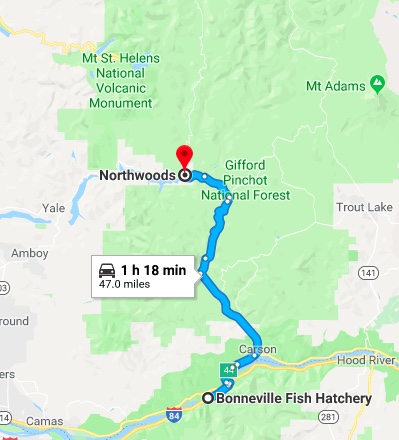
I thought I’d throw in some information of our current location. My next post I’ll include what hosting at Bonneville Hatchery entails as well as historical information of the area.
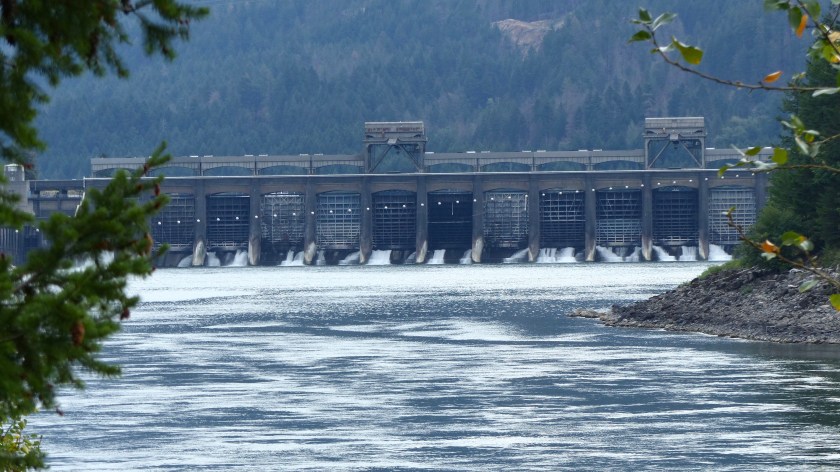
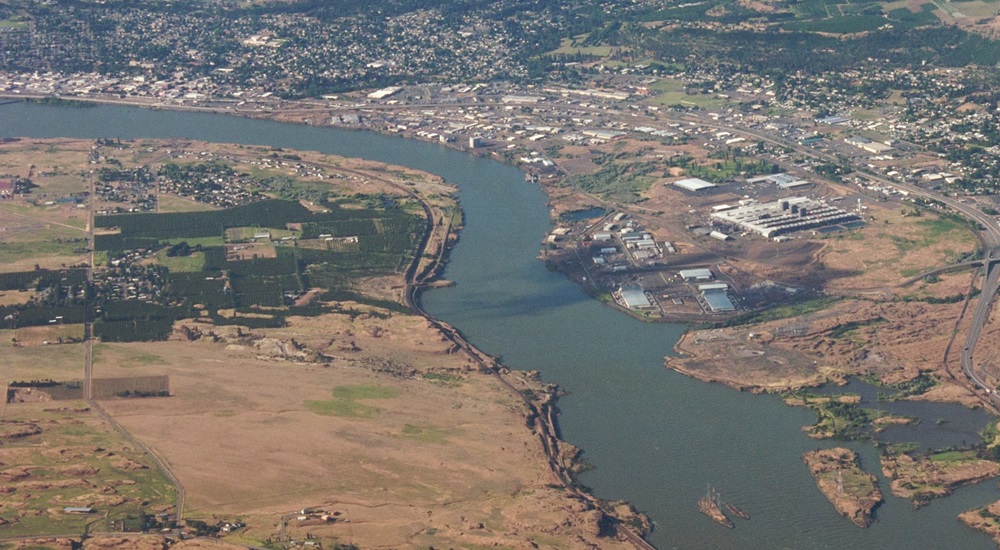
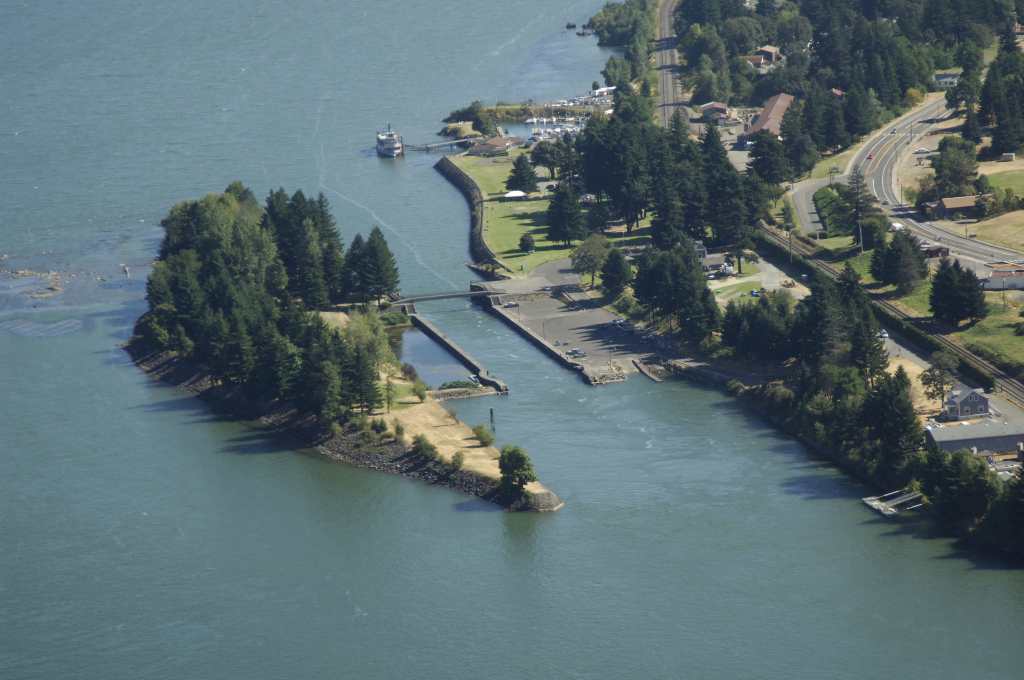
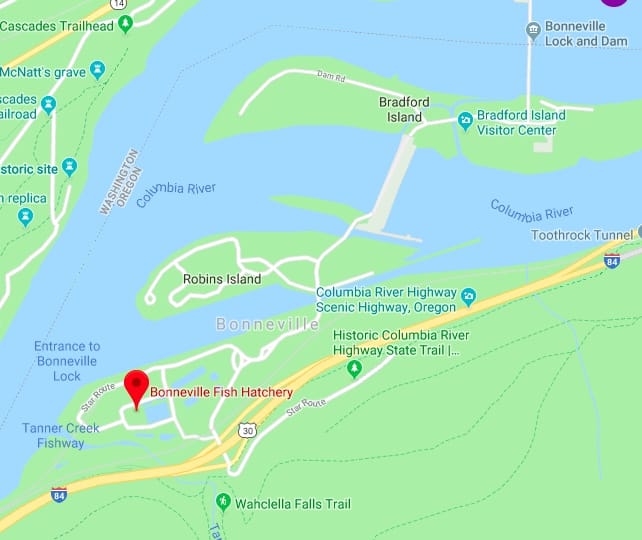
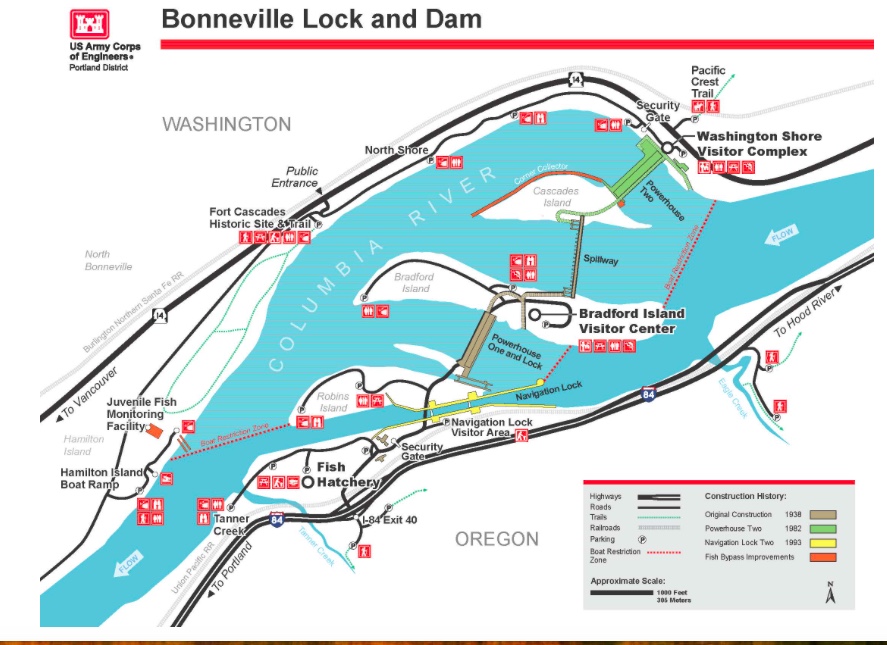
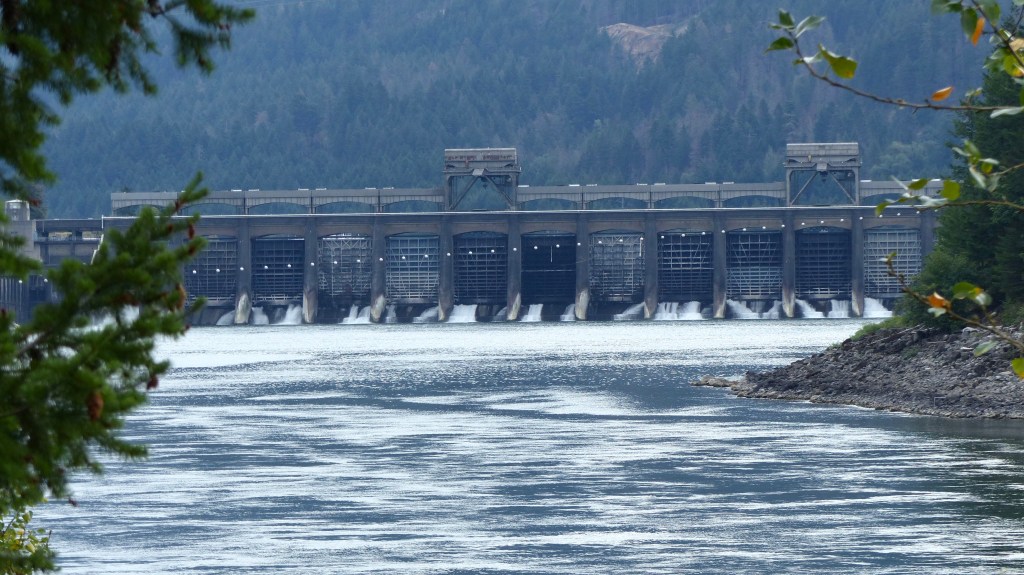
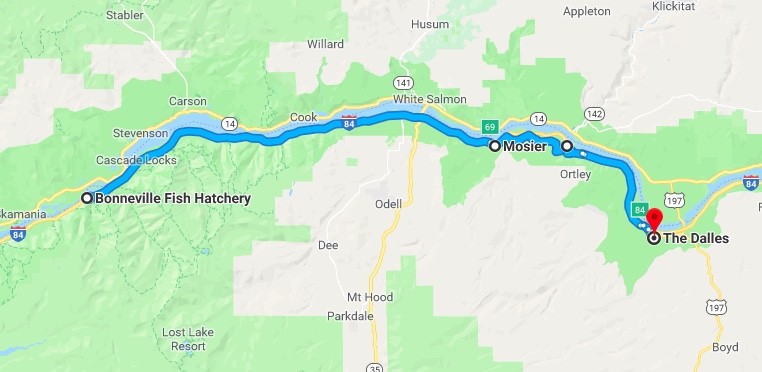
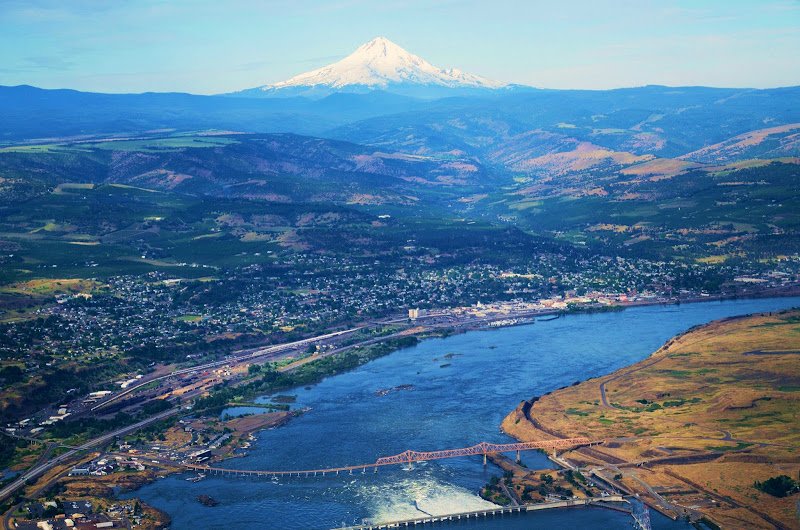
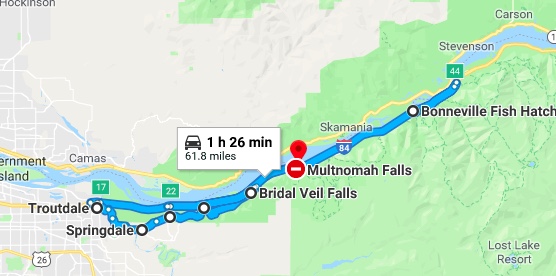
The Bonneville Lock and Dam is located in the Columbia River Gorge approximately 40 miles east of downtown Portland Oregon. The Bonneville Fish Hatchery is adjacent to the dam. It consists of two powerhouses, and three islands. Bradford Island visitors center is accessed from Oregon and the North Bonneville visitors center is accessed from Washington.
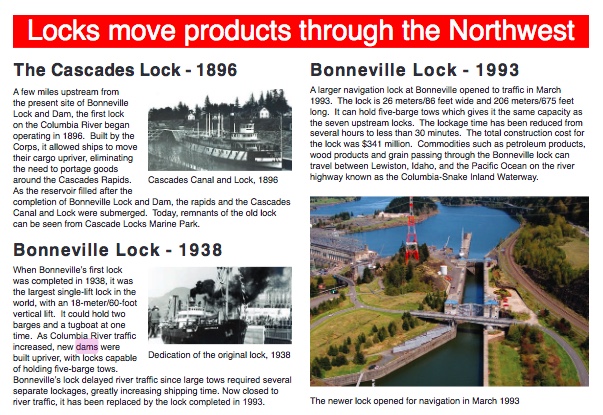
Bonneville Lock & Dam, built and operated by the U.S. Army Corps of Engineers, was the first federal lock and dam on the Columbia and Snake rivers. The project’s first powerhouse, spillway and original navigation lock were completed in 1938 to improve navigation on Columbia River and provide hydropower to the Pacific Northwest. A second powerhouse was completed in 1981, and a larger navigation lock in 1993.
Today, the project is a critical part of the water resource management system that provides flood risk management, power generation, water quality improvement, irrigation, fish and wildlife habitat and recreation along the Columbia River.
A Public Works Administration project of President Franklin D. Roosevelt’s New Deal, portions of Bonneville Lock and Dam Project were declared a National Historic Landmark in 1987.
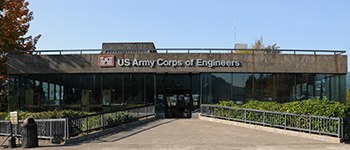
Bradford Island Visitors Center (BIVC) entrance
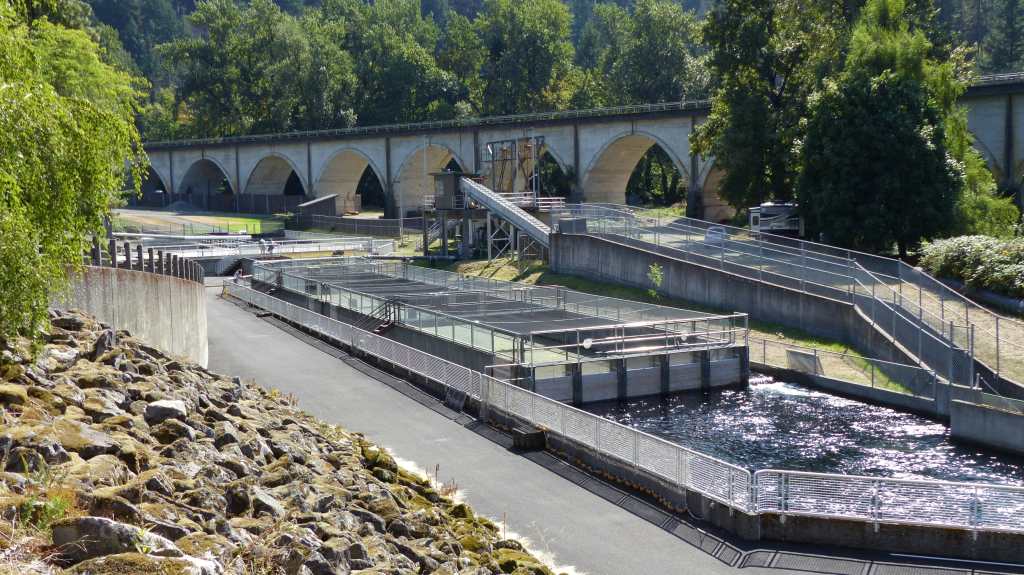
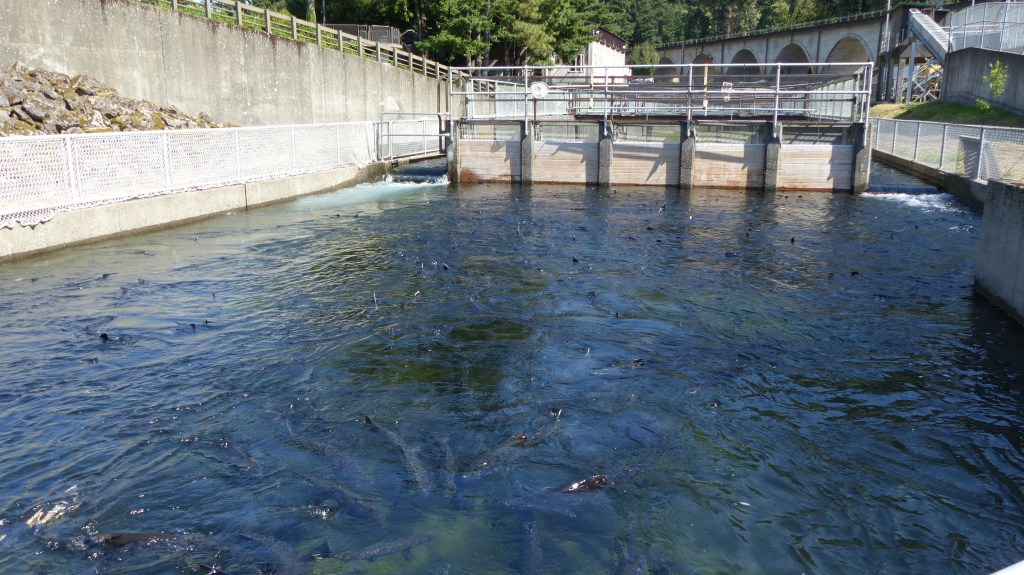
A lot of folks like to visit the dam. Bradford Island has an outstanding visitors center which is accessed from the Oregon side of the river. In it is a large fish ladder that allows many species of fish to travel from below the dam to the lakes and river above the dam. Folks can either view the ladder outside from above or go into the visitors center where they can view fish through a long viewing window. In a private area adjacent to that window fish counters sit for hours identifying the different species of fish and the numbers of each that pass through the dam.
Back on September 5th the lock operators noticed a problem with the downstream lock gates and shut the lock down. The lock was drained and the problem identified. There is only one lock that allows vessels to pass from river level to lake level. River traffic is at a standstill. That means barges full of wheat and other goods heading down river to market are stymied and barges bringing supplies up river also have to wait. Cruise ships are on hold.
A roadway provides vehicular access over the lock and that is now closed. Bradford Island Visitors Center is not accessible to the public. The dam has another visitors center in North Bonneville, WA but it doesn’t have a fish ladder nor a viewing window. A lot of would-be visitors are disappointed. Now comes the process of repairing the damage. The estimated date when the lock will be reopened to river traffic is September 30th.
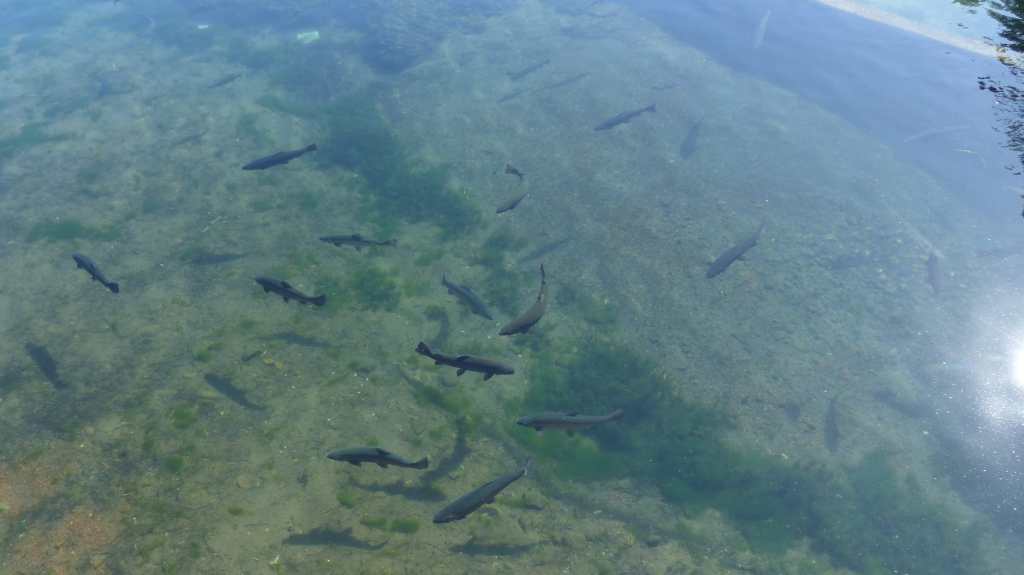
Confluence of Tanner Creek and Columbia River. Dark areas in center of creek are returning salmon
Friday, September 6, 2019
Bonneville Fish Hatchery- Week One
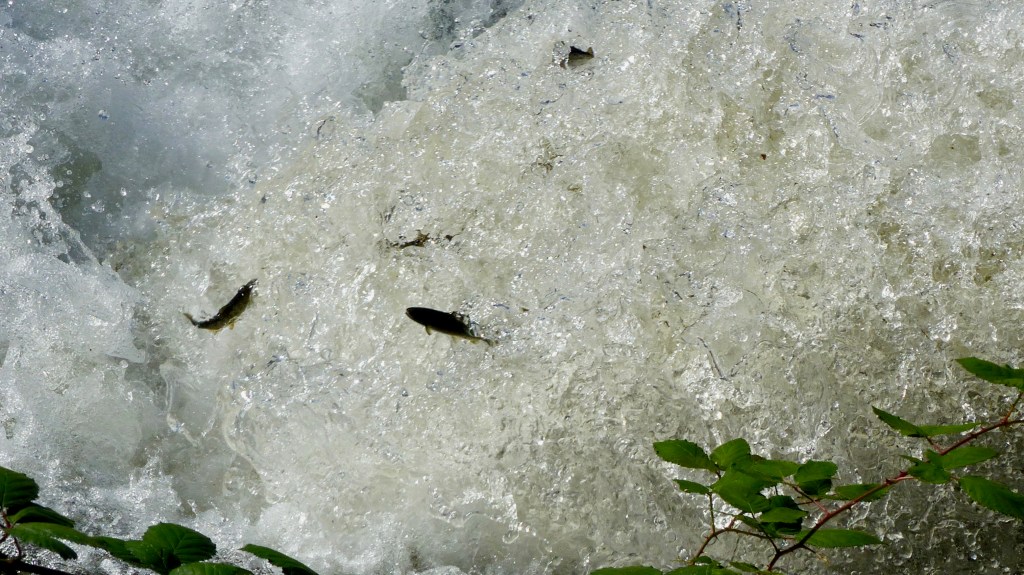
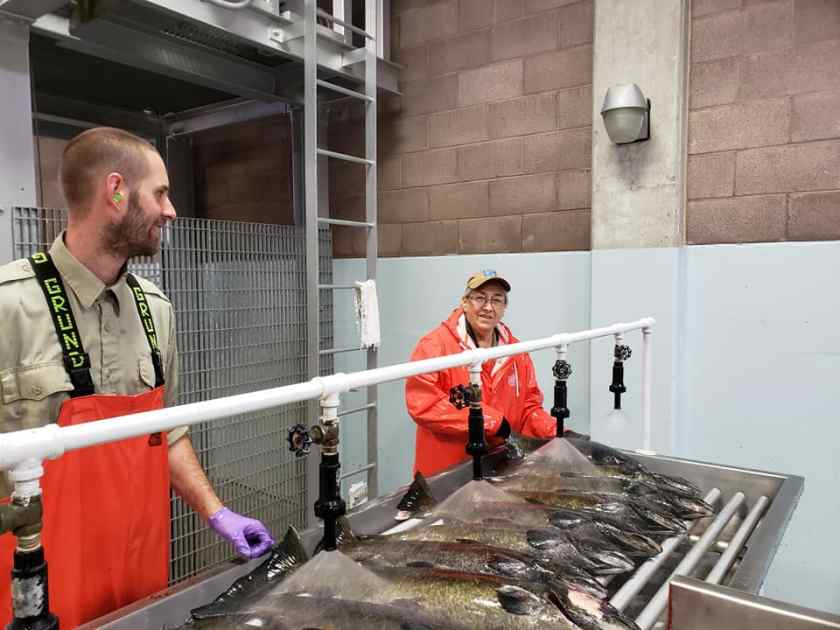
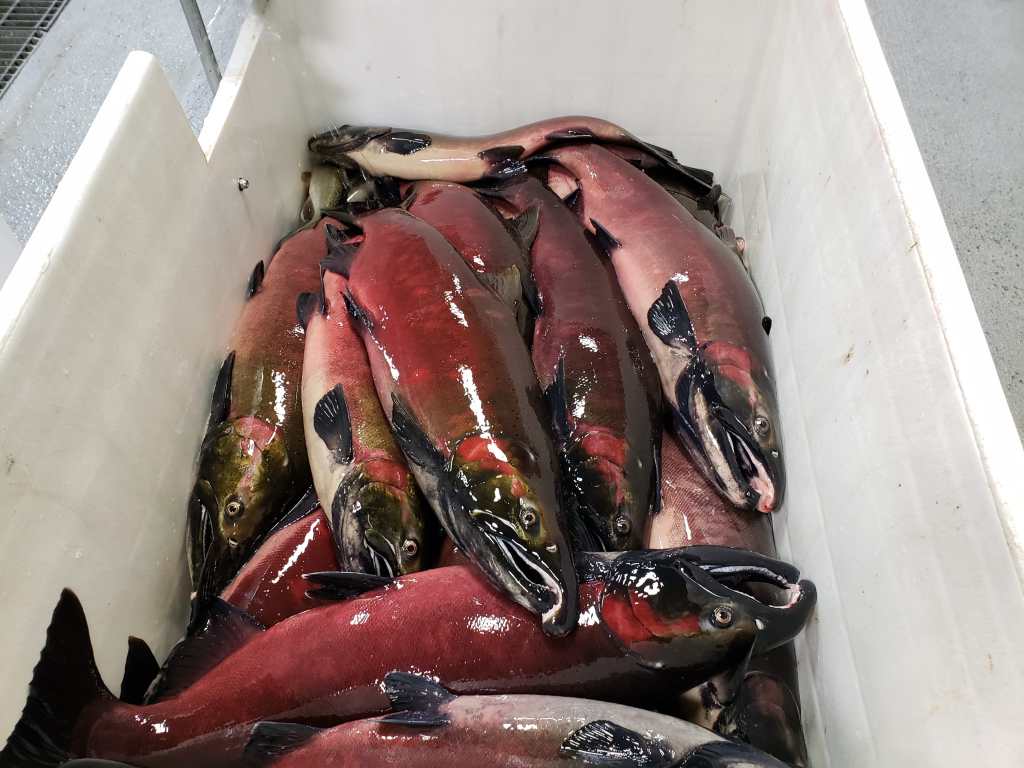
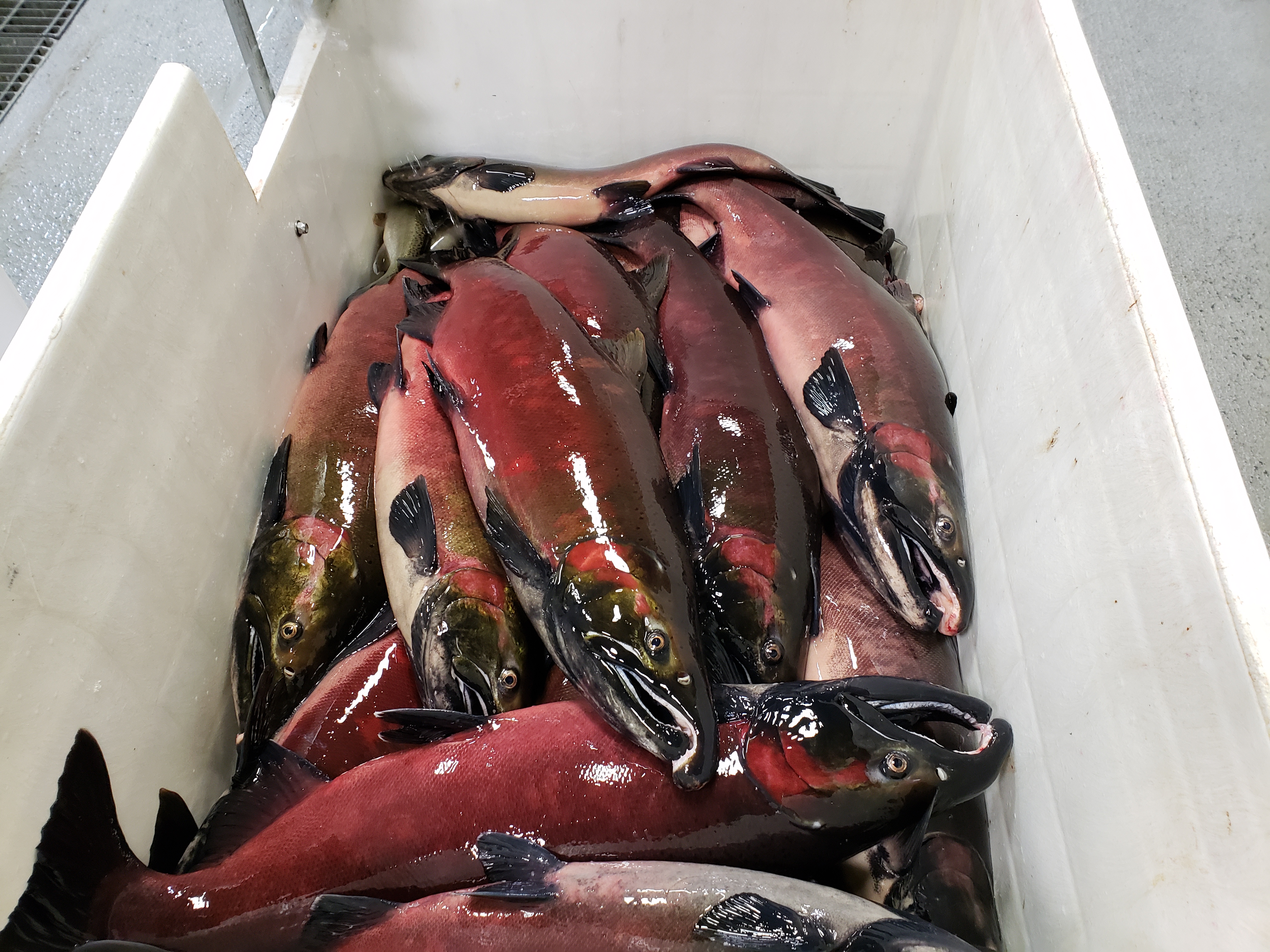
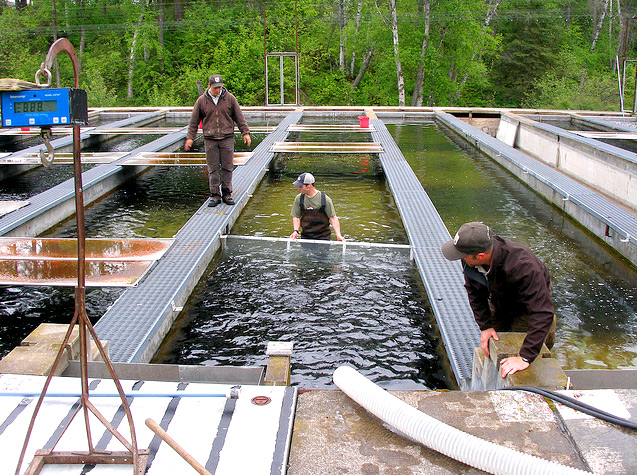
The Fall Chinook Salmon run begins in mid-August and continues until the end of September. The Fall Coho run occurs a little later. Our first observation regarding the salmon is that there are a lot of them, and they are stacked thick in the holding pond and channels leading to the “crowder” channel. They are backed up several hundred yards down Tanner Creek as far as the Columbia River. Question- Are the salmon not being worked?. The answer- “There is no contract.” Since then a contract with the buyer has been approved and the buyer’s truck and refrigerated trailer arrived this morning, Friday, a full week after our arrival. Fish are finally being processed, either saved as spawners or sent to the buyers processing plant.
A little history concerning the hatchery is in order: Bonneville Fish Hatchery dates back to 1909. In it’s first year the staff was able incubate and release an estimated 15.2 million fry into Tanner Creek or nearby points along the Columbia. In 1910 the hatchery began receiving new supplies of eggs mainly from locations in Oregon and Idaho with the U.S. Bureau of Fisheries contributing 3.4 million of the 10.7 million eggs. A hatchery in Alaska also contributed 1.5 million sockeye salmon eggs.
An American Dipper, a.k.a. Ouzle searching for food in Tanner Creek
“To cope with these rearing responsibilities, the staff worked hard to construct rearing ponds where they could feed the fry until their release into the Columbia. In 1910 Warden Clanton went to the cannerymen and packers along the Columbia to solicit their assistance and secured contributions of $1,500. Using these funds, Clanton had the crews at the Central (now Bonneville) Hatchery construct three ponds, each 100 feet by 20 feet and three feet deep.
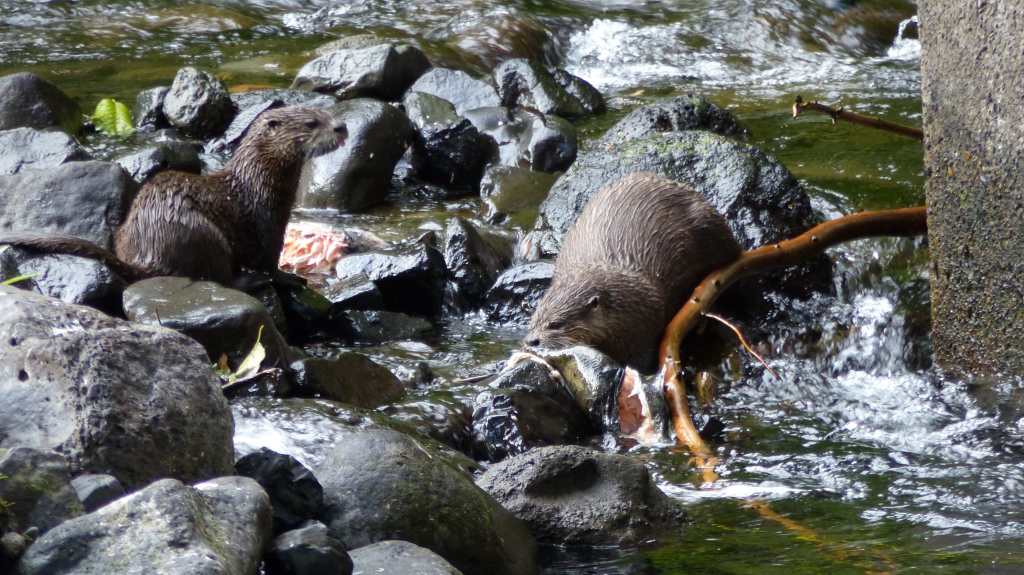
Otters Dining On Salmon In Tanner CreekRavens- Cleaning Up After The Otters
… The ponds at Bonneville functioned so successfully that the Fish Warden proposed in 1911 that all hatcheries in Oregon construct rearing ponds. The pond system at the Central Hatchery was expanded steadily so that by the end of the year fifteen large ponds held the fry. The crews constructed a new flume to carry water from Tanner Creek to flush these rearing facilities. …” [Bonneville Dam Historic District, National Historic Landmark 1986 Nomination Package]. And that’s how it all began 110 years ago.
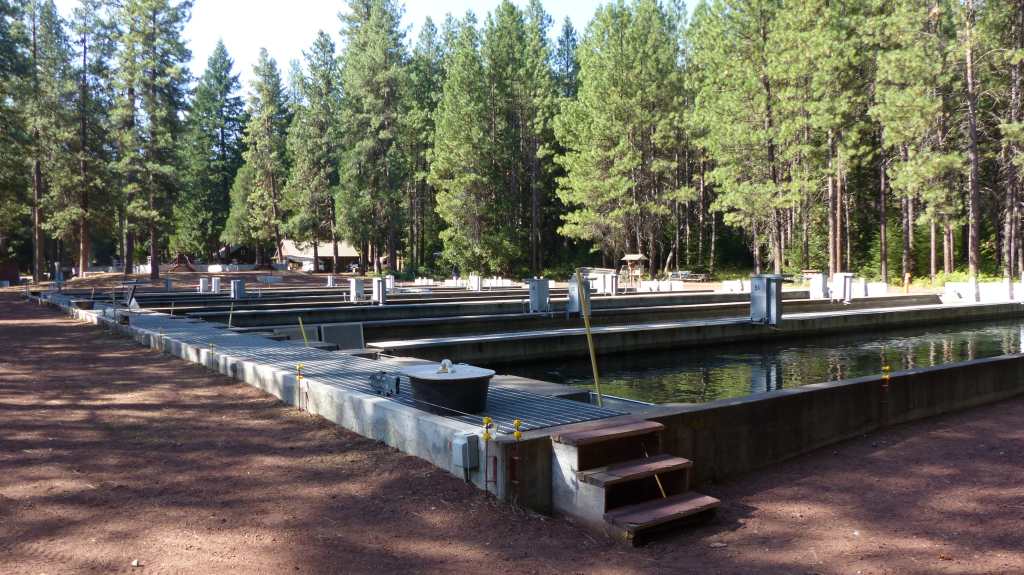
With construction of the Bonneville Dam in the 1930s the Fish Hatchery itself had major renovations, realignment, and construction. Of the original rearing ponds only the three farthest to the northeast were retained and were rebuilt as new display ponds. The Incubation Building was built in 1936. In front of the Incubation building are 22 concrete rearing ponds, constructed in the 1930’s. Each pond has a capacity of 300,000 fingerlings.
Egg Incubation Building built in the 1930’s
The facility was remodeled and expanded again in 1957 and again in 1974 the last as part of the U.S. Army Corps of Engineer’s mitigation of fish losses from the construction of the John Day Dam. In 1997 the Hatchery was added to the National Register of Historic Places as part of the Bonneville Historic District.
Host Site #2- Beautiful spot right next to Tanner Creek
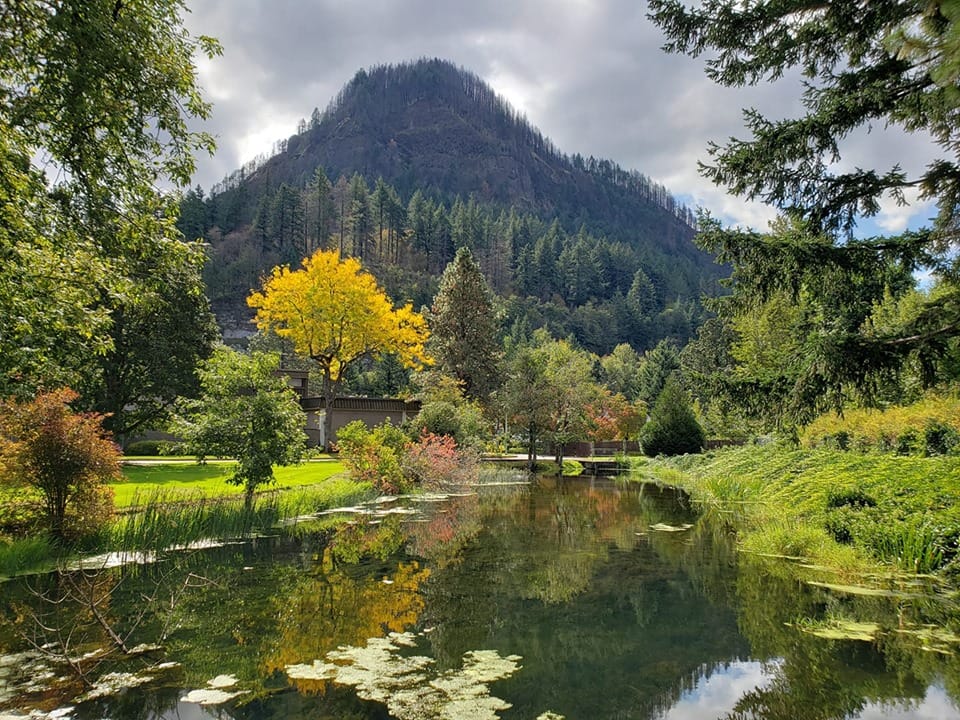
Host Site #2 is our home for two months. It’s located away from the public areas of the hatchery behind the fish ladder, holding pond and channels where the salmon enter the hatchery. Out our right side windows not 35′ away is Tanner Creek. The fish come in from the ocean via the Columbia River and turn right into the mouth of Tanner Creek. They are prevented from continuing up the creek as far as our location by an electrified “fence”. Their desire to continue to the spawning grounds is what brings them here.
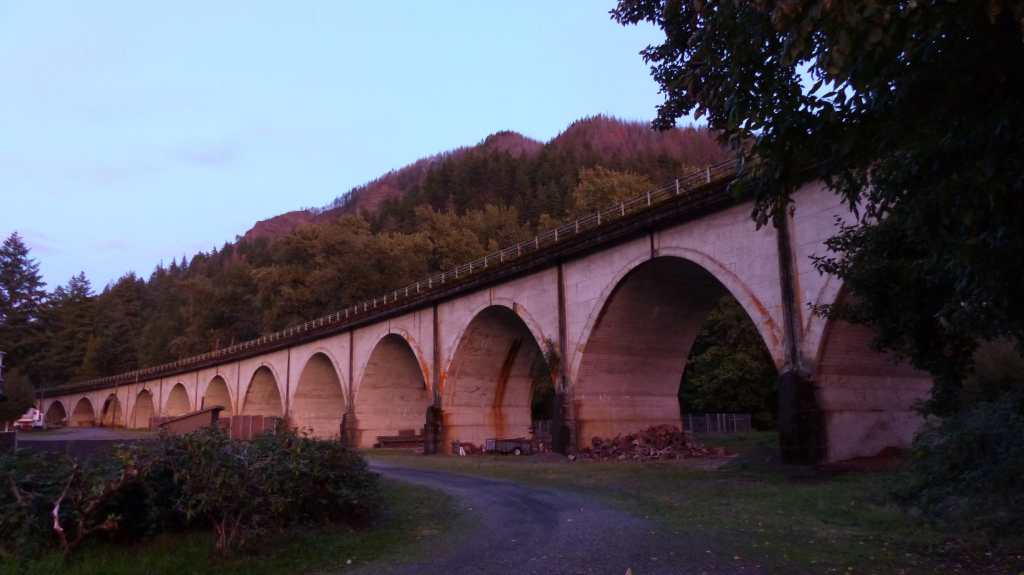
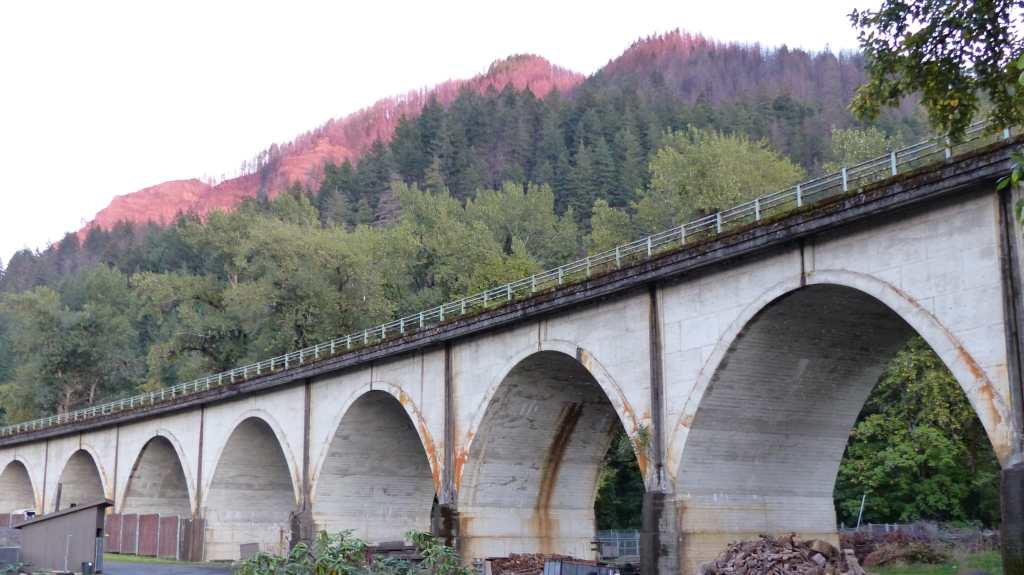
View of Railroad Trestle From Our Front Window
For those who aren’t savvy to the workings of a salmon hatchery I’ll do a little ‘splainin’, as Ricky Ricardo once said. The hatchery raises 10-15 million fish a year and may see a return of 1-2 million.
Hee, Hee- Salmon Dorsal Fins, NOT Shark Fins…….
Each female holds 3000-5000 eggs so the number of females required to fulfill the amount of eggs needed to perpetuate the species is small in comparison with the amount of salmon that return to the hatchery. Many less males than females are needed as their milt fertilizes the eggs of more than one female. The most desirable spawning candidates are separated from the crowd and placed in one of two spawning ponds, the rest are sold to a buyer.
The weather thus far has been on the warm side. A possibility of rain is in the forecast for early next week. More about the hatchery, Bonneville dam and surrounding area in future blogs. Until then, Adios!
We are heading north from Bend this morning, destination Bonneville Fish Hatchery, a distance of 160 miles. The hatchery will be our home for two months. We’ll take US 97 to Madras then US 26 to the outskirts of Government Camp and then OR 35 to Hood River. Once there we’ll head west on Interstate 84 four miles past Cascade Locks, OR to the Bonneville Dam and Fish Hatchery turnoff.
The first city north of Bend is Redmond (30,000 souls). As with her sister city Bend, Redmond has had rapid growth due mainly to the availability of jobs and less expensive housing. In fact, from the 2000 census to the 2010 census the city population doubled. Points of interest include Smith Rock State Park, a favorite of rock climbers, The Redmond Caves, and Eagle Crest Resort.
Madras (2600 souls) is another 26 miles up the road and it is Madras where we join US 26. Madras. The city is the seat of Jefferson County. It lies in rolling hill country dotted with farms and ranches. It’s believed that the name “madras” was inspired by the cloth fabric of the same name. Its is a tidy farm based community.
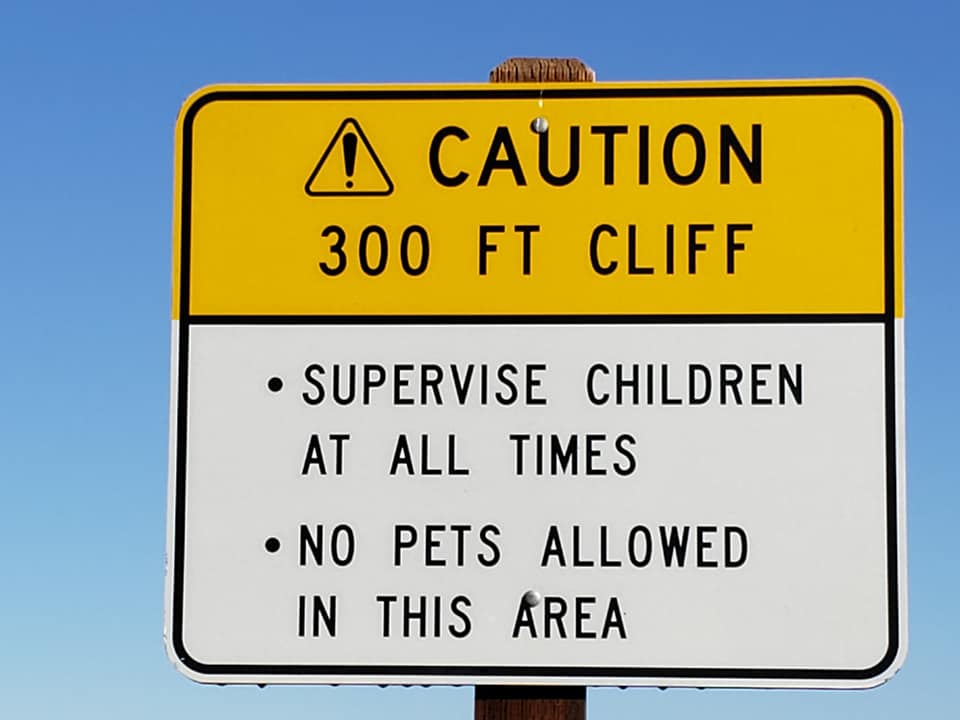
On the way to Madras Highway 97 crosses over a deep canyon carved by the Deschutes. Jil has never looked into that canyon so we stopped. The 300 foot drop is dizzying and dangerous. No dogs are allowed past the parking lot, thankfully, or there would be a lot more of man’s best friend in the bottom of that precipice.
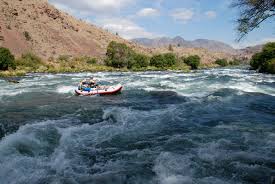
We dive down the steep sides of the lower Deschutes Canyon winding down, down until we reach the Deschutes River. In the narrow portion of the canyon is Whitehorse Rapids which continues on for a half a mile.
Fourteen miles north of Madras on US 26 is the community of Warm Springs (2900 souls). The community is located in the lower Deschutes River Canyon on the Warm Springs Indian Reservation. The Warm Springs Agency represents the Warm Springs, Wasco and Piute tribes.
The agency built a beautiful resort and casino naming it Kah-Nee-Ta for a woman who used to live near the springs. The resort was built 12 miles from town along the Warm Springs River adjacent to the hot springs. It included a small casino, convention center, golf course, olympic size pool, spa and RV park. The tribe council felt that the casino should be moved to the major highway to generate several times more revenue than the $2-4 million it was netting, so US 26 it was.
Lacking the draw of the casino, the resort slowly started to decline. For a reason only know to the tribe council outside influence was not an option for the tribal council. The decision to move the casino coupled with poor management caused the demise of resort 2018 putting 140 agency residents out of work. We passed the Indian Head Casino- it didn’t appear busy at all, maybe because the closest lodging is 14 miles away in Madras……..and Madras is not primarily a destination town. For that matter, neither is Warm Springs.
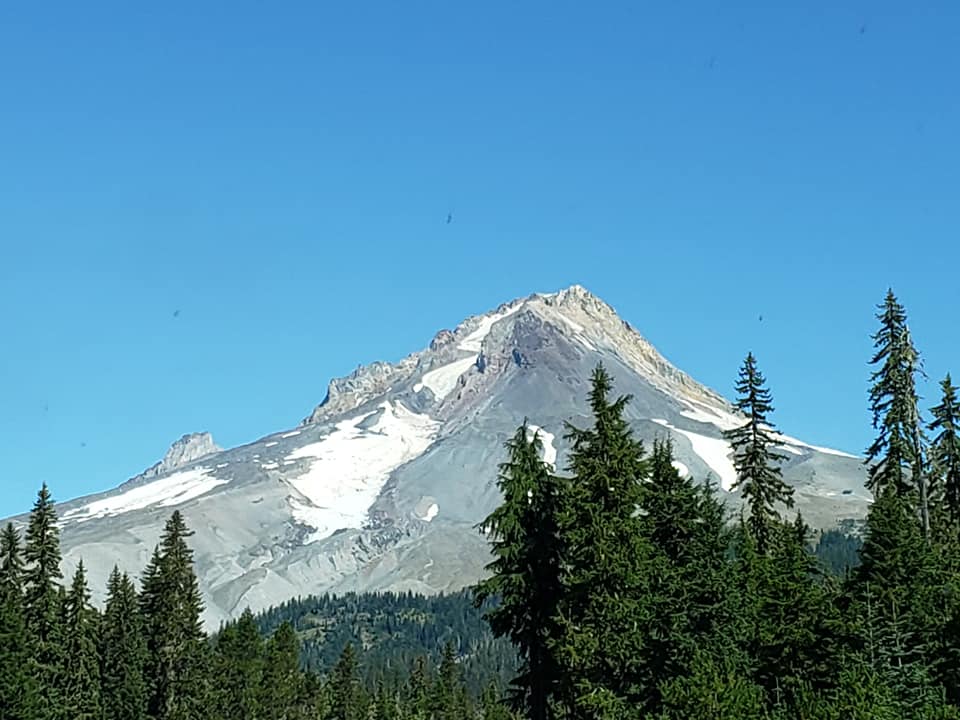
After leaving Warm Springs the road has us climb onto a plateau where we see Mt. Hood off in the distance. Sage gradually changes to juniper, juniper to pine as we gradually gain altitude. Then comes a thick conifer forest, it’s trees blocking most of the suns light. We summit at Barlow Pass (elevation 4155).
US 26 and Oregon 35 intersect just outside of Government Camp (193 souls). This place is the defecto “mountain town” or “ski town” of Mount Hood. It’s the gateway to several ski resorts. A sign in front of the town’s post office states, “Formerly a camp on the old Barlow Road, the village was named in 1849 when U.S Cavalry troops were forced to abandon wagons and supplies here.“
Heading down the southeast shoulder of Mt. Hood we come to a large barren rock and boulder strewn area reminiscent of glacial activity- and it is! The White River Glacier has left it’s mark on the mountain. This is also the headwaters of the White River.
The road takes us to lower elevations but not out of the conifer forest. It does begin to transition to a mixed forest as we drop down towards the Hood River Valley following the Hood River.
The valley is spectacular. Farms and vineyards have been carved out of the forest creating a patchwork of multi hued green. Pear, cherry and apple tree orchards as well as grape vineyards abound. In other areas not suitable for those crops alfalfa and hay are grown. Farm stands dot the road. As we look back we see Mt. Hood standing sentry over us. It doesn’t get any more beautiful than this!
We drop down into the community of Hood River (7100 souls) which is located at the confluence of the Hood River and the mighty Columbia River. The city does double duty as it is also the seat of Hood River County. The hilly downtown commercial district overlooks its harbor and the mighty Hood River/White Salmon Bridge.
We jump on Interstate 84 and head west, the highway paralleling the largest river in the Pacific Northwest. We drive past 3000 foot high basalt cliffs and greenest of green forest. We stop in Cascade Locks to refuel and fill our propane tank, continuing on the last four miles of our journey exiting on the Bonneville Dam/Bonneville Fish Hatchery offramp.
We are fortunate to find our “boss” Hugh on the grounds of the hatchery. He says he needs us to work Sunday/Monday. I said we could relieve the hosts that are leaving on Sunday and work their shift on Saturday so they can take their time packing. He said “that’s not necessary, Mike and Sue love it here”. So we ran into Mike and Sue, offered to work Saturday for them and they jumped at our offer. You see, they were planning to leave between 4 and 5 am Sunday morning and had a lot preparation to do. No problem Mike and Sue- Safe Travels!
These two are playing in our back yard at Bonneville Fish Hatchery
Monday morning we picked up, jacks up, hooked up the toad and headed south on Cascade Highway NE. At Sublimity (2600 souls) we turn east on OR 22. The 22 follows the Santiam River by Mehama (283 souls), through Mill City (1800 souls). Part way up a steep walled volcanic rock dominated canyon we come to two dams, the Cliff and the larger Detroit which holds back Detroit Lake.
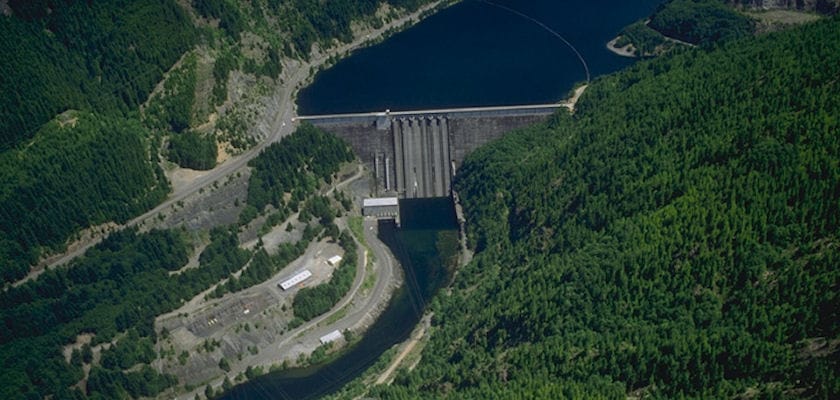
Detroit Lake and Detroit Dam
We pass Detroit Lake State Recreation Area and the town of Detroit (202 souls). It was named for Detroit Michigan in the 1890s because of the large number of people from Michigan in the community. From there OR 22 runs through deep forests mostly following the Santiam River.
Oregon Route 22 merges on to US Highway 20 and steadily climb until we reach Santiam Pass (elevaton 4817), then a long downhill grade until the road flattens out a few miles from the town of Sisters (2100 souls).
Mt. Washington as Seen from Highway 20
Sisters was named after the nearby Three Sisters mountain peaks. Navigating Sisters is a giant P.I.A. as US 20 runs right through the quaint, touristy commercial district. On any given day the narrow route is packed with jay walking people and bumper to bumper vehicles- including big rig trucks. Side traffic darts in and out. Stop and go, really slow traffic is a given. A downtown bypass route is needed.
Sisters- Traffic is Relatively Light Today!
Just east of town tall conifers give way to open sage, ranch and farm country. We get a great view of the local volcanic peaks, seven are within sight. US 20 takes us into the north side of Bend where we pick up US 97, traveling to the south side of town. Crown Villa RV Resort is where we will stay for four nights.
Bend is the seat of Deschutes County and the principal city of the Bend-Redmond metropolitan statistical area. It is located on the eastern edge of the Cascades Range along the Deschutes River. Ponderosa Pine forest transitions into the high desert, characterized by junipers, sagebrush, and bitterbrush. Bend is also Central Oregon’s largest city. The 2000 census recorded 52,000 souls living here. The current estimate is 100,000, nearly double from that of 20 years ago. This place is growing like gang busters! The Bend-Redmond metro population is estimated at over 197,000 making it the fifth largest metro area in Oregon.
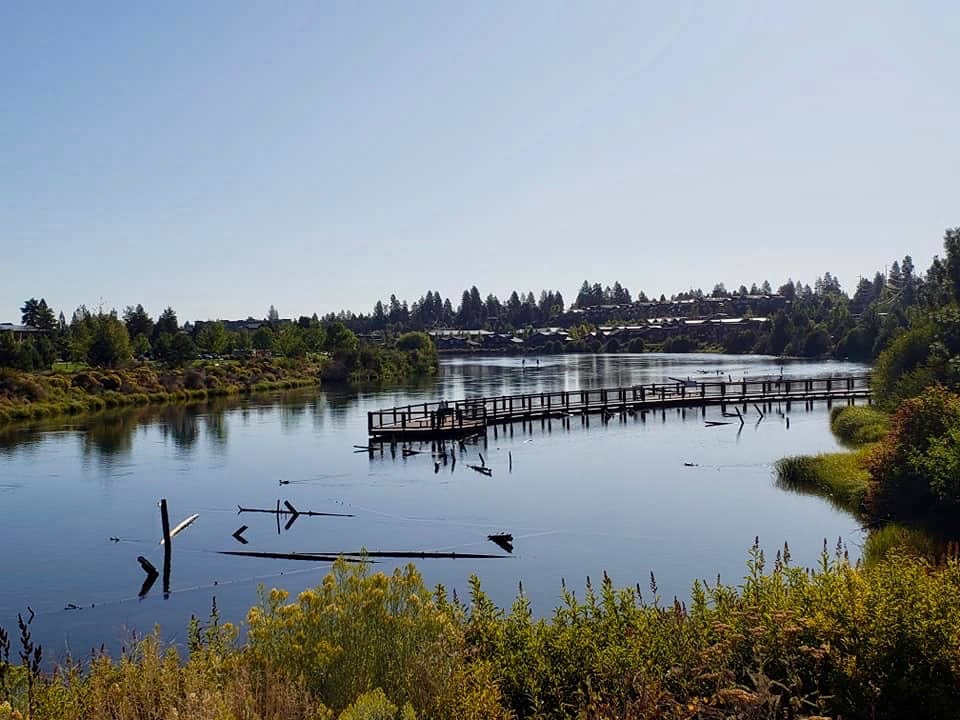
Deschutes River at Farewell Bend Park
Bend was named after one of the few fordable locations on the Deschutes River, Farewell Bend. The area was first visited by a fur trapping party in 1824 followed by John C. Fremont and other U.S. Army survey parties. Next came pioneers who forded the Deschutes at Farewell Bend.
The first sawmill was operational in 1901, the next, a water driven sawmill, became operational in 1903. A dam built in 1910 provided the city with its initial source of electricity. It is still produces electricity today supplying nearly 200 households.
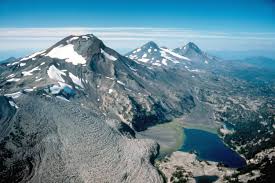
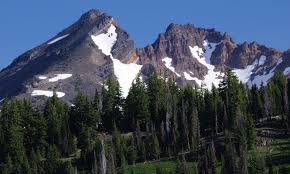
The Cascade Range has a string of volcanic peaks that line up like soldiers from south to north beginning in California and ending in British Columbia. Several of those peaks can be seen from Bend.
Mt. Bachelor
Three Sisters
Broken Top
The best viewing from town is from 500 foot Pilot Butte, itself an extinct volcano. Three Sisters, Broken Top and Mount Bachelor are easily seen from the butte. Three Fingered Jack, Mt. Jefferson and Mt. Washington are also close by.
We usually stay at the Crown Villa RV Resort. It is one of the few self proclaimed resort parks that we consider an actual resort. It was originally advertised as purchase your own lot. However sales were slow so that idea was nixed. Amenities include an fitness center, a gathering room, a lounge, a patio with fire pits and a BBQ, tennis/pickleball court, horseshoe court, pool table, hot tub, steam rooms and a very nice laundry facility. Whew! As a plus the staff is incredibly courteous, helpful and friendly.
Old Mill District- Smoke Stacked Building Was A Lumber Mill, Now A Mall
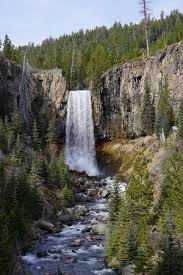
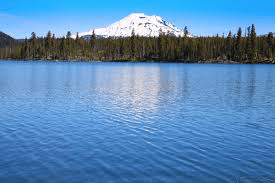
One place we always go while in Bend is the shopping mall at the Old Mill District. One of us likes to shop at JJill! Sometimes we take the Cascades Lakes Scenic Byway and loop through a portion that beautiful country. Little Lava Lake is one of our favorites. Picture a small alpine lake surrounded by fresh smelling pines with Mt. Bachelor looming large in the background. Sometimes we take a drive up to 97 foot Tumalo Falls.
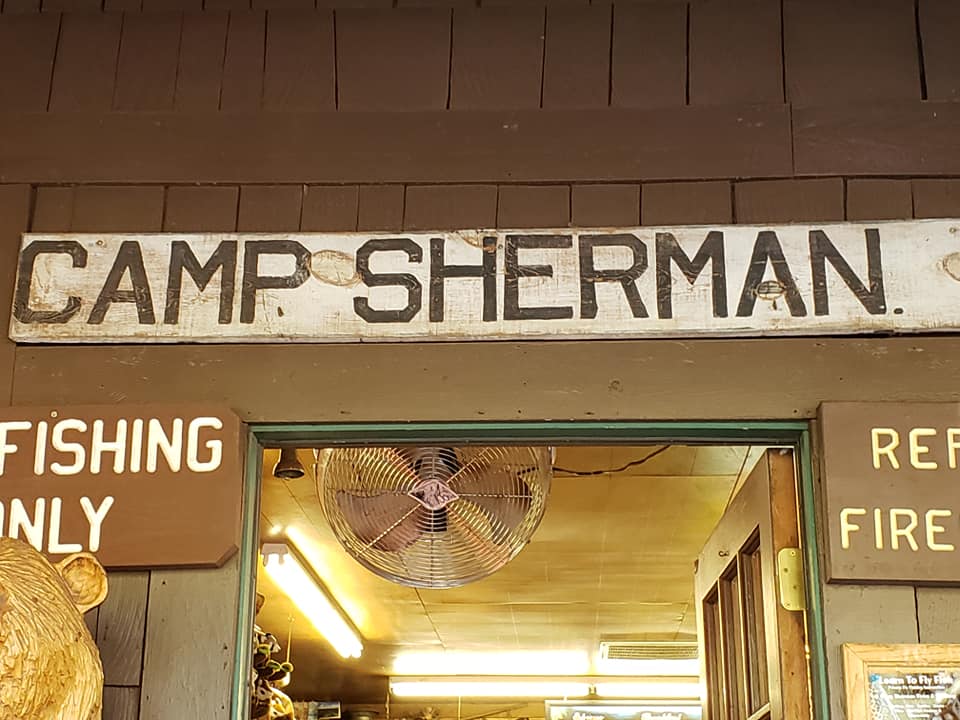
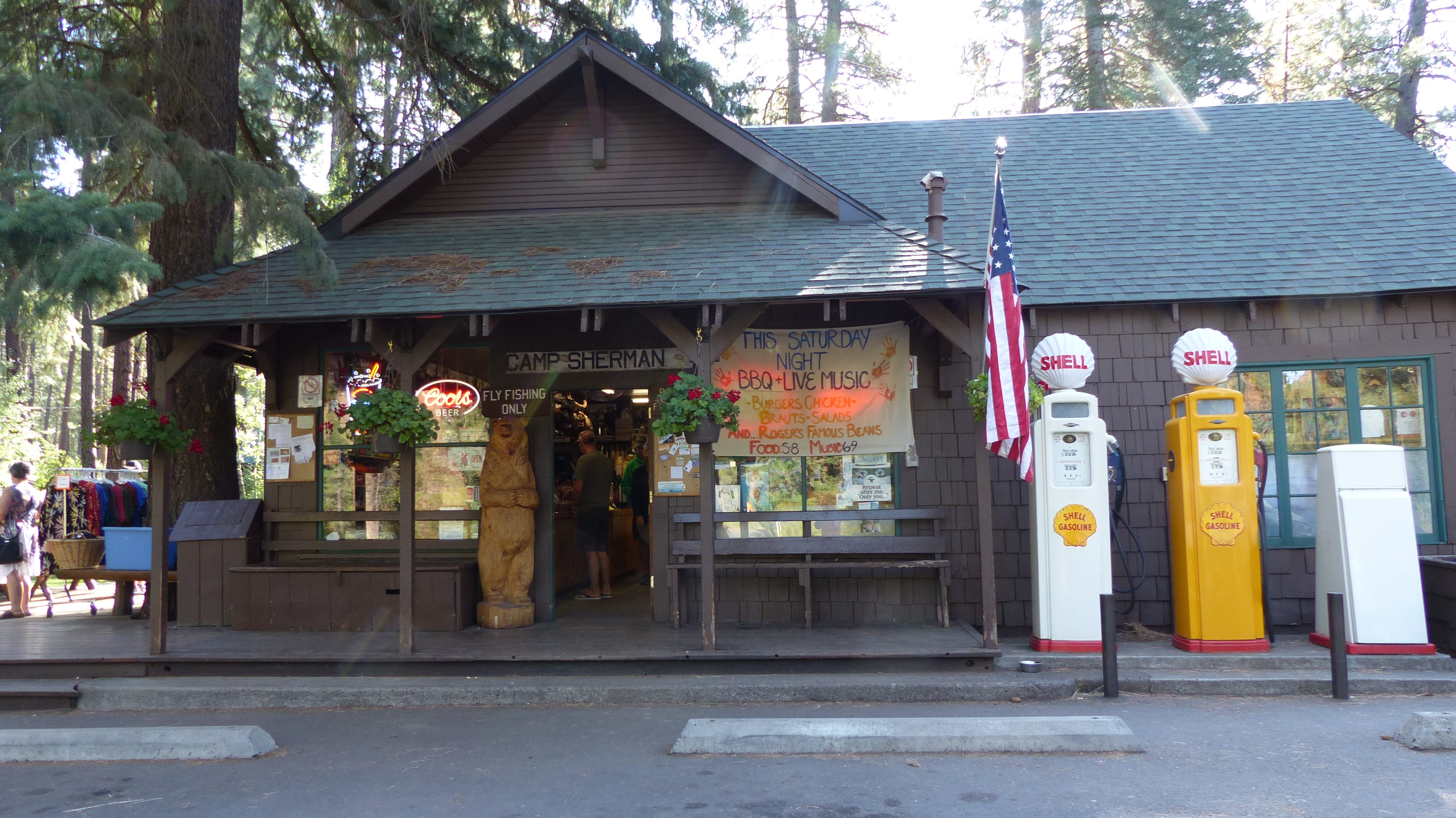
On this visit we decide to go to another one of our haunts, Camp Sherman even though that requires driving through Sisters- ugh! Camp Sherman is a tiny community of 230 souls located very near the headwaters of the Metolius River. That population swells to three or four times that during high season.
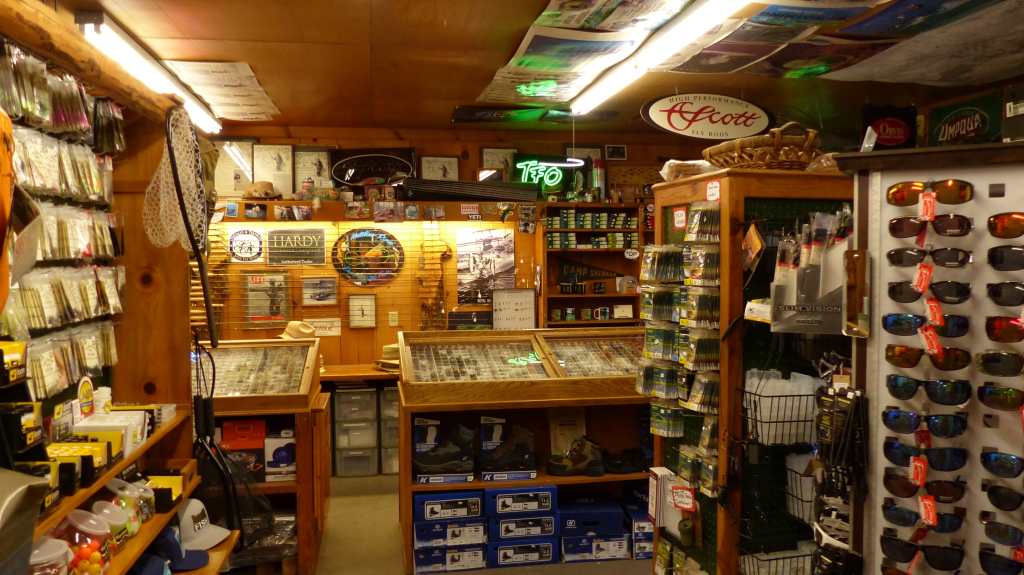
It’s a fisherman’s haven, however only fly fishing is allowed and much of the river is catch and release. The folks of the little Camp Sherman Store realize the importance of fishermen to the Camp as they devoted one entire section to fly fishing supplies. Coincidently, the tiny Post Office is attached to the tiny but well stocked store.
Five Miles downstream is the delightful Wizard Falls Fish Hatchery. The water supplying the hatchery does not come from the nearby Metolius but from the spring that fed Wizard Falls.
The water is just the right temperature and is pure- perfect for raising fish. Since our last visit several new ponds have been added indicating that they plan on raising more trout and salmon.
The Beautiful Metolius River Runs By Wizard Falls Hatchery
A large settling pond contains the largest fish. I understand that these fish were “escapees” from the rearing ponds at one time. The hatchery employees leave them be, but have added a few fish food machines for those who wish to feed them.
We visit the headwaters of the Metolius on our way back to camp. It’s almost unbelievable that this river originates from springs that magically appear at the edge of a hill. It’s not possible to get a good photo of the springs as lush growth obscures the view, but I gave it a whirl just to contrast the size of the river not 100 feet downstream.
Top Photo: Headwater Spring; 100 Feet From Spring- The Metolius River
That concludes our visit to Bend. We enjoy this diverse area so I suspect we will visit again and again. We’ll be pushing on to the Bonneville Fish Hatchery tomorrow. See you there!
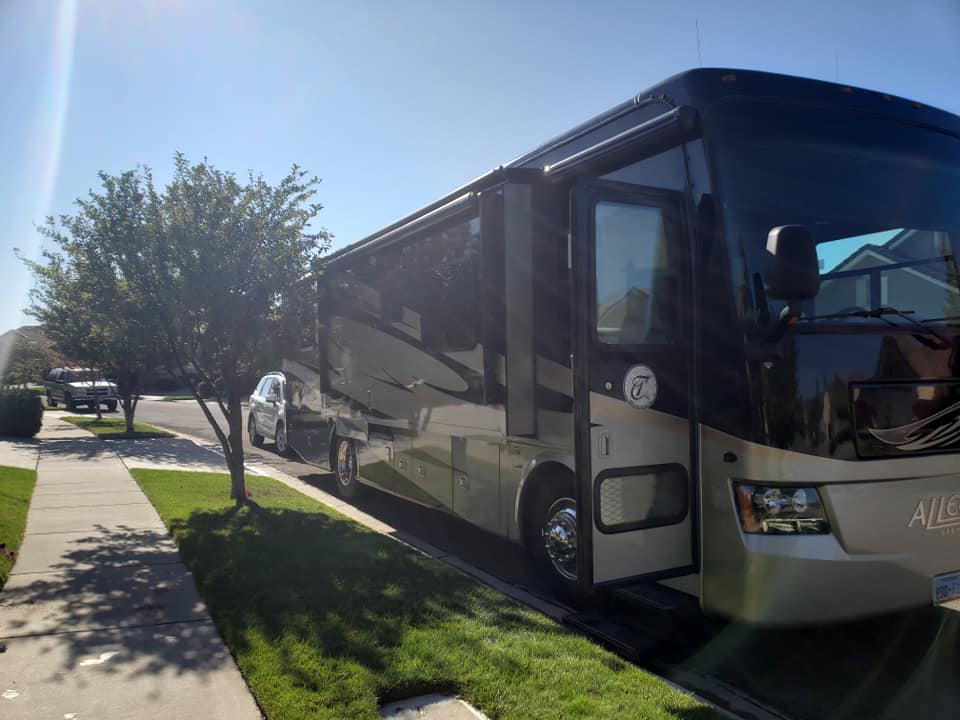
Just When You Think You’ve Seen It All-Your Neighbor Shows Up In His 2.3 Million Dollar Coach!
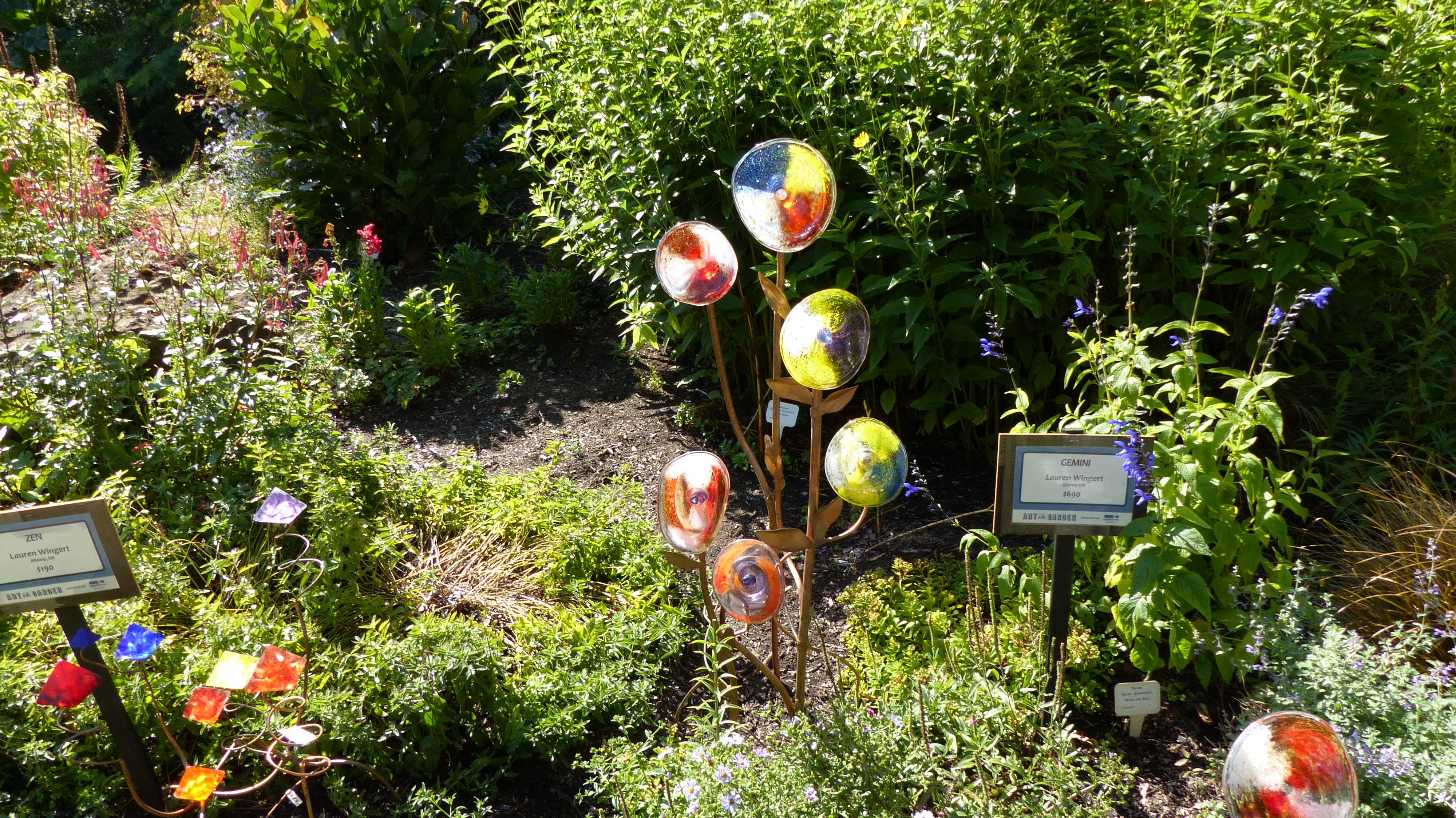
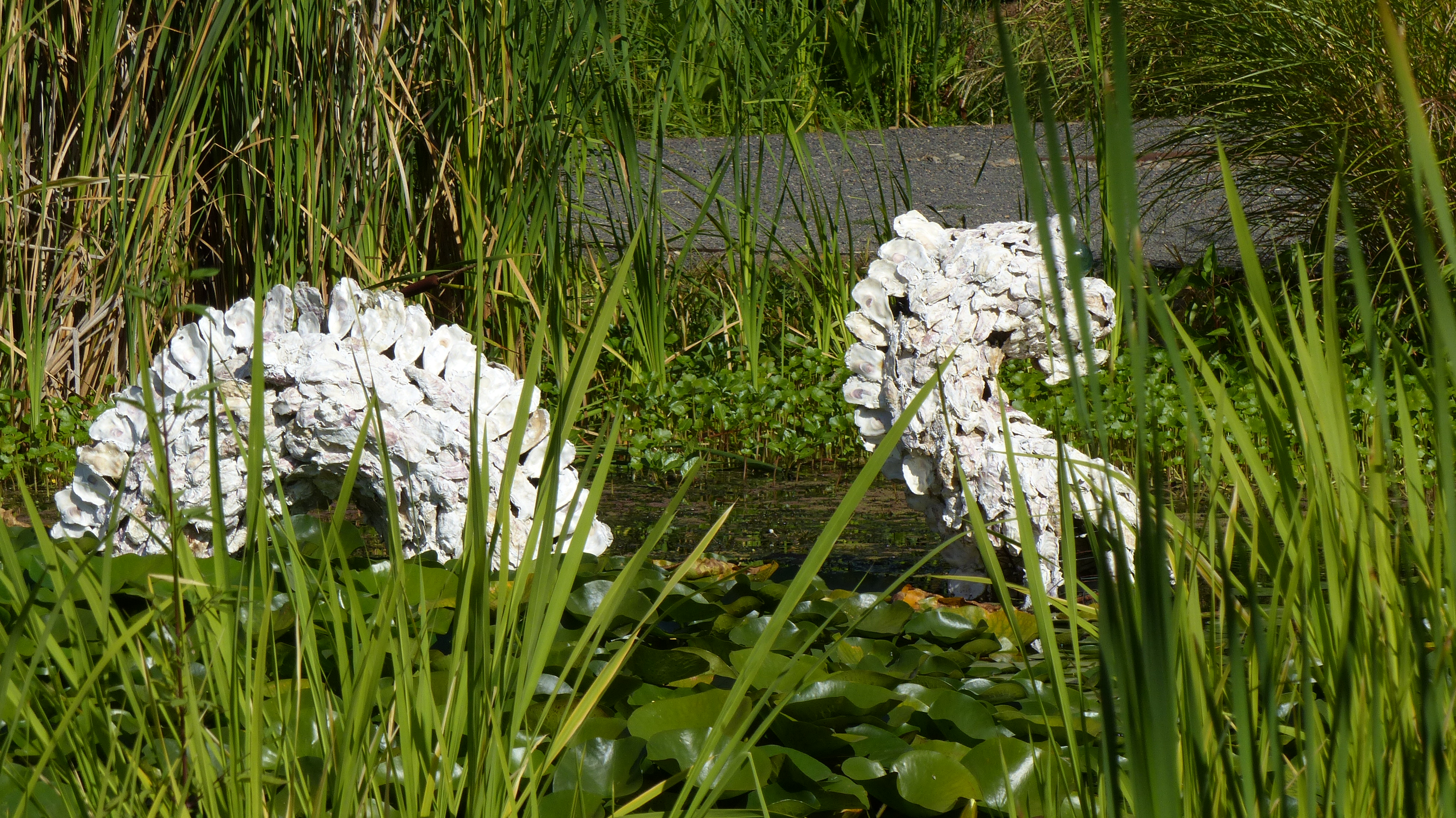
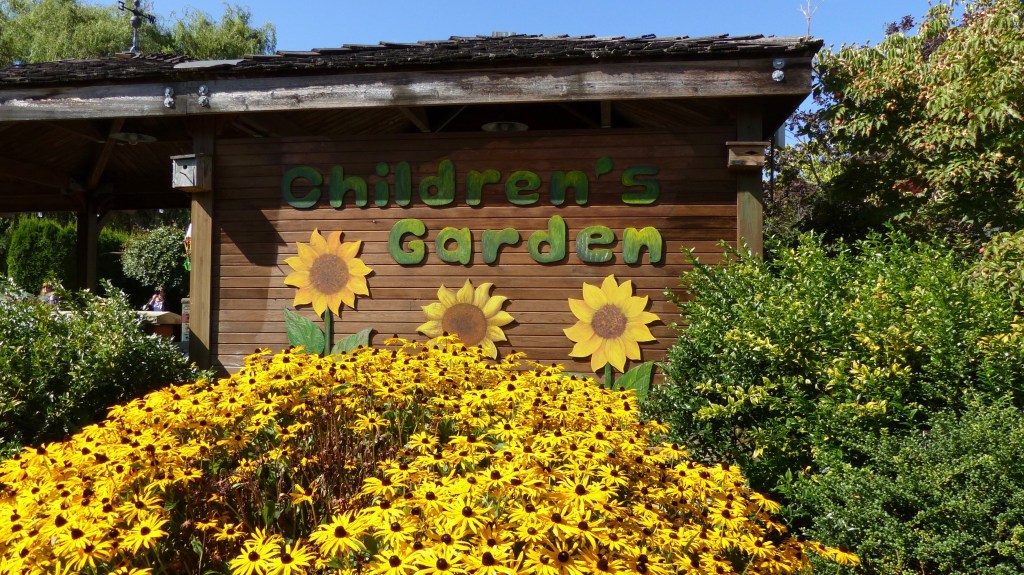
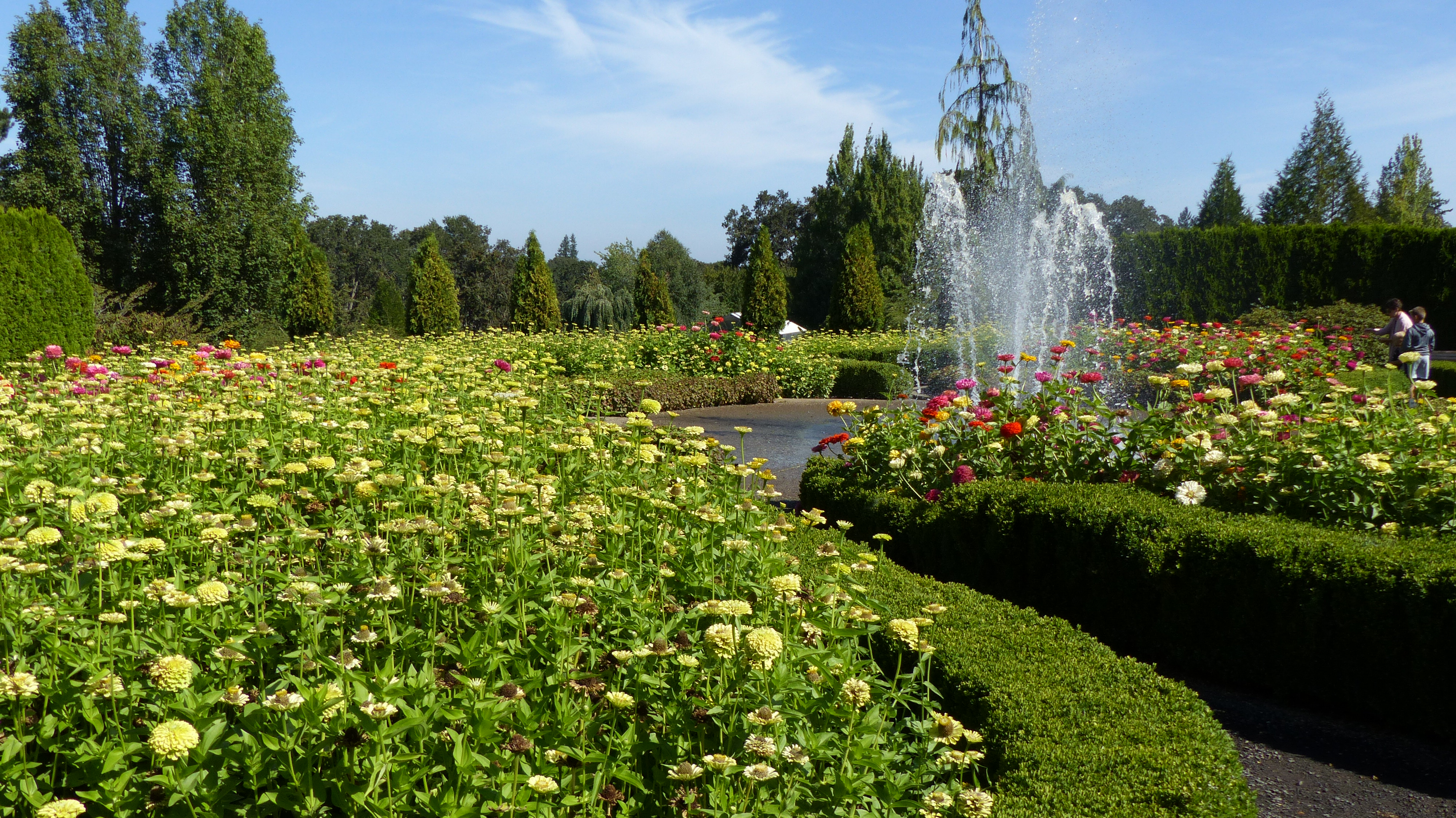
The Oregon Garden is an 80-acre botanical and tourist attraction in Silverton. Opened in 1999, it is home to over 20 gardens including the Rose Garden, Children’s Garden and Silverton Market Garden.
It is open 365 days a year and hosts both public and private events. The Garden is also home to the Gordon House, Oregon’s only Frank Lloyd Wright home, and The Oregon Garden Resort.
The Children’s Garden
It’s dog friendly so all four of us take a walking tour. It’s a must see place if one appreciates a diverse garden as we do.
Silver Falls State Park has quite a history. In 1888 the lumber community of Silver Falls City sat near South Falls. As the land was cleared admission was sold to view the falls. That included attractions such as pushing a car over the falls and even a daredevil riding over it in a canoe. June D. Drake was local photographer who began campaigning for park status, using his photos to gain support.
The National Park Service rejected the area because of the proliferation of unattractive stumps after years of logging. Drake was successful in that Silver Falls became an Oregon State Park in 1933. In 1935 F.D.R. announced that it would become a Recreational Demonstration Area, and sent in the C.C.C. to develop the park’s facilities.
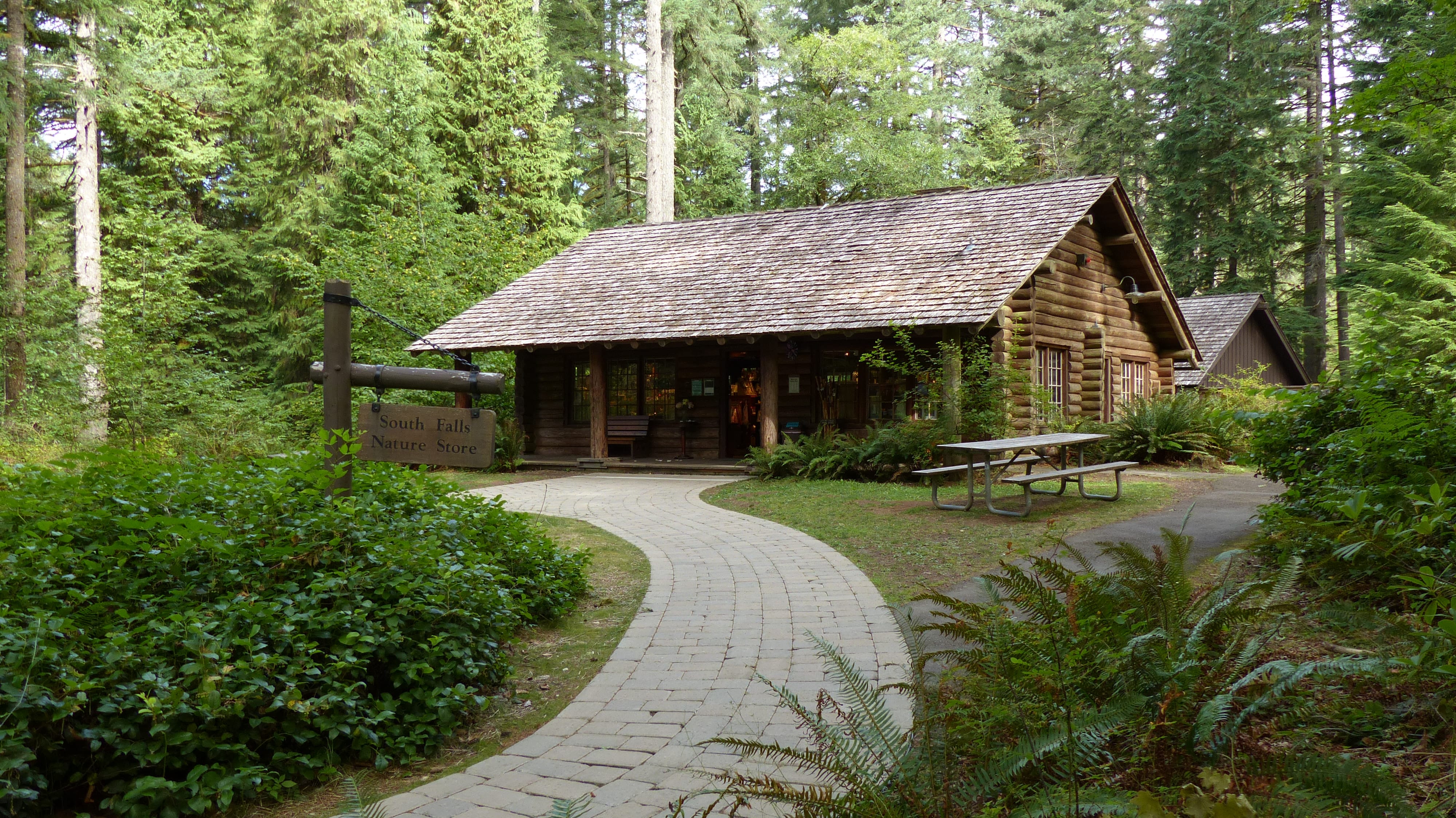
Thanks to the efforts Mr Drake and of the Civilian Conservation Corps the park has a beautiful campground, rustic lodge and assorted out buildings. Silver Creek is dammed above South Falls to form a swimming pond. A convention center is on premises. Evidence of bygone logging has disappeared. Ten beautiful water falls are accessed by trail- some of which can be viewed from the canyon rim. This area is just drop dead gorgeous!
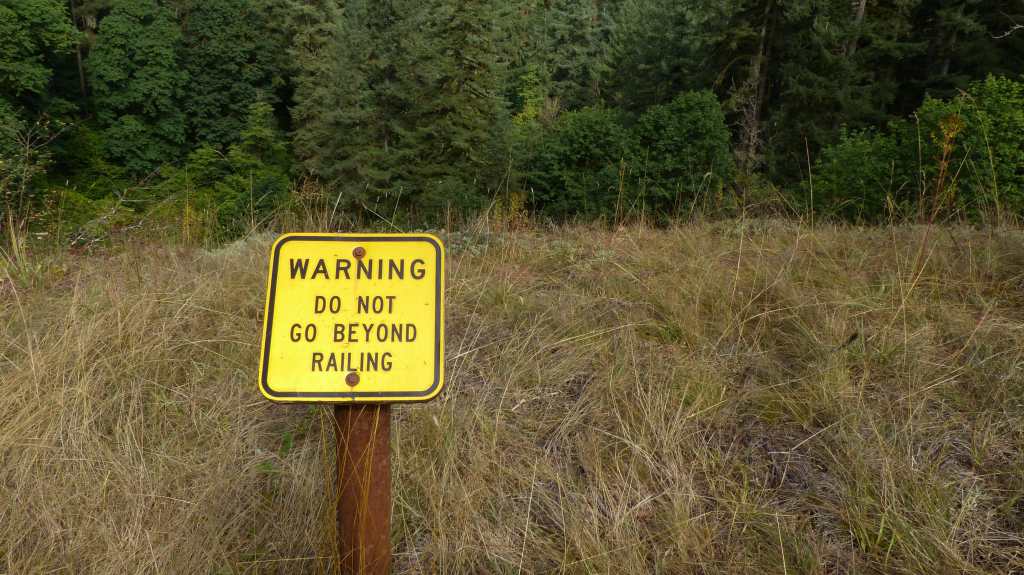
Warning Sign at South Falls (duh)- Precipice of 170 Foot Drop on Right
Like many small towns major roadways converge in the downtown business district and Silverton is no exception. Two major country roads from the north, one country road leading from Salem to the west and the road to Stayton to the south. Boy, traffic can really get heavy!
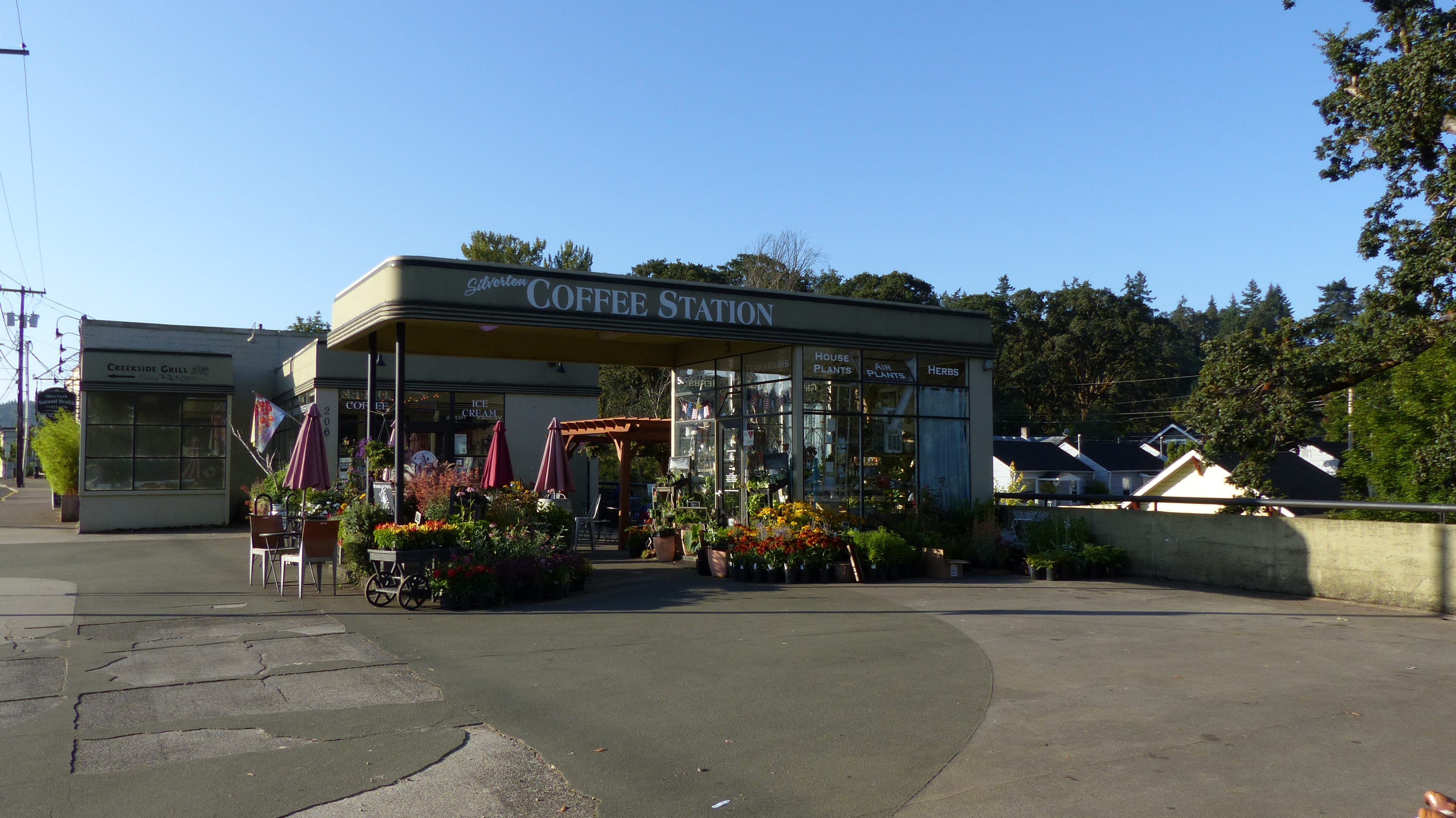
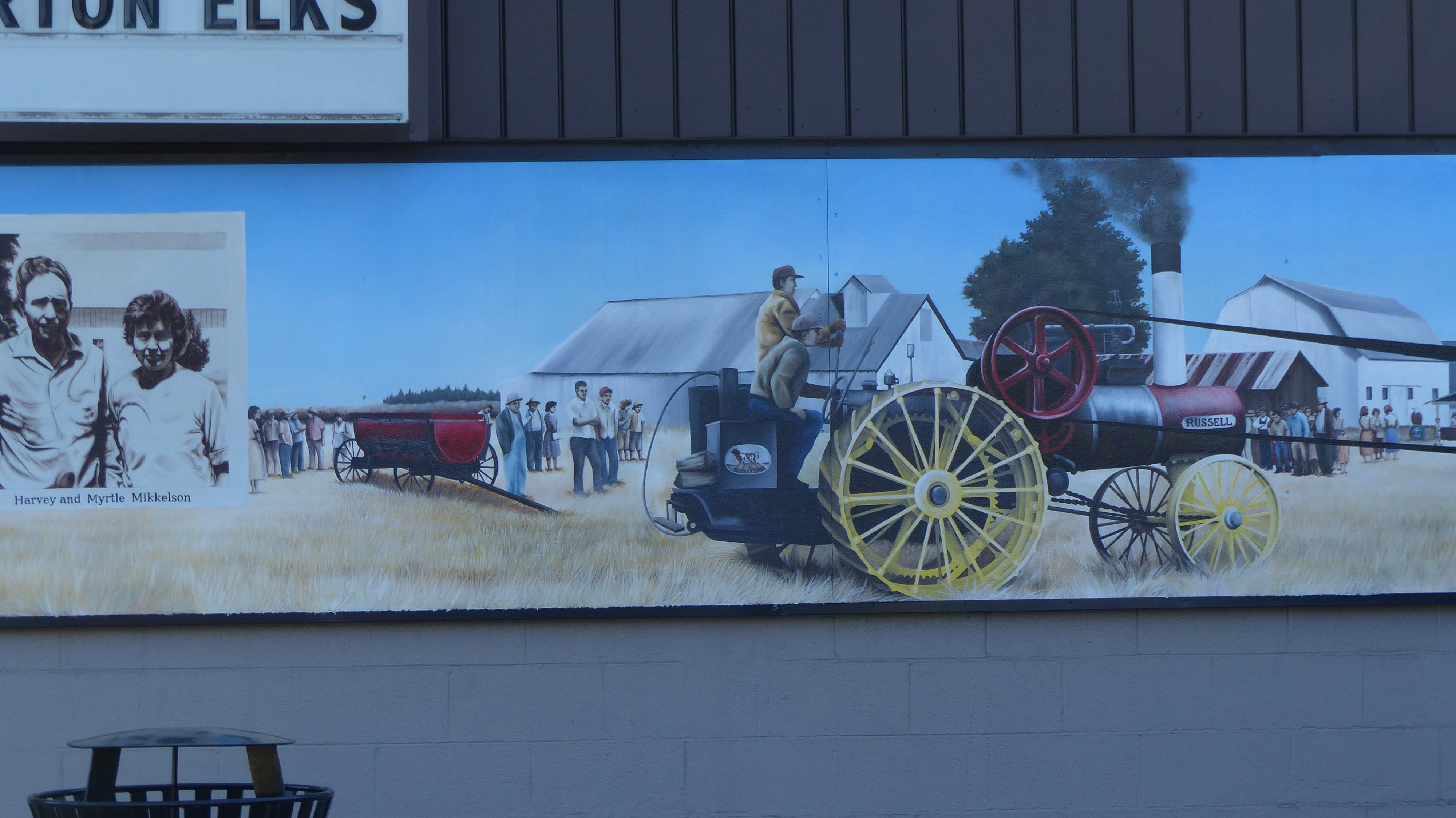
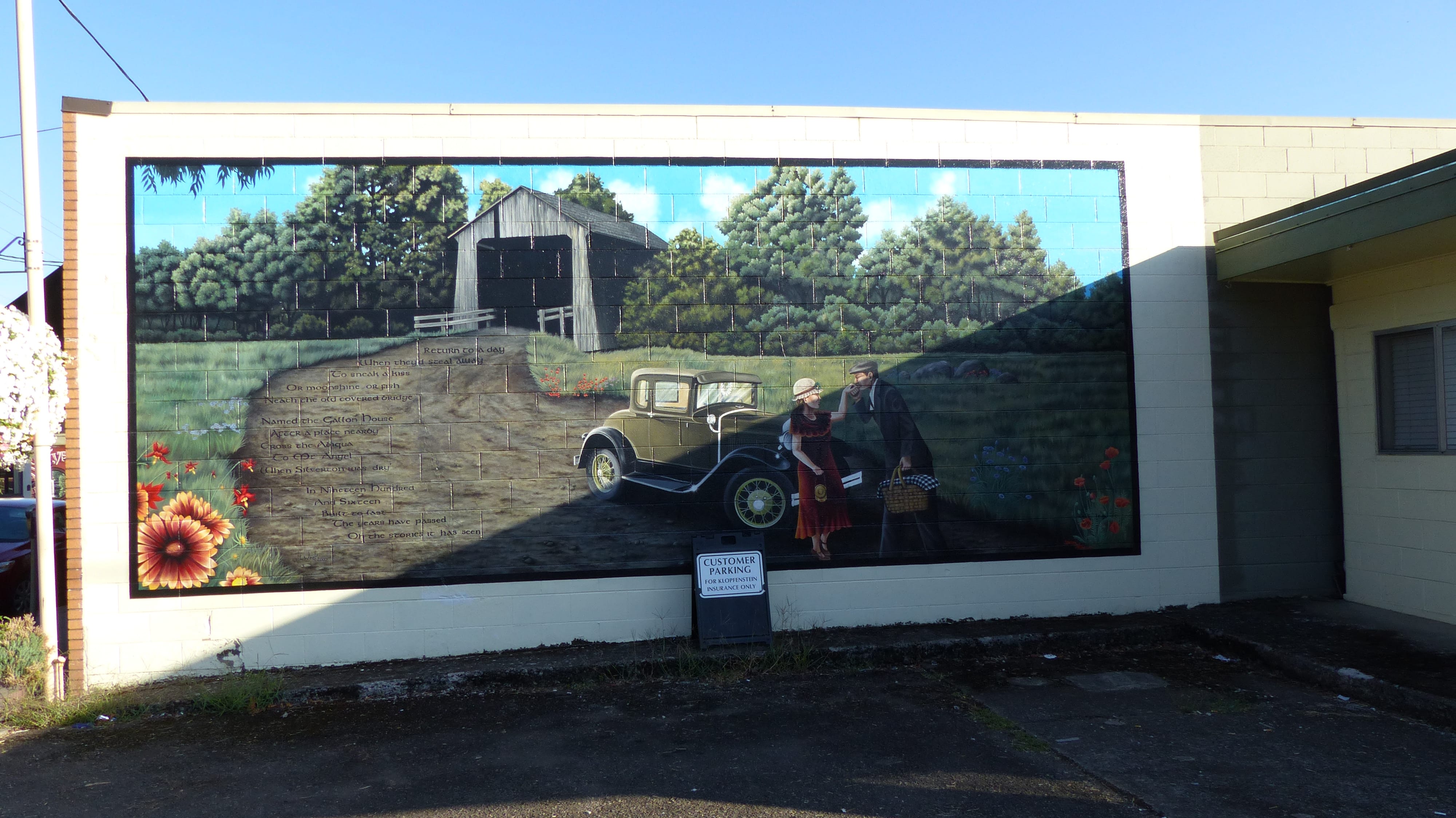
We chose to walk around the handsome downtown of Silverton one morning before the crowds arrived and before all stores except the restaurants opened. We found quite a few murals painted on the side of its buildings. Murals are thing here in Silverton.
New Sign in Progress
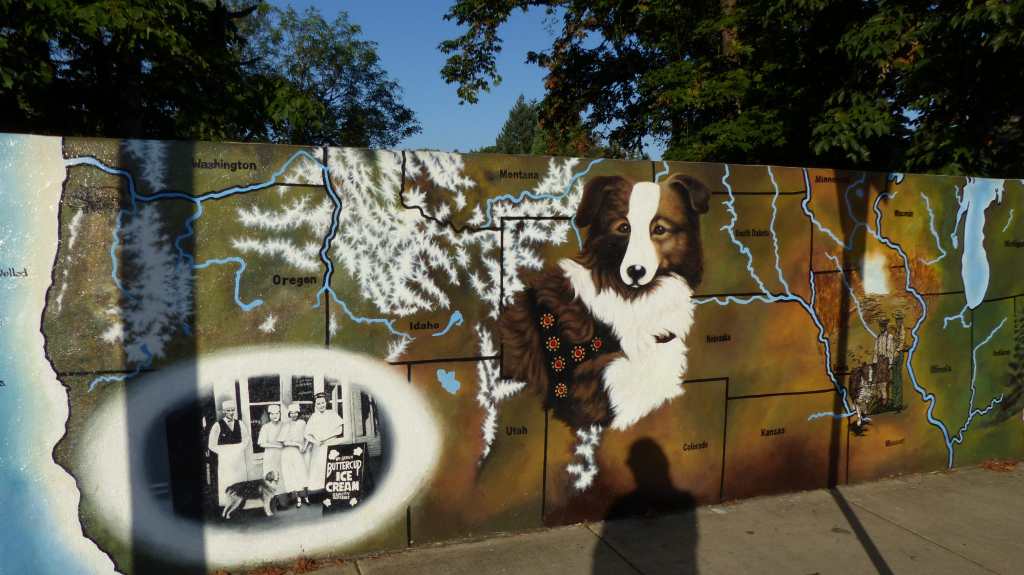
One multi part mural told the story of Bobbie the Wonderdog. He became lost (attacked by 3 dogs and fled) while his owners, the Braziers visited family in Indiana. The family could not find him so it returned to Silverton. Six months later Bobbie returned to Silverton mangy, dirty, scrawny, with evidence he walked all the way home, a distance of over 2500 miles in the dead of winter. After his story was published folks who had fed and sheltered Bobbie wrote to the family about their time with him. The Humane Society of Portland was able use the stories to assemble a fairly precise route that Bobbie traveled.
Bobbie the Wonder Dog
Jil and I have made a command decision. Originally we were going to head into southern Washington and visit Mt. St. Helens. We would have to travel through Portland to do that. We’ve already had a good snootful of heavy traffic. If we don’t go north through Portland, where shall we go? Let’s go to Bend!
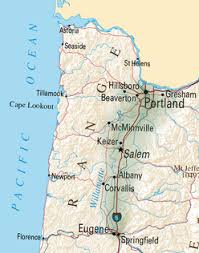
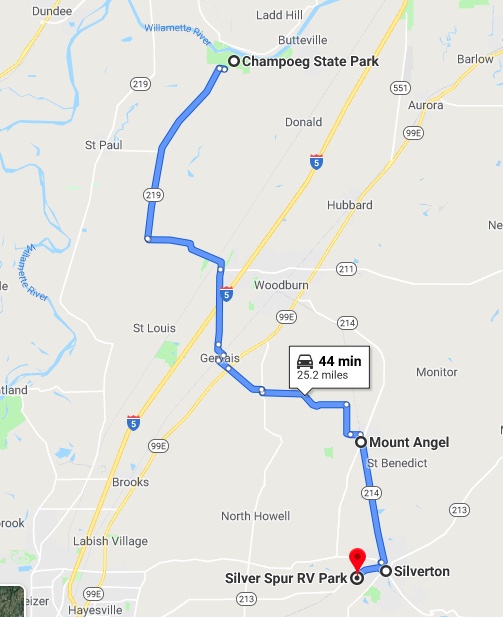
As you can see on the map above our travel day is really short. A lot of RV park management don’t appreciate early arrivers so we did our best to not come into Silver Spur RV Park in Silverton too early. We took the dogs over to the big field which is designated as a dog exercise area and let them run and sniff, cleaned up the inside of the RV twice, rotated the air in all ten tires, and waxed the armadillo before we left and still arrived an hour and a half early. Yep, we were chastised for coming in early. We took our punishment and settled in to site B6.
Our route Thursday morning was all country roads- just the way we like it. Interesting to me is the fact that we came in from the south on I-5, exited at the Gervais offramp and took country roads to Champoeg. On the way to Silverton we backtracked to Gervais but on a completely different set of roads. From Gervais we were on virgin roads to us as we had never traveled on them until we got to familiar territory in Mt. Angel.
There are many reasons to visit the Silverton (9200+ souls) area. The Oregon Garden is in town and Silver Falls State Park with its spectacular display of 10 waterfalls is a half hour up the hill. We like to visit Mt. Angel Abbey, a Catholic Benedictine monastery and seminary. Downtown Silverton is straight out of the early 20th century and might take up a couple of square blocks of real estate. The farmland nearby is beautiful.
Mt. Angel Abbey:” The monks of Mount Angel Abbey in Oregon form a Benedictine community founded in 1882 from the Abbey of Engelberg in Switzerland. We maintain a monastic tradition that has been a vital part of the Roman Catholic Church for more than 1,500 years.”
Honest Folks, Our Selfies Are Getting Better……..
The Abbey includes a seminary, a guest and retreat house, a library, its own post office. Mass is celebrated once a day and the Liturgy of the Hours 5 times. The church has the largest bells in the west.
New since 2018 is the Benedictine Brewery. Hey, Trappists brew beer, why not Benedictines? This complex sits on top of Mt. Angel, a 450 foot hill, encompasses 340 acres and lies next to the town of Mt. Angel. The grounds are beautiful and so are the services.
Mt. Angel (3200 souls) was founded the same year as the monastery in 1882 by German settlers. The townsfolk built a church which was outgrown after three years. The parish moved into the church built by the monastery but it burned down. A third church was built and outgrown within 17 years.
St. Mary’s Catholic Church, Mt. Angel OR
The fourth church and current church was completed in 1912. Its soaring 200′ bell tower can be seen for miles. Everything in this town oozes German- the architecture of its buildings, the glockenspiel, the food- everything. During Oktoberfest the population swells to over 350,000!
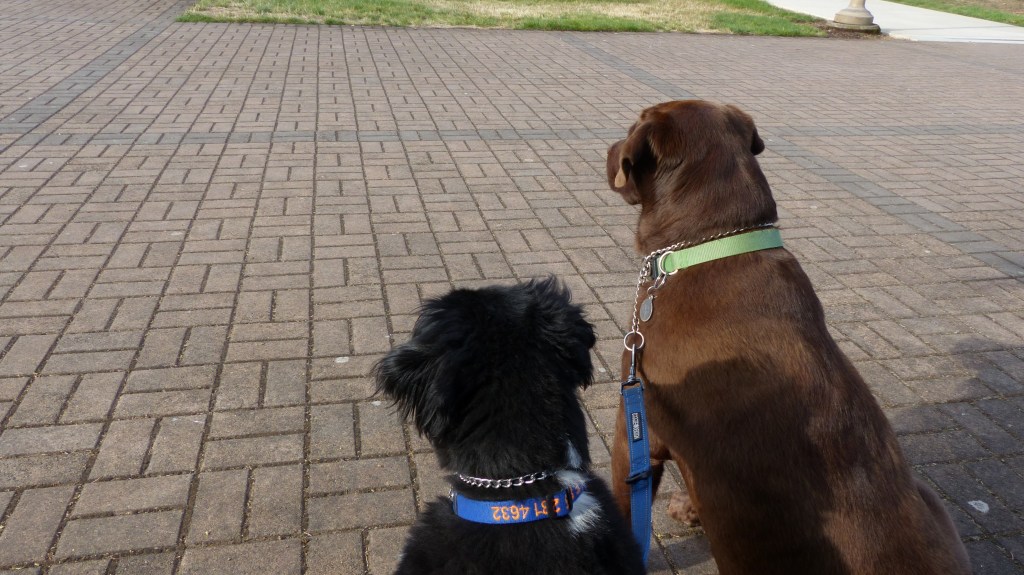
Nope, the mutzos are not admiring the view of the Willamette Valley from Mt. Angel, they are waiting for their Mom to come out of the retreat office.
Our next blog will focus on downtown Silverton and the Oregon Garden. Until then, Safe Travels!
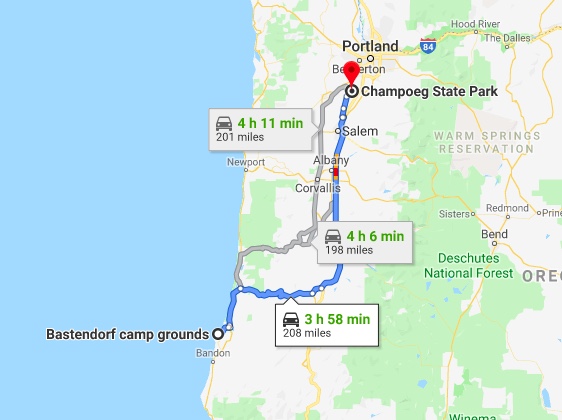
Planning our route from Bastendorff Camp Ground in Coos Bay to Champoeg State Park located a few miles off of I-5 and halfway between Salem and Portland appeared to be easy. We could go up the coast and go inland from Newport or Florence- or could we? I stumbled on to some information that indicated that the Suislaw Bridge in Florence and the Yaquina Bay Bridge in Newport have had 20,000 pound vehicle limits for several years now. To cross them with our motorhome we’d have to enlist flaggers to block traffic at each end of the bridge and drive slowly down the center. That was not going to happen. I read that Oregon 38 was a good route to take inland so that’s the way we went.
On our way out we bypass the chaotic downtown Coos Bay traffic in favor of taking a more direct route to US 101 through North Bend. We cross the Coos Bay Bridge and continue on to Reedsport (4100 souls) bypassing the Umpqua Light (been there, done that), and Winchester Bay.. Reedsport was developed when the railroad (circa 1912) was extended south to Coos Bay. The flood of 1964 caused the small mouth bass fish hatchery to lose hundreds of thousands of fish to the river. Bass are now the most common fish in the Umpqua. We turn east on Oregon 38. The 38 follows the Umpqua River for many miles so the road is pretty flat. It’s a nice relaxing and scenic drive.
Cruising Along Oregon 38 on the Bank of the Umpqua River
Scottsburg’s (327 souls) importance came and went in the mid-1800’s. It was the location where stage coach travelers coming from Drain transitioned onto riverboats to continue their journey to the coast. It was a seaport located 20 miles from the ocean that serviced the interior of Southern Oregon. The town declined after the 1861 flood.
Downtown Elkton (pop. 195) looks like a good place to stretch our legs. The town was founded in 1850 by the Klamath Exploring Expedition near Fort Umpqua. The purpose of the Expedition was centered around discovering gold in Oregon Territory along the Klamath River as well as possible areas favorable for agriculture and commercial enterprises and the site of a harbor on the coast. After all, California was going through a gold driven boom so why not Oregon? Maps in those days were not always accurate. They sailed by schooner from Sausalito CA overshooting the Klamath, stopping at the Rogue River instead. The Rogue was unsuitable so they headed north, wound up in the more inviting Winchester Bay where they explored many miles along the Umpqua River. What they probably didn’t know was land suitable for a townsite in Winchester Bay was already owned by two fellas, so the Klamath Exploration Expedition bought those fellas out. And the area now known as Elkton was established by the Hudson Bay Company (Fort Umpqua) as well as other emigrants. They did establish the townsite of Elkton, however.
Downtown Elkton Oregon
Elkton’s
The city park is right on the bank of the Umpqua and it includes a really nice RV park. It’s nickname is “Bass Capitol of Oregon”. I wonder if that flood in 1964 had anything to do with that motto………
The Umpqua River at Elkton Oregon
One can tell when folks take pride in their community and the folks of Elkton show a lot of it. Downtown is small, inviting and neatly kept. The homes are well maintained with beautiful gardens. Wow!
The last town we come to on Oregon 38 is Drain (1151 souls), named for Charles Drain who donated 60 acres of land to the Oregon and California Railroad in 1871. Drain was the starting point for the Drain-Coos Bay stage line, established in 1876 which ran by road to Scottsburg then by river steamer to Gardiner. We turn onto northbound Oregon 99, then northbound I-5.
North of Salem we turn off onto country roads that take us through beautiful Willamette Valley farmland. Some farmers grow hops, others row crops, some alfalfa some nursery plants.
Ten miles more and we pull into Champoeg State Heritage Area. The heritage area has several historic buildings, the Historic Butteville Store (1863) that is still open for business, wide open fields, forests and wetlands- all on the bank of the mighty Willamette River. Interdispersed with all of that is a huge picnic area, frisbee golf course and a nice campground.
Although the park is a must see we were a little dismayed as to the condition of the campgrounds. The grass at each site was browned out. It didn’t appear that it was irrigated relying on rainfall alone. Obviously no rain has fallen for a while. Nice green grass is a plus in our book. The dump stations were out of order and it didn’t look like the park ranger was in any hurry to have it repaired. Maybe it’s not his call…… We survived.
The most disturbing thing to us was the two unsupervised 2 and maybe four year old children play dangerously close to and sometimes in the roadway. Those kids were all over the campground and mom was no where to be seen 99% of the time. Many of the neighbors did what the mom should have been doing- watching out for the kids safety………
Rows of These Steel Rings Embedded in the Concrete Curb- Horse Tie Outs?
While at the state park we had an opportunity to do some cruising. We shopped in nearby Newburg. (23,000 souls). We also visited St. Paul (431 souls). St. Paul is a farming community established in 1836. A church was built the same year out of logs. On January 6, 1839 Father Blanchet celebrated the first Catholic Mass in Oregon at St. Paul. St. Paul Roman Catholic Church was built in 1846 and is the oldest brick building in the Pacific Northwest. In St. Paul Cemetery lies William Cannon, the only authenticated Revolutionary War veteran buried in Oregon. Two members of the Lewis and Clark Expedition are purportedly buried there. Also of note is the St. Paul Rodeo, one of the 20 largest rodeos in the U.S. and voted by the Professional Rodeo Cowboys Association as the finest rodeo in the Pacific Northwest in 1991.
OK, back to Champoeg. The town was built on the bank of the Willamette River. It grew to be a sizable town. In the 1840’s the question of the disputed possession of Oregon Country between the U.S. and the U.K. began to loom large. A meeting was held at the town to determine if a provisional government should be established. The vote was 52 to 50 in favor. This is the site where Oregon’s first provisional government was formed by a historical vote in 1843. The town continued to grow after Oregon became a state in 1859. But in 1861 disaster struck when the Willamette River rose 55 feet flooding the town with seven feet of water, destroying most of the structures in town. The town was never rebuilt.
OK, ok, back to the title of this post. How do you pronounce Champoeg? Champoeg is not pronounced Sham-poge, nor Cham-pog. The correct pronunciation is Shampooie, like shampoo with a “y” or “ie” on the end.
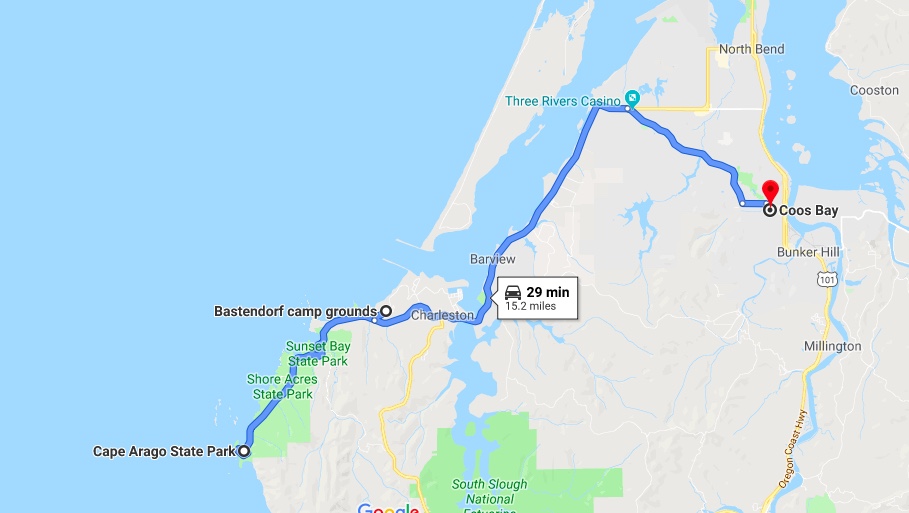
Our stay at Bastendorff Campground is fabulous. We are far enough away from the bustling city of Coos Bay-North Bend metropolis and just a few miles from the sites we want to see. Coos Bay, along with nearby Charleston and North Bend at 34,000 souls is the most populous area on the Oregon coast.
There’s not a lot of traffic in the downtown Coos Bay commercial district. An exception is the main thoroughfares leading to the crazy busy US 101. US 101 is the main coast road that extends from the US/Mexico border all the way around the Olympic Peninsula terminating in Olympia, Washington, a distance of nearly 1550 miles.
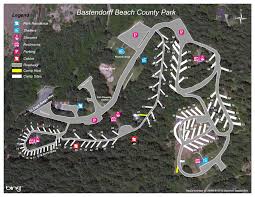
Bastendorff Beach and Campground- Coos County Parks and Recreation
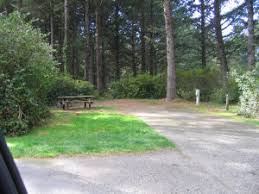
The campground at Bastendorff, a Coos County Park, is really a nice place to stay. There are lots of trees, RV friendly nicely sized sites, clean and has a beach down the hill from the campground. It’s dog friendly. It has nice views of the ocean. It’s $120 a night cheaper than staying in the RV park next door. What more can I say?
Nearby are three Oregon State Parks, the South Slough National Estuarine Research Reserve and the Cape Arago Light which are really the draw to the area. Shore Acres, Sunset Bay and Cape Arago State Parks adjoin one another.
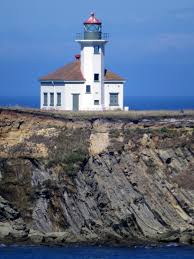
The Cape Arago Light stands on an island just off shore between Cape Arago and Coos Bay. The current light is Number 3. The light was moved twice due to erosion of the bluff caused by the sea. This light is no longer active.
Sunset Bay is a beautiful little bay that offers beach access, a day use area and a nice campground. I first tent camped here when I was eight years old. The most obvious change since then is the campground has been improved to include nice RV sites.
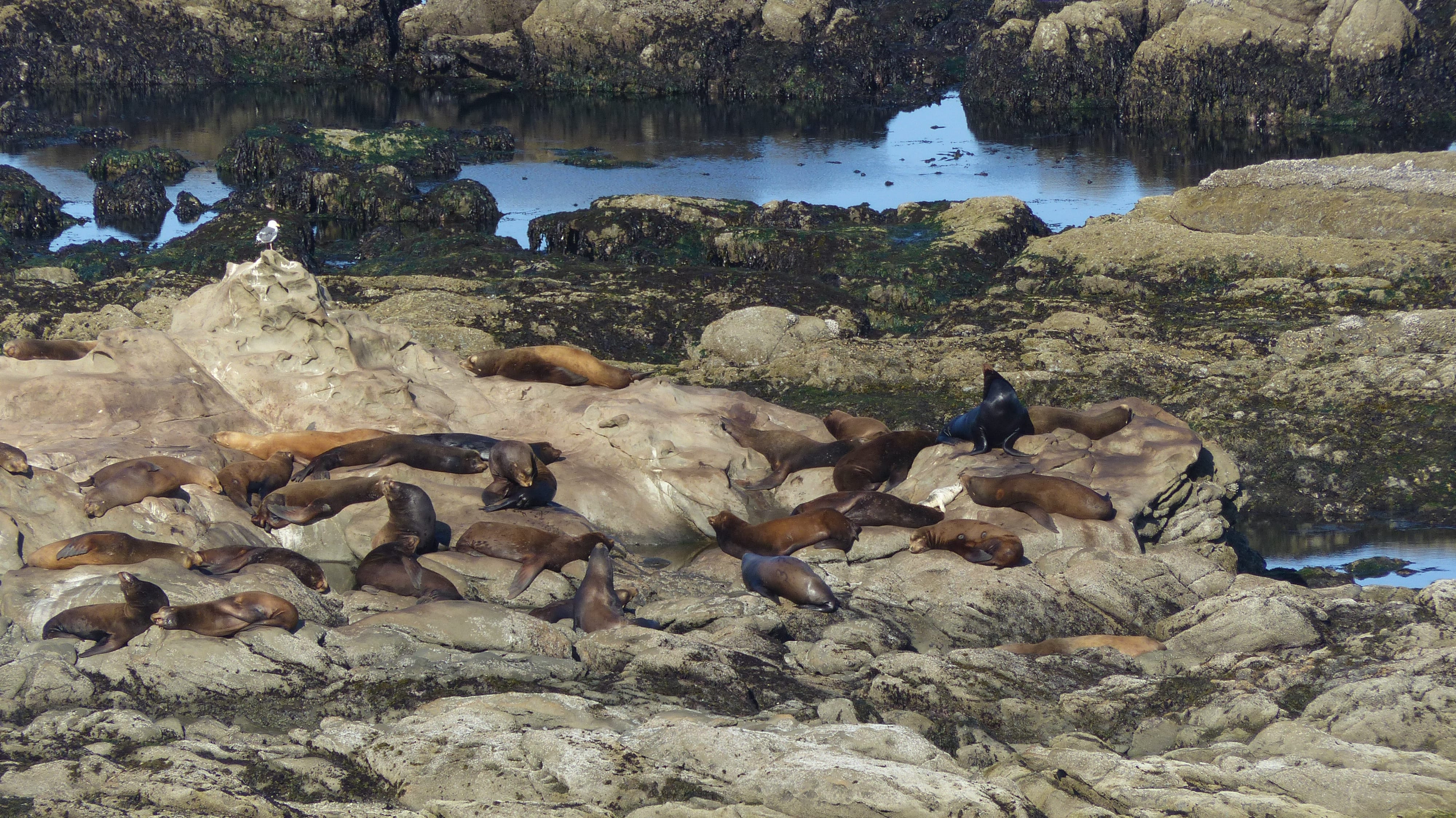
On the way to Cape Arago we stop at the Simpson Reef and Shell Island viewpoint. Four species of pinnipeds (seals and sea lions) haul out regularly on Shell Island . One can also observe grey whales as they migrate to and from Baja California and Alaska.
Shell Island with Simpson Reef in the Background Pinnipeds, Possibly California Sea Lions Lounging on Shell Island
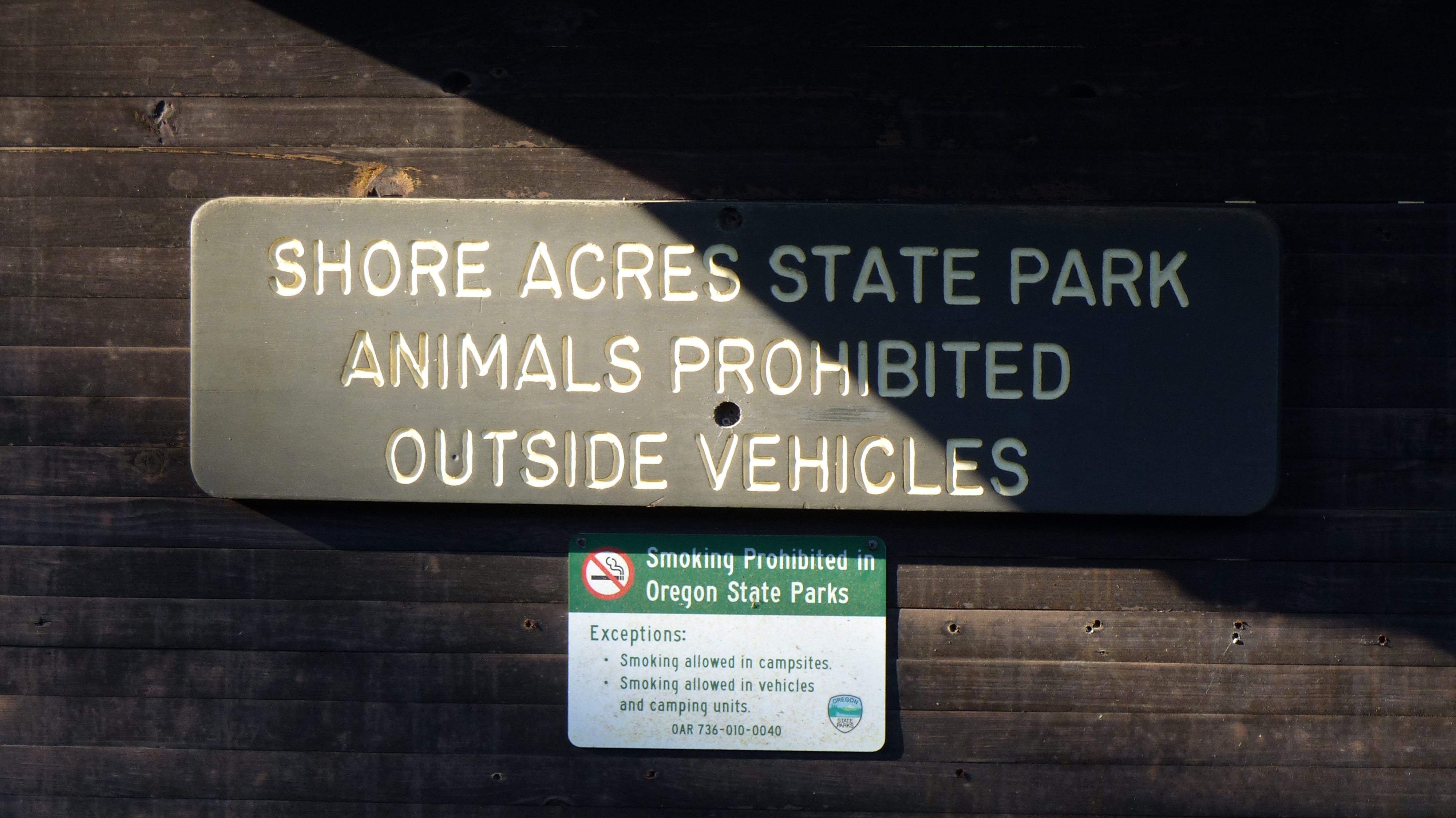
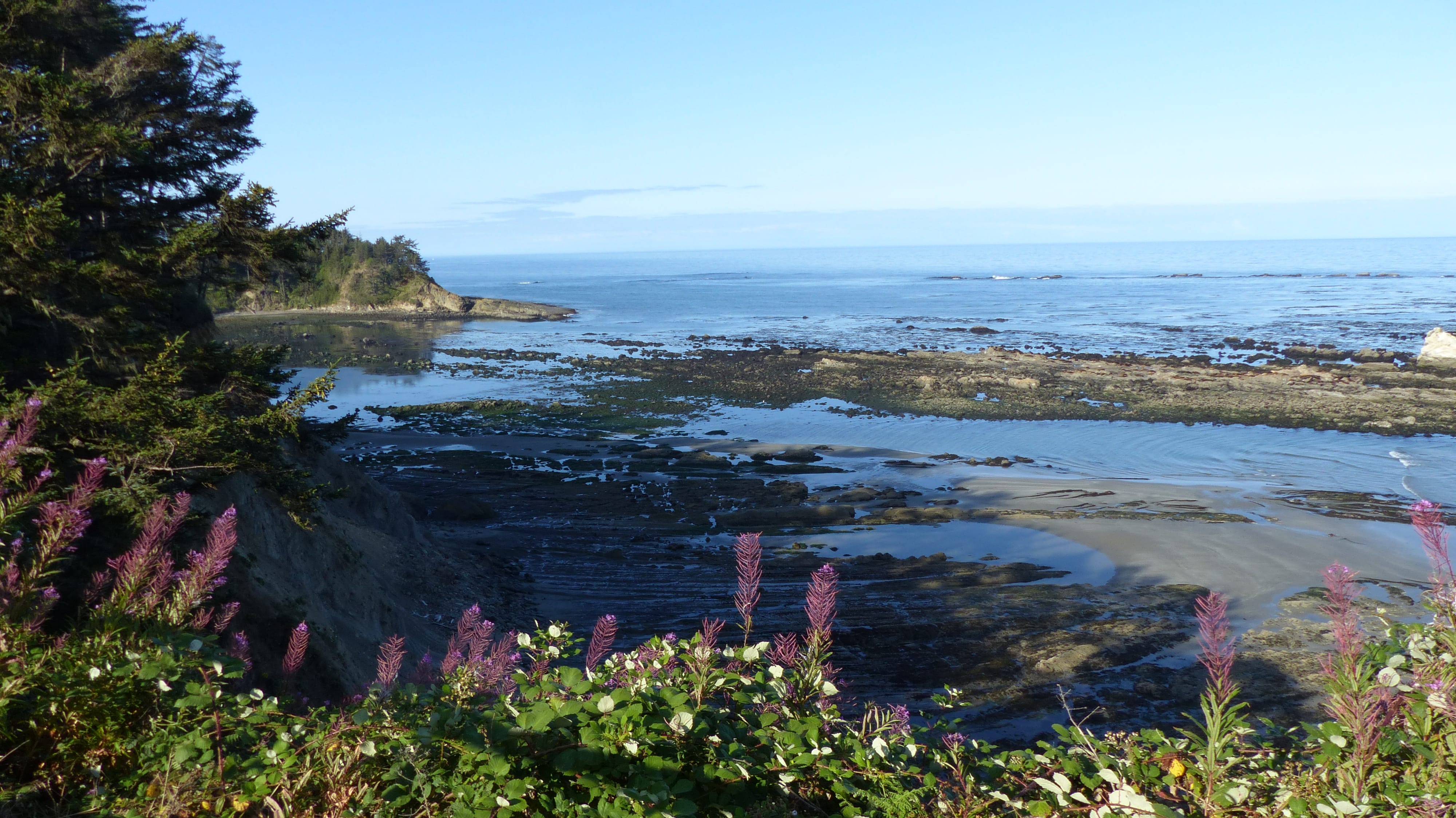
Shore Acres State Park has quite a history. Louis Simpson was sort of a party boy when young. Dad sent him to Holquiam OR to learn the business but the partying and gambling continued. He fell in love with Cassandra Stearns who divorced her husband in 1899 to marry him. Dad, Asa Simpson, gave the young couple a new start at his company town of North Bend.
Simpson worked hard, eventually changing the company town into the city of North Bend. To spur growth he gave away waterfront sites for manufacturing plants and other lots for hospitals and churches. He also invested in new businesses. He enticed the railroad to build a line to Coos Bay.
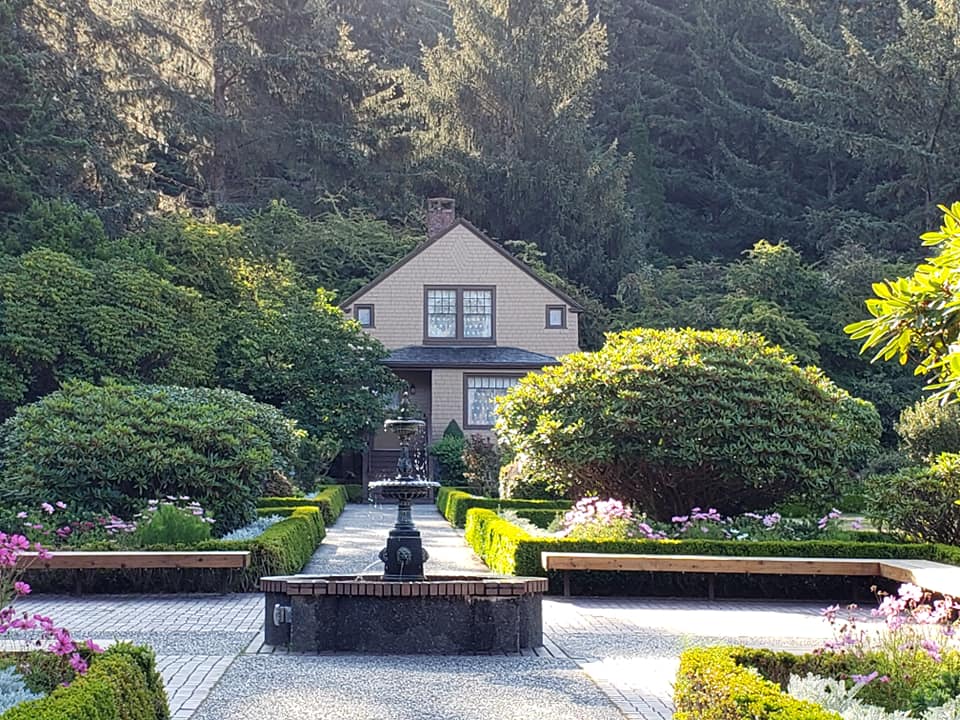
Entry Walk at Shore Acres Garden Garderner’s Cottage
In 1906-1907, Simpson built a large seaside home for his wife Cassandra. Shoreacres (Cassandra preferred “Shore Acres”), on the ocean about fourteen miles from Coos Bay-North Bend, eventually included an indoor swimming pool, spacious gardens, a modern farm, and a dairy herd. The Simpsons moved to Shoreacres in 1915. Cassandra died in April 1921, the house burned in July. The newly remarried Simpson moved into the gardener’s cottage while the new house was being built.
The Great Depression took its toll on a lot of folks including Simpson who lost business after business to bankruptcy. He lost Shore Acres which was sold to the State of Oregon. The house was in disrepair and was razed. After his death in 1949 his coastal properties became popular state parks: Sunset Beach, Shore Acres and Cape Arago.
The house may be gone but the original gardens thrive and the gardeners cottage is still there. What a great location for a home with acres of trees, a large meadow out front and the rocky seashore for a back yard. One change that we did not anticipate when visiting- dogs are not allowed out of vehicles anywhere in the park, not just the gardens- and there’s plenty of room for them to exercise without entering them. We had to cut our visit to the gardens a little short and find another place where mutzos are more appreciated. Even so the gardens are well worth the visit.
Sir Francis Drake purportedly sought shelter for his ship, the Golden Hinde, around Cape Arago. The headland was originally named Cape Gregory by James Cook on March 12, 1778 after Saint Gregory, the saint of that day; it was renamed Cape Arago after François Arago.
The park road ends at Cape Arago. Several trailheads are located here, a few lead down to the beach. One beach trail even allows dogs but we didn’t want to chance it- a sign stated the trail was steep with drop offs and uneven footing. There is also a picnic area. The views of waves crashing on the rugged, rocky coast are outstanding. There’s enough room on top of the cliffs to walk our mutzos. They appreciate the fresh smell of the sea air and the mowed grass adjacent to the parking lot.
All things considered we enjoyed Bastendorff Park a lot. There’s plenty of room to walk the dogs, great views of the ocean and a friendly staff. The only downside may be the location of the sanitary dump facility. We didn’t use it.
The eye candy along this portion of the Oregon Coast is an equal to any we’ve seen. What’s not to enjoy? We even heard that the seafood served at local restaurants is outstanding. We move on tomorrow………
One of the many chores associated with RV’ing to empty the waste water tanks. Most RV’s have two waste water tanks, one for sink/shower water and one for the toilet. We are not sure when we’ll have the opportunity again. We visit the sanitary dump site located in the park. While the tanks are being emptied we hook up the car to the RV which magically changes the Subaru into a Toad (towed vehicle).
We head north on I-5, turn off on exit 112 and take a meandering path to Oregon 42 near Dillard and proceed on to the Oregon coast. Google Maps made the route from I-5 to OR42 sound a lot more complicated than it was. The Coos Bay-Roseburg highway is rather narrow and “turny” as one youngster aptly described a winding road to Jil and I. We are in no hurry, preferring to slow down a little in order to drink in the beautiful scenery.
Many of the settlements in the less populated areas of Oregon have interesting names. The hamlet of Remote (pop. unknown) was named by pioneers for its distance from other settlements. Drain (1150 souls) was named after its founder Charles J. Drain. Bridge (pop. unknown), named after that structure on which one crosses a river had 40 people living there in 1940- I surmise it is less now as most of the businesses that existed back then have dried up. The towns of Myrtle Point (2500 souls) seems to be thriving but tiny Norway is only a name on the map. Other interestingly named places are Prosper, Cranberry Corners, Riverton and Winterville.
Downtown Coquille, Oregon
We stop and stretch our legs by walking around downtown Coquille (3800 souls), the seat of Coos County. The town lies on the banks of the Coquille River. Both the town and the river are pronounce Ko-keel yet the Indian tribe pronounce their name Ko-qwel. Indians name Ko-qwel was the original and White Eyes changed the pronunciation to suit their fancy.
At one time river boats ran the river carrying cargo and passengers. One story has it that one boat carried 400 passengers from Coquille to Bandon so they could attend a baseball game. Right behind it came another river boat that carried another 150 folks to the same game! As the river ran inland, it became so narrow it was said that passengers could amuse themselves by leaning out the windows to pick wildflowers.
We took a longer route to Coos Bay via Bandon in order to avoid a sketchy route that Google Maps had made for us. Google Maps via Jil’s Miss Smarty Pants phone has cause us grief in the past- like trying to send us under a low bridge that would have taken the roof off of our RV and the infamous “squeeze” a tunnel built for pedestrians that if we would have proceeded would have reduced the volume of our rig by two thirds. The “long cut” didn’t turn out to be so good either. The roads were not big rig friendly being very narrow and “turny” but we made it to Bastendorff County Park Campground in one piece.
The Rogue River has long been a source of food and water for indigenous people and emigrants. Today it is also a recreational paradise. Fishing for salmon, steelhead and trout is popular as is rafting, canoeing/kayaking, and birding. In the lake below Grants Pass all kinds of water sports are available. One can ride one of the Hellgate jet boats for a super fast thrill ride.
Rafting on the Rogue River
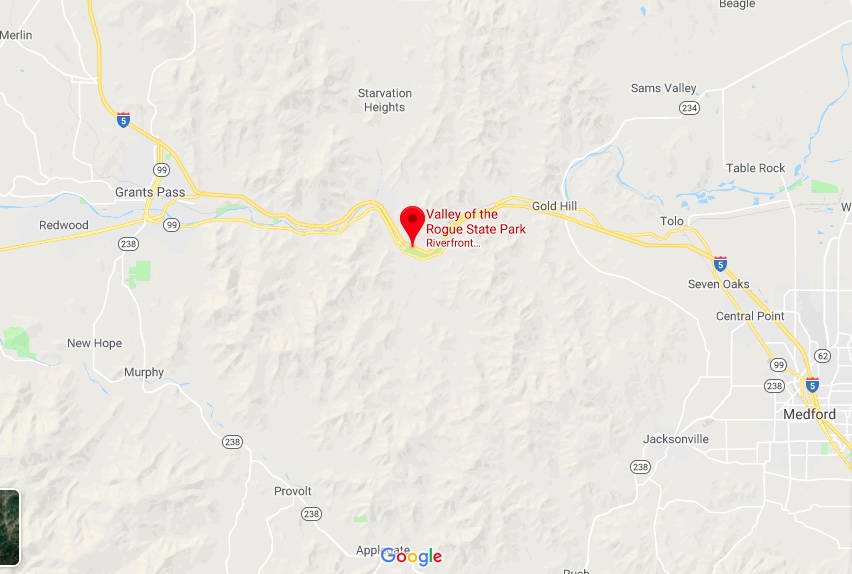
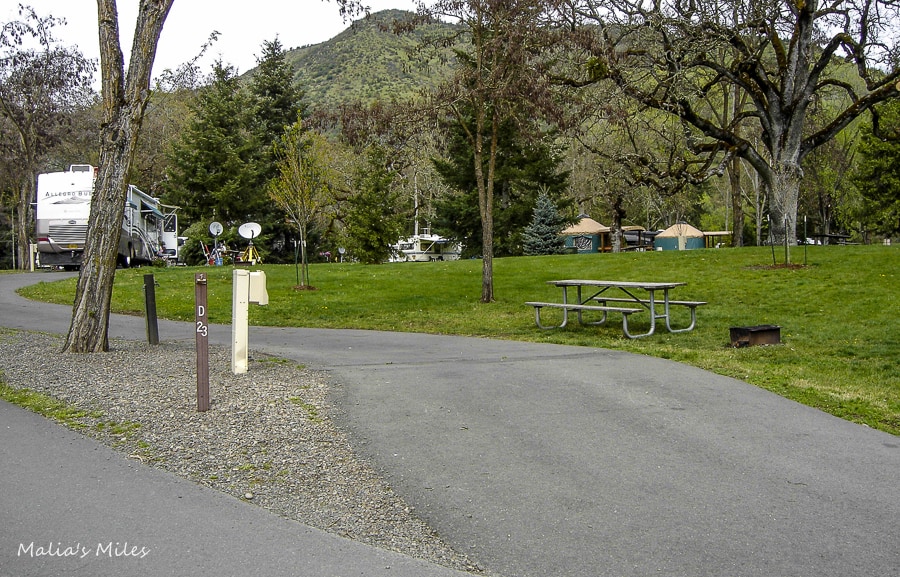
We arrived at Valley of the Rogue State Park shortly after the check out time of 1300 hrs and was promptly informed by the ranger at the entrance station that we weren’t guaranteed that our site was yet available. I said we’d chance it…… Our site, F14 is in the back loop of the park. It has great access to the path that parallels the Rogue River that’s not more than 100 yards from our back door. The sites are wide and deep….. and lush.
Entrance Station Valley of the Rogue State Park
We find our site vacant and back in, set the brakes-pshhhhh, activate the leveling jacks- wrrrrrr, plug in the power cord and we are set. Looking around all the “lush” has turned yellow.
Campground before irrigation withheld from lawns
Normally the mowed grass between and behind the campsites is green- but not this time. Our site has a large field behind that separates us from the river. It’s full of needle like one inch long stickers that are not mutzo friendly. Our normal access to the river is cut off and we are limited to taking a paved path that adds quite a distance to river access. It’s not nearly as pleasurable as walking on a dirt path through that big field.
Out of curiosity I ask one of the camp host volunteers why the grass is yellowed out- is there a drought here in Oregon? The reply- no drought, the water source for the park is that big ol’ Rogue River that flows on the western border of the park. The answer was the Head Ranger didn’t want to get the RV’s wet. Lordie! Heaven forbid that my RV should get wet…… They said that they could only water when a site was vacant and only with permission from the Head Ranger. The Head Ranger is off on weekends so the volunteers can never water on Saturdays and Sundays even if the entire campground is empty….. gads…. The kicker is a mile long access road that joins the entrance to all the camping/picnic loops and the amphitheater. Along that road is a greenbelt consisting of lawn a conifers- and it is irrigated and is greener than green.
We drove over to Gold Hill (1200 souls) just to browse. As the name implies gold was discovered on a nearby hill around 1851. As usual not there’s not much going on in town except that a couple of farmers appear to be growing CBD oil based plants-hemp maybe?The Oregon Vortex House of Mystery located a few miles outside of town sports gravity defying illusions, and may be enhanced by that CBD oil. Del Rio Vineyards is also in the area.
Hemp Plants?
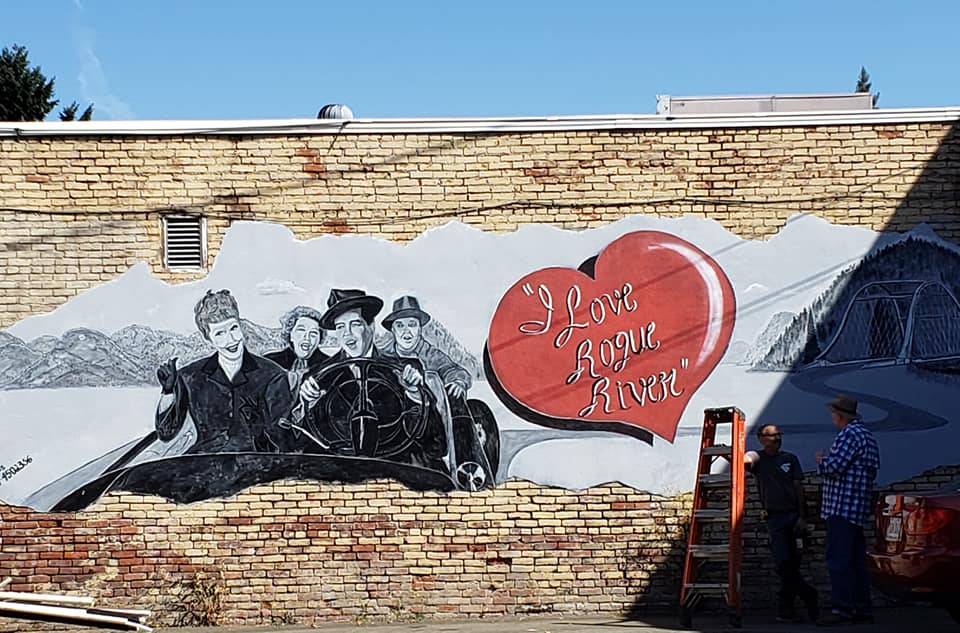
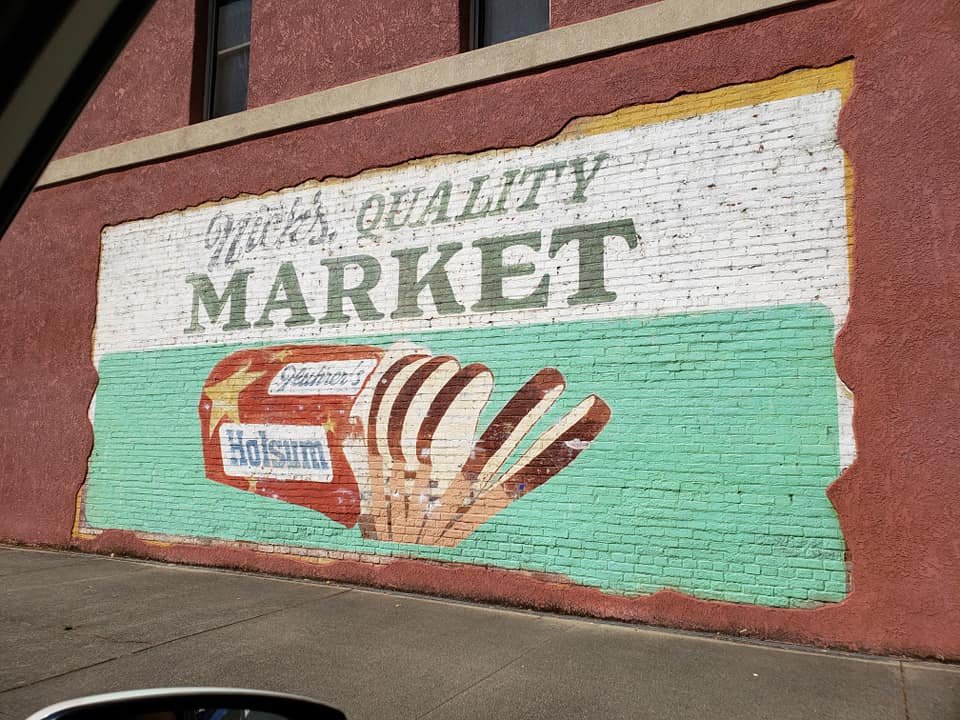
It is said that the town of Rogue River (2100 souls) was established in 1831 by French fur traders. We drove through the tiny downtown and spent some time at Palmerton Park walking the pretty grounds with Doyle and Megan. We also enjoyed the wall art.
Images From City of Rogue River
Grants Pass (35,000 souls) is the seat of Josephine County. The city has beautifully maintained parks along the banks of the Rogue River. The clean downtown is bustling with foot and vehicular traffic.
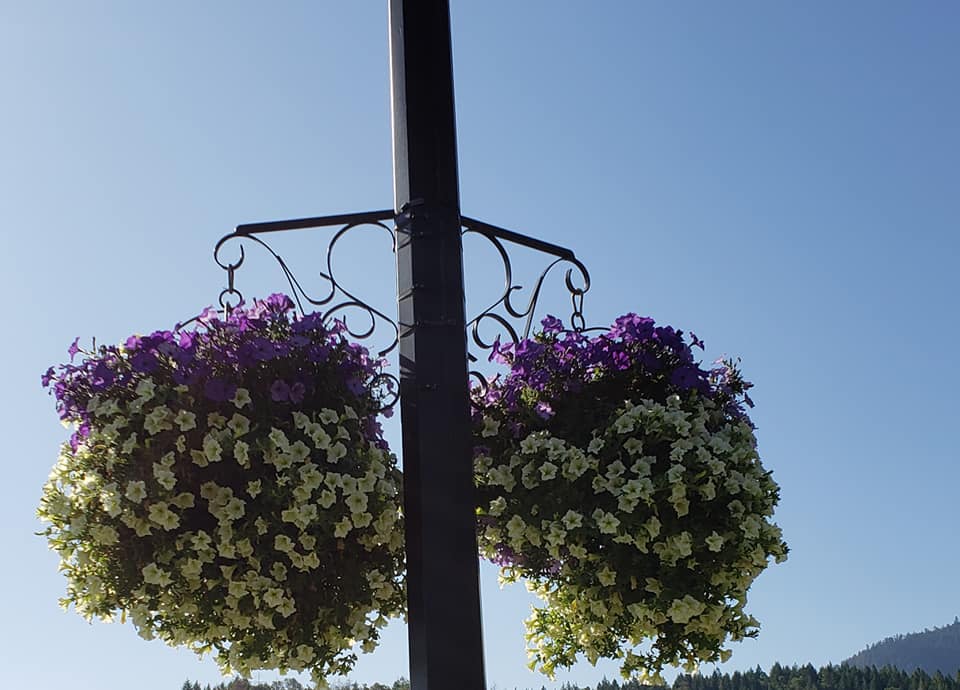
Flower pots hanging from light standards are everywhere. Just a ways ways from the scenic downtown are your typical big box stores such as Lowe’s, and Fred Myers. Freddie’s is like Walmart in that it sells practically anything one wishes to purchase for the home including a huge grocery department. We shopped at Freddie’s for a few needed items and went back to camp.
Valley of the Rogue was somewhat of a disappointment for us. Apparently water is available to irrigate. It’s a shame that the beautifully manicured lawns in the campground are all but gone in the summertime. I blame that on the Head Ranger who doesn’t want to get my rig wet.
We had a short drive today, less than 130 miles. Check out time at Oregon State Parks is 1:00pm. If we get to the park before that time we’ll probably have to sit in a parking lot and twiddle our thumbs. After packing up we take the dogs for a nice walk but it’s still pretty early, like 0700 hrs early. Tired of waiting to leave for no good reason we head out.
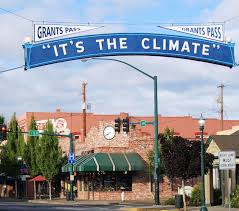
Jacksonville, OR isn’t far off of our path- let’s go! We pull out of the RV park and head west on CA 89 and go over that steep hill that the lumberman’s oxen had trouble pulling wagons over back in the 1890’s. It’s a grunt but we catch a slow logging truck half way up the grade. It’s having trouble pulling the hill just as the oxen. We transition on to north bound I-5 at the little town of Mount Shasta (2600 souls).
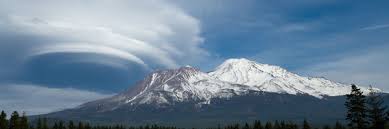
This part of Northern Kali-Fornia is beautiful. The majestic Mt. Shasta looms large on our right, Black Butte, a black volcanic cinder cone is at 12 o’clock and pine trees everywhere. We pass the quaint town of Weed (2900 souls) named for Abner Weed, a Civil War soldier and lumber man who settled in the area (https://en.wikipedia.org/wiki/Abner_Weed).
We drive past Yreka (7800 souls), the seat of Siskiyou County. The town gets it’s name from the Shasta language for North Mountain or White Mountain in reference to Mt. Shasta. The infamous Mark Twain had another take on it. His rendition is that a bake shop was opening, had a “BAKERY”sign painted, the sign was hung backwards to dry with all but the “B” showing through. It was read by a miner wrong end first, supposed that it was the name of the camp, the campers were satisfied with it and adopted the name. Ya gotta love Mark Twain’s wit.
The road takes us over hill and dale until it we reach a valley north of Mt. Shasta. We are now in “Jefferson County”, cow country pocked by mini volcanic cinder cones, an area that wants/wanted to secede from the state of California. Now we are in the Siskiyou Mountains, cross the Oregon border, eventually cresting Siskiyou Summit, elevation 4310′, highest elevation on Interstate 5. We take the long downhill grade towards Ashland (21,000 souls), a tourist mega offering the Oregon Shakespeare Festival, art galleries and restaurants. We are now in rolling hill country. Near Phoenix (4100 souls) we turn towards Jacksonville.
Oregon Welcome Sign Located Halfway Up Siskiyou Pass
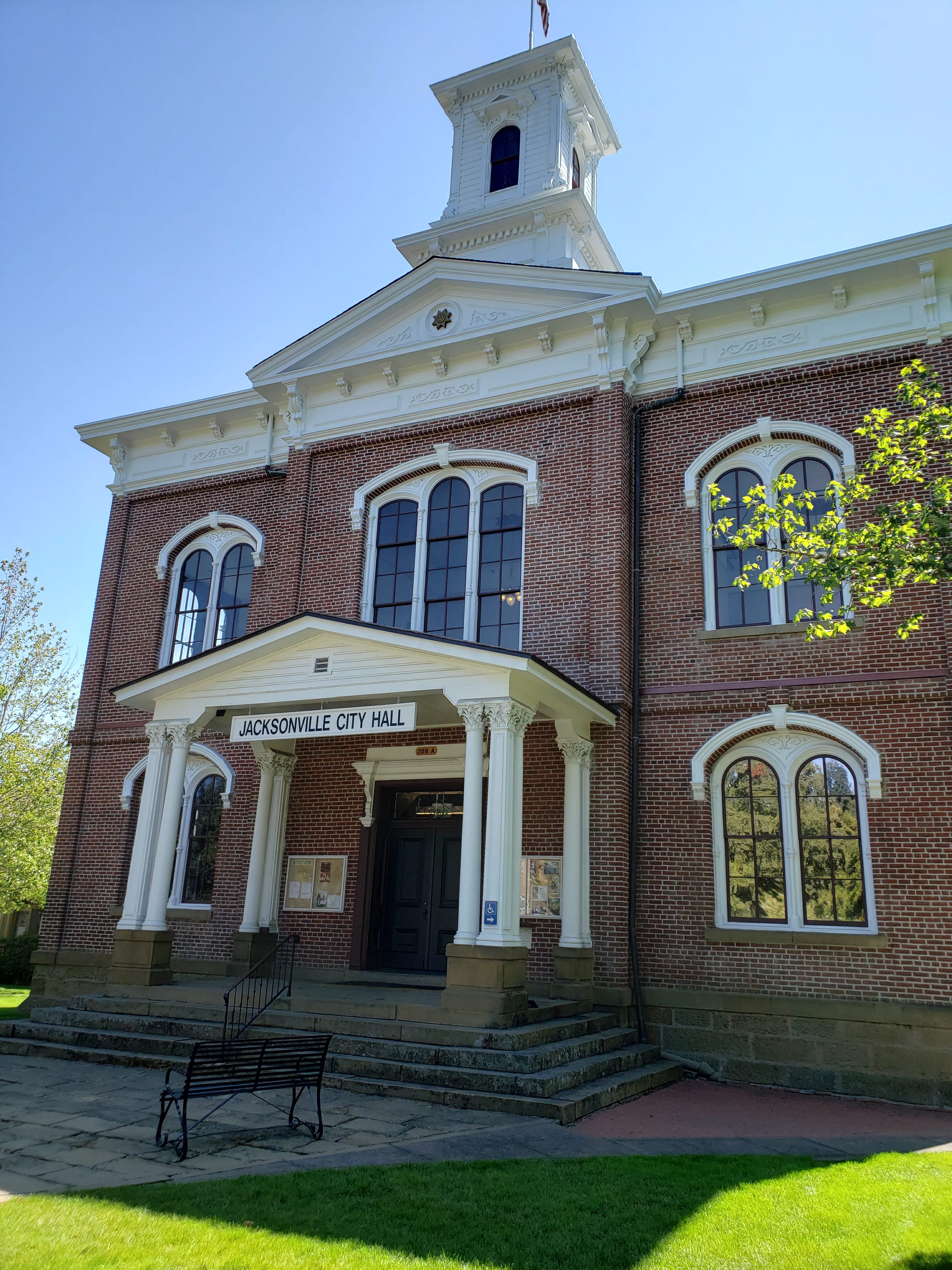
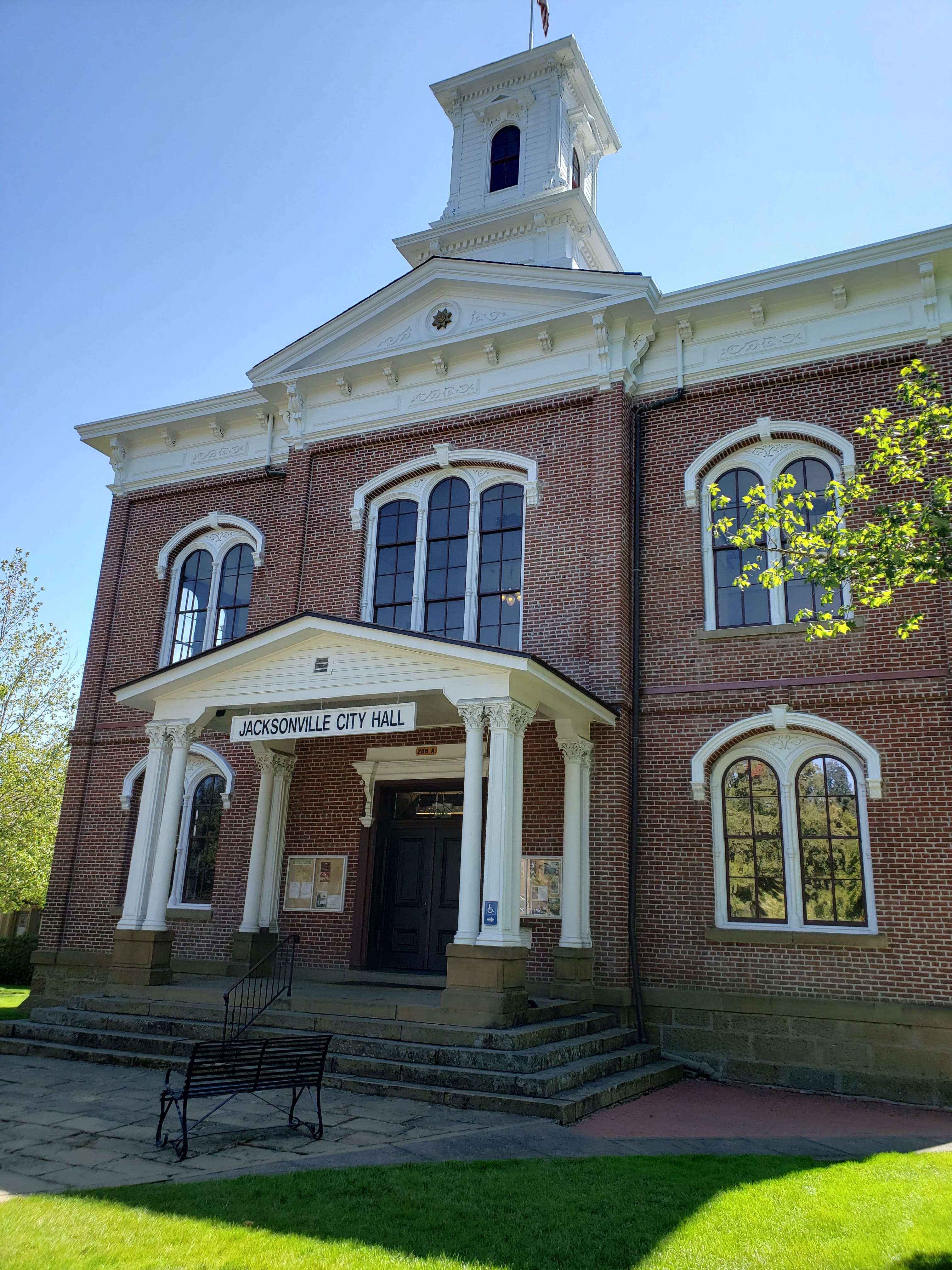
Jacksonville’s (pop.2800) historic district, a U.S. National Historic Landmark, was founded following the discovery of gold deposits in 1851-52. It was the original seat of Jackson County, now at Medford. It was also home to the first Chinatown in Oregon. The city was the principal financial center of Souther Oregon until the railroad was rerouted to Klamath Falls due to the severity of the grades of Siskiyou Pass.
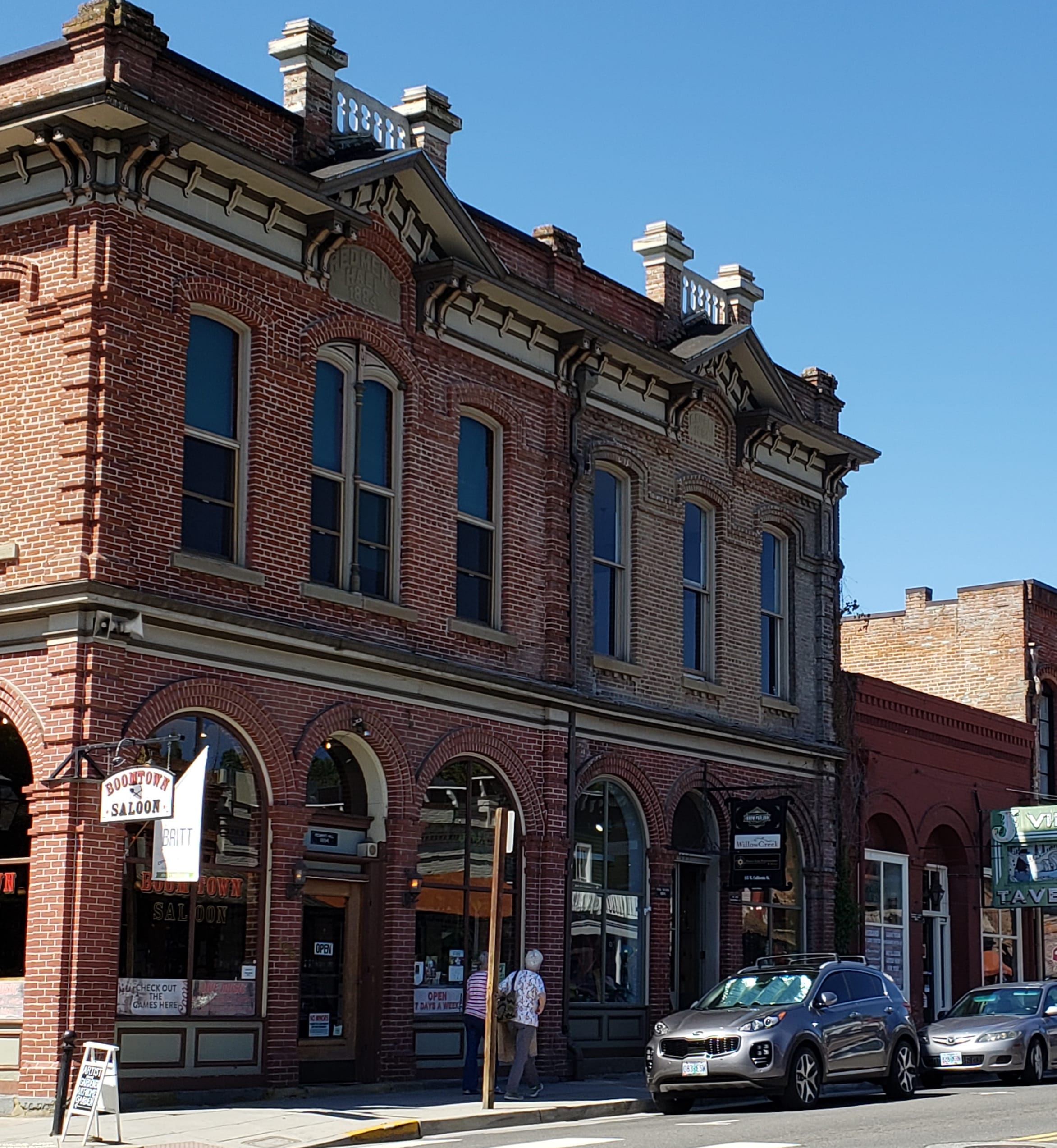
Downtown Jacksonville Covered Sidewalk
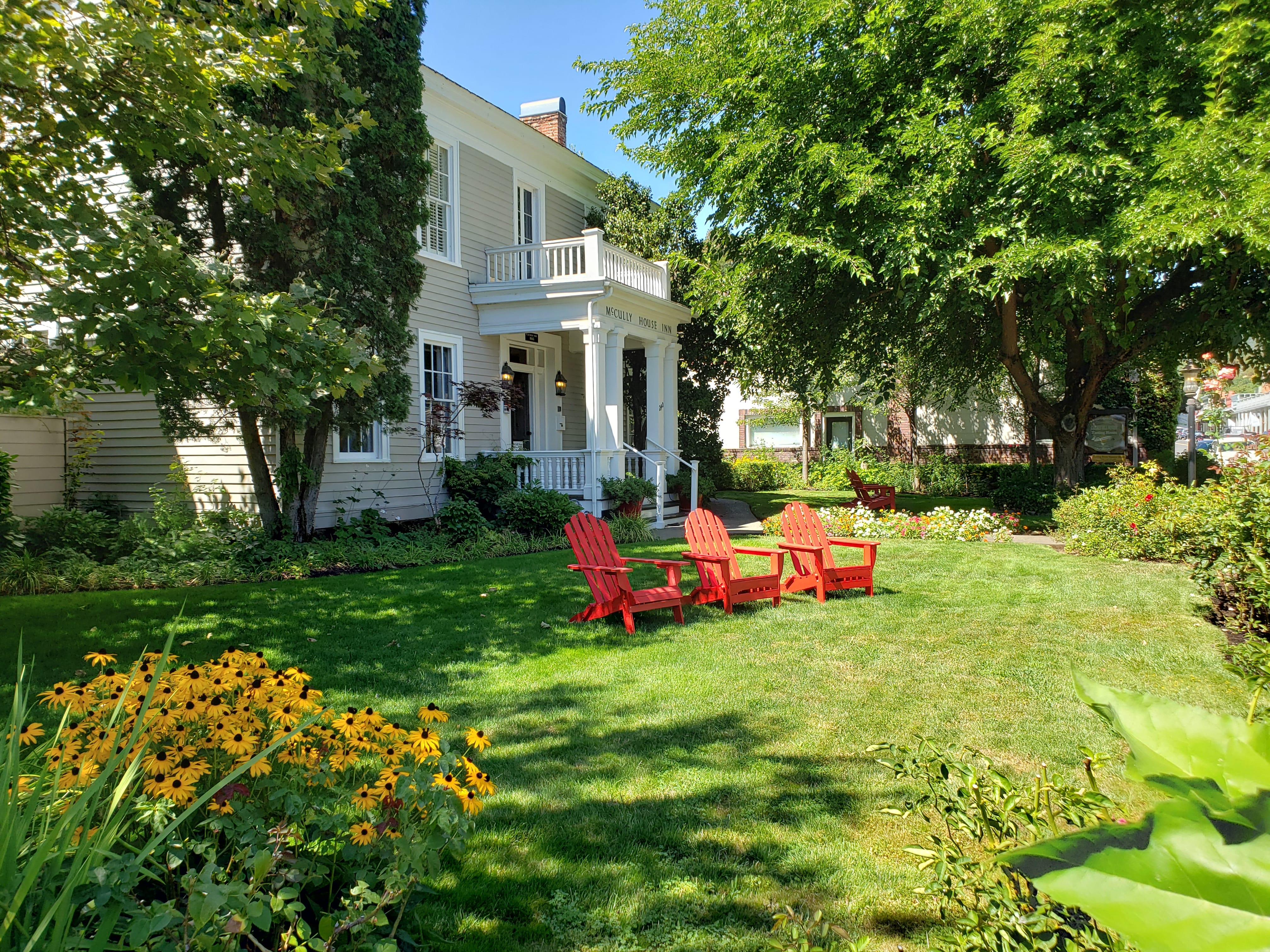
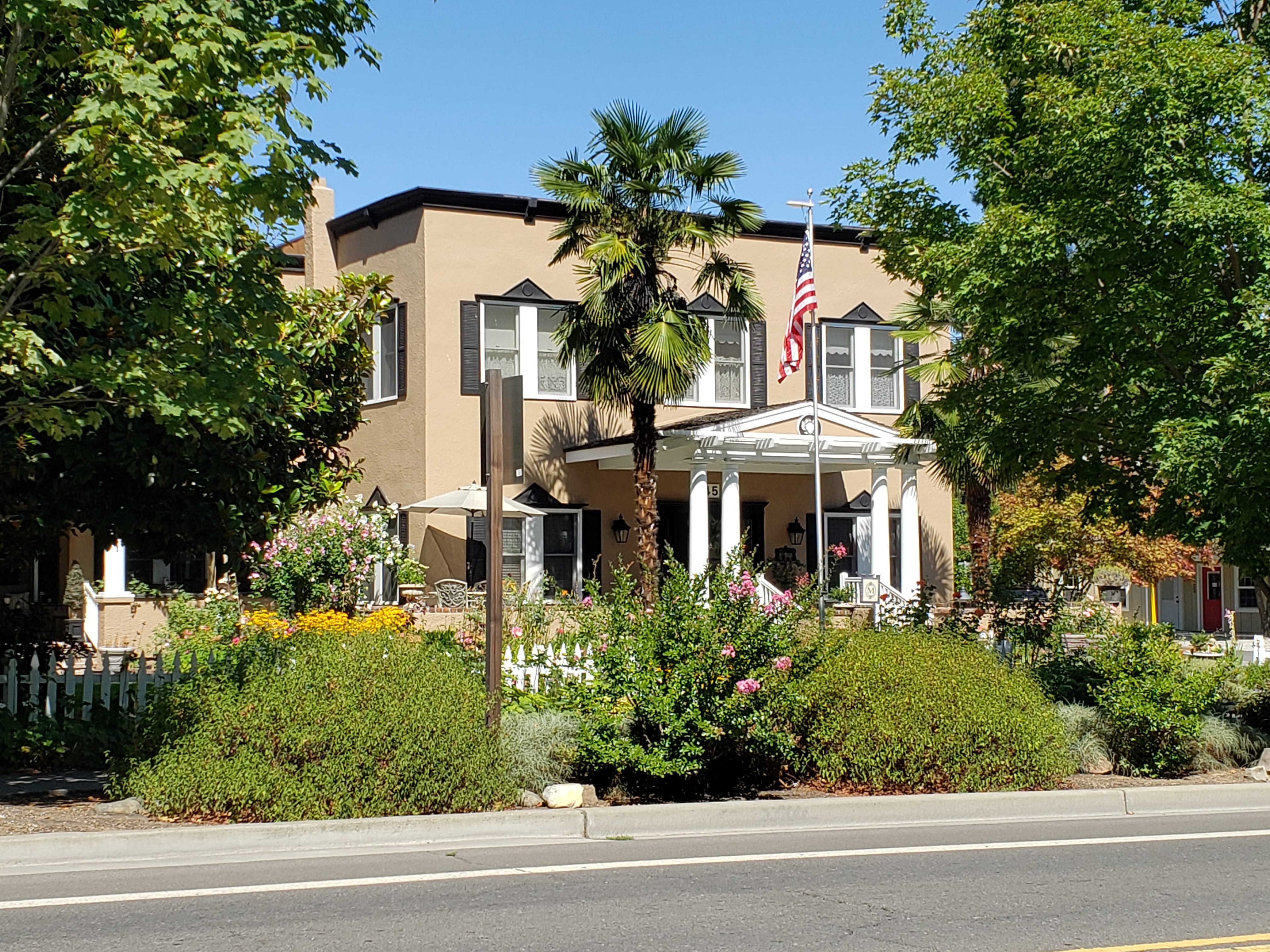
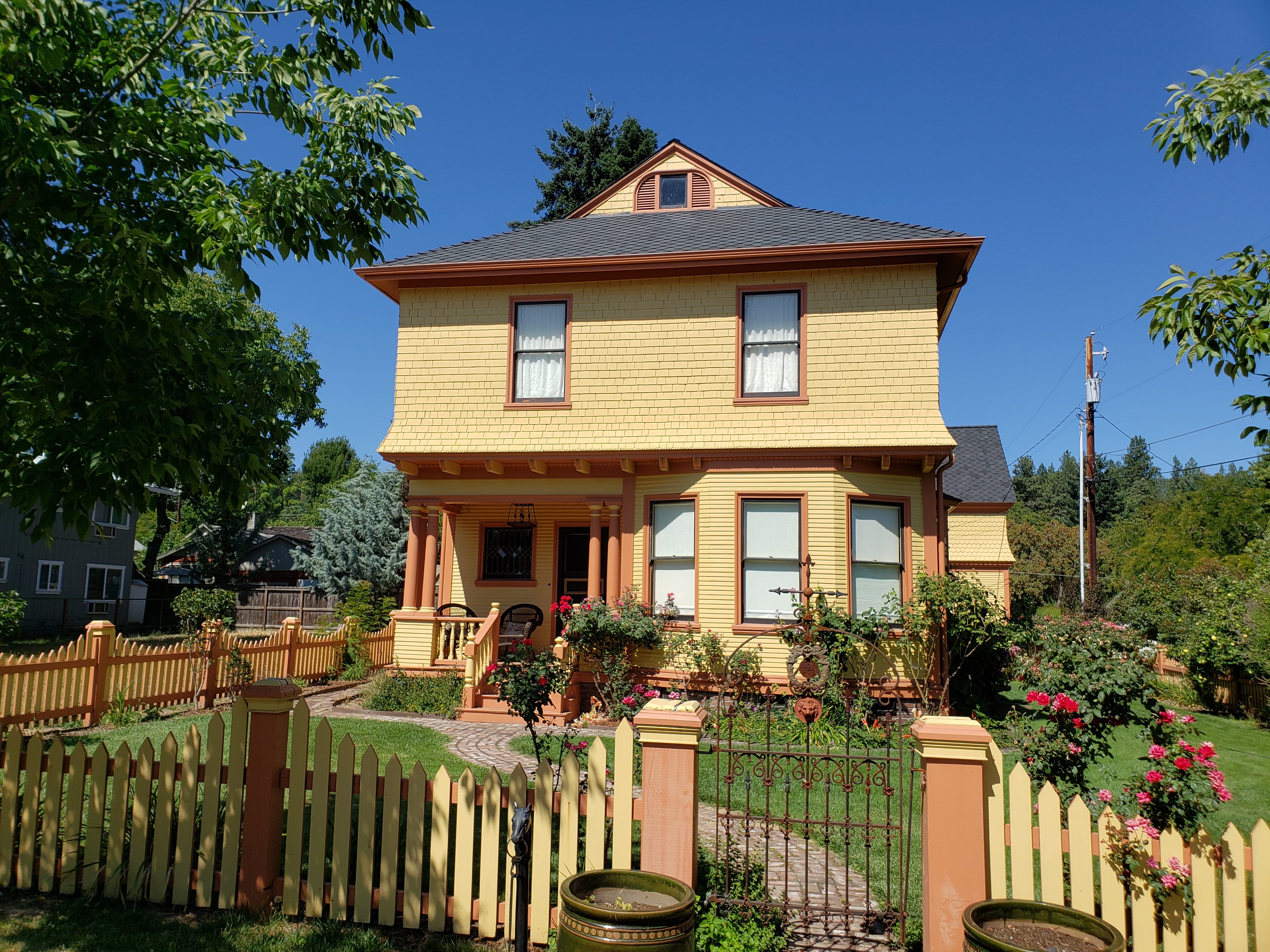
Over 100 buildings are on the National Register. Walking downtown is like walking into the Old West. The experience is diminished by vehicular traffic. I wonder aloud what it would have been like when the horse was the principal mode of transportation. Jacksonville is a popular place to visit. B&B’s, restaurants, breweries and saloons are a daily draw.
The Britt Festival is a popular seasonal music festival and the town has several museums, an arboretum and beautifully landscaped homes adorned with colorful flowers.
After a pleasant visit it’s time to head towards Valley of the Rogue State Park. We are staying in the F loop in Site 14. No sewer hookups in this loop but the site offers water and 50 amp power…….. and a clear view of the southern sky for our satellite dish. We check in and set up for a two night stay. Tomorrow we’ll visit Nearby Gold Hill, Rogue River and Grants Pass where we’ll do a little shopping at Freddie’s, i.e. Fred Meyer big box store.
We’ve been planning this trip for quite some time- ever since we got back from our winter trip last March. We are taking a round about course back to the Bonneville Fish Hatchery where we’ll spend the months of September and October as volunteer hosts once again.
Ten Minutes to Blast Off!
I think this is our number 4, maybe number 5 stint at the hatchery. As in the past our friends Jim and Nancy are occupying our home in our absence.
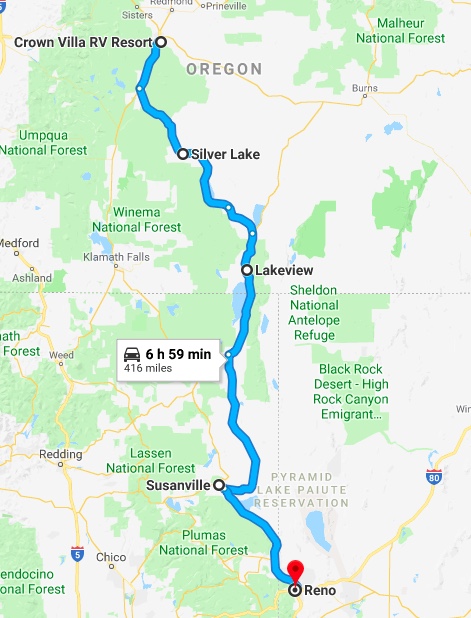
We headed up US 395 to Susanville, CA (pop. 17,000) . This is a pretty stretch of road once out of Reno. It follows the Sierra Front with it’s rugged pine covered hills north through beautifully colored hills, vertical sided creek beds cut by flash floods, and terminal lakes that have no outlet. Honey Lake is one such lake. It’s an important wildlife refuge for migrating birds. Alfalfa and hay are farmed and cattle are a raised in the area.
Susanville’s (elevation 4100′) main industries were mining, lumber and farming but the first two are no more. The main industry now is the two state prisons located nearby which employ approximately 6000 folks. Driving down main street we noticed an upswing in the commercial district.
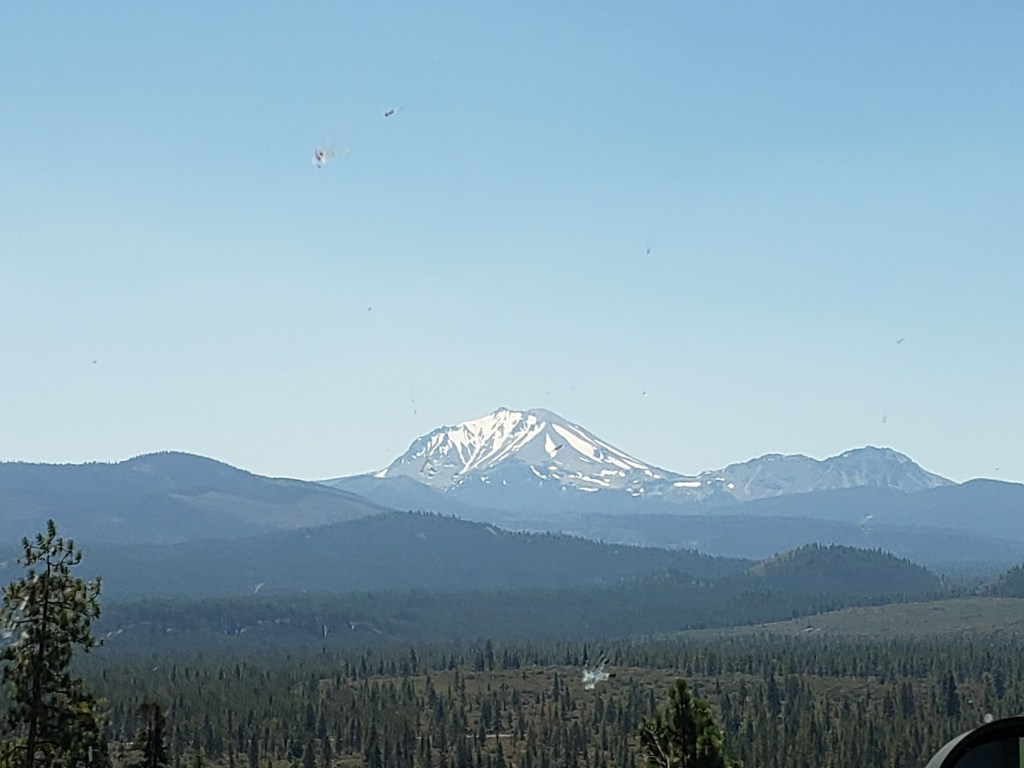
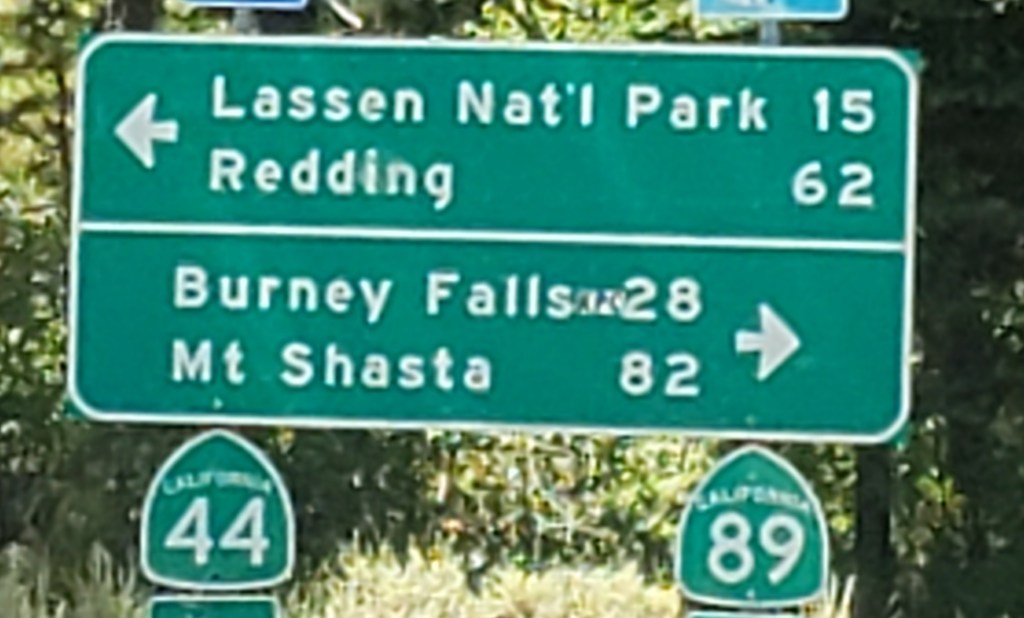
We continued on CA 44 through pine dominated hills occasionally opening to large meadowlands. Cattle seemed to be enjoying the rich grasses growing in those flatlands. We come to Old Station, a former stagecoach stop back in the day, now a traveler services oriented community of 51 souls. where we pick up CA 89 but not before viewing the star of Lassen Volcanic National Park.
Lassen Peak stands majestically at an elevation of 10,470′. I climbed to it’s summit when I was a pup. On the way up I was anticipating staring down at a boiling caldera of boiling lava. Boy was I disappointed-nothing but a little steam up there! It’s last major eruption was in 1914- the year my mother was born.
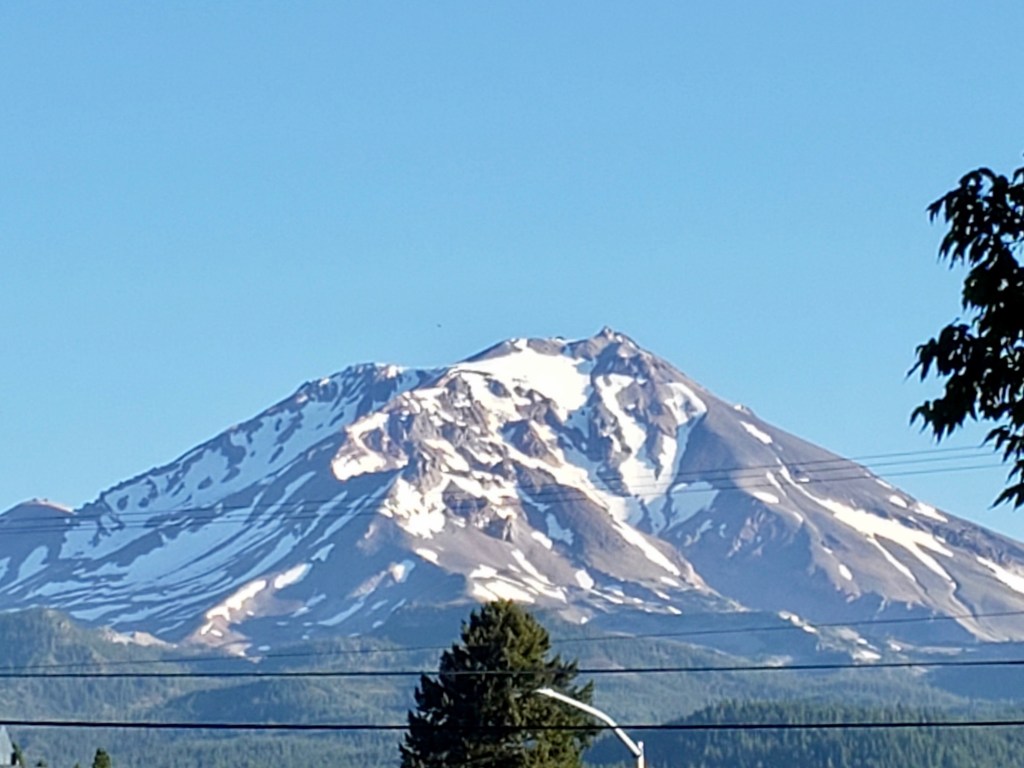
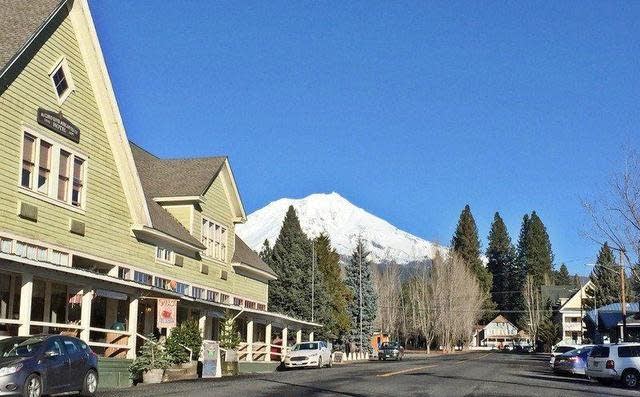
At Old Station we transition on to Highway 89 and travel on to McCloud, CA. (1100 souls). At times the highway lines up like a gun site aimed squarely at the majestic snow covered Mount Shasta (elevation 14,179′), the tall conifers framing the mountain on either side of the road. It’s a very picturesque drive.
A little history is in order:The town was named after Alexander McCloud who led a party of Hudson Bay Company trappers into the valley where McCloud now stands. In 1892, A.F. Friday George built the first mill located in what is now McCloud, but it failed because of the difficulty of hauling the lumber over the hill by oxen. In 1897, the town of McCloud was finally established by George W. Scott and William VanArsdale, founders of the McCloud River Railroad Company. The railroad made it economically feasible to transport the lumber to more populated areas.
The McCloud River Lumber Company (known as Mother McCloud) kept the town secure and prosperous. The homes were steam heated and electricity was supplied by the mill. When your faucet leaked or a light burned out, “you’d just call Mother McCloud and a crew would be over to fix it for you” recalled a third-generation McCloud native. Those days ended in 1963 when U.S. Plywood Company purchased the mill, the railroad and the town.
In 1965, U.S. Plywood transferred town properties to John W. Galbreath and Co. whose job was to help company towns make the transition to privatization. The houses were then sold to the people living in them. The McCloud Community Services District was formed and the utilities, such as water, sewer and street lighting, were turned over to the district. They also assumed responsibilities for fire and police protection, library services and some road maintenance. U.S. Plywood promised that there would be years of employment and a good economic future for the town as there were 50 years of timber to be cut. But, after privatization the economy of the town began to deteriorate due to the diminishing timber industry. U.S. Plywood, who had since merged with Champion International Corp., tried hard to keep going, but the days of the big timber companies were gone. In 1979 the lumber mill was closed.
The lands once held by Champion International are today owned by the John Hancock Mutual Life Insurance Company and managed by Campbell Timberland Management. Land management companies see their role as one of stewardship over the forests making sure that they survive in a healthy diverse way. The mill closed for good in 2002 when it was determined that it would be too expensive to modernize the WWI vintage machinery.
The McCloud River Railroad ran as the Shasta Sunset dinner train for several yards but that too came to an end. Two working steam locomotives were sold, one to Oregon Coast Scenic Railroad located in Garibaldi, OR and the other to the Virginia and Truckee Railroad located in Virginia City, NV.
Many homes are being purchased and renovated to serve as vacation housing. The area is still a haven to fishermen as the area is nationally known for it’s trout fishery.Even though McCloud is once again facing an uncertain future, it’s unique architecture, the beauty of the surrounding countryside, the purity and taste of the water, and the friendliness of the local townspeople, insure that McCloud will retain it’s charming and attractive atmosphere well into the 21st Century.
Original Entrance to the RV Park
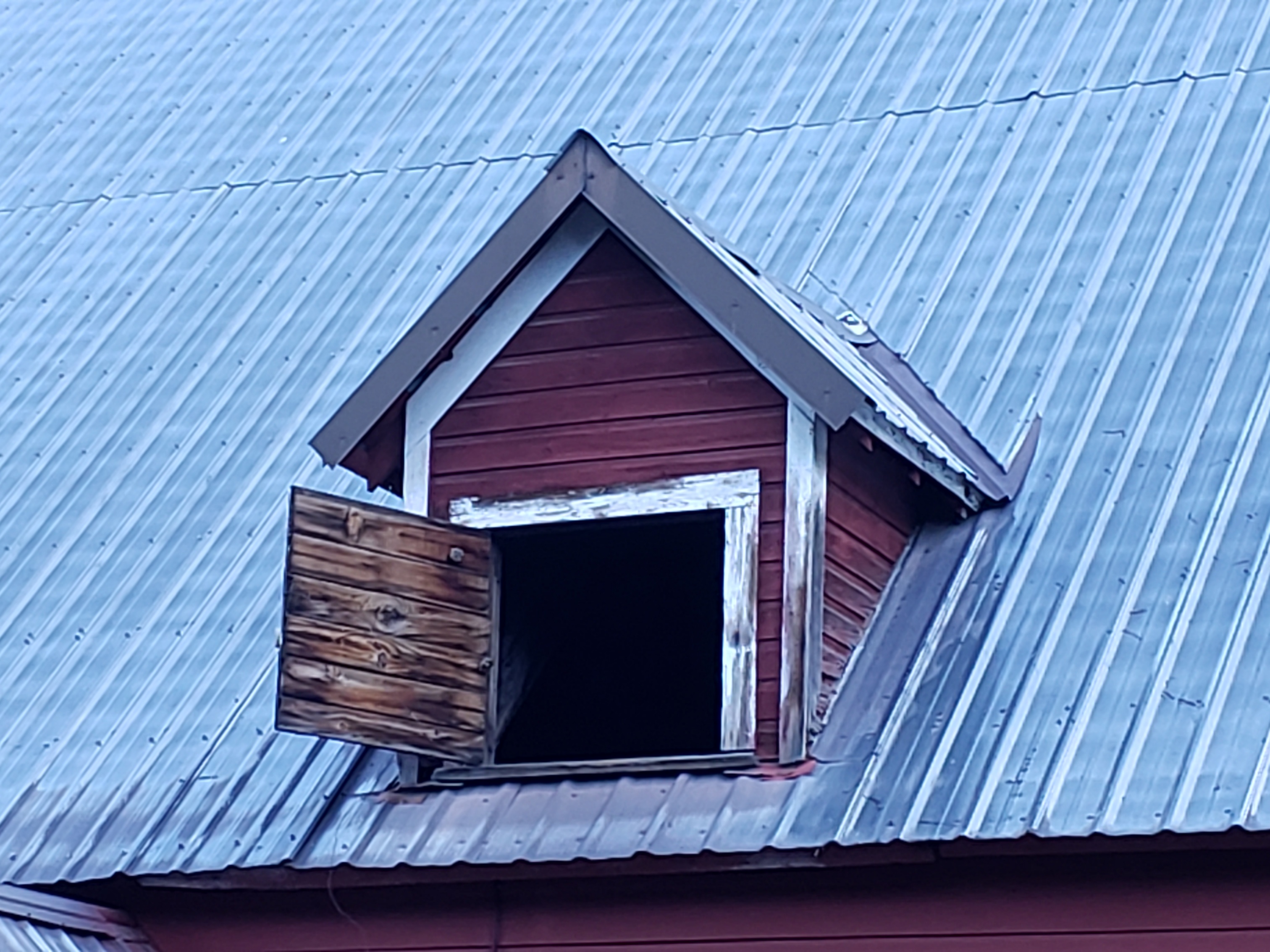
Old Dairy Barn on McCloud RV Resort Property
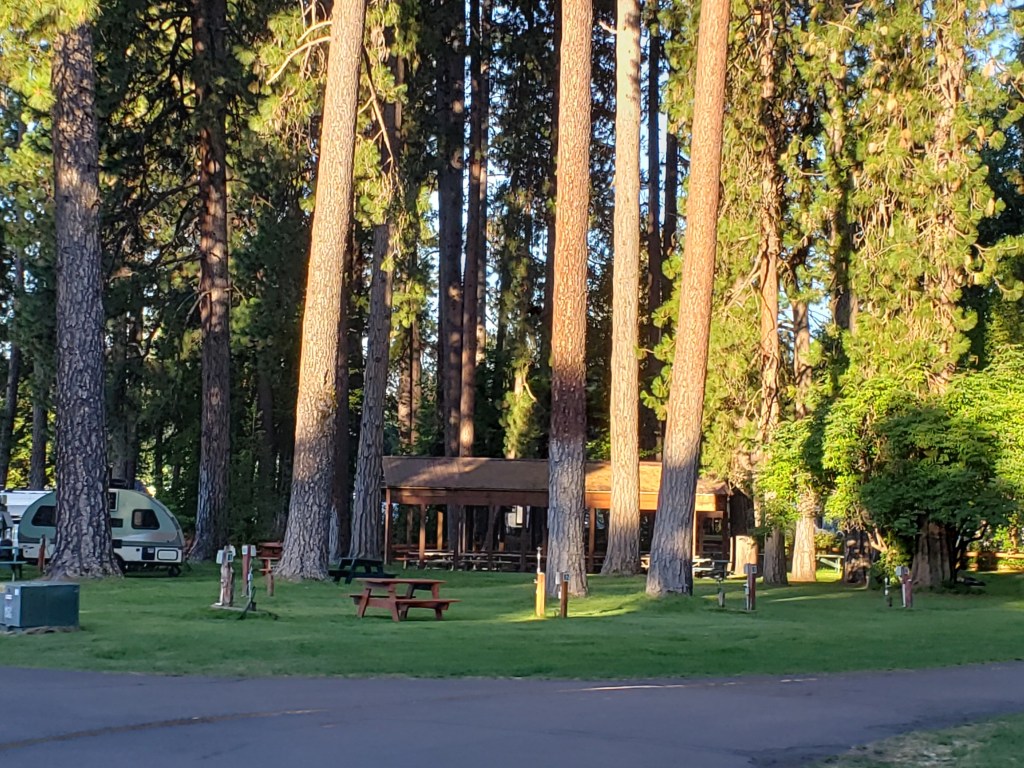
Beautiful Grounds of the McCloud RV Resort
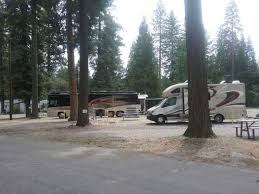
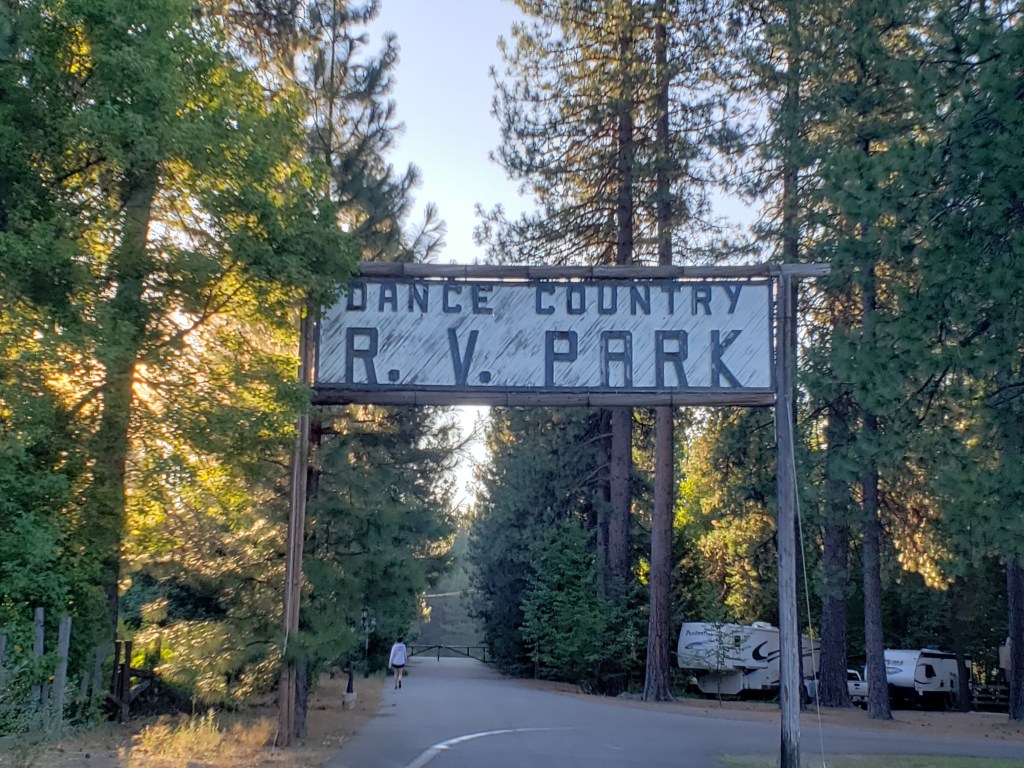
We pulled into McCloud RV Resort after traveling 216 miles- a perfect distance for the first day on the road. The park’s previous name was the McCloud Dance Country RV Park named in honor of the McCloud Dance Country Ballroom, a venue since 1906-” Your Northern California venue for Ballroom Dance, Square Dance, Round Dance, Weddings, Conferences & Events – Dance Packages.” The park is very nice aesthetically- lots of mowed grass, beautiful tall pine trees but not laid out as well as it could have been. But heck, it’s been here for a long time, rigs have changed from 16 foot travel trailers to the largest of all RV’s- the 45 foot diesel pusher motorhome. All in all its still a nice park- but not a resort……..
I am writing this edition of our Jil and Mike blog from the comfort of my easy chair in our home. Yes, we are home! Two months, three weeks of adventure now over. We arrived two days ago. Those of you who travel know that arriving at the ol’ barn in itself is a nice feeling but then the work begins. The coach has to be off loaded- clothes, food, etc. most goes into the house. Everything inside the coach is cleaned, everything outside the coach is cleaned. It’s a two day job and all of that is behind us. I can now catch up and conclude the adventures of Jil and Mike. No, our adventures are not over, just this episode. Below you will find the account of our last 400 miles on the road.
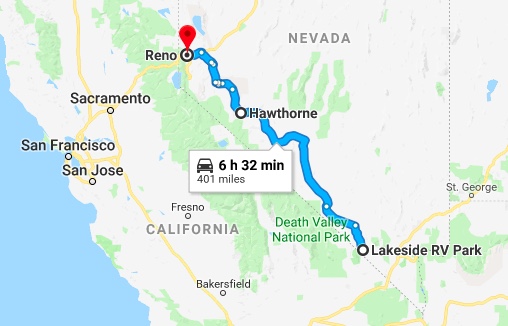
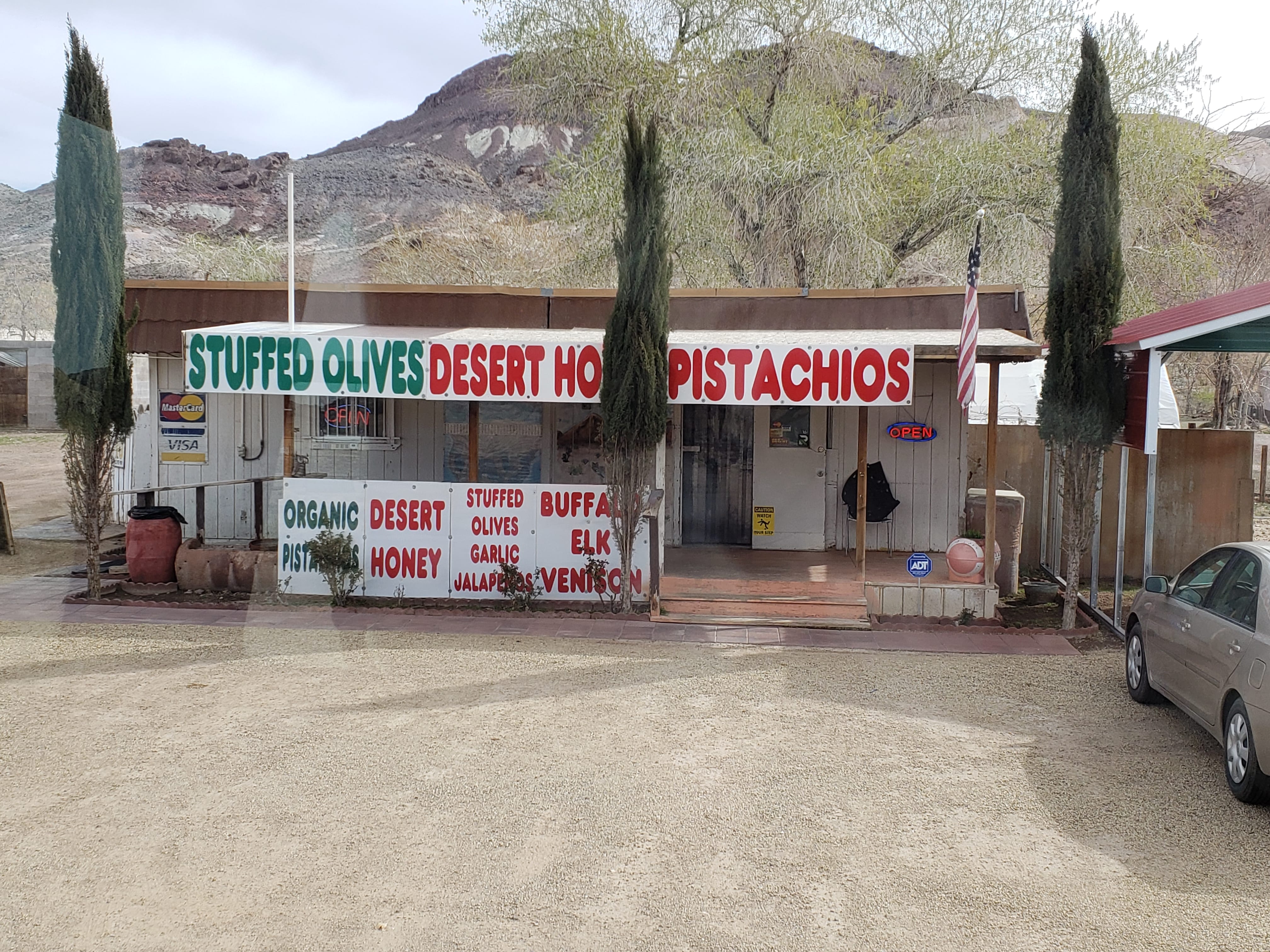
The last leg of our trip brought us through some very interesting country. It’s still over 400 miles to our home so we stopped in Hawthorne overnight. On the way from Pahrump to Hawthorne we stopped in Beatty (1000 souls) at an interesting store. The proprietor makes his own toffee covered nuts and sells honey. Haven’t sampled the honey yet but the butter toffee almonds were great!
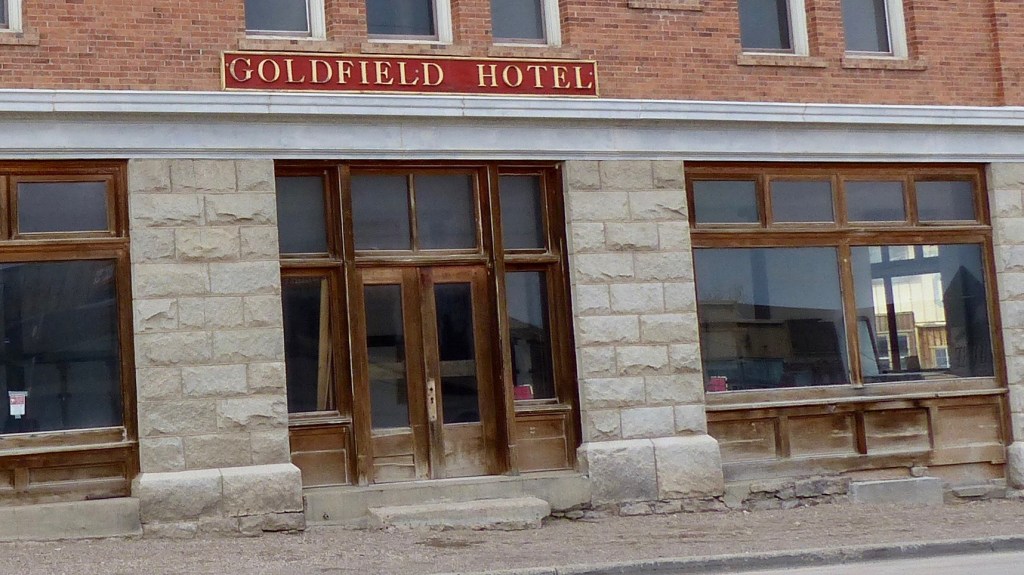
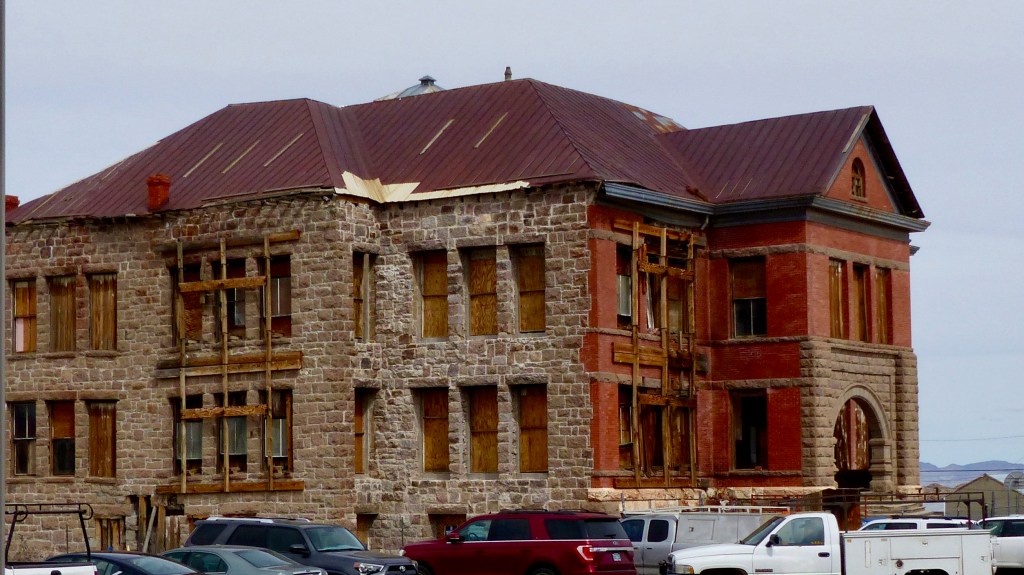
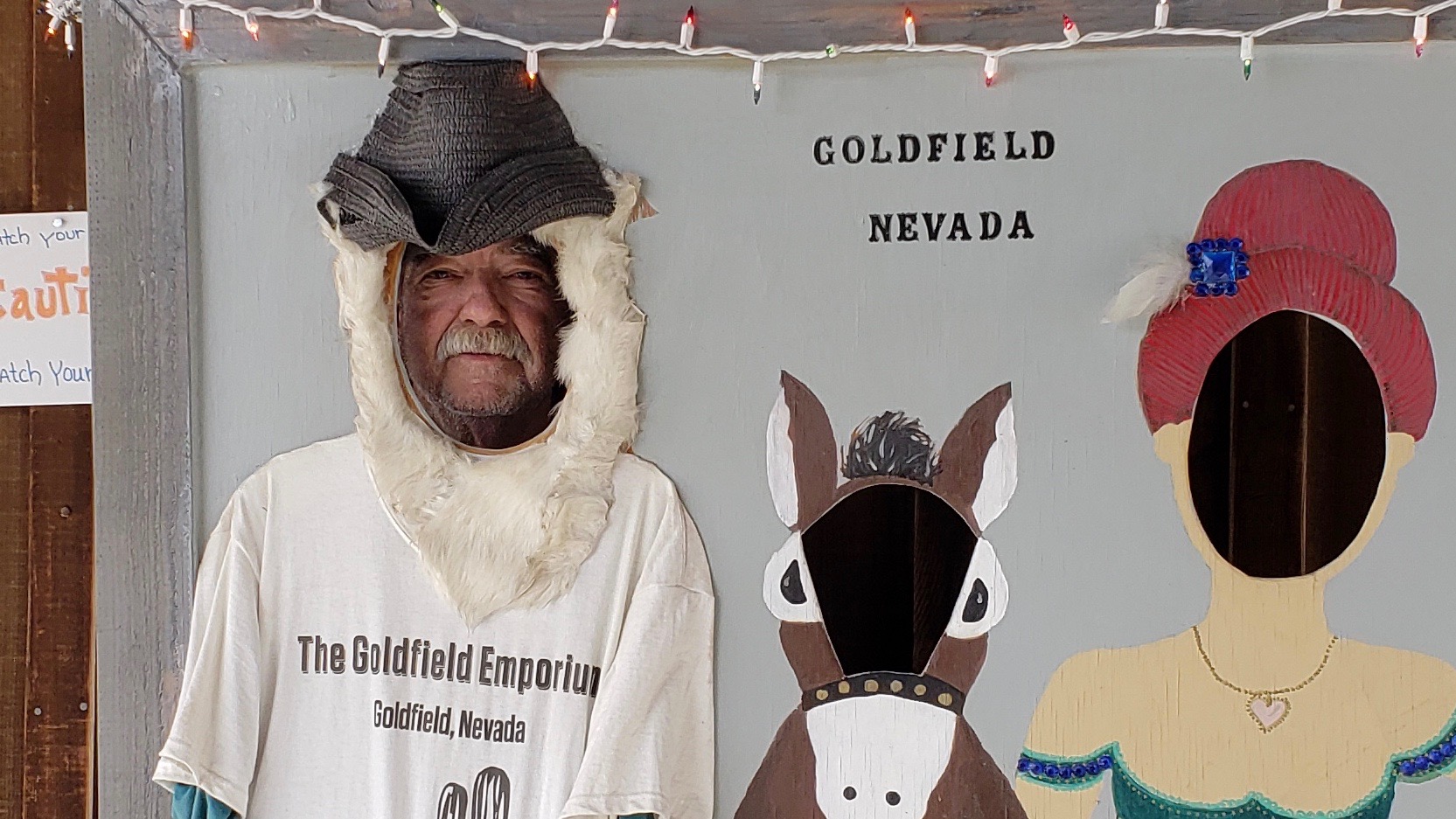
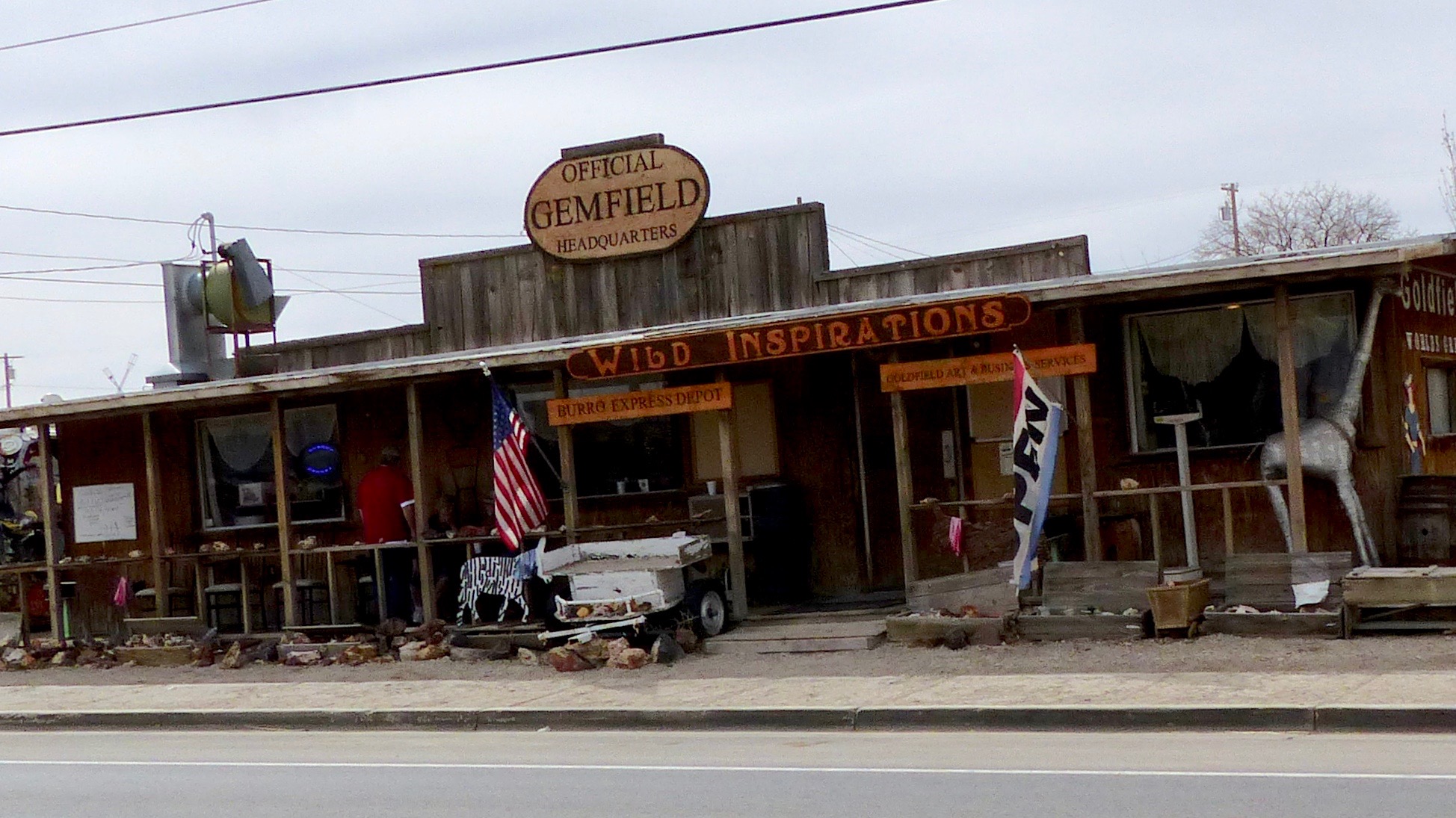
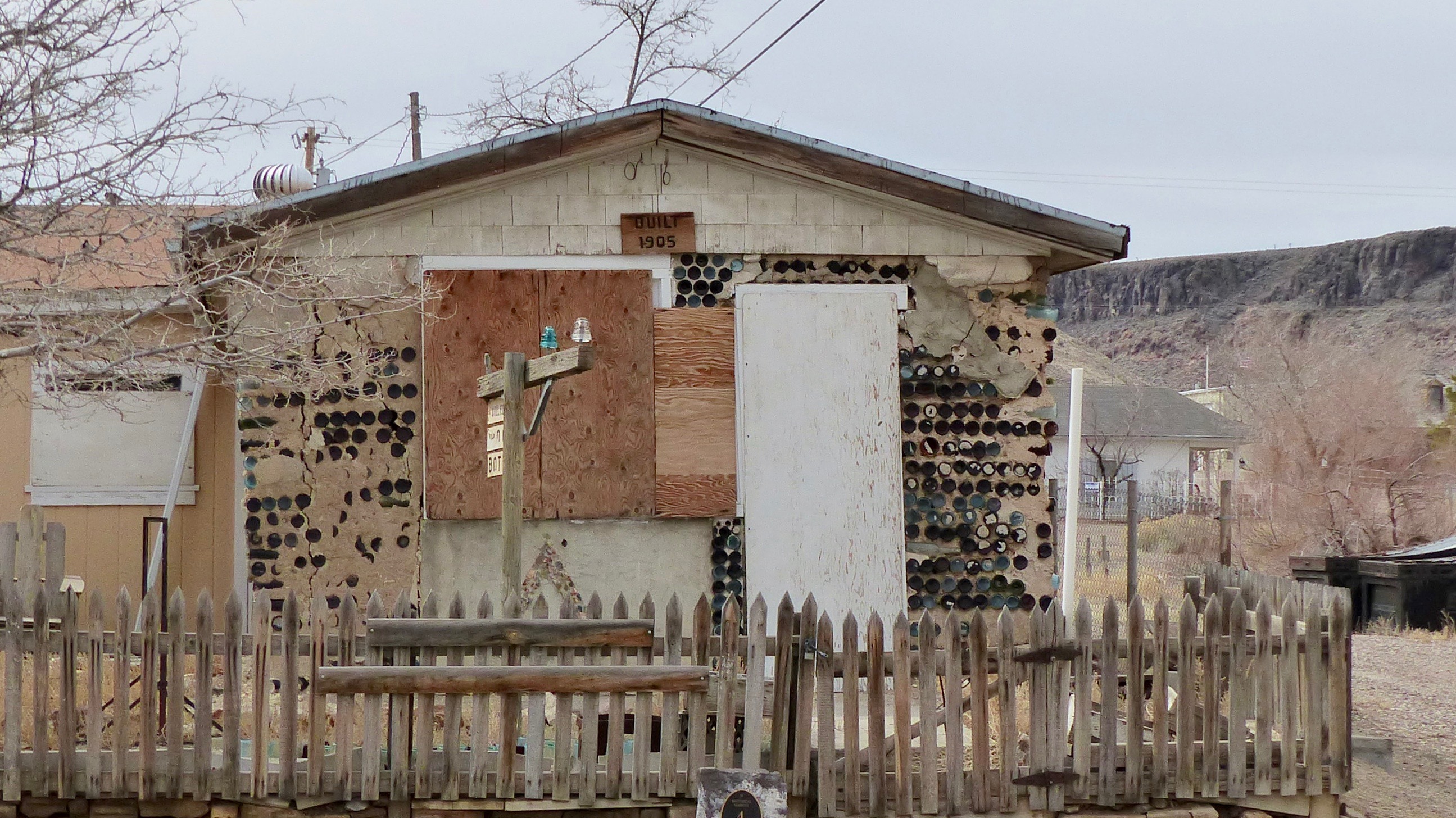
We also stopped in Goldfield. We almost didn’t when Jil thought it was just another down and out town. Well, she was correct about the down and out but the place has one hell of a history.
Mining was in deep decline from the 1880’s until the early 1900’s in Nevada. As a matter of fact the state lost one third of its population because of the downturn. Then gold was discovered in 1902 in Tonopah and Goldfield. The economy boomed, a railroad connecting Goldfield with Las Vegas was built and population swelled to 20,000, making Goldfield the largest town in Nevada at the time. Between 1903 and 1940 $86,765,044 in precious metals were mined in Goldfield alone. The current population is 288 souls.
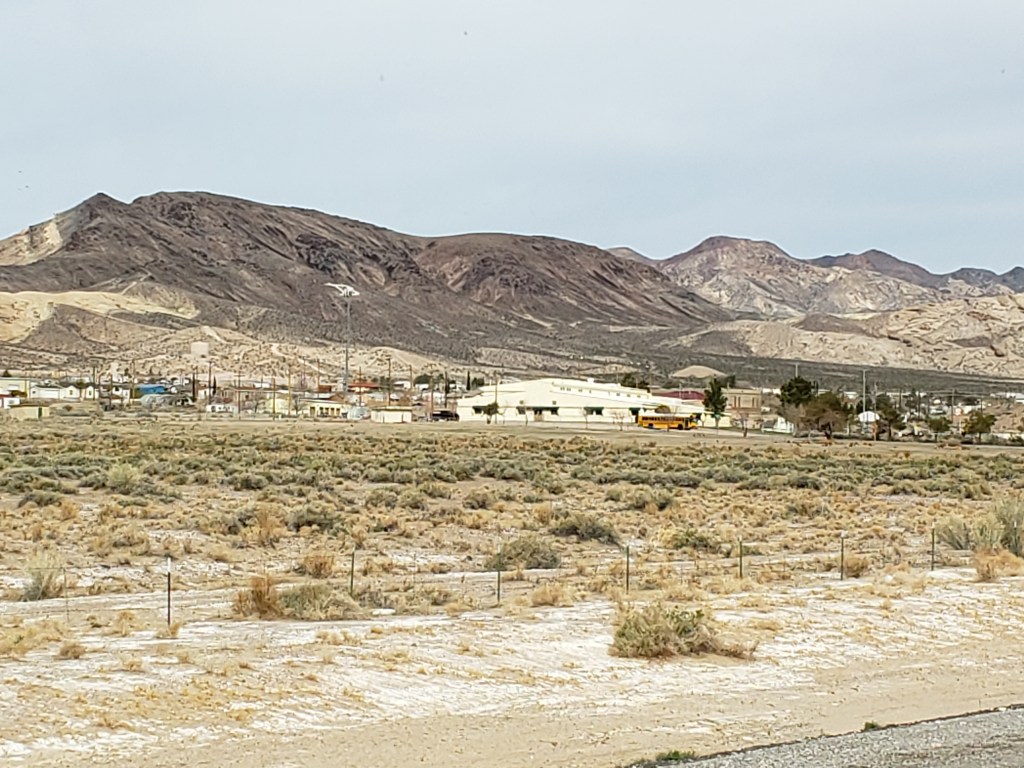
If one has never been through the State of Nevada one can only envision a desert wasteland as Nevada is the driest state in the Union. The latter is true, Nevada is very dry.
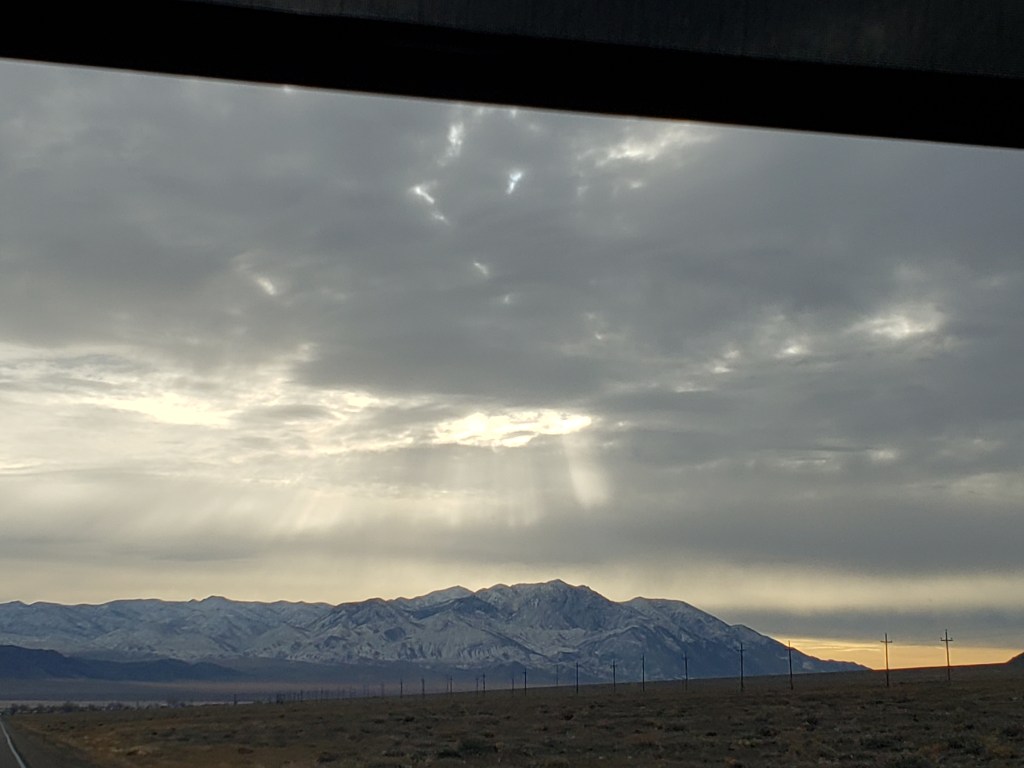
Those who have never traveled through the state may not realize is that most of it is not flat, ugly desert. There are mountains- range after range of snow capped mountains-snow capped mountains this time of year. Valleys, sure. Ya can’t have mountain range after mountain range without valleys in between.
The towns on US 95 vary in elevation from 3000 feet to over 6000 feet. Beatty (1000 souls) is fairly low at 3300 feet. Beatty is located in the Oasis Valley, home of the indigenous Shoshone people.
The town came to be the railroad hub for the mines in the Oasis Valley, including the Montgomery Shoshone Mine in Rhyolite. Tonopah (2400 souls), the site of the second richest silver strike in Nevada, is located on a hillside at over 6000 feet in elevation, yet still looks like desert. Jil liked the Clown Motel in Tonopah. NOT! She loathes Chuckie!
Jil’s Favorite Place in Tonopah!
Mining is a major concern in Nevada. Casinos mining the pockets of gamblers, sure, but I’m talking about mining minerals out of the ground. Gold and silver were discovered in the late 1800’s and early 1900’s. Many mines still exist but many more do not.
Rhyolite is one of those boom to bust gold towns which grew rapidly near the Montgomery Shosone Mine. It’s located about four miles west of Beatty near the Gold Well Open Air Museum. We didn’t visit either one of those places as we were dialed in for home. If we are ever back in this area we sure will!
Except from Wikipedia:
Industrialist Charles M. Schwab bought the Montgomery Shoshone Mine in 1906 and invested heavily in infrastructure, including piped water, electric lines and railroad transportation, that served the town as well as the mine. By 1907, Rhyolite had electric lights, water mains, telephones, newspapers, a hospital, a school, an opera house, and a stock exchange. Published estimates of the town’s peak population vary widely, but scholarly sources generally place it in a range between 3,500 and 5,000 in 1907–08.
Rhyolite declined almost as rapidly as it rose. After the richest ore was exhausted, production fell. The 1906 San Francisco earthquake and the financial panic of 1907 made it more difficult to raise development capital. In 1908, investors in the Montgomery Shoshone Mine, concerned that it was overvalued, ordered an independent study. When the study’s findings proved unfavorable, the company’s stock value crashed, further restricting funding. By the end of 1910, the mine was operating at a loss, and it closed in 1911. By this time, many out-of-work miners had moved elsewhere, and Rhyolite’s population dropped well below 1,000. By 1920, it was close to zero.
If one’s not interested in ghost towns Death Valley National Park can be accessed from Beatty or Armargosa Valley. I understand that a ten mile long lake appeared at the bottom of Death Valley a while ago. That’s what lots of precipitation can do to the desert.
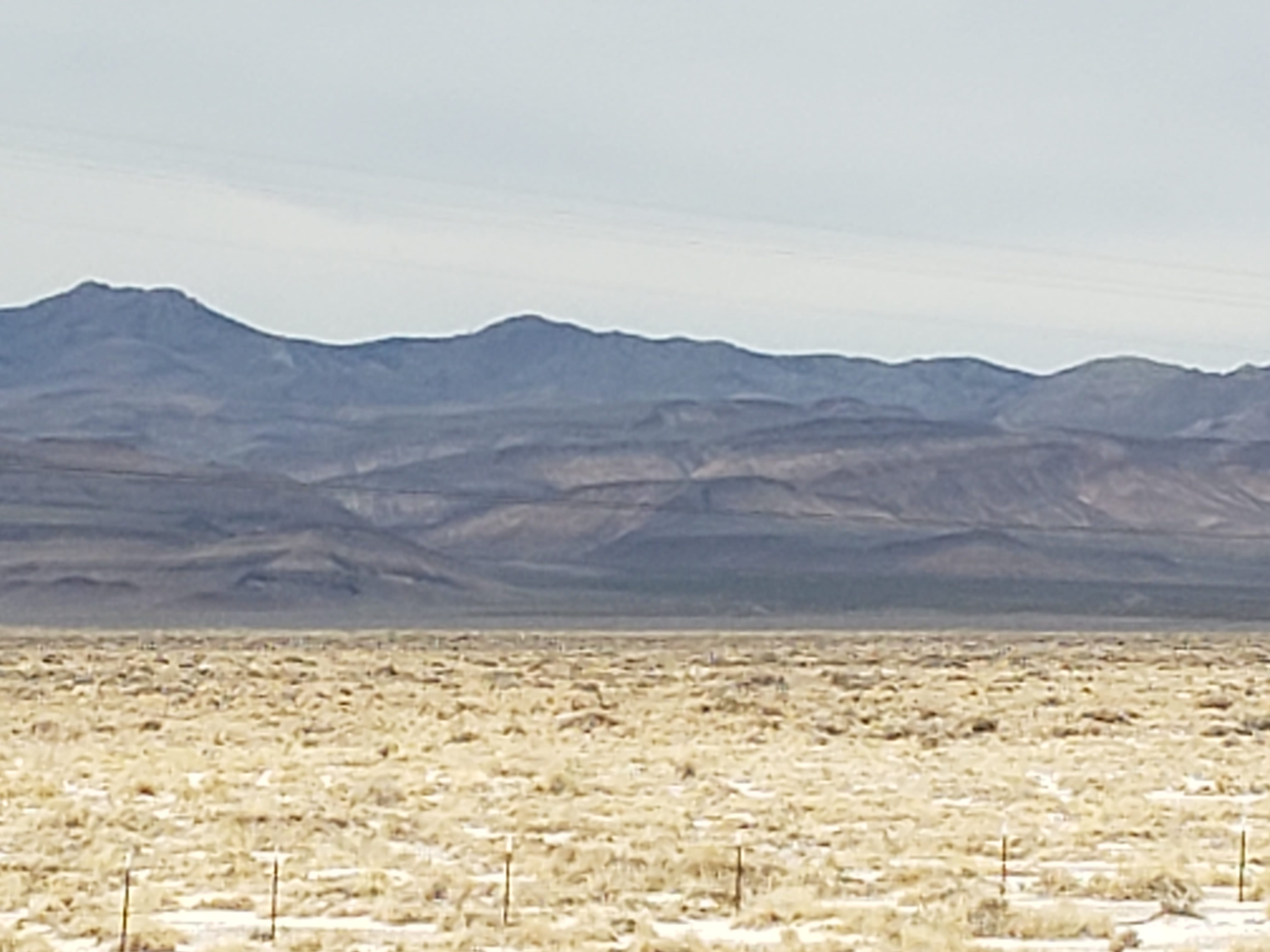
Approaching Hawthorne- Mt. Grant elevation 11,300 feet.
Hawthorne (3300 souls) is where we spent our last night on the road. Its the seat of Mineral County and the nearby Hawthorne Army Depot is the primary economic base of the town.
The Depot is the “World’s Largest Depot” according to the write up. Ammunition is divided into three ammunition storage and production areas, plus an industrial area housing command headquarters, facilities engineering shops and the like. It covers 226 square miles and contains over 2400 bunkers The depot was established after an accident virtually destroyed the Lake Denmark Naval Ammunition Depot in New Jersey in 1926, causing heavy damage to adjacent Picatinny Arsenal and the surrounding communities killing 21 and seriously injuring 53 others. The loss to the Navy alone was the equivalent of $1 billion today. A court of inquiry recommended that a depot be established in a remote area within 1000 miles of the Pacific Ocean. The Depot received its first shipment of high explosives in 1930. During WWII it became the staging area for ordinance for almost the entire war.
Walker Lake
Just north of Hawthorne is 5 by 11 mile Walker Lake. The lake is fed by the Walker River and has no natural outlet. Again we follow the valleys. Some of the valleys have enough water to raise a cows, sheep and goats. Occasionally a river runs through it as is the case of the Walker River that runs through Yerington (3100 souls). We traveled through fertile valleys where farmers grow alfafa, hay. Couldn’t tell what else as growing season has not yet begun.
Wild horses and burros share a lot of grazing land with domesticated animals. Some ranchers don’t want to share their land with wild horses so their presence can be controversial.
Silver Springs (5,000 souls) is where we leave US Alternate Highway 95 in favor of Nevada State Route 439, better known as the USA Highway. Nearby is Lake Lahonton fed by the Carson River. The reservoir was created in 1905 to supply water to farmers.
Nevada 439 is a new road connects the Tahoe Reno Industrial Center located adjacent to Interstate 80 just east of Reno/Sparks. The industrial center is the largest in the US at 107,000 acres. Its home to over 100 companies employing 4000 folks including the Tesla Gigafactory.. The facilities include rail service, water, sewer, natural gas and five power plants.
Turning westbound onto I-80 we follow the Truckee Canyon to Sparks, then through Reno. Five miles west of downtown is where we live. We have great views of the Carson Range and the Sierra Nevada Mountains. Ahhh, it’s so nice to be home!
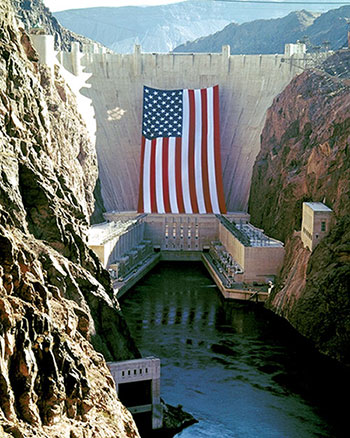
We left Blake Ranch RV Park and Horse Motel, and yes, two horses took advantage of the hotel. We headed west on I-40 to Kingman, then US Highway 93 towards Las Vegas. Along the way we paralleled the mighty Colorado River but didn’t see much of it until we got close to a very important structure that dates back 88 years.
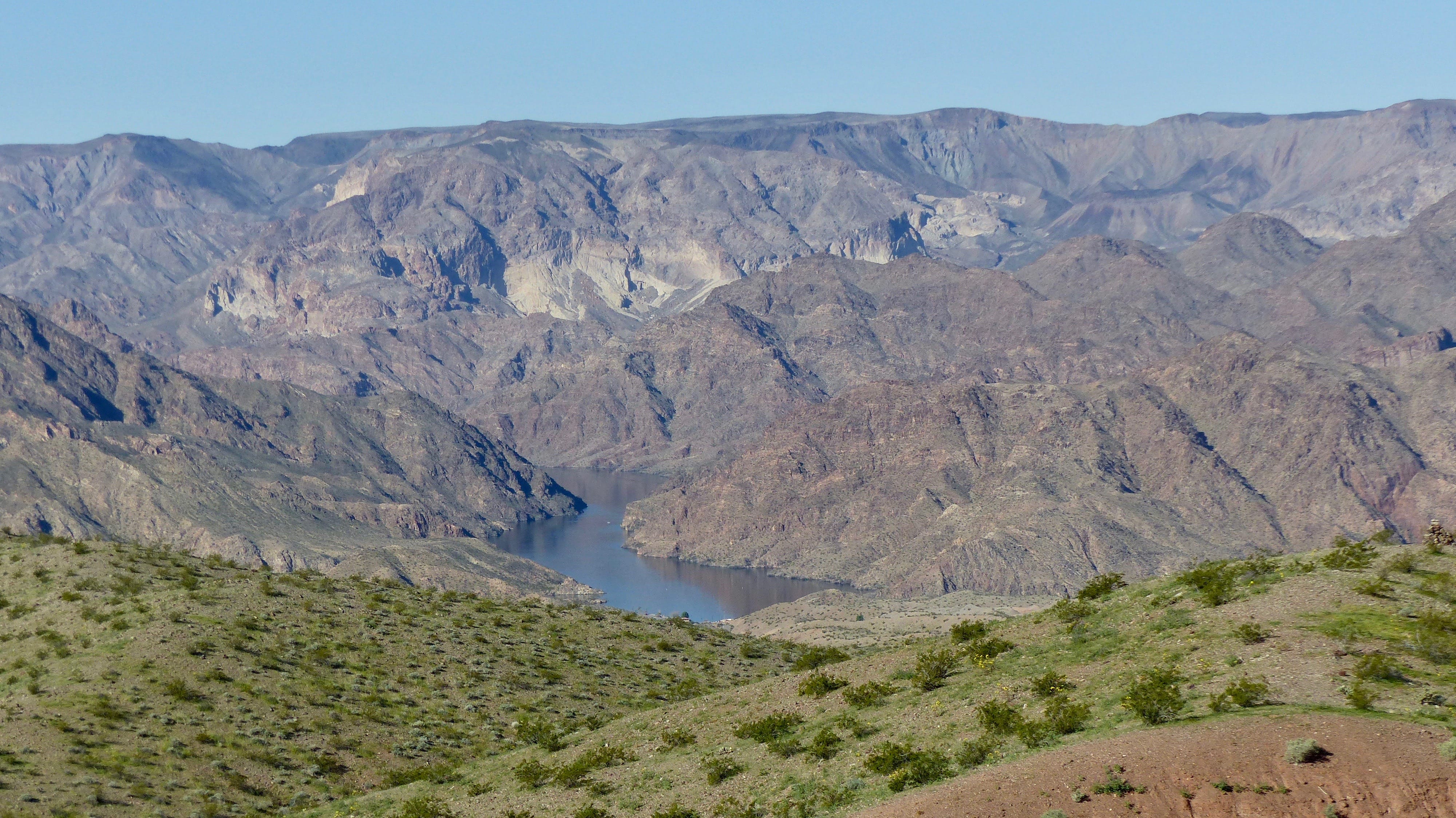
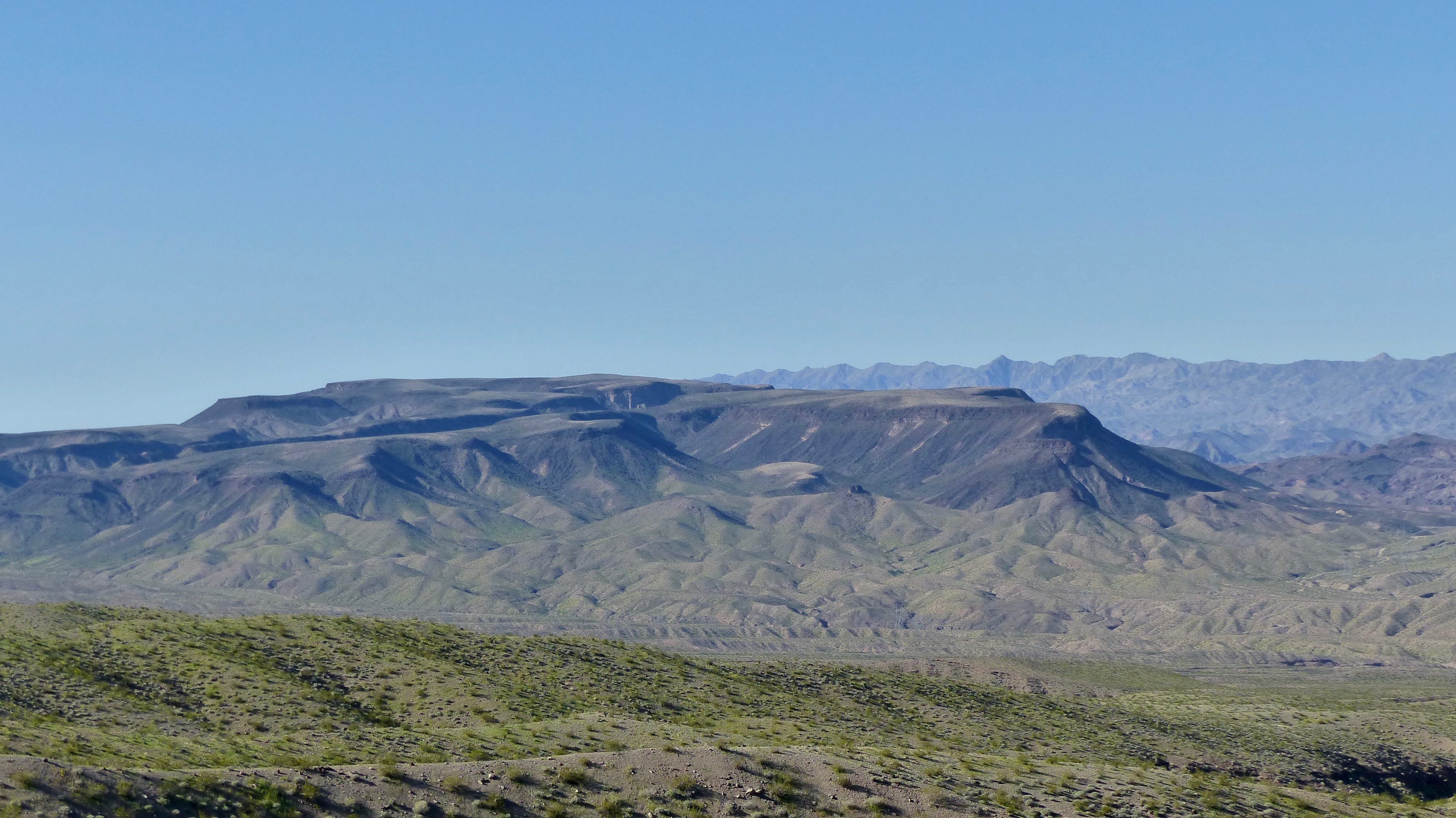
Our First Peek of the Colorado River.Green Hills Near the Colorado View of Highway 93. Photo Taken From Parking Lot 15, Hoover Dam
Some of you astute readers may have picked up on the title theme. Or maybe you’ve traveled this route before and may recognize the place to which I refer. Or, more likely my verbal nudge isn’t a very good one and no one will have a clue of what I am talking about. I vote for the latter.
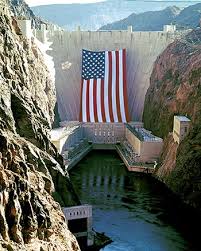
So, this place has very large intakes that supply water through penstocks to massive hydro electric turbine generators. Water from behind Hoover Dam is gravity fed reaching 85 miles per hour.
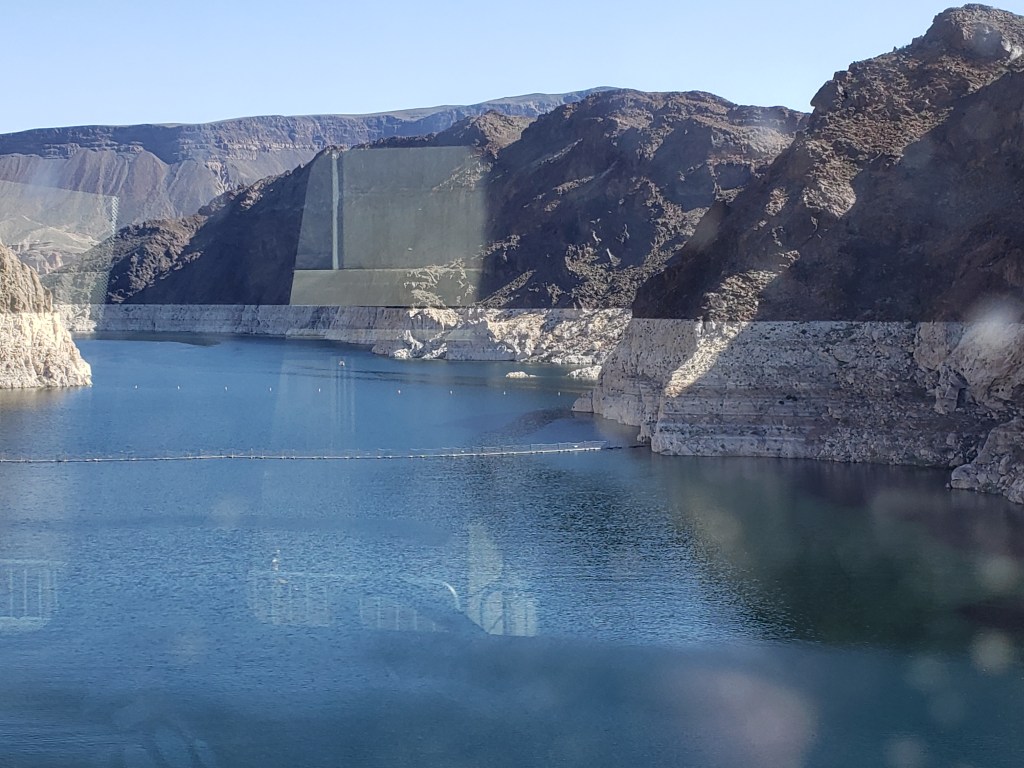
Looking Upstream From the Dam is Lake Meade- Notice the “tub ring”- Water Level is Way Down
That power turns the turbines which generate electricity for many communities. In fact the average power generated before the current drought was 4.2 Two/year or enough to power 19,800,000 homes a year! To learn more of this incredible structure from planning to completion use this link: https://en.wikipedia.org/wiki/Hoover_Dam
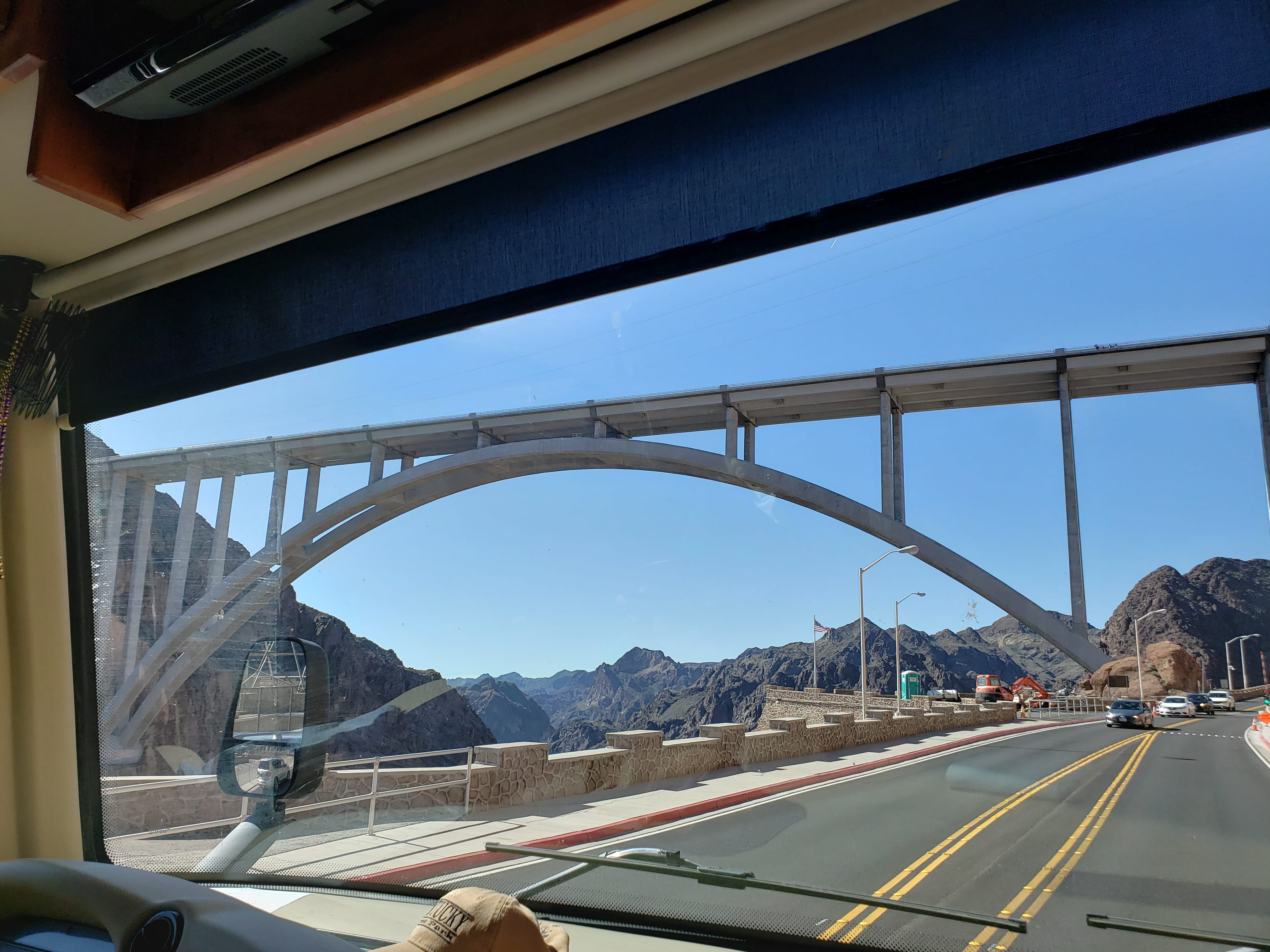
And oh has everything changed here for the visitor since 911. A new visitors center was built and 15 new parking lots dot the hillside on the Arizona side of the dam. After the terrorist attacks on New York and Washington D.C. all vital facilities including dams were put off limits. One used to be able to cross most every dam that included a roadway. In fact the main thoroughfare for one traveling from Las Vegas to say Bullhead City, Kingman or Flagstaff included driving across Hoover Dam. For several years Hoover Dam was off limits. A very high bridge was built over Black Canyon to the south of the dam which once again allowed travel between the states of Arizona and Nevada via US 93.
Highway 93 Passes Over Black Canyon Near Hoover Dam
We spent some time at the dam but couldn’t take the mutzos on it or in it. Nor could we park the beast anywhere but on a hillside parking lot high above the dam. Parking lots are numbered one through 15 and 15 is where big rigs park. I’m sure it would have been a 3/4 mile walk down a very steep hill to get down to the dam and a huff and puff back. We got searched, or our rig did, at a security checkpoint before reaching the dam as well as did every other vehicle. 15 parking lots you say? Yes, Hoover Dam is a very popular tourist attraction. Not only the dam but several overlooks are provided along US 93 for a more broad overview of the dam and Lake Meade.
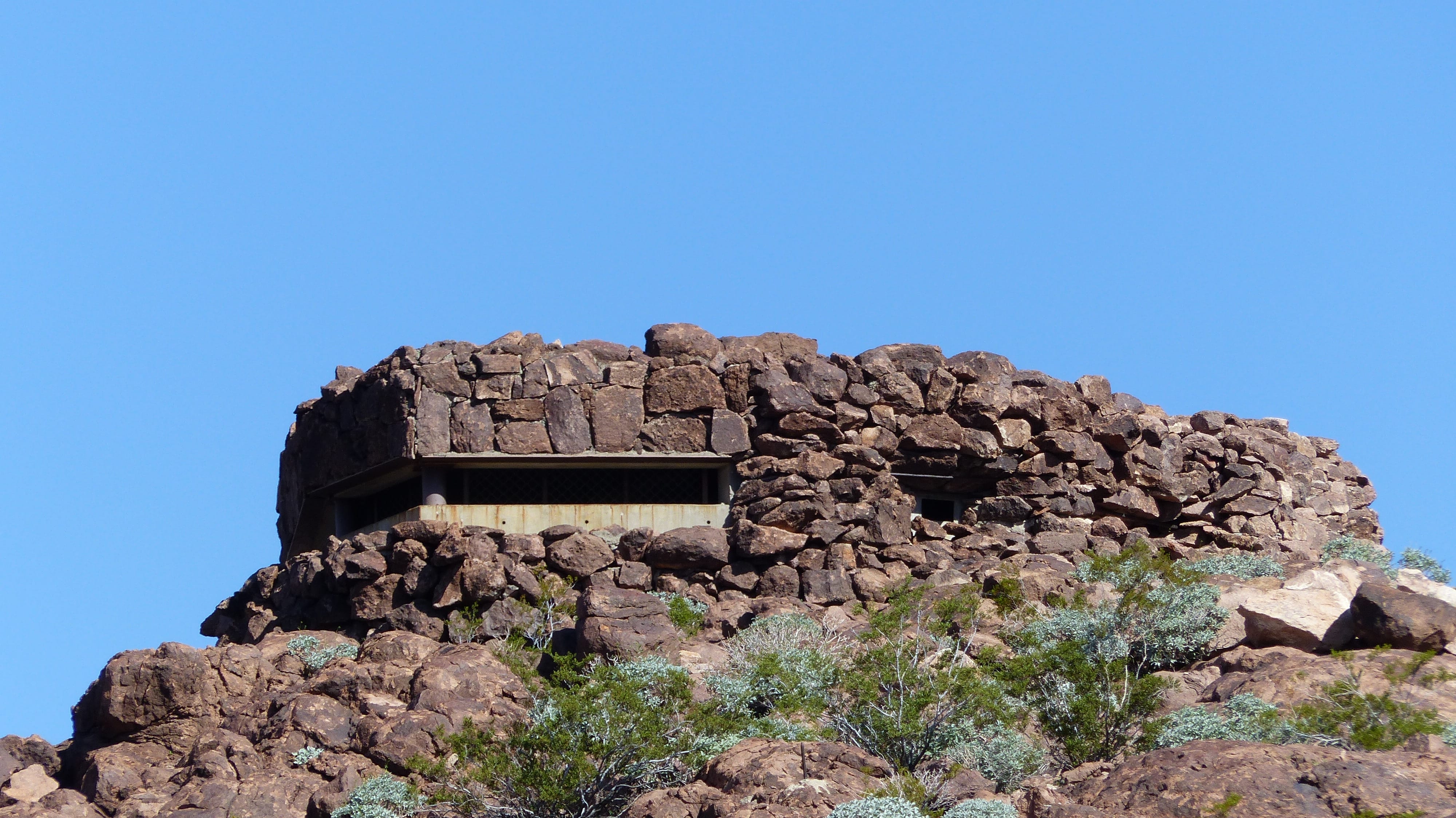
Vintage WWII Bunker Created to Protect Hoover Dam Sits High On a Hill On The Arizona Side
We push on towards Lost Wages, er. Las Vegas, skirting the Strip to its south. Las Vegas has grown exponentially over the last decade.The city’s population is over 600,000 souls. In combination with the rest of Clark County’s 2.2 million folks it accounts for 3/4 of the state’s population. A few more transitions and we are heading northwest on Nevada Highway 160 passing Red Rock Canyon and a very new master planned community on the outskirts of Las Vegas. We travel over a mountain pass enjoying the snow capped mountains to our north. An hour after leaving Las Vegas we reach our home for two nights, Lakeside Casino and RV Resort in Pahrump, NV (36,000 souls).
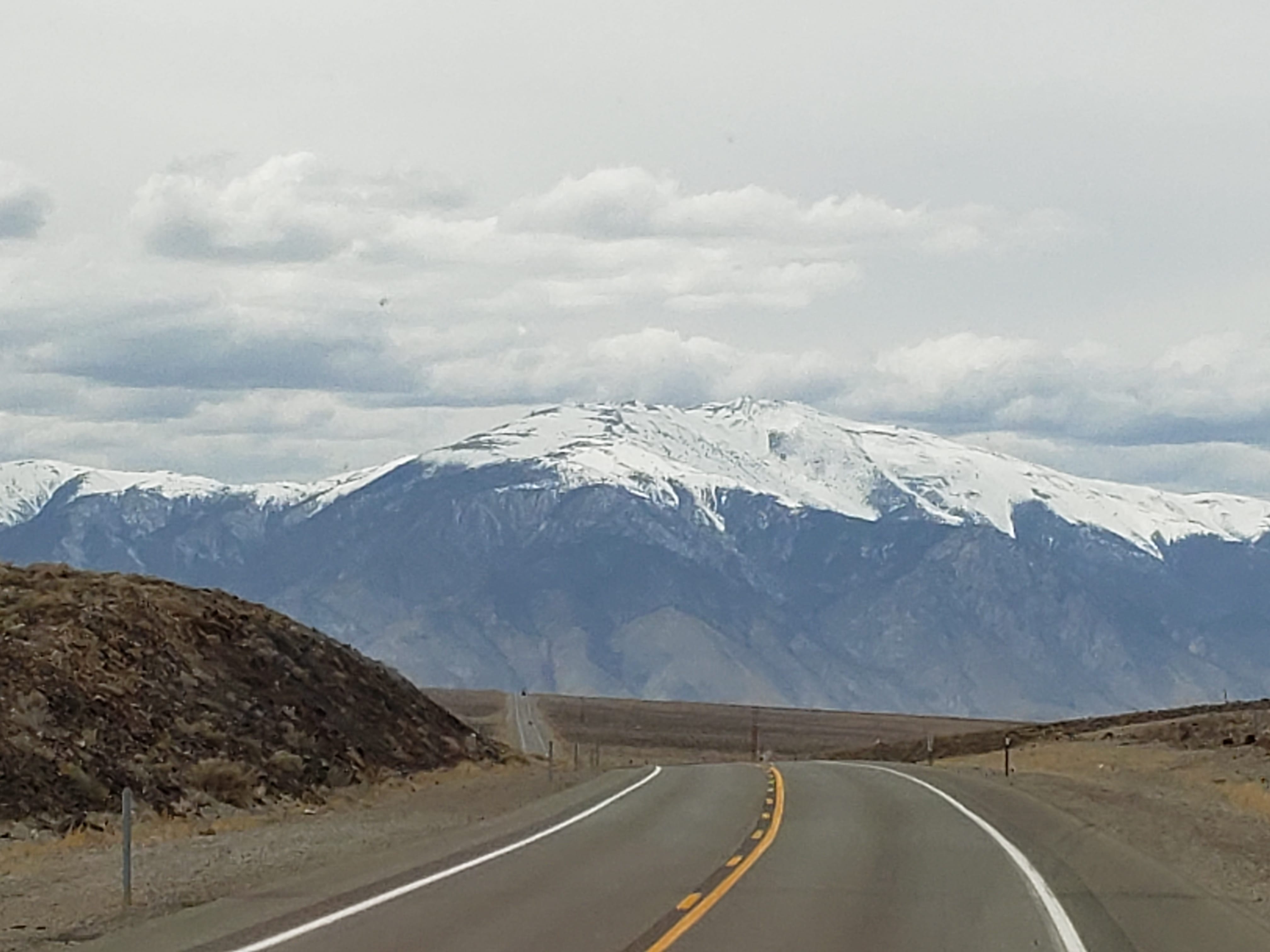
View From Lakeside Casino and RV Park Towards Snow Capped Mt. Charleston, Elevation 11,916 feet.
Excerpt from Wikipedia:
Pahrump was originally inhabited by the Southern Paiute. It was slowly inhabited by settlers in the late 19th century. They reportedly chose the name for Pahrump after the original indigenous name Pah-Rimpi, or “Water Rock,” so named because of the abundant artesian wells in the valley.
From here we’ll head towards Hawthorne with a one night layover, then to home. See you then!
I know, this post is a little out of sequence. It should have been posted before “Hit By A Dustdevil”. Hey, I’m not perfect, OK?
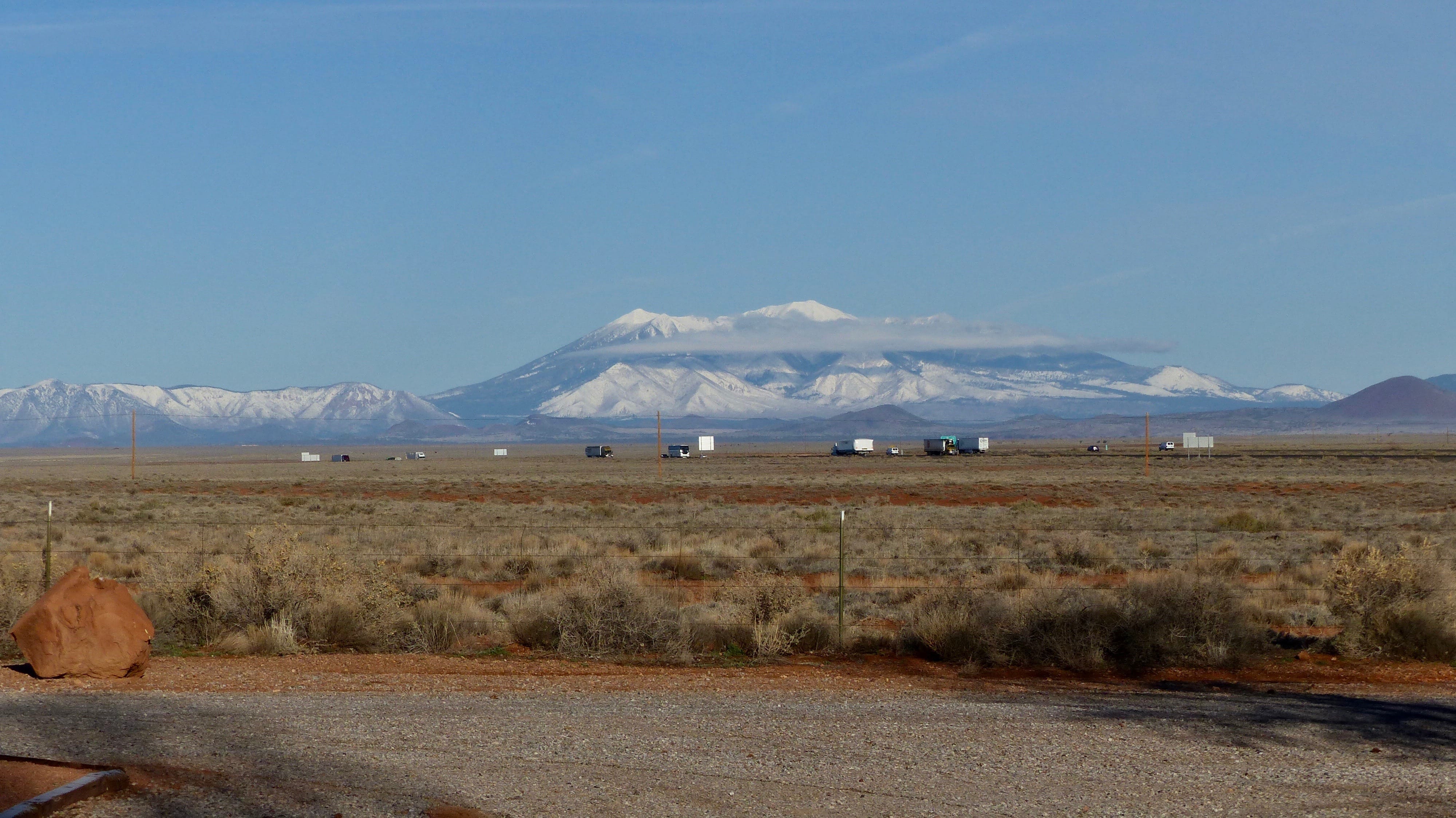
What I didn’t tell you is how nice it is to cross the shoulder of the San Francisco Peaks, the highest being Mt. Humphreys at 12,633 feet. Flagstaff (70,300 souls) is the largest city north of Phoenix. It’s a really nice city situated in prime location for businesses such as Purina PetCare and is home to the Lowell Observatory and the Northern Arizona University.
What we didn’t know was what the heck is at Walnut Canyon. The canyon is located just east of Flagstaff about three miles south of I-40. We decided to go find out since we had a short travel day. We got there a half hour before Walnut Canyon National Monument opened, so we took the dogs for a walk before the gates opened.
The following is an excerpt from the National Park Service website:
Walnut Canyon has a long human history. Artifacts show that Archaic peoples occupied the canyon at times. Later came the first permanent inhabitants, who flourished in the region from about A.D. 600 until 1400. Archeologists labeled this prehistoric culture Sinagua, from the old Spanish name for the region, Sierra de Sin Agua, or “mountains without water.”
Scattered families farmed the canyon rims for centuries, growing small gardens of corn, squash, and beans. During the 1100s, many moved into limestone alcoves below the canyon rim, where they constructed the cliff dwellings we see today. The Walnut Canyon community thrived for another 150 years before the people moved on.
Others have visited the canyon since the Ancients departed. With the construction of the railroad nearby in the 1880s, Walnut Canyon became a popular destination; scores of “pot-hunters” streamed into the canyon. Armed with shovels and dynamite, these souvenir-seekers upturned ancient floors, toppled enduring walls, and desecrated graves.
The theft and destruction alarmed local citizens and led to establishment of Walnut Canyon National Monument in 1915. Remnants of the canyon’s past were protected first by the US Forest Service, then (since 1934) by the National Park Service.
Dogs aren’t allowed in the canyon so we parked and then walked the rim trail. We could see quite a few of the 25 cliff structures. It amazes us that folks would prefer to live on the cliffs
Flagstaff has a strong tourism factor due to its proximity to Grand Canyon National Park, Oak Creek Canyon, the Arizona Snowbowl, Meteor Crater, Sedona, and historic Route 66. We’ve stayed in this area before and enjoyed what it has to offer but hadn’t visited Walnut Canyon. Downtown Flagstaff’s streets aren’t terribly RV friendly so we decide to push on to Kingman.
OK it wasn’t that bad. We are at Blake Ranch RV Park and Horse Motel. Yes, you read that right, horse motel. Cowboys can stop here and off load their fillies into on site stables. We had some doubts as to whether we could stay at this highly rated park. We called ahead as was informed that there was no vacancy but that was before check out time. Call back! Okie, Dokies, we called back and yes, they have a vacancy now. Yay! We arrive and the work camper lady behind the desk says “Oh, Oh, we appear to have someone coming in and they reserved that spot.” Crap. “BUT, we can put you in a site over by the horses.” OK then!
So we pull into our site next to the horse stable just as two beautiful horses are being off loaded from their trailer. It’s one of those trailers that houses horses in the back and humans in the front. It looks pretty nice from the outside. Our site doesn’t have 50 amp electric service so we are somewhat limited as to how much power we can draw without tripping the breaker so we’ll have to be a little more frugal with our power usage.
OK back to the title. We just get back to the rig after walking the mutzos and a little dust devil kicks up. No big deal, everyone is inside except me- and I’m wearing my new ball cap that Jil just bought for me yesterday. It’s a Route 66/Take It Easy, Winslow Arizona themed hat and I really like it- GONE! The dust devil got stronger- and I was just able to get the door closed before all the flying debris was blown inside the rig. In the process my cap was blown off of my head and is now somewhere near the New Mexico Border by now. Darn.
I’ll probably spent an hour looking for it and never find it. I think God was trying to tell me something. You see, for some reason I was really tired yesterday. Besides being tired a few things didn’t go as perfectly as I thought they should. That caused a little dust up with Jil and it was all my fault. I felt weird like my brain was just numb. I wasn’t mad but my attitude caused My Sweetie to B.L.E.V.E. (Boiling Liquid Evaporating Liquid Explosion) and I don’t blame her. But I guess my attitude was viewed as close enough to anger by Our Lord. An excerpt from yesterday’s Gospel reading by Matthew states-“But I say to you, whoever is angry with his brother will be liable to judgment”. I think that dust devil taking my cap was actually the Lord warning me- First the hat my son, first the hat……
Visitors Center Located at 7 O’Clock at the Lower Edge of Meteor Crater
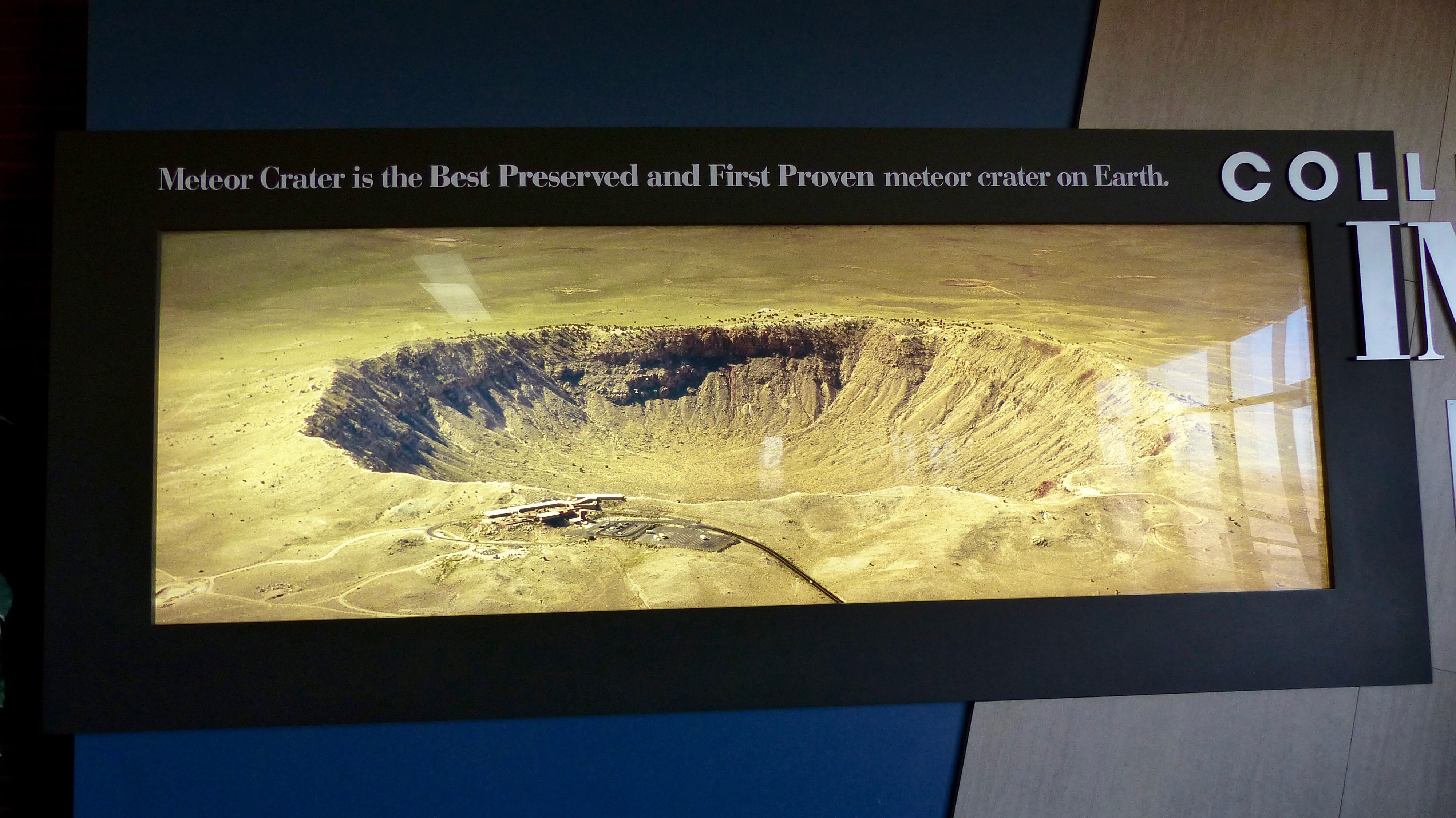
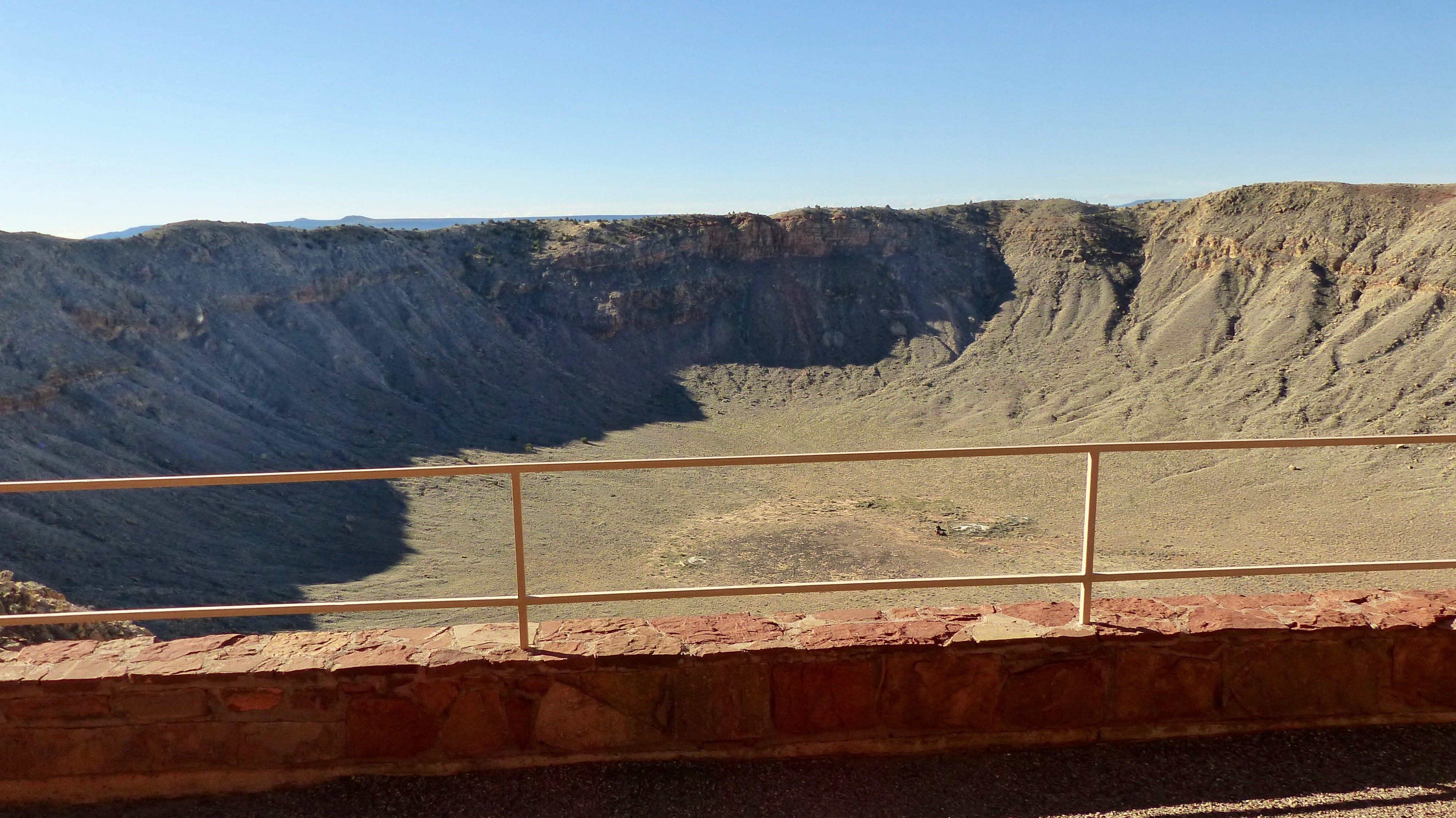
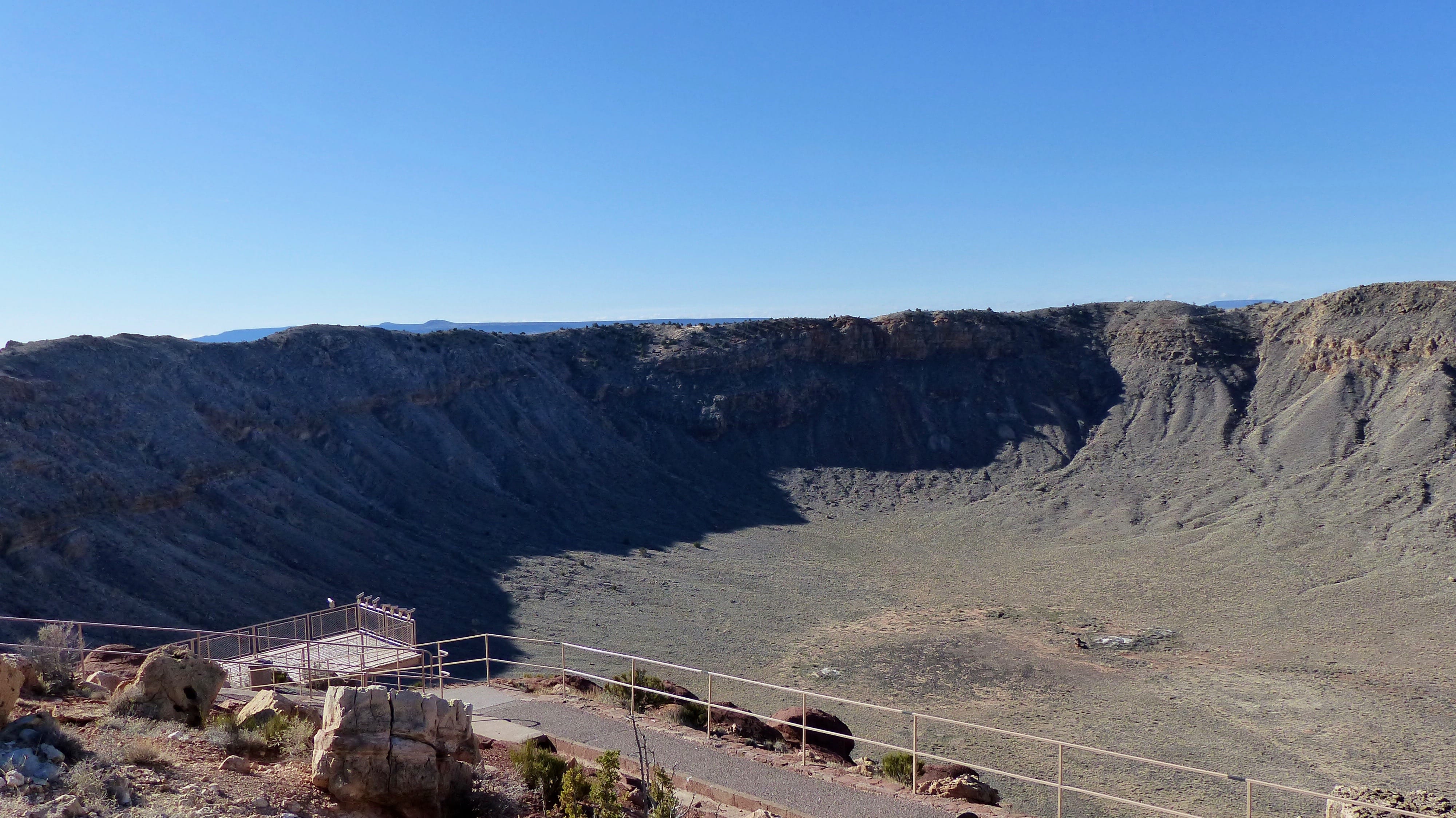
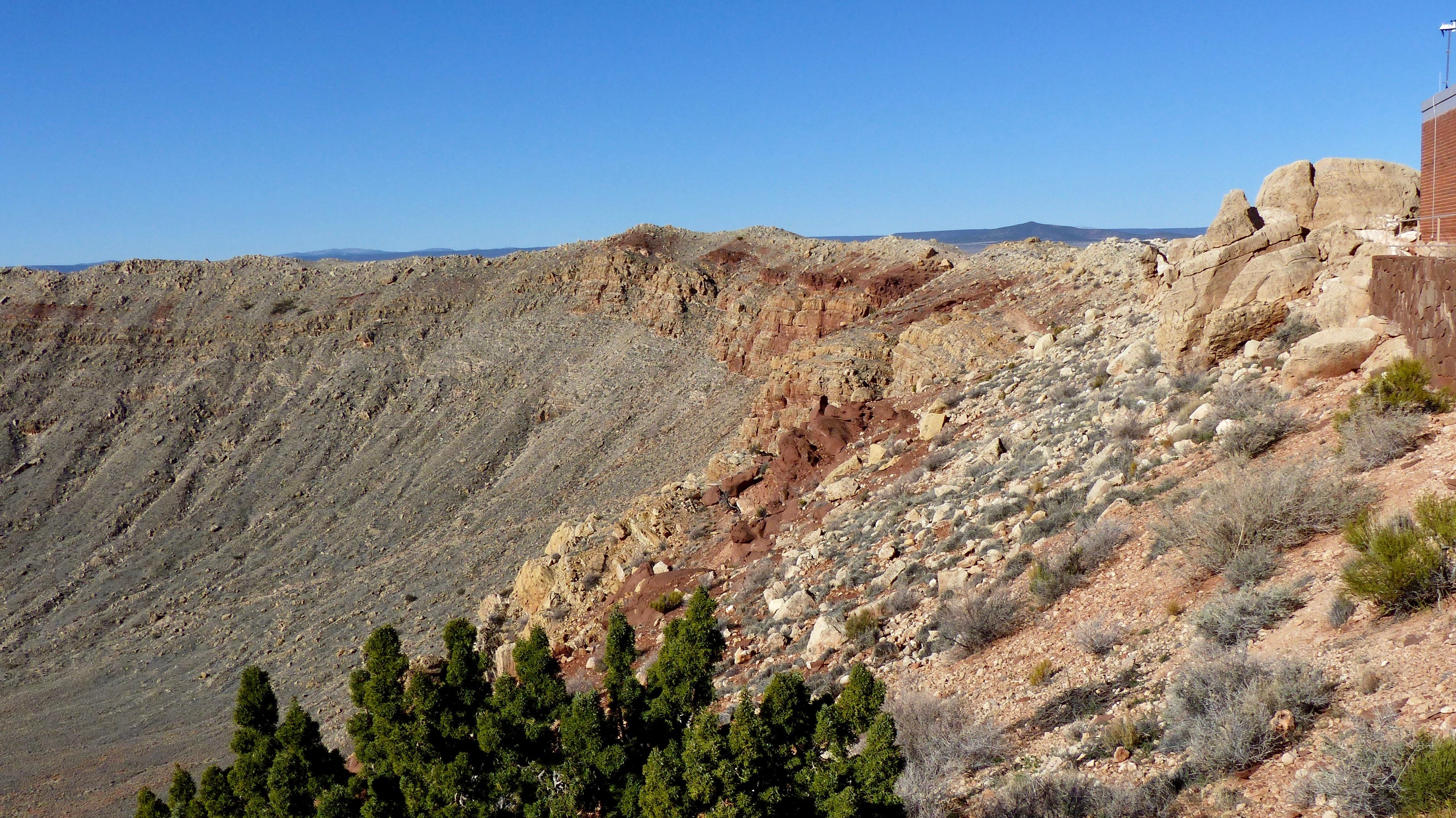
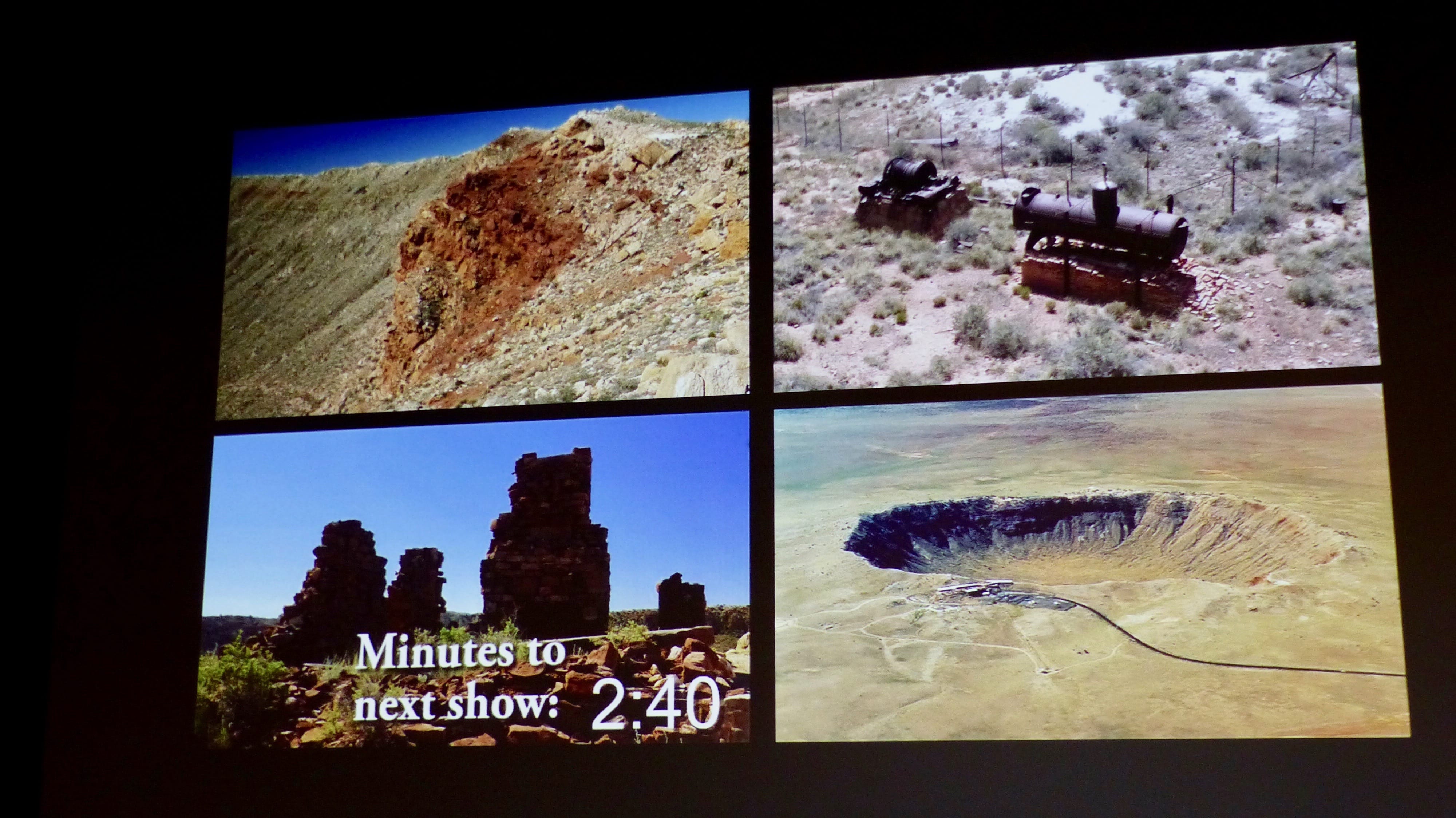
Yesterday we went to the Meteor Crater blasted out by a meteor strike 50,000 years ago. Man, that hole in the ground is big! It’s a mile walk around its perimeter. The blast debris surrounding it looks like the normal terrain so one would never know the crater is there unless they walked up to the top- and looked way down to the bottom. It is on the National Register of Historic Places but is privately owned, the same owner as the Meteor Crater RV/gas station/mini mart where we stayed.
Looking Up at Visitors Center
The claim is that the crater is the best preserved meteor crater in the world. It has been the subject of many scientific studies as is noted by wells drilled down at the bottom of the crater.
Drill Site in Bottom of Crater
At first it was thought that the crater was created by volcanic activity like the majority of them are. Scientist drilled holes looking for the meteor that produced the crater but never found it. Small meteors have been found in the area however.
The site also has a visitors center that focuses on meteors in outer space, how they affect the earth, space travel and much more. Meteor Crater is a must see if you are in the area.
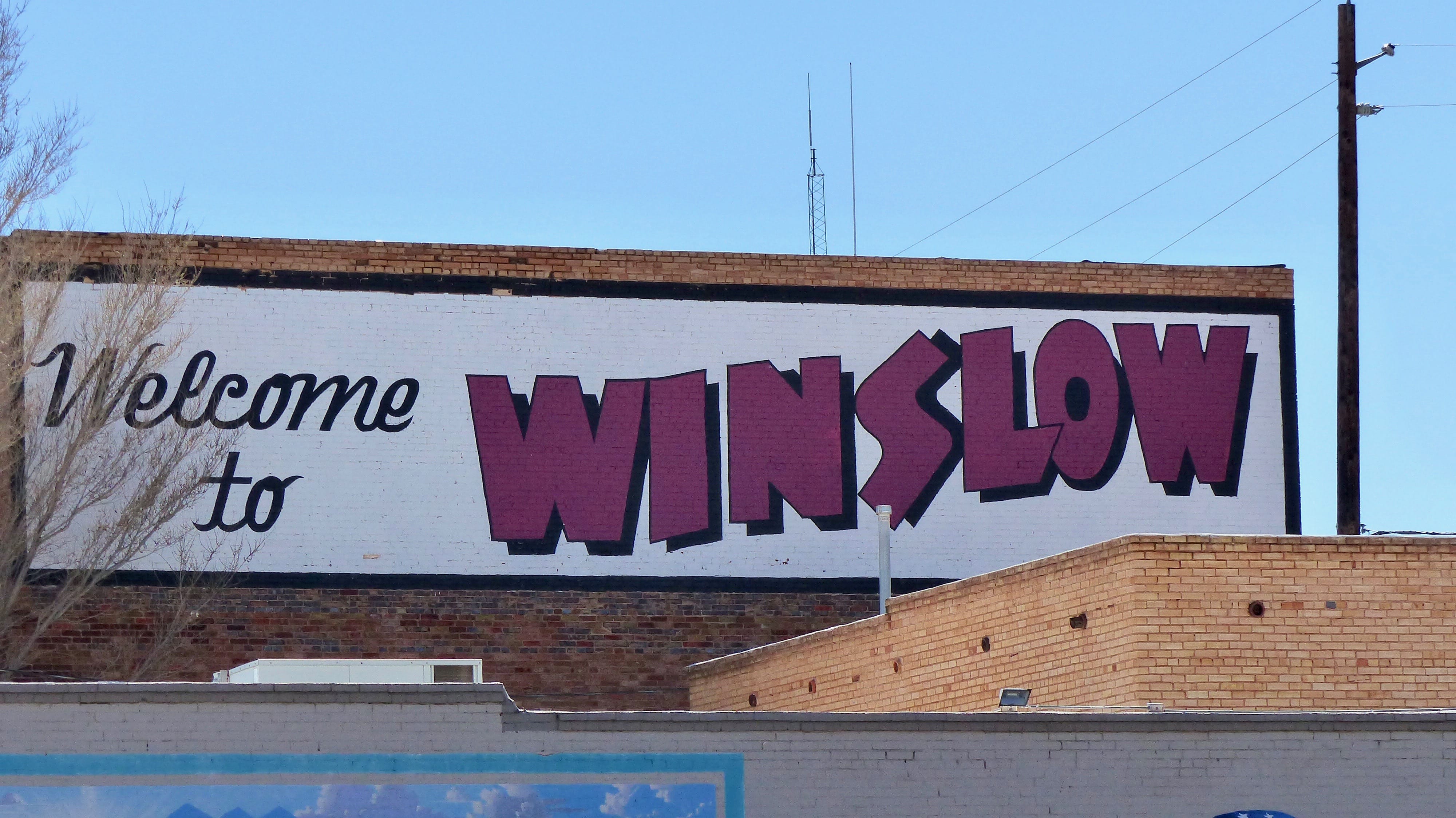
Next we drove 20 miles east to Winslow, you know, this Winslow Arizona:
Lyrics: Take It Easy by The Eagles
Well, I’m running down the road tryin’ to loosen my load I’ve got seven women on my mind, Four that wanna own me, Two that wanna stone me, One says she’s a friend of mine Take It easy, take it easy Don’t let the sound of your them old wheels drive you crazy Lighten up while you still can don’t even try to understand Just find a place to make your stand and take it easy Well, I’m a standing on a corner in Winslow Arizona and such a fine sight to see It’s a girl, my Lord, in a flatbed Ford slowin’ down to take a look at me Come on, baby, don’t say maybe I gotta know if your sweet love is gonna save me We may lose and we may win though we will never be here again so open up, I’m climbin’ in, so take it easy Well I’m running down the road trying to loosen my load, got a world of trouble on my mind lookin’ for a lover who won’t blow my cover, she’s so hard to find Take it easy, take it easy don’t let the sound of them old wheels drive you crazy come on baby, don’t say maybe I gotta know if your sweet love is gonna save me, oh oh oh Oh you knoe we got it easy We oughta take it easy
That song Take It Easy was co-written by Jackson Browne and Glenn Frye and made famous by The Eagles. Winslow citizens picked up on the “Winslow Arizona” mentioned in the song and are capitalizing the title- Take it Easy.
The 1958 Flat Bed Ford
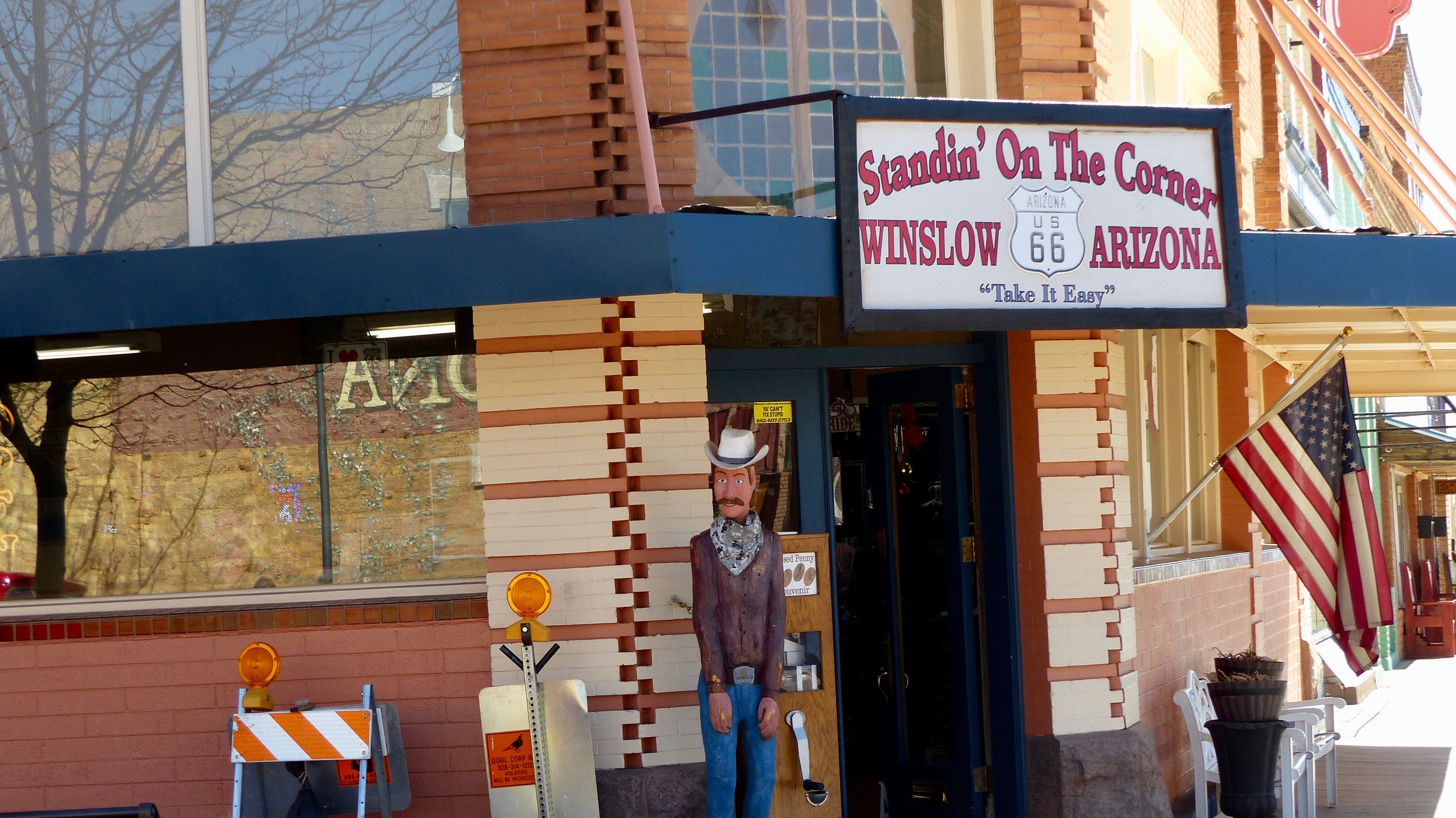
In 1999 the small park “Standin’ On The Corner“Park was opened right in the middle of town. It features two statues, one of a dude with a guitar and one of now deceased Glenn Frye with a theme back drop painted on the wall behind.
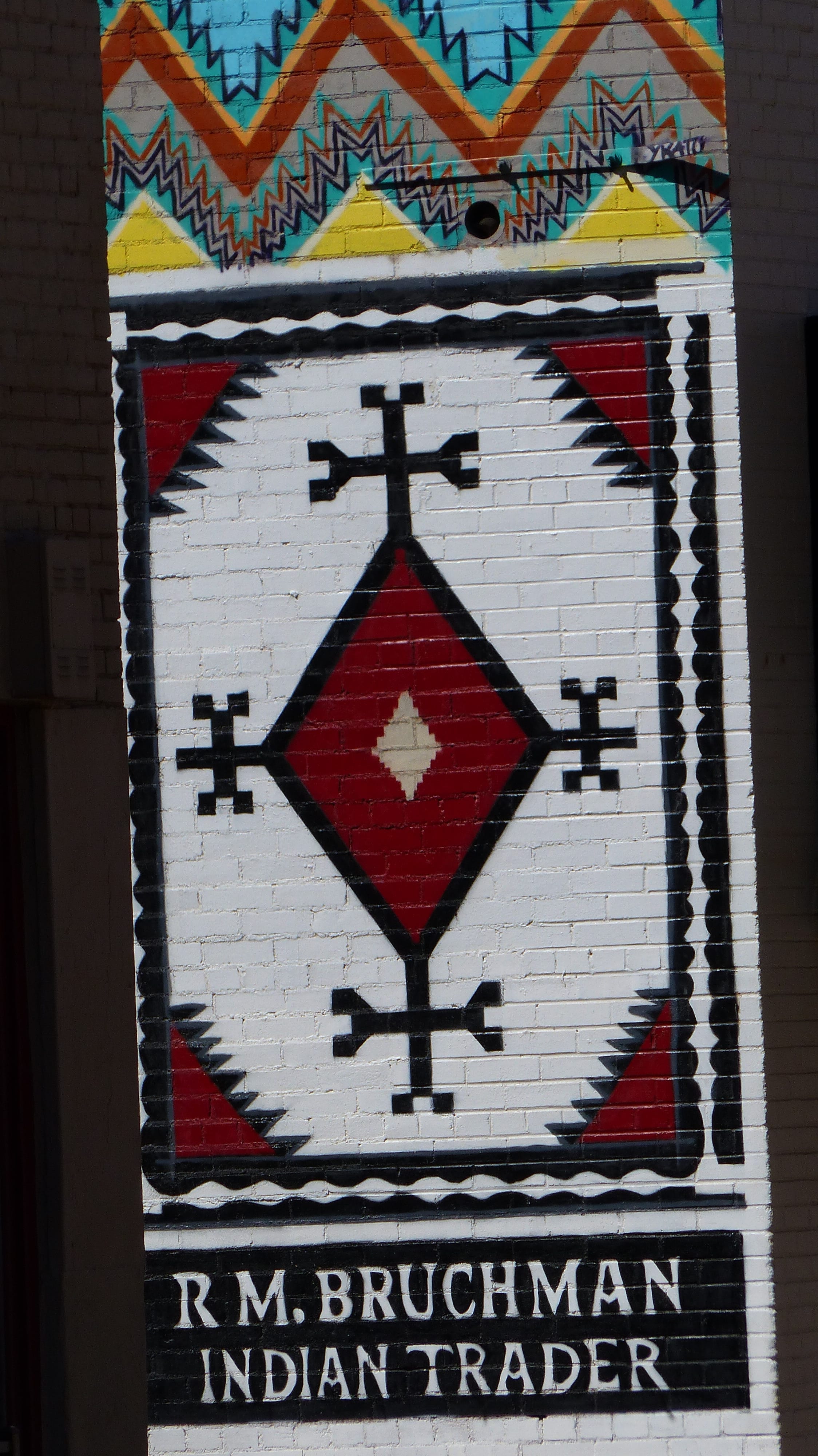
Window Map of US Route 66- Chicago IL to Santa Monica CAIndian Trader?
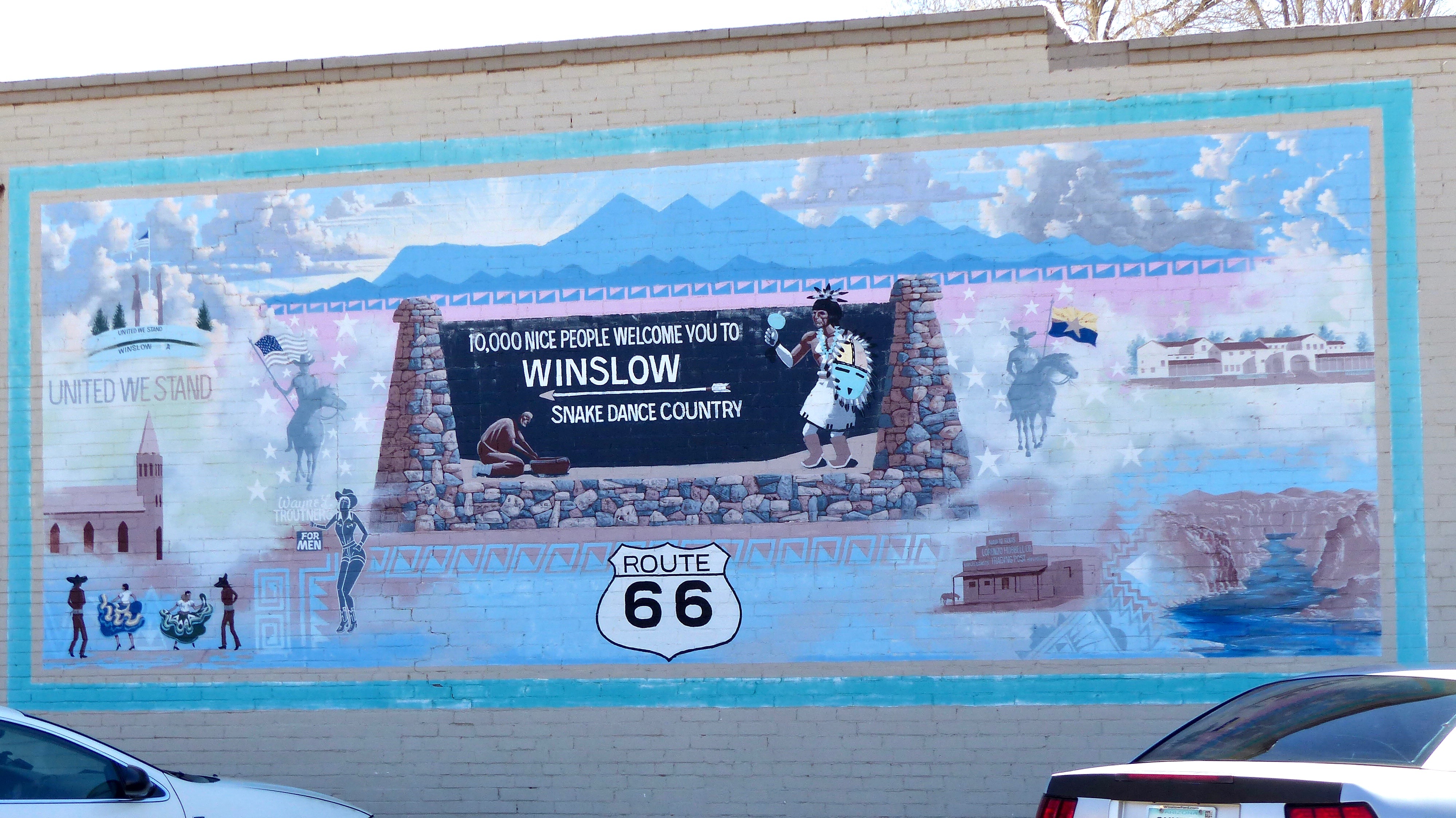
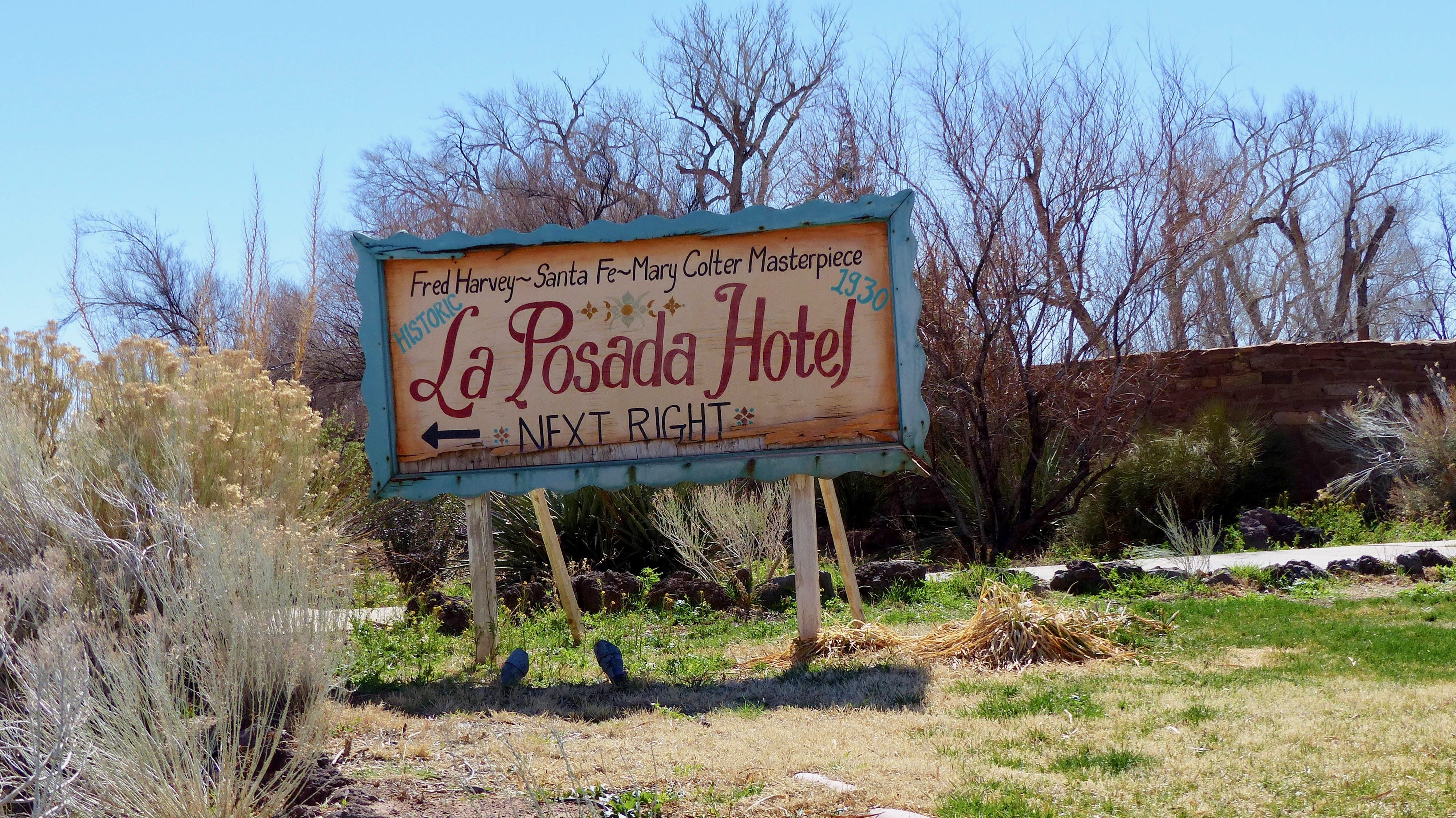
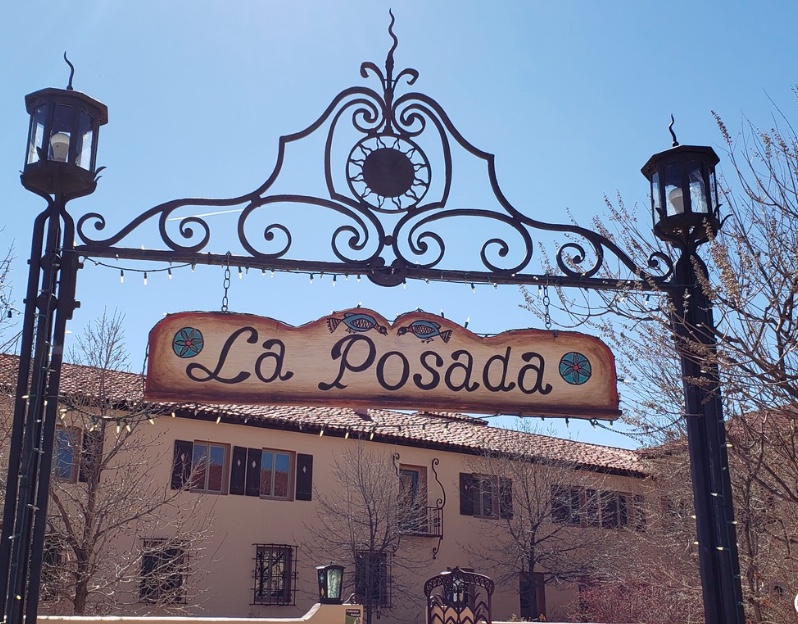
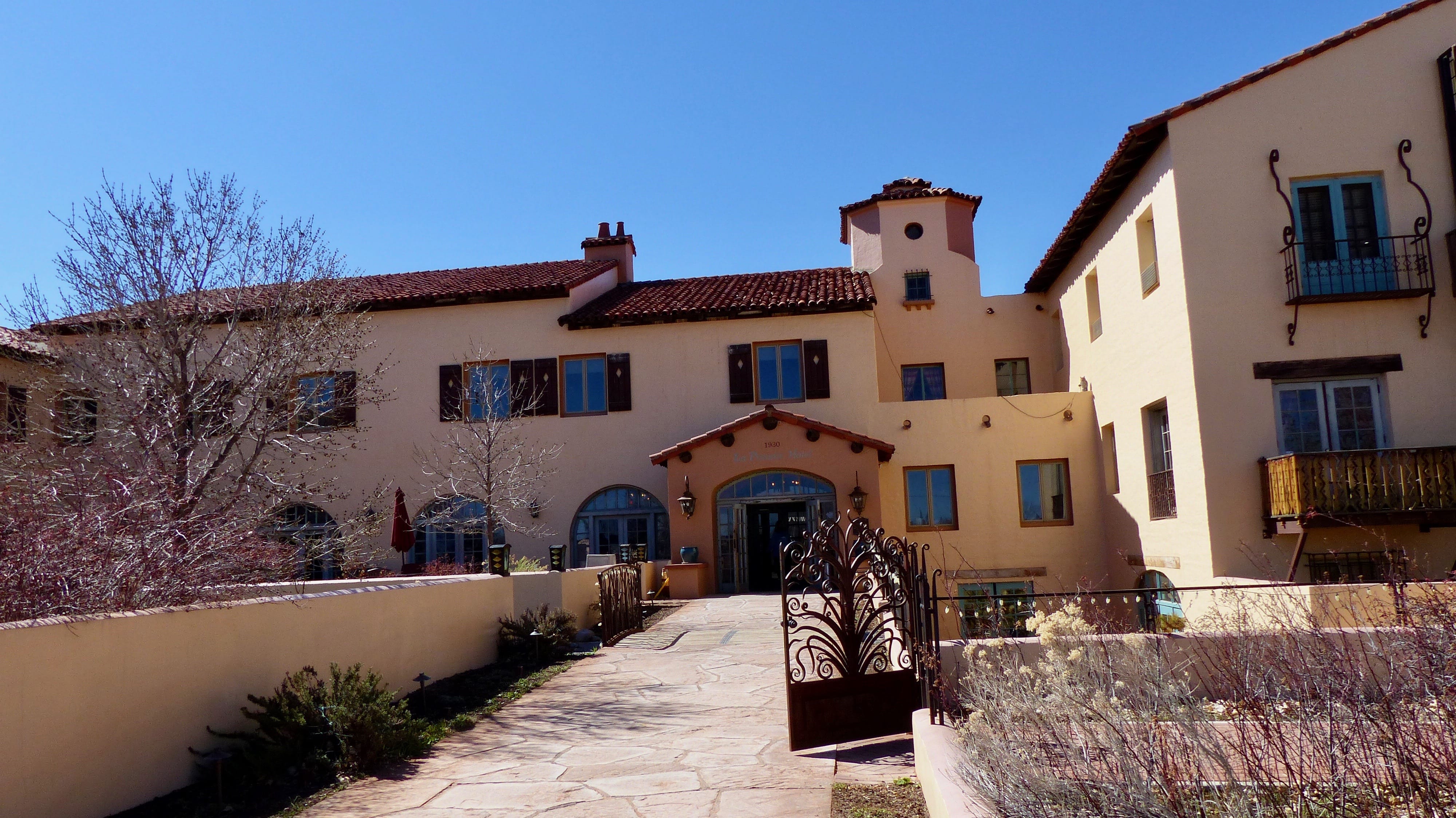
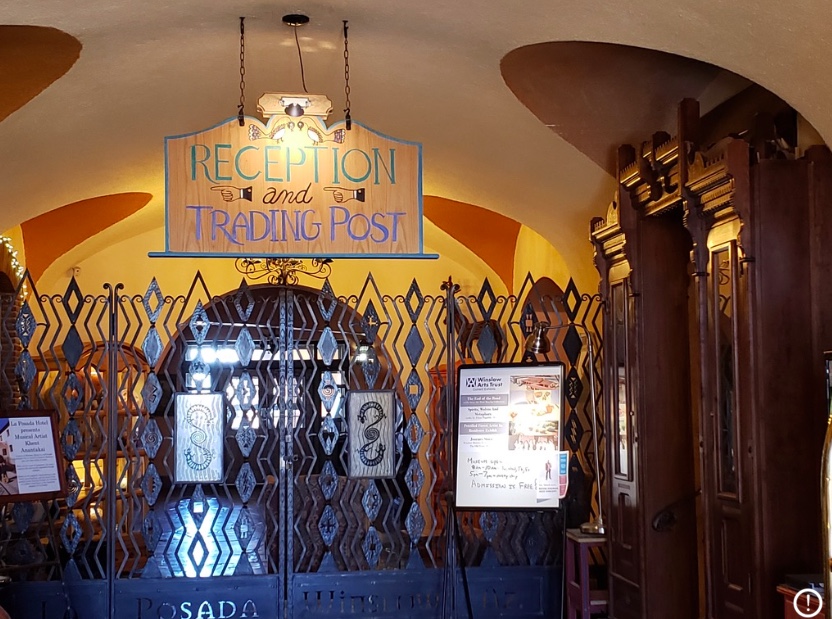
There’s lots of eye candy in Winslow. Signs, benches, window displays all tout the Route 66 and Standin’ On The Corner icons. But we also walk a short ways from downtown to visit the historical La Pasada hotel.
Came upon This Sign Near La Pasada HotelMetal Sculture Outside the La Pasada Hotel
The town is a railroad town established in 1881. It was thriving partly because of the railroad but mostly because its passengers spent time in town dining and staying in the hotels. The elegant La Pasada Hotel circa 1930, was built specifically for rail passengers by Fred Harvey, who “civilized the west” by introducing linen, silverware, china, crystal, and impeccable service to rail travel. He was so famous that MGM made a movie named The Harvey Girls starring Judy Garland. The Harvey Girls were the ladies who provided that impeccable service.
Passenger travel declined in the 1950’s and the hotel closed in 1957 with the museum quality furnishings auctioned off. The railroad took over the La Posada as a headquarters and moved out in 1994 after which the building was nearly demolished. Allen Affeldt purchased the building and is actively restoring same. Townfolk recognize its importance to their history and volunteer with its maintenance.
Today thousands of visitors, sometimes daily, visit Winslow specifically to visit its little Standin’ On The Corner Park and drink in the Route 66 memorabilia. It’s a nice little town to visit for sure.
We’ll see you once again as we travel farther west. Adios!
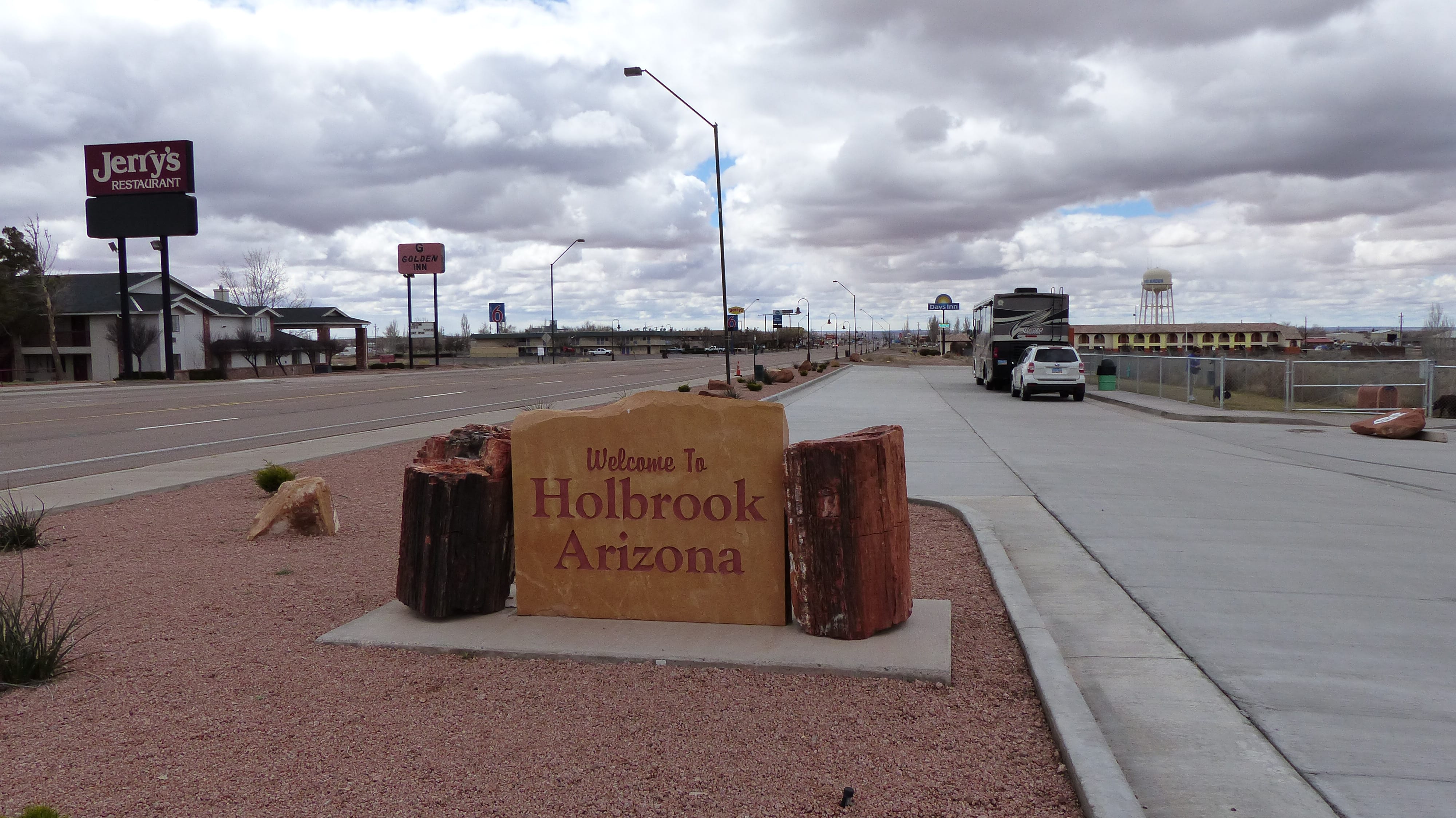
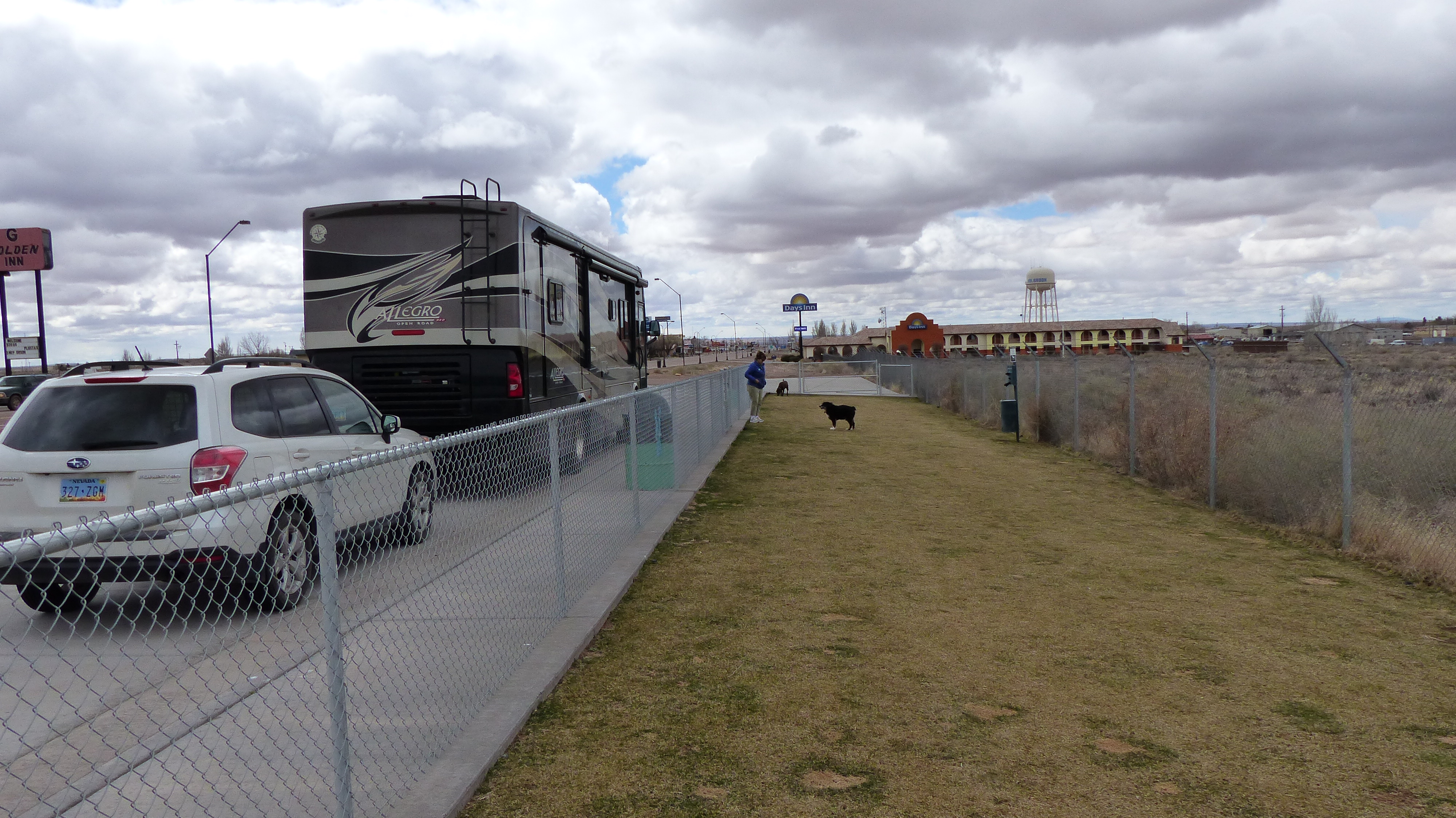
It was time to get the wheels rolling Thursday morning. The 35 mph steady winds had died down and what wind we had would mostly be a head wind. Our original plan was to lay over in Holbrook but there’s not much to do there.
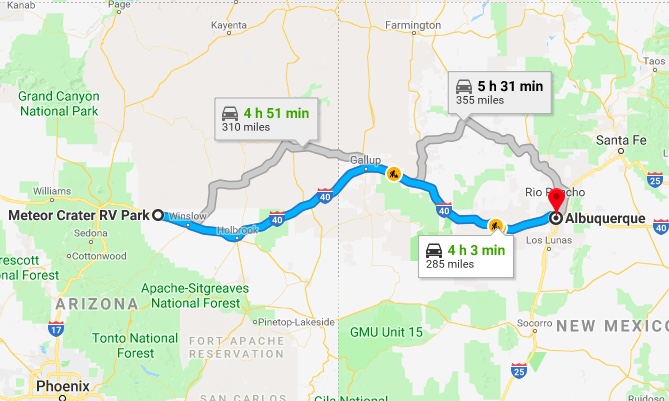
We decided to push another 52 miles to Meteor Crater RV Park located 20 miles west of Winslow AZ. Although we traveled an hour longer we still pulled into camp at 1330 hours due to the time change. You see, the majority of Arizona is on Mountain Standard Time year round which just happens to coincide with Pacific daylight time. Going from Albuquerque which is on Mountain Daylight time to Winslow we actually gained one hour in time as the little hand on the clock moved back one hour.
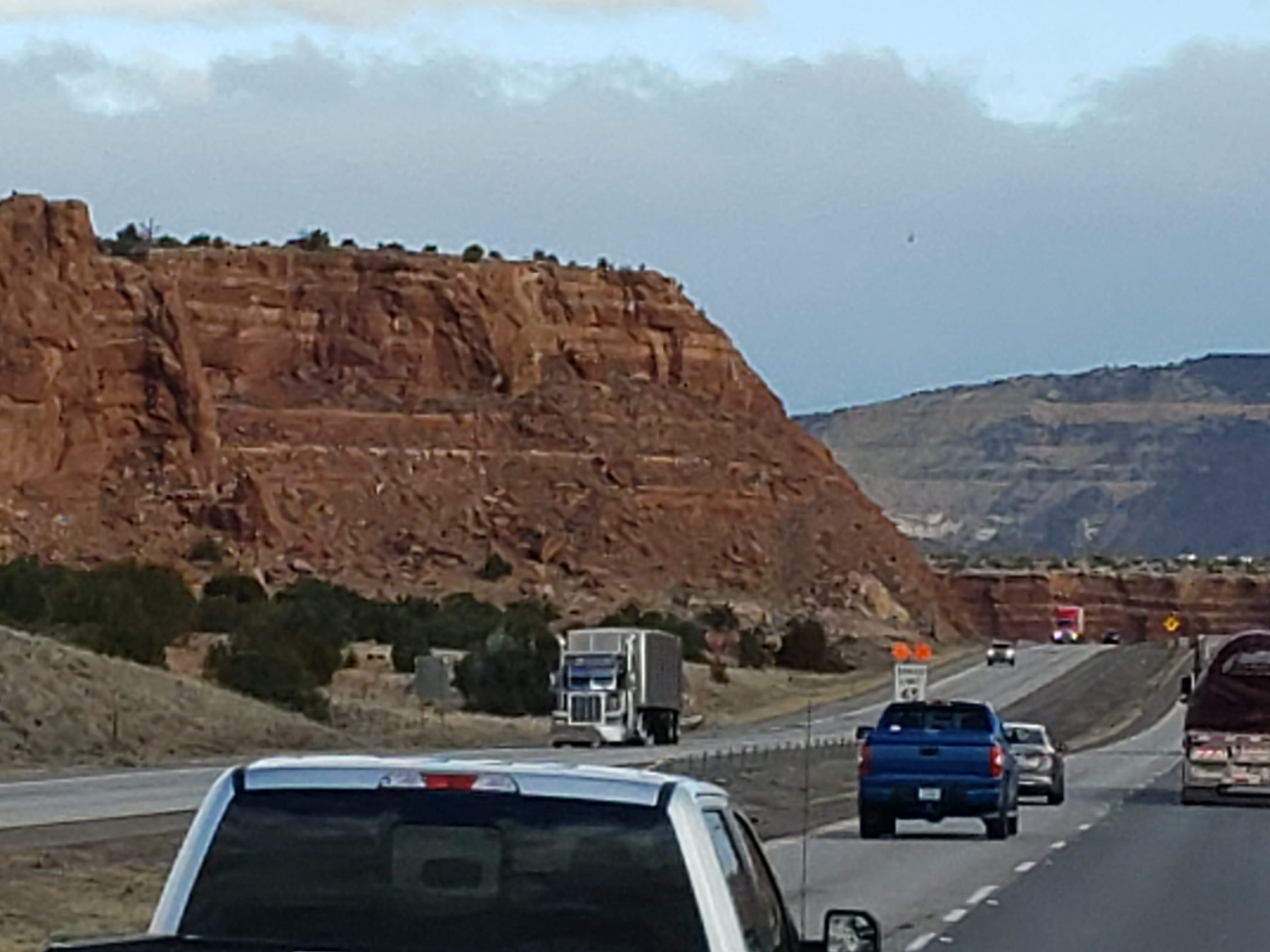
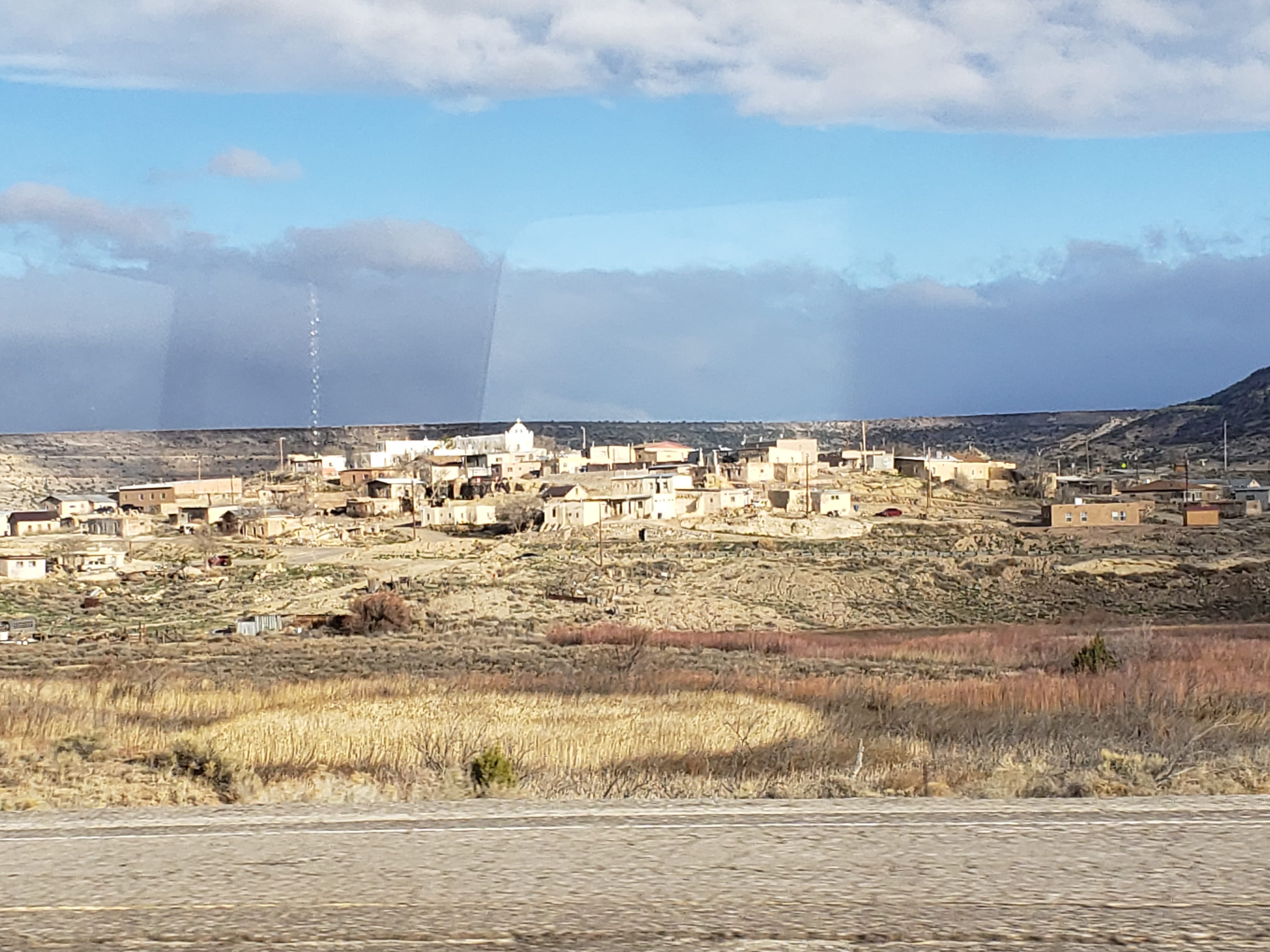
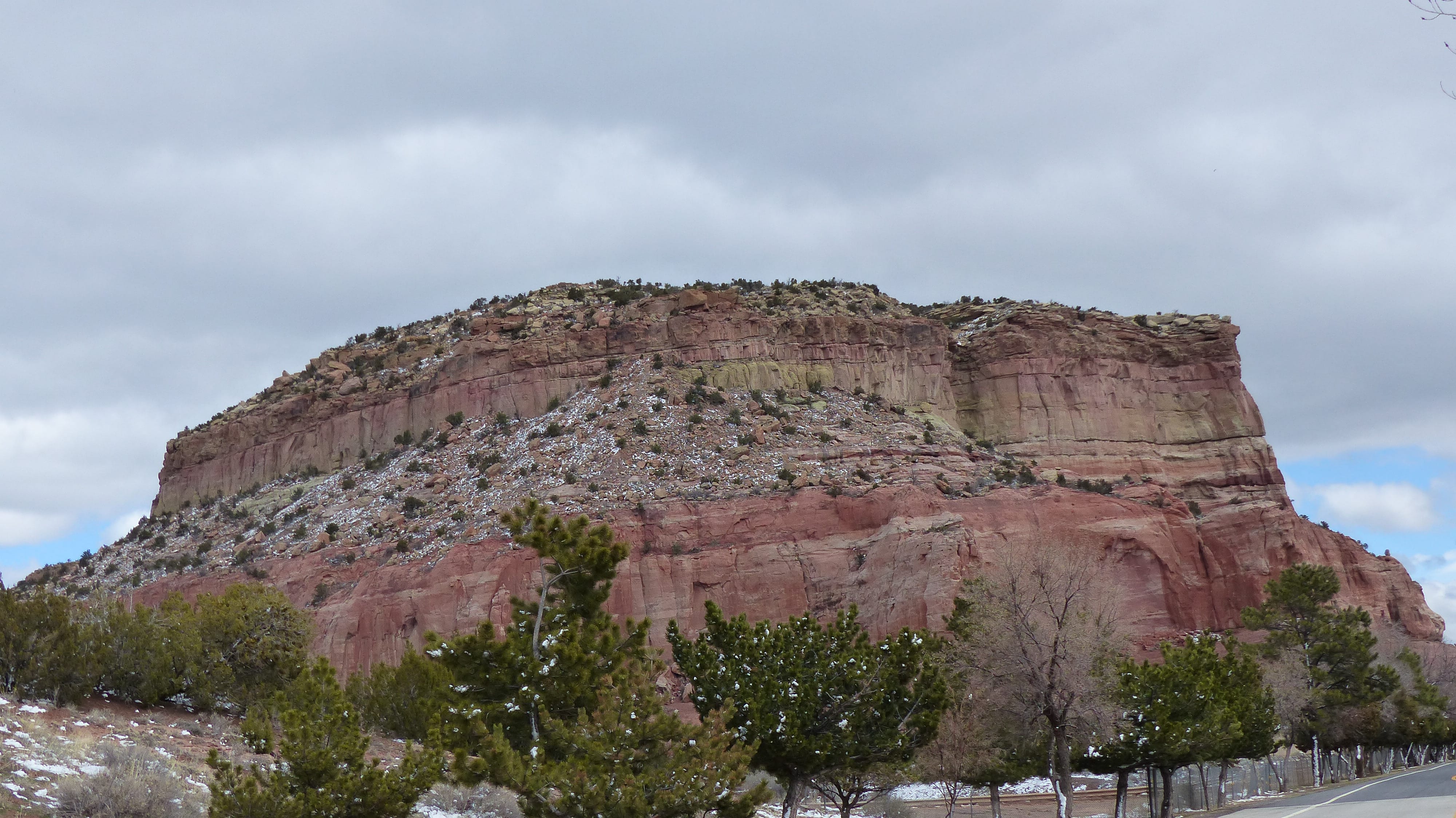
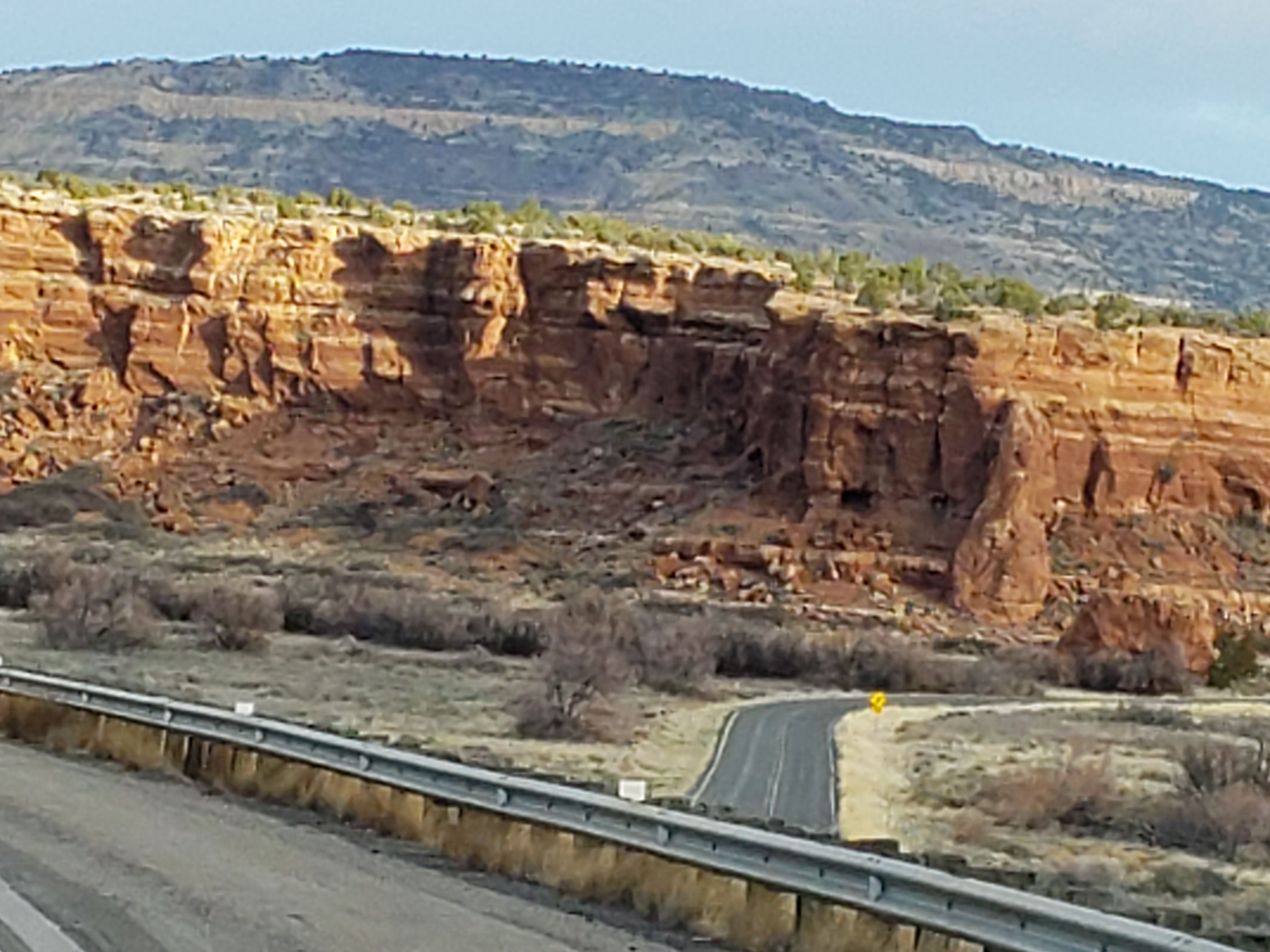
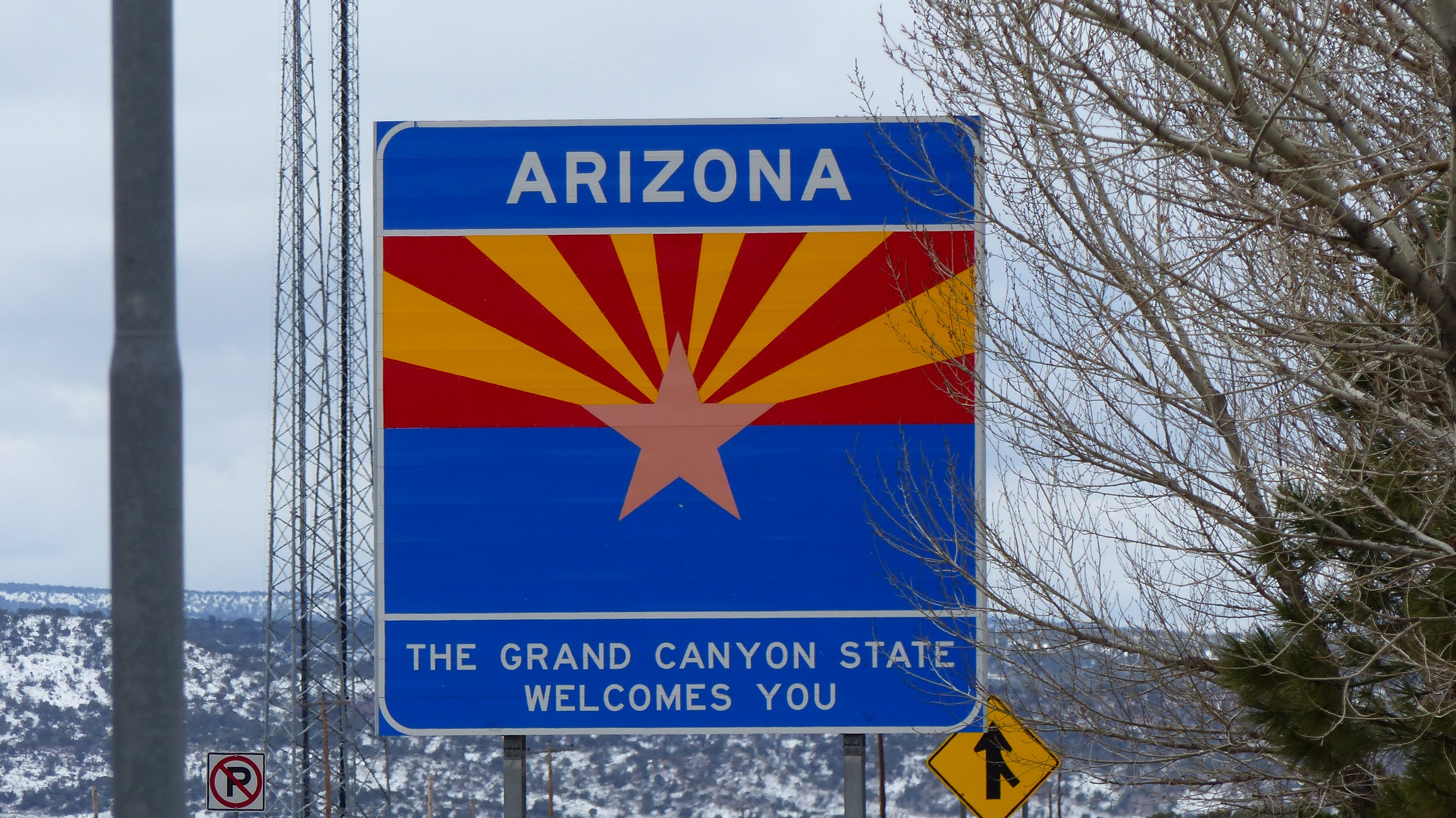
Heading west on I-40 through New Mexico we cruise through and around flat mesas. It’s pretty rugged country all in all. We pass a number of small communities which we guess are predominantly Native American habitats. Many Indian casinos have sprung up along the highway and most of them have truck stops. Every truck stop we passed had a zillion trucks sitting in them. I think most of them had laid over the day before because of the extreme wind conditions. Along the way we passed a semi that was laying on its side, a wrecker crew attempting to upright the rig and its trailer.the Arizona border At the Arizona border is a very picturesque rest area.
At the Arizona border is the Yellowhorse Trading Post. The trading post is decorated with very colorful buildings, at least as colorful and the bluffs behind it. We didn’t stop there but we did stop next door at a most beautiful rest area. This portion of Arizona and much of the countryside we passed through in New Mexico is just drop dead gorgeous.
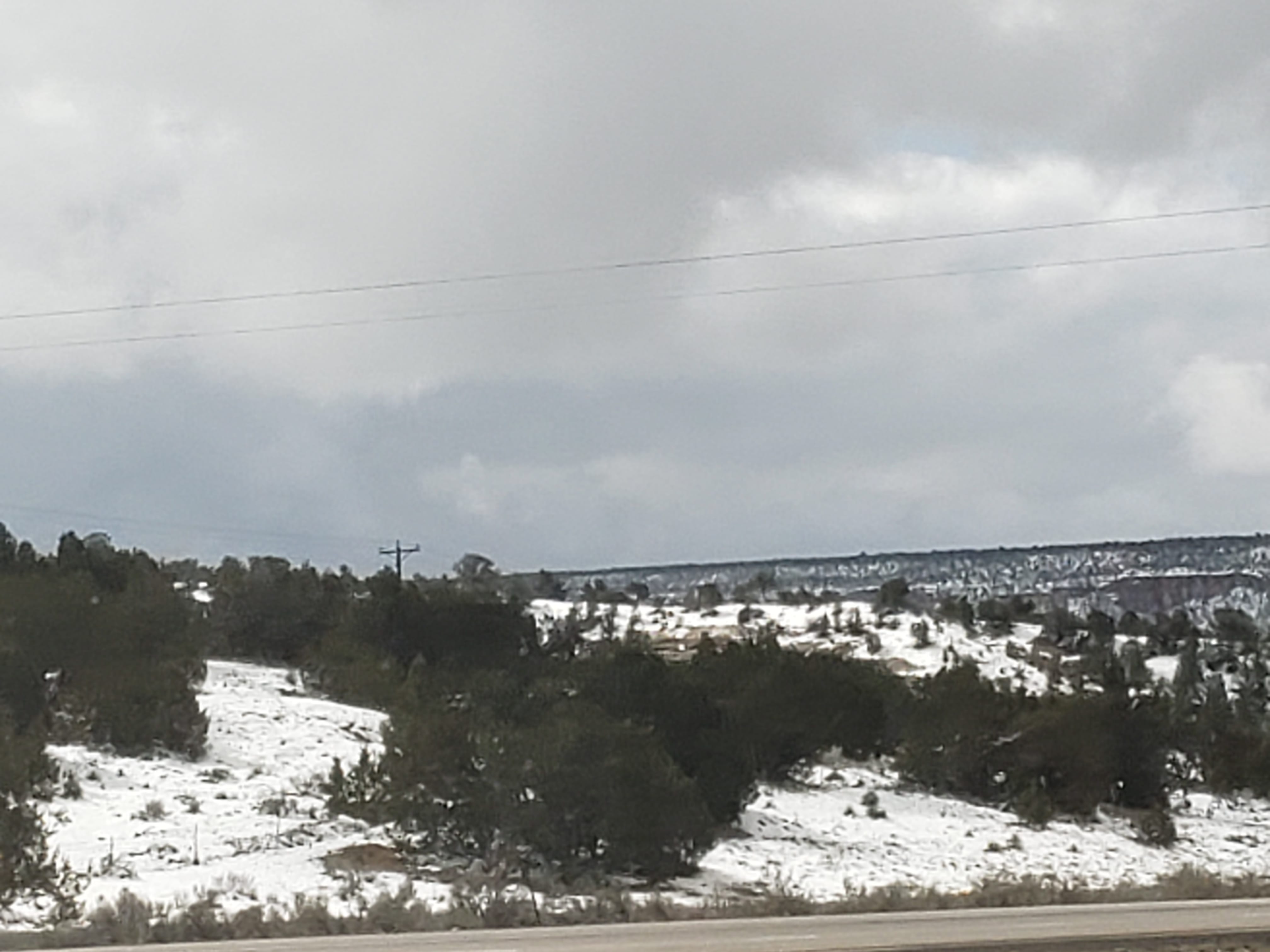
Eventually the mesas and red and buff striped bluffs make way to rolling plains. Surprising was the amount of snow clinging to the mesas but this is pretty high country.
The Continental Divide at Interstate 40 is over 7200 feet. I haven’t seen an elevation sign less than 5000 feet since leaving Alburqueque NM.
We stopped in Holbrook (5050 souls), seat of Navajo County. The town was founded around 1881 when the railroad was built and named in honor of the first chief engineer of the Atlantic and Pacific Railroad. After the railroad was established one of the largest ranches ever to exist, the Aztec Land and Cattle Company was established. That brought cattle rustlers, outlaws, sheepmen, and farmers all competing for the same land. A bloody range war ensued known as the Pleasant Valley War.
There are many wonderful sights not too far from Holbrook. El Desert Pintada, aka the Painted Desert, Meteor Crater, Hopi ruins and the Grand Canyon are within striking distance. And don’t forget Sedona with all its beautiful red rock formations nor the alpine town of Flagstaff.
Jil found a dog park on the internet that is in Holbrook and wanted to check it out. Yeah, right, I’m thinking. It probably is a dirt area full of loathed goat head stickers enclosed by a chain link fence. But by golly it was a nice sized grass area with a very large paved parking lot surrounding it on three sides. The mutzos really enjoyed the romp on real grass! We drove through Holbrook and back onto Interstate 40, driving past Winslow, continuing 20 more miles west to Meteor Crater RV Park.
Meteor Crater RV Park is pretty nice. There’s not much grass in this neck of the woods so the owners created large gravel islands between the RV parking pads and furnish picnic tables. There’s also a few trees around. The drive thru sites are adequately long. Out front is a small convenience store and a gas station. It’s a comfortable park.
This will be a good stop. We plan to visit Meteor Crater and the town of Winslow while here. More next time!
Our Lab Megan had to endure thunderstorms yesterday- she was a mess. Today the wind event began at 0600 hours and is now blowing a steady 35 miles per hour and gusting at 50+. So windy that we decided to pull our slides in to protect the slide toppers. Neither of our mutzos enjoy that kind of wind. As a matter of fact neither do we. Gads, what happened to nice, mild sunny days?
Today we are going to plow through all of the wind and visit Albuquerque’s Plaza Vieja.
But first, a little history supplied by Wikipedia:
Albuquerque was founded in 1706 by Governor Francisco Cuervo y Valdes. Cuervo reported that the new settlement was home to 252 residents and had been laid out with streets, a plaza, and a church in accordance with the town planning regulations set forth in the Laws of the Indies. It later emerged that much of Cuervo’s account had been exaggerated and the original “villa” was just a scattering of farms along the Rio Grande rather than a centralized settlement. Despite a formal investigation, the villa was allowed to keep its title and a more legitimate town was soon established. Possession of Albuquerque along with the rest of New Mexico passed to Mexico in 1821 following the Mexican War of Independence.
Mexico didn’t own New Mexico very long. In 1846 during the Mexican-American War, U.S. forces took control of the territory without resistance. A U.S. army post was established in Albuquerque. In 1860 the population was 1608, a third of which was made up of the army garrison. The town was captured by Confederate troops in 1862 but they were forced to retreat as they lost their supplies at the Battle of Glorieta Pass.
The Atchison, Topeka and Santa Fe Railroad reached ABQ (Albuquerque) in 1880 building a depot about two miles east of the plaza. That led to the creation of “New Albuquerque (now downtown) which quickly boomed and was incorporated as the City of Albuquerque in 1891.The Old Albuquerque quickly declined as businesses moved to New Town. By the 1930’s hardly any businesses were still operating around the plaza. The 1940’s was the turning point for Old Town as people began to notice the historic value of Old Town. It was annexed into the new city in 1949 bringing improvements like paved roads and sidewalks for the first time. Old Town has developed into a popular tourist attraction with most of the adobe houses repurposed into shops, restaurants and galleries.
Old Town is about 15 minutes away. We arrive before most of the stores, restaurants and galleries are open. No matter, we are more interested in the historical buildings more than shopping or eating. We walk around the plaza, then go into the gift shop/museum. Our luck holds- the museum is closed but the gift shop is chock full of great religious items. We ask if the church is open and it is.
The Cross, and All Statuary Shrouded in Purple ClothHamming It Up – Still Lousy Selfie Takers
San Felipe de Neri Church was started in 1706, the current church built in 1793 after the old church collapsed a year earlier during a very rainy summer. The church is cross shaped with walls 5 feet thick. Except for the tin ceiling, the brick floor and south entrance the church is the same structure as in 1793.
We enjoy walking around the plaza and the historic buildings that surround it. We might not be history buffs as such but we do appreciate the history and the historic buildings of places like Old Town Albuquerque.
Other than doing some shopping at Walmart we are hunkered in here at the RV park. The wind is atrocious. Hopefully it will subside enough to allow our westward movement in the morning.
Closer to home, yes and a little more safe as we are now out of the severe weather zone we left behind in Clovis, NM. No, the weather is not ideal. Rain and thunderstorms are predicted through tomorrow then a high wind advisory for Wednesday. Mother nature is not being kind to a lot of folks across the United States.
So we head out westbound on US 84. Who knows what we’ll discover on our way to Albuquerque. Well, we found a place called Fort Sumner, the place where Billy The Kid was shot and killed by Sheriff Pat Barrett, and buried in the Fort Sumner cemetery. Who would of thunk it? We follow the signs to the historic Fort Sumner and the cemetery where Billy is buried.
I’m a little skeptical driving the beast down narrow country roads, not because the roads are narrow but with the inevitable lack of places to turn the beast around. It turns out that a large parking lot allows us to turn- and park at the Fort Sumner Museum which is closed today. Nonetheless we walk the Fort Sumner cemetery where William Bonney, aka Billy the Kid and his pals are buried.
The Elusive Tombstone of Billy the Kid
Also buried here is Lucien Maxwell who bought the failed fort which included the largest single tract of land owned by any one individual in the United States.
An International Site of Conscious
Fort Sumner was established in 1863 to ovesee an internment camp for 500 Mescalero Apaches and 10,000 Navajos on the Bosque Redondo Reservation. Unfortunately there was an inadequate clean water supply, insufficient food and inadequate shelter. These harsh conditions led to rampant disease and hundreds of deaths. The Mescalero Apaches escaped but the Navajos remained imprisoned until they signed the Treaty of 1868 and returned to their homeland in the Four Corners region
Albuquerque has a lot to offer. Weather is going to impact our visit. Thunder is not our Lab’s friend so we hope the storms coming through tomorrow are kind to her. Our Aussie, Doyle doesn’t seem to be affected too much. He just sympathizes with Megan.
My cousin Barbara lives in Los Alamos about two hours away. We’d love to visit them but you know, the KABOOMS kind of make that a no go. Instead Barb and Ed were willing to come to our location, the American RV Resort just west of Alburquerque. It’s a two hour drive for them and we are thankful that they understand our furry ones anxiety concerning the Kabooms. It will be a great visit as we haven’t seen them in a few years.
Nasty Looking Clouds East of Albuquerque and the Sandia Mountains
We travel through the high plain east of Albuquerque US 84 to I-40 west. No rain or thunder yet but you can see at least rain is in the forecast. Then we see something that you might only see in the Southwest- miles and miles of billboards advertising Bowlin’s Flying C Ranch a fueling station and gift shop. Not just the ranch but possibly the store’s entire inventory. Signs line both sides of I-40. Sheesh! The closer one gets to Bowlin’s the closer together are the billboards!
The Flying C Ranch
Clines Corners also gets it’s fair share of advertising. It even has it’s own interstate signage. You know, Clines Corners-11 miles, Clines Corners offramp.
Anyhow, we land at the American RV Resort a few miles west of downtown Albuquerque. Down go the jacks, out go the slide rooms, utilities are hooked up. We are here for three days. Yesterday thunderstorms were predicted but it only rained. Today more thunderstorms and wind are predicted. Tomorrow a high wind advisory has been posted for the entire region. I don’t like traveling in 30-50 mph steady winds, so we are here until at least Thursday.
See you next time!
A Grackle Decided to Strut ii’s Stuff on Our Rig’s Side View Mirror
Note: Most photos on today’s blog were borrowed from the internet as the onboard photographer’s shutter finger was sore. Or something like that….
Our normal routine in the morning was no different than normal. Walk the dogs, pack up, pick up, jacks up and away we go. But were are running an hour later than our normal 0800 hr. departure. Why? Daylight Savings is now in effect. So we left at 0845 and headed west on I-20. Sunday morning traffic is usually light and this morning was no exception. Originally we were going to stay a couple of nights in Lubbock (256,000 souls) but the coming severe weather event scheduled for Monday night and Tuesday scared us off. We transition on to US 84 at Sweetwater heading north towards Lubbock.
Lubbock is a big city, the eleventh largest in the state. You’ve heard that everything is bigger in Texas and for the most part that’s true. An example of big is if you enter Texas from the west on Interstate 10 near El Paso and exit at the Louisiana border one would travel 877.5 miles. That’s longer than runner up I-5 that runs the length of California from the Mexican border to the state of Oregon by 85 miles. Third place goes to I-20, also in Texas.
Lubbock is located in northwestern Texas in a region known historically and geographically as the Llano Estacado, the Staked Plains. The Llano Estacado is one of the largest mesas on the North American continent at 37,000 square miles. That’s Texas big! Legend has it that when the Spaniards explored this region they drove stakes in the ground so they could find their way out. The plain rises from 3000 feet to 5000 feet at a steady rate of 10 feet per mile and tilts southeast to northwest. One can actually see the shoulder of the mesa as we drove north.
The city celebrates rock and roll legend Buddy Holly with the Buddy and Maria Holly Plaza, hosts the Buddy Holly Music Festival, renamed the Lubbock Music Festival, and a new performing arts center. It is also home to Texas Tech University. Five major wineries are in the region, the National Ranching Heritage Center, the American Cowboy Culture Association and much more.
Texas Tech University
Weather wasn’t too bad on this leg of our trip. It rained off and on for a couple of hours, the wind blew constantly coming mostly as a quartering, following wind so I didn’t feel like I wrestled that 400 pound gorilla again. We drove through miles of prairie with only a smattering of cattle visible. Then we came into more fertile land, or maybe more abundance of water, with big farms producing- nothing- remember its winter. But we did see hundreds of huge rolled bails of cotton as this area is the largest contiguous cotton growing region in the world. We also passed several large dairy farms and growing lots with plenty of very young black and white cattle.
US Highway 84 takes us through mostly cattle towns south of Lubbock but then there’s a change on her north side. Starting in Anton (1100 souls) we see huge storage silos which prominently poke up 100′ in the air. Cotton doesn’t require silos so they are used to store other main crops such as corn, grain sorghum and peanuts. Sudan (1100 souls) sports a six silo grain elevator that is in sad shape and obviously not being used. Unlike most of the other communities we pass through Sudan looks like its dying.
Mule Monument in Muleshoe. Notice the Grain Elevators in the Background
Muleshoe, on the other hand is a thriving community of 5,000 souls, seat of Bailey County. It’s home to the National Mule Memorial, and the Muleshoe Heritage Center which commemorates the importance of ranching in West Texas. Twenty minutes away is the Muleshoe National Wildlife Refuge, the oldest of its kind in the state of Texas. I know, your dying to learn how Muleshoe got its name. It was named after the nearby Muleshoe Ranch.
Right on the Texas/New Mexico border is the town of Farwell, Tx (1360 souls) and right across the railroad tracks is Texico, NM (1100 souls). They are that close. Farwell is the seat of Parmer County. Farwell began as a cow camp for the XIT Ranch and named after the two Farwell Brothers who built the state capital building in exchange for 3.05 million acres of virgin ranch land. Ever heard of the Red River War? It was the largest military operation for the U.S. between the times of the Civil War and WWI. Five armies converged on this part of the High Plains, ultimately defeating the main Comanche force in Palo Duro Canyon by driving off and killing the Comanche’s horses. By the way the XIT Ranch failed because of massive cattle rustling, ultimately the ranch was sold off in parcels to families drawn by the cheap price of land.
We finally reach Clovis after what seems forever. We’ve been limiting our travel days to 150 miles, more or less. This one was 120 miles longer. We aren’t used to traveling that far anymore. The elevation of Clovis is a surprising 4200 feet, a gain in elevation of 2500 feet since leaving Abilene. We worked our way up the mesa’s tilt not realizing that we were gaining 10 feet of elevation every mile. We look at each other a say, “Heck, it looks pretty darned flat to me!”
Clovis-Gateway to the Sierras?
We slide into the outskirts of Clovis heading west and we spot a park- and we have room to park the beast! As we walk passed the kiddie play area a soccer field emerges. No one is around so Jil unleashes our Lab Megan. The next thing I know Jil is yelling her head off for Megan to come back to her. Megan had left the soccer field and went running into a vacant lot. When I see her she is running fast to one place, slams on the brakes and heads in another direction. Her antics continue running to, slamming on the brakes, then running fro. And so does Jil’s yelling for her to return. I ask “What the heck is going on?” And this is the reply, “She’s chasing prairie dogs! When she gets close to one they duck into their burrow, then she chases after another, then another!” The lot is a full blown prairie dog town! Megan finally comes back out of breath. It wasn’t funny that she wouldn’t come back to Jil but very amusing that she was playing Doggie Wack a Mole (OK Prairie Dog).
Excerpt from Wikipedia: Clovis is largely an agricultural community, closely bordering Texas, it is noted for its role in early rock music history and for nearby Cannon Air Force Base. After the discovery of several “Clovis culture” sites in eastern North America in the 1930s, the Clovis people came to be regarded as the first human inhabitants who created a widespread culture in the New World. Clovis people are considered to be the ancestors of most of the indigenous cultures of the Americas. The Atchison, Topeka, & Santa Fe Railway system helped to establish Clovis over a hundred years ago, and for that railroad and its successor BNSF Railway continues to be a major hub of operations. Also notable is the Southwest Cheese Company, the largest cheddar cheese producer in North America.
ClovisSo here we are in Clovis (39,000 souls), staying at the Travelers World Campground. It’s located on US 84 with railroad tracks running a hundred yards behind. Surprisingly, it wasn’t too noisy at all. Grass separates the sites. I should say dormant grass separates the sites. The access roads and site pads are gravel. All four sides of the perimeter are doggie friendly mowed grass, but don’t let the furry ones wander off of that grass as the dreaded goathead stickers lurk!
One night here and hopefully we’ll escape the predicted severe weather beginning tomorrow evening and head to Albuquerque. Albuquerque will only have occasional thunderstorms, non predicted to be severe.
It took a while to map a work around out of the Dallas/Fort Worth area. After 10 miles of lighter traffic and only getting cut off twice by people trying to merge onto I-35 we get off the interstate and onto a US highway. It didn’t take long to vamoose out of the city and into the country. Not far down the road is the town of Decatur, seat of Wise County. Signage was good until we got into the middle of town.
I like to follow the signs when we transition from one highway to another. Ah, a sign to highway 51, cool! Jil’s “Miss Smarty Pants” phone is routing us another way. I ignore the phone and follow the signs…… until there aren’t any. Crap. Since I ignored “Miss Smarty Pants” Jil ignores it also……. until we don’t make a proper turn to highway 51 and drive off towards Never Never Land again for lack of, you guessed it- signage. Miss Smarty Pants saves the day again but Jil is aggravated at me for not following Smarty’s directions. I’m aggravated because the signs to highway 51 ceased to exist- and I don’t trust little Miss Smarty Pants as she has put us in some doozies of predicaments. Hot tempers slowly return to normal. I have to get a good map application specifically made for big rigs, and soon.
I wanted to drive through Weatherford as it looked like a beautiful town but Miss Smarty Pants routes us around town. OK, I concede, I’ll follow her directions- this time. Soon we are back on I-20 heading west. As usual the interstate bypasses many smaller communities. Signage tells you that they are close by but one cannot actually see the towns from the highway. Ranger (2400 souls) is an exception as we can actually see its water tower and maybe even downtown as we pass by. Eastland (3900 souls) is another town we actually can see.
Notice Old Rip is Missing a Leg- Then Governor Connelly Picked Him Up By That Leg……
Eastland, seat of Eastland County, has a ‘true’ story concerning the construction of a new courthouse. A few documents, proclamations and a Bible were laid in the cornerstone. At the last minute a justice of the peace walked up with a Texas horned lizard that his son had caught and placed it in the marble block before it was sealed. Thirty years later that courthouse was replaced with a larger one. The old was torn down, the cornerstone opened and construction workers pulled out what appeared to be a dead horned toad- then it moved! Will Wood, the boy, now man who caught the lizard took it on tour. Old Rip met President Calvin Coolidge at the White House. He appeared on stage in Dallas. Eastland people felt Old Rip was city property and demanded the lizard be brought back to Eastland and sued. The lizard was brought back, kept in a gold fish bowl and fed ants. A year after his return his was found dead in his bowl. Of pneumonia, the papers said. He was embalmed and placed in a velvet lined casket. Old Rips story goes on but I’ll stop there. You can read about him on the internet.
Bypassing Cisco (3800 souls) and a couple of other small towns we arrive in Abilene, our “safe haven” for a couple of nights. Last night we had one hell of a thunderstorm roll through with heavy downpours- but no severe weather. Our Lab, Megan would argue with that statement because she is not a fan of loud noises- KaBOOM! We got our fair share of thunder and lightning last night. Megan shook like a leaf, poor girl.
We drove into Abilene this morning. It’s a true town of the wild and wooly West. Many folk of notoriety lived or passed through here. Do the frontier legend names Doc Holliday, Wyatt Earp, Billy the Kid, Butch Cassidy, Pat Garret or Big Nose Kate ring a bell? Big Nose Kate, nah, but the others, yes.
Halograms Look Like Real People
We learned all about them and life at that time at the wonderful Frontier Texas Museum. Displays featuring those who lived here. Narrative was of their perspective during that period of time. Native Americans, the frontiersmen who basically annihilated the bison on the prairie, and the cattlemen who found the bison less prairie ideal for raising cattle. Housewives, saloon keepers, all told their stories. This was all done with the written word, videos in amphitheaters, displays sporting hologram characters in sets such as wagons, saloons, etc. that did a great job of explaining life back in the day. This is a must see place!
Everything is Bigger in Tejas!
We took a walking tour of old downtown Abilene. I wouldn’t say it’s special but it does have some interesting buildings and occupancies
Tomorrow we move once again. Yep, more severe weather predicted in the Abilene/Lubbock area. We’re heading northwest past Lubbock and into safer country. Until then, Via con Dios!
Traveling west and out of the predicted severe weather area that the National Weather service had published seemed the better part of valor. Call us coward if you will but we’ve been a few hours away from some towns devastated by tornadoes, which is too close for us. We picked up, packed up and jacks up and were out the door, so to speak, on our way to the Dallas, TX area before 8am on Wednesday. Interstate 20 will take us to the Dallas area then a series of jukes up to Lewisville where we’ll spend a couple of nights at the Lake Park Campground, just a part of the City of Lewisville’s huge Parks and Recreation complex located on the shore of Lewis Lake.
The ride west on I-20 was great. Good scenery with lots of trees with many of them leafing out and not much wet bayou type country. The interstate avoids most towns and skirt two major Texas cities, Tyler (104,000 souls) and Longview (81,000 souls). Tyler is known as the Rose City for its rose production. In fact it has the largest rose garden in the United States.
Traffic is pretty light until we reach the outskirts of Dallas. Our destination is north of the city so we have to do our best to skirt the megalopolis. Well, that didn’t happen. Everyone else had the same idea. Traffic is heavy on US 80, I-635 and I-35. US 80 and I-635 were meant to provide a means around city center. Traffic accidents on both sides of the highway slow traffic even more. In fact, like other bypass sections of interstates, they instead allow the city to sprawl. We’ve been fortunate thus far to have avoided heavy traffic. So to say the last 40 miles of our journey was unsettling is an understatement.
We chose to stay in a location half way between two points of interest- senior housing developments, one in Denton which is located on the west shore of Lewis Lake, and one on the east shore of Lewis Lake located in Frisco. Lake Park Campground, a City of Lewisville (106,000 souls) venue, is smack dab in the middle of them and that’s where we stay.
The campground is only one aspect of the entire park. Located on the large 29,000 acre Lewis Lake it has a boat launch, a large picnic area, several large lighted baseball fields and soccer fields. It appears that some ball fields and the soccer fields are in the process of receiving light so they can have games after dark. There is lots of room for us to roam with the doggies and that is what we prefer.
Anyhow, after we checked into the park office we take several minutes to set up in our site for two nights. Leveling jacks go down, room slides go out. As the last slide goes out this god awful very loud noise just about has me jump out of my skin. We’d been having a little problem with one of our slide rooms balking so I initially thought that the slide hydraulics were blowing up as I had my finger on the button that controlled that particular slide rooms movement! Or something like that. But the noise was very loud and seemed to be coming from outside. I went outside and yep, that’s were the very loud noise was coming from.
It was so loud I couldn’t triangulate where the source was located. The noise stopped less than two minutes later. Phew! The mutzos didn’t like that at all- and neither did we……. Yep, Thursday 1300 hr. test of the tornado warning sirens! Sheesh!
Anyhow, the park charges $11, yes you read that right, $11 a night to camp here if you are a senior and that includes 50 amp electric service and water on site with a really nice sanitary dump station and run of the entire park. I think it’s less the than $15 for everyone younger. The only downside of the RV portion of the park is the parking pads are in need of some maintenance and we are in the flightpath of Dallas Intenational. Luckily the plane engines are throttled down as they are on final approach.
Back to why I am here in the Dallas area……….. First, I love to drive a 35 foot motorhome towing our Subaru through wilting traffic conditions. I love to drive I driving in adverse conditions and not understand all the highway signage that is foreign to everyone not native to Texas. I love driving the speed limit and have cars camped two inches off of my back bumper. And I love trying to merge 50 plus feet of rolling stock from one lane to another with not one driver willing to yield 50 feet of real estate. Yep, that’s why I am here.
A Del Webb development-Frisco Lakes in Frisco, TX
One of Three Swimming Pools
Well, that is what goes on for the driver of this big rig but the real reason we are here is Jil wanted to check out a Robson and a Del Webb Senior Community. We only made it to the Del Webb community in nearby Frisco.
Spacious LibrariesA Nice Place To Eat And Converse With Friends and NeighborsOne of Three Well Equipped Fitness Centers
That community is really nice. Nice homes, nice amenities. 3000 homes will be built. It’s amenities include a public golf course, three large community centers, three outdoor swimming pools, one indoor swimming pool, large event rooms (450 folk capacity) , craft rooms, billiard rooms, tennis courts, pickleball courts, miles of walking paths- all at a reasonable price for the homes and monthly owner assessments.
Lots of Community Activities
It’s all very nice but this part of the world doesn’t excite me. I’m used to SoCal and Reno weather, not Dallas weather. It’s a little too far from family. I’m used to the light Reno traffic, not that of the megalopolis of 1.3 million people, all who drive on the interstates at the same time, called Dallas. We wanted to see Del Webb, Frisco Lakes and we did, so there.
Next we head west once again. A storm is brewing and it’s headed right for Dallas. See you next time!
We are staying at another KOA which is so much unlike us. We’ve stayed in three so far.
Spacious Dog Park
There were several places in Shreveport (192,000 souls) that we wanted to visit, Holy Trinity Church, the Cathedral of St. John Berchmans, a Confederate statue that stands in front of the Caddo County Courthouse, the Mardi Gras Museum and Riverside Park.
We can go years without staying in a one of them. The Shreveport/Bossier KOA is OK as have been the other two.
It didn’t take us long to get downtown using Interstate 20. Unlike the French Catholic influence nearer the coast this area of Louisiana is not dominated by Catholicism.
The first place we visit is the Cathedral of St. John Berchmans, consecrated in 1929. Uh, oh the church is locked! This is the first church that we’ve visited in the South that has not had its doors unlocked.
The parish office is next door and the kind lady there let us in and gave us a short narration of the church and its parish. The church is as beautiful as expected. Unfortunately work was being done on the electrical system so the lights couldn’t be turned on- and boy, was it was dark in there. But we got it- it is beautiful!
Next we head to downtown Shreveport. We’ve been to a several large downtowns on this trip and what has amazed us is the lack of traffic at nine or ten in the morning. When do these places come alive, if ever?
Holy Trinity Church dates to 1896 and is on the National Register of Historic Places. Unfortunately, this church was also locked. At least we got a good look at the old gal from the outside.
The Caddo Parish Courthouse has a controversial statue out in front. This monument lionizes Confederate leaders Lee, Jackson, Beauregard and Brigadier General Henry W. Allen, Civil Wartime Governor of Louisiana from 1864-65 by the United Daughters of the Confederacy, created in 1905.
Rather than creating memorials to the men who perished which was their norm, this monument and others were aimed at vindicating the antebellum South and controlling the historical narrative of the Civil War and Reconstruction. Just recently a federal judge indicated that the parish can remove the statue from public grounds.
A place of interest that exists in this town is the last working steam powered water plant that finally shut down in the 1980’s, nearly 100 years after it was built.
The plant pumped clean water three miles from Cross Lake. Why pump water that far when the Red River runs through town? Well, it’s called the Red River for a reason.
It carries an ungodly amount of particulates and debris. And we didn’t know this- the water is very salty as it picks up salt deposits from deep within the soil. We’re told by the docent that it’s not as salty as the ocean but pretty salty. Jil read that the river picks up 2400 tons of salt on its way to the ocean.
Anyhow, the water from Cross Lake was aerated, lime softened the water and alum coagulated suspended particles out of the water. The treated water was then pumped into the city’s mains.
The waterworks is now the Shreveport Waterworks Museum. When the plant was shut down it was left intact and is recognized by the Smithsonian Museum.
Also on the premises is a small railroad museum that features local railroads.
Next we cross the Red River into Bossier City and go to the Riverside Boardwalk. I’m thinking it’s a nice grassy area next paralleling the Red River that I’ve seen on Google Maps. That park was on the Shreveport side of the river.
This Riverside Boardwalk in Bossier City and is a freaking MALL!
Texas Bones Restaurant Signage
Well, it does have a concrete walk down alongside the Red River but it’s sure not what I’m expecting. It does offer some great views across the river of downtown Shreveport, however.
Jil picked this place out to visit- score one for Jil. Jil didn’t go shopping- score one for Mike!
Bossier City also has the Mardi Gras Museum. Strike two- it’s closed. However on its grounds are Mardi Gras floats being readied for tonights big celebration- Fat Tuesday.
Fat Tuesday is the day before the beginning of Lent. Lent is a Christian 40 day solemn religious observance that begins on Ash Wednesday, tomorrow, and ends before Easter Sunday.
Fasting is traditional on Ash Wednesday, and every Friday thereafter during Lent so the Tuesday before Ash Wednesday is the last day to pig out, so to speak. Thus Fat Tuesday!
We’ve seen what we wanted to see. We’ve driven the streets of downtown Shreveport. We’ve visited the churches, the waterworks, the Riverside Boardwalk, the Mardi Gras museum. We are done.
A couple of things of note: the weather and THE WEATHER. The deadly storm that blew through a couple of days ago was created by a cold and warm front. Both merged and caused death and an incredible amount of damage in Alabama and Georgia. The weather: what remains is cold air drifting down from the Arctic. The temperature here in Shreveport was 37 degrees when we arrived yesterday afternoon with a low of 24 degrees last night. Today was a balmy 47 degrees. Normal is in the mid 60’s. Tonight may break a record low of 24 degrees. THE WEATHER: Another round of severe weather is due in a large multi state area beginning Saturday. The weather guessers aren’t sure where the bad weather will extend but they know it’s gonna be a dusey.
That said we decided to move on to the Dallas area a day early, Wednesday, and leave there on Friday heading towards Abilene. That will take us out of that iffy severe weather zone and closer to home. At least that is the plan.
OK, so we were going to move anyway……… It’s time to start heading a little farther west. Yes, I know, you looked at the map and said to yourself, “Self, that’s not a lot farther west and it is a lot farther north!” And, Self, you’d be correct. We are pretty much done with the coastal areas of the South and want to head more inland.
Back to the storm. We were sitting in a “marginal area” for severe storm activity beginning last Saturday evening. Marginal means a 5% chance of severe storms. You know, storms that produce high sheer winds, severe lightning storms that produce large hail and an occasional tornado. The prediction was for “heavy thunderstorms”, whatever that means.
Well Saturday evening is when Frog City RV Park put on the crawfish boil- and the weather was pretty good. Overcast as usual but pretty good. We learn from the weather guessers that the storm is coming in quite a bit later than predicted but are still guessing that we’ll have quite a bit of rain and a goodly amount of thunder and lightning.
This is what really happened. Sunday morning I had walked our Lab, Megan, who has a bad habit of needing the most perfect spot to take a dump. That means we could walk for a mile before she decides that she has found that perfect spot. It doesn’t matter that her colon could be bursting, she will always have to find the perfect location to do her duty. We could be out for a very long time, sometimes a half hour or more until she relieves herself. Doyle, our little Aussie, on the other hand is not shy. When he needs to go he goes- sometimes in the least discreet location- like on a sidewalk.
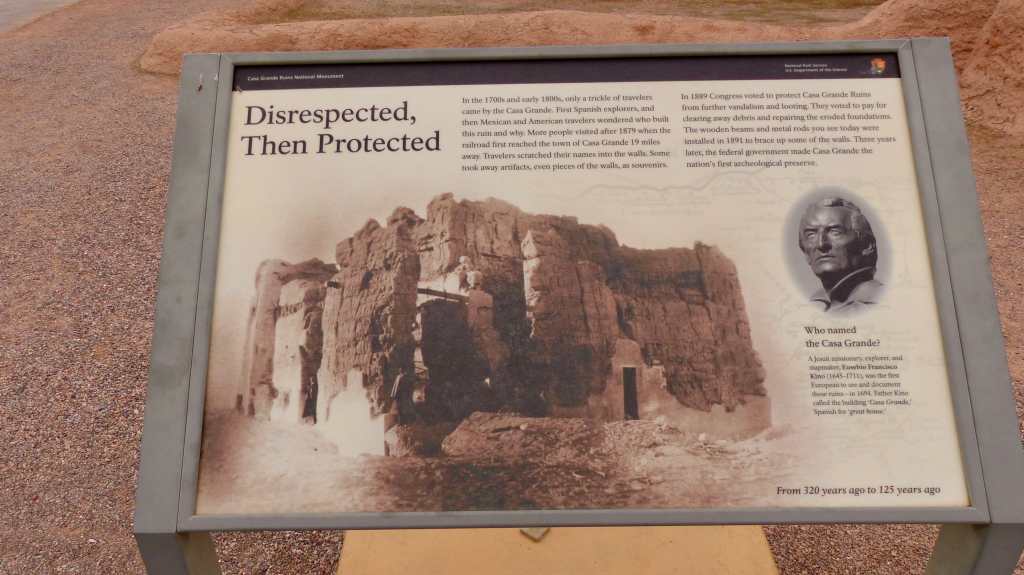
OK back to what really happened. It started raining- hard. Then it would let up for a while. That’s the time we’d take advantage of walking the dogs. The streets in the park started to flood. Oh My! The weather stayed that way for a few hours but no severe weather in our area, and no thunder. About mid morning we were walking the dogs a noticed a very dark low hanging band of clouds to our north. THAT LOOKED OMINOUS! It passed by and did not affect us but 50 miles east that same storm cell dropped golf ball sized hail on a place called Gross Tete.
Temperatures this morning were a muggy 70+ degrees, even with the rain and cloudy skies. After the warm front was pushed east the cold front took over- and how! The temperature dropped 30 degrees in just minutes. Sort of reminded me of what folks in Texas have been known to say- “If you don’t like the weather now, just wait a minute”. The warm and muggy weather is gone which means in my mind the minimal threat of severe weather has passed.
It turns out that we were on the tail end of the most deadliest storm system of 2019. As the storm progressed I followed it in real time on internet weather sites and on TV. The entire area east of Baton Rouge, LA lit up in red outlines by counties (Parishes in Louisiana), red outlines meaning a tornado advisory was in effect. Those outlines shortly became solid red meaning tornado- warnings are now in effect. You’ve probably heard the results, at least 23 folks were killed by violent EF3 and even more powerful EF4 tornadoes packing 170 mph winds in Alabama and Georgia. We were near ground zero not long ago.
Our current location is in Shreveport, LA, a couple of hundred miles north and slightly west of Duson. Our plan is to hunker down here for a few days then head west towards the Dallas, TX area. Who knows where we’ll end up after that. The only known is that we are heading west from, there slowly meandering slowly towards home.
At trip up to Hot Springs AR would have been fun and new to us but bad weather is causing us to reconsider. We’ve been to the Lafayette Louisiana area before and are familiar with the many places to visit nearby. Funny that we’ve not been into the town itself. So we pack up, pick up, jacks up and off we go. The weather in the South has thus far been consistent- overcast and wet. Hopefully the next park in which we stay will drain a little better than Pine Crest. We’ll see.
Miles of SwampAtchafalaya Visitors Center- the Bridge Across the Atchafalaya is 20 Miles Long! No ThanksYes, the Bugs are THIS BIG
So here we are in Duson, LA. Why Duson (1700 souls)? Well, the Frog City RV Park is located here. Where is Duson? Just about 12 miles west of Lafayette. Lafayette has a population of over 127,000 folks, and many Acadian cultural areas to visit. We also want to visit a few other places while here. Does Tabasco come to mind?
St. John The Evangelist Cathedral, Lafayette
This area was under Spanish influence in the 1700’s. The French speaking and Catholic Acadians lived in Acadie, now Nova Scotia, under French rule until 1713 when the region went into English hands. The Acadians refused allegiance to the British crown and Anglican Church so the English governor acting on his own expelled the Acadians in 1755. In 1784 the King of Spain consented to allow them to settle in South Louisiana. The Acadians settled along the bayous where they could live according to their own beliefs and customs.
Their first settlement was established by the English on the Vermilion River as a small trading post and Revolutionary outpost. That location became known as Pin Hook named after the local bridge. A fella by the name of Mouton donated land on which to build a church, then a second land donation for a courthouse and was known as Vermilionville. It was renamed Lafayette in 1844 in honor of the French Marquis de Lafayette. So there you have a short synopsis of the history of this area and of the city. Oh, one more thing, throw in a mix of intermarriage into the works and out come Cajuns or maybe.
We wandered around downtown Lafayette visiting the Cathedral of St. John the Evangelist and a couple of Cajun strongholds on the outskirts. We visited small towns, Abbeville (12,000 souls), St. Martinville (6000 souls), Breaux Bridge (7300 souls) and New Iberia (29,000 souls) located in the Bayou Teche/Spanish Lake area come to mind. Of those, Abbeville’s town square and church are the most impressive, New Iberia’s mansions are spectacular and St. Martinsville the most unique. Breauz Bridge is the Crawfish Capitol of the World. All have extensive histories. If you have some spare time drag out the ole computer and look them up.
Cajun Duck- a Foul of Many Cultures
One thing that one might notice in all the Acadian towns and cities is the abundance of Catholic Churches. Large churches, with impressive architecture and beautiful interiors even in small towns. The small towns are very well kept and so is downtown Lafayette. The outskirts are a mix of very nice clean looking properties next to a place that the pickers would like to peruse.
Old St. Martinville Bank Building
Interior of St. Martins
Cajun Bayou Home
Raised Creole Cottage
We visited Longfellow-Evangeline State Historic Site. Henry Wadsworth Longfellow’s 1847 epic poem Evangeline made people around the world more aware of the 1755 expulsion of the Acadians from Nova Scotia and their subsequent arrival in Louisiana. In this area, the story was also made popular by a local novel based on Longfellow’s poem, Acadian Reminiscences: The True Story of Evangeline, written by Judge Felix Voorhies in 1907. The property was once part of a cattle ranch and indigo plantation. Cotton and sugar cane were raised here. On the property is an example of a Raised Creole Cottage.
Town Square, AbbevilleLooks Like Ferns Growing on Old Oak TreeAbbeville Bank BuildingSt. Mary Magdelen Church, Abbeville
Main Street, Abbeville
We even visited Avery Island, home of the factory of a very popular hot sauce- Tabasco sauce.
Tabasco Factory, Avery Island
Also on the island is a place called Jungle Gardens where one is invited to drive through the gardens created by the McIlhenny family. The gardens include beautiful flowers, lots of birds, alligators and beautiful and impressive old trees. It even has a 900 year old Buddha!
Bird Island in Jungle Garden, Avery Island
Ok, while we are here Jil has the hots to attend a Mardi Gras Parade. Yesterday was the day. I stayed home and she headed over to the nearby town of Rayne, The Frog Capital of the World.
She came home a lot earlier than I expected, like at 3:30pm- the parades started at 3:00. I asked if she got to see the parade- she held up a half bazillion beaded necklaces! And she gave most of them away to little kids. Needless to say the parade is a highlight on this trip.
Crawfish Factory
Last night our hosts here at Frog City RV Park put on a crawfish boil. The crawfish are boiled in a big pot with cajun spices, corn and potatoes until done. Besides those little buggers they supplied hamburgers and hot dogs. Crawfish look like a miniature fresh water lobster. I was invited to imbibe by our neighbor sitting across the table as I had no clue how to shell the tail. She “shucked” that tail in no time and handed me a piece of meat about 1/3rd the size of my pinkie. It tasted good, not unlike lobster. The spices added a nice flavor. The room was full of us folks visiting Frog City, all enjoying the boil, sharing stories and generally enjoying one another’s company. Thanks for the food and the good time Frog City!
So that concludes our visit to the Lafayette, LA area. See y’all!
As the morning went on the French Quarter slowly became untenable for our furry ones. More people, more anxiety. Not sure if our doggies were more stressed than us- that’s up for conjecture. We are not into crowds so we assume our mutzos aren’t either. We head back to the car, pay our parking fee and head out of the French Quarter .
Heading up I-10 towards camp in Slidell we see a sign to Chalmette Battlefield. Heck, it’s early, why not? So about 10 miles off of the interstate we find The Chalmette Battlefield. And we don’t have a clue as to the history of this place. But we’ll soon find out!
Chalmette Battleground Located Next to St. Bernard PortThe Big Muddy is at Flood Stage
The British decided that they didn’t want to give up the colonies, now the United State of America. Great Britain had violated the U.S. maritime rights and were whipping up anti- U.S. sentiment with the Native Americans .
The battle was fought in 1815 on the plantation of the de Chalmet family, the very disciplined British led by Major General Sir Edward Pakenham against a rag tag U.S. army composed of volunteers and conscripts that General Andrew Jackson had assembled.
de Chalet Home
A situation that must have added a little angst for General Jackson was a brigade from Kentucky arrived without rifles believing that Jackson had arms for them but Jackson believed that they would bring their own.
The British arrived by boat via the Mississippi River which runs along side the de Chalmet Plantation. A few skirmishes were fought with little success then a major assault by the British in an attempt to conquer the Americans. Try as they might, the British could gain no ground and took heavy losses. British casualties in the first half hour of the major battle numbered 2000, American casualties 60. Again and again the British were repulsed. This action, believed to be the last major battle of the War of 1812, the Battle of New Orleans, is also known as the Battle of Charlmette.
Ibis Feeding at Plantation
We learn about the battlefield at the visitors center, then walk a portion of it. This place is one of three locations of the Jean Lafitte National Historic Park. The de Chalmet’s fate is much like so many plantation owners in the time of war- they went broke and sold the plantation to the St. Amand brothers. The St. Amands were prominent free people of color who already owned several plantations It was not unusual for free people of color to own plantations and slaves in Louisiana. The brothers rebuilt the property, repairing damage caused by the Battle of New Orleans and returning the land to sugar production.
Freeman’s Cemetery Located Near Battleground
Next door to the battlefield is the Chalmette National Cemetery. This place was established in 1864 for the reinterment of Union soldiers who died in hospitals in various nearby locations.
Inscription “US CLD Trps= US Colored Troops
However, many Confederate soldiers are also buried here, as well as black Union soldiers of the same era, sometimes shoulder to shoulder with one another. This is much different that what we’ve observed in other parts of the north where Union and Confederate troops are segregated into their own cemeteries in different locations- and I’m not sure of how the colored troop casualties were treated. As time went on soldiers from every war up to and including some from the Vietnam War are here. In all 15,000 soldiers are buried here.
Entering Chalmette National Cemetery
The weather has been pretty gloomy. If not stormy, cloudy and or foggy. Most days on our entire two month trip have been overcast with little to no blue sky.
Sugar Cane Mill Ruin
Taking advantage of a break in the rain we took a 20 minute ride to Fountainebleau State Park. It was initially developed as a sugar plantation on 2800 acres of land. It is bordered on three sides by water- Lake Pontchartrain, Bayou Cane and Bayou Castine- and characterized by a convergence of diverse ecosystems.
The Beach at Fountainebleau State Park
It’s a very pretty park that has walking trails, interpretive bayou trails, two RV parks, and a grand beach on Lake Pontchartrain. The large grassy area are soaking wet, lake like, or maybe swamp like would be a better description so a romp on the grass with the mutzos is out. Darn.
A Side Trip to Downtown Slidell Produced This Gem
So that should wrap it up for our time here in the Big Easy. More is coming!
Note: As this post was getting a little long tomorrow’s post will include the Battle of Chalmette and Fountainbleau. Today’s post is the French Quarter only.
Our original plan to head north had been short circuited by some bad weather. Instead we left Fairhope and stayed close to the Gulf coast. Slidell, LA, the location of the Pine Crest RV Park is about 22 miles from New Orleans. With all the parades and partying going on almost daily we decide to slip into town in the morning and amble through the historic French Quarter.
A Tribute to Immigrants Overlooks the Big Muddy
The mutzos accompany us so we are somewhat limited as to what we can do, but no matter, it is what it is. They were well behaved around people, (shock!) and actually were obedient (gasp!). We first walked the grassy Woldenberg Park that lies on the levee along the shore of the Big Muddy passing the ferry building and the sternwheeler Natchez. From the park’s elevation we can easily look into the French Quarter.
Excerpt from Wikipedia: The French Quarter (French: Quartier français), also known as the Vieux Carré (“Old Square”) or Vieux Carré Historic District, is the oldest section of the City of New Orleans. Founded in 1718 by Jean-Baptiste Le Moyne de Bienville, New Orleans developed around the Vieux Carré, the city’s central square. Today, the district is commonly known as the French Quarter, or simply “the Quarter,” a reflection of the diminished French influence after the Louisiana Purchase.[4]
Most extant historical buildings were constructed in the late 1700s, during a period of Spanish rule, or during the early 1800s, after U.S. annexation and statehood. The district is a National Historic Landmark, and numerous contributing buildings have received separate designations of significance. The French Quarter is a prime destination for tourists and local residents.
Jackson Square with the St. Louis Cathedral-Basilica in Background
We reach a wide set of stairs that either takes one down to street level or……. into the Mississippi River? I don’t know why they lead into the river but they do! We chose the less wet route and walk into Jackson Square. We are within 50 feet of exiting the square when a nice young fella informs us that dogs are not allowed in the square and points in a direction that would have us walk the entire square in order to comply. I point towards the Cathedral and say we will exit that way since it’s about a mile closer to the street. Ok, I exaggerate, 300 feet closer. He agrees and we exit.
St. Louis Cathedral- Basilica
The first church built on the Cathedral’s site was completed in 1718. That church burned in the Great New Orleans Fire of 1788, rebuilt in 1789 and raised to the cathedral rank in 1793. That church proved too small and was essentially torn down to its lateral walls, expanded and rebuilt in 1850. Pope Paul visited here in 1987.
Inside the Cathedral- Basilica
Ok, now it’s time to explore the Quarter. We strolled many rues, er, streets enjoying the beautiful architecture, most of that comprised of the ornate cast iron railings and posts that sets this section of town off from any other that we’ve visited.
I also found it interesting that most of the buildings were three stories high, also novel. In our experience most old brick and masonry buildings in other parts of the country rarely exceed two stories unless its a big hotel or other prominent structure, then four stories was very common.
Mule PowerJil Joined the Dixiland BandJean-Baptiste Le Moyne de Bienville MonumentJoan of Arch Monument
Of course we visit at nearly the height of Mardi Gras. With that celebration comes the human horde….. and great decorations. We stay long enough to get a flavor of the Quarter and it’s party atmosphere, then make a quick exit as the sidewalks are starting to fill up with humanity.
We are in no hurry to get to our next destination, Pine Crest RV Park in Slidell, Louisiana. We won’t be able to arrive there before noon and the office is closed for the lunch hour. The fast route is taking Interstate 10 almost directly to our new home of three nights but the coast route of US 90 will take us through the towns that were devastated by two hurricanes- the 1969 category 5 storm Hurricane Camille and the 2005 category 3 storm Katrina. Of the two Katrina caused more damage due to the higher storm surge of 28 feet. We wanted to see what progress has been made almost 14 years later.
Driving through Mobile is usually no big deal. Traffic isn’t that bad on the interstate. Surface streets are a different matter. Approximately 26 miles after leaving downtown Mobile we cross into Mississippi. We’ll again cross another state line on our way to Slidell, that of Mississippi and Louisiana. That’s three states in one morning.
We zinged off towards Pascagoula (22,000 souls) in which the Pascagoula River runs (aka the Singing River) which brought us to the westbound US 90, nicknamed the Old Spanish Trail which eventually would extend from Fort Lauderdale FL to San Diego CA. Click on the link or copy and paste for more info: https://en.wikipedia.org/wiki/Old_Spanish_Trail_(auto_trail). US 90 is the main coastal route between Mobile and New Orleans. US 90 goes through all of the towns on the coast, sometimes right on the white sand beaches of the Gulf.
Photo Taken From Ocean Springs Toward Biloxi
We cross over Biloxi Bay via the Biloxi Bay Bridge. It was heavily damaged by Katrina in 2005, rebuilt and reopened in 2007. Biloxi (44,000 souls) is a casino town, a fun and sun town with beautiful white beaches.
Hundreds, Possibly Thousands of Lots Still Vacant
We stopped in an area that looked like an unkempt park across from Harrah’s Casino. It wasn’t an unkempt park, is was in fact a series of vacant lots. Prior to Hurricane Katrina most of the casinos were located on floating barges, now they are all large land based buildings.
Steeple From Historic Biloxi Lighthouse?The Hard Rock’s Iconic Guitar
As we looked around heading west it was apparent that a lot of new commercial structures had been built including a couple of small malls. A few new homes were under construction, some had already been built but the majority of the residential lots along Beach Blvd and for blocks inland are still are vacant. We pass Confederate President Jefferson Davis’s lovely retirement home.
Jefferson Davis Home
We find that true in Gulfport (71,000 souls) , Long Beach (15,000 souls) and Pass Christian (5800 souls), in fact all of the coastal towns large and small. Most of the new construction, at least of residences are being built on stilts as most of a hurricane’s devastation in coastal locations is the tidal surge. All of these places populations were downwardly affected by Hurricane Katrina but are slowly recovering.
Traveling Along White Sand Beaches
We cross another long bridge over Bay St. Louis to the city with the same name. The old bridge was destroyed by Katrina was replaced by a new one. Bay St. Louis (12,600 souls). Bay St. Louis was ground zero in 2005 with a storm surge over two feet higher than the 28 foot surge of Camille.
Bay of St. Louis Bridge
Not long after leaving Bay St. Louis we pass the entrance to NASA’s ,Stennis Space Center rocket testing facility. At the facility is the Infinity Science Visitors Center where visitors learn that the facility specializes in all aspects of earth and space science. The place is loaded with exhibits that would be of interest to anyone.
Crossing the Pearl River brings us into the State of Louisiana and to our home of three days, the Pine Crest RV Park in Slidell, LA.
Well, actually were spending several days at the Fairhope Motorcoach Resort. Not by choice, our first choice being the very nice Meaher State Park about 15 miles closer to downtown Mobile. Fairhope Motorcoach park is nice- and brand new, opening only a month ago. It’s set up as a own your own lot RV Park but is encouraging prospective buyers to stay on a daily basis. We are one of five staying here. One is a work camper who also owns a lot here, his renter, a new owner couple from Mississippi, a full time California Couple from SoCal, and Jil and I. The park is nice but very expensive. Mardi Gras is in full swing, places to stay are rare so here we are!
Mardi Gras in Laurel MS
Our route from Natchez MS to Mobile AL includes a stop in Laurel MS (18,400 souls). Jil has been watching a HGTV home improvement show, Home Town, for quite some time which is based in Laurel. So……. we go! We spent the night at nearby Big Creek 10 campground, then went into Laurel the next morning.
Erin and Ben Napier take pride in improving Laurel by helping local folk buy run down homes and renovating them into beautiful, functional places that the new owners can take pride in. Laurel is a very nice little town making our visit very enjoyable.
Our route to Fairhope via Mobile is a good one. We see a lot of interesting terrain with farms, ranches and lots of woods. Going through Mobile is rather painless as we skirt the downtown area. Interstate 10 splits the Chacaloochee and Mobile bays via a causeway. Twenty miles from downtown Mobile is Fairhope located on the east shore of Mobile Bay.
Jil with Mardi Gras Bunting in Fairhope
We took a side trip back into Mobile (190,000 souls). Back over the causeway and past the WWII Battleship Alabama. Boy, is she a big ship and is now a museum. In town we visit the old quarter which coincidently is located just down the way from the new skyscrapers.
Old vs. New MobileOrnate Tiled Bench- Spanish Plaza
We can never pass up a visit to a historic church. The Cathedral- Basilica of the Immaculate Conception is right in old town across the street from the plaza. This one’s history dates back to 1704, the cornerstone of the church laid in 1835. The church is one of the more elegant that we’ve visited.
We like visiting the old sections of any town. Our destinations include the Basilica of the Immaculate Conception. The cornerstone of the beautiful church measuring 162 feet in length and 90 feet in width was laid in 1835.
We also visited Mardi Gras Museum located a block away. Ironically, the church was open but the Mardi Gras Museum, almost in the height of the celebration, was not.
Next we visit Fort Blakely in Spanish Fort. The fort has the distinction of harboring the last battle in the Civil War. The running battle was fought between April 2 and April 9, 1865, hours after General Robert E. Lee’s surrender at Appomattox. It’s considered the last major battle of the Civil War. Many of the three mile long line redoubts, trenches and artillery positions are still intact. The Confederate Army outnumbered by almost 5 to one put up a good fight but eventually were overwhelmed.
Fort Blakely Monuments and The Sixth Redoubt
We spent a little time in Daphne, mainly to visit the infamous Alligator Alley- only to find one gator- and not a real one. We also visited a preserve in Daphne just to get some exercise.
Magnolia Springs, now that’s a great name for town, isn’t it? This quaint village of 700 folks is just beautiful. Not much here but beauty, some homes, some churches and a famous restaurant. Heck, what more does a person need. OK, a nice grocery store would be nice, I suppose.
Beautiful Oak Canopy in Magnolia Springs
Met This Personable Young Fella While He Was Fishing in Magnolia SpringsPelican Says “What Do You Mean, No Swimming, No Fishing?
Tomorrow, February 25th we are leaving the Mobile area and heading towards the Big Easy. Not sure if we are going into town……who knows?
You’d Never See This In The West
We and our neighbors were invited to a BBQ by our campground hosts. Hamburgers and sausages were cooked to perfection accompanied by a potato casserole, chili beans, potato salad, veggies and dip. Oh yes, and an adult beverage or two. It was good getting to know new folks a little better.
Our Site Overlooking the Lake at Fairhope Motorcoach Resort
We’ve spent six wonderful days in the Fairhope, Spanish Springs, Magnolia Springs and Mobile area. Maybe we’ll return some day as we’ve just scratched the surface.
We left Grand Gulf Military Park the morning of February 15th. Port Gibson isn’t far away and we haven’t been in town since 2011. Nothing has changed except the industrial plant at the edge of town is more dilapidated and overgrown with vines. Downtown doesn’t look like its full of life either. But the town is lining Main Street with Old Glory flags in honor of Presidents Day.
Port Gibson, Mississippi
We headed back to the Natchez Trace. Not the most direct route but definitely the most relaxing. Almost zippo traffic and most of that is heading the opposite way. One disappointment was not being able to access Emerald Mound and Mount Locust- roadwork on the access road to Mt. Locust and a possible road to hell leading to Emerald Mound, at least from an RV’ers point of view. We’re not sure if we can get turned around so we chicken out.
How Things Have Changed- Easy Rollers RV Club, a Predominantly Black OrganizationMississippi River Barge Traffic
Our home for several days is the River View RV Park in Vidalia. LA (3990 souls). It’s the best park near Natchez (14,800 souls). While here we talk to some folks who are enjoying each other’s company- The Easy Rollers RV Club. It just tickles us that a club composed of mostly black folk are enjoying the RV life. They average an outing once a month. This one includes good food, lots of laughter and dancing to some tunes. What a great bunch of folks!
One thing we’ve noticed while here in the South is everyone is extremely friendly and courteous, and I mean everyone. Doesn’t matter what color, size, sex- everybody is friendly and courteous. Did I mention slow? The folks running the cash registers are in no hurry, preferring to gab while performing their tasks. So don’t be in a hurry- it won’t do any good. Besides, gabbing can be enjoyable, y’all.
Under The Hill Section of Natchez- Shops Now, Slave Traders in 1800’s
The Forks of the Road was a slave trading location in Natchez. Natchez and Baltimore, MD were the two slave trading capitals of the U.S. at the time. The South’s cotton plantations could not have existed without the use of slaves. Owning a hundred slaves was common for plantation owners. Many owners saw themselves as kindly to their slaves. That was true for some but for as many the opposite was true. Many were tortured by whipping if they tried to escape the bonds of slavery. Many families were separated during the slave trade.
Chain, Irons, Leg and Neck Irons Recovered From the Forks of The Road Slave Trade Center
The Civil War brought profound changes to the lives of the enslaved persons in and near Natchez. The Union forces who occupied the city after the fall of Vicksburg in 1863 were overwhelmed by the sea of slave refugees. This unforeseen mass departure found the Union Army ill prepared. A hastily prepared plan called for leasing plantations to the government where former slaves would work for wages, some able bodied would be conscripted into the army to defend the city and refugee camps were established to care for the sick, the displaced and those unable to work. Despite efforts to emancipate the slaves, a goodly amount of them would die from disease and pestilence. It was a sad time in our history.
Natchez is just brimming with historical buildings. The town surrendered, was not destroyed by military action, so many buildings still stand that date back to the 1700’s.
The Stanton MansionGlen Auburn MansionCirca 1796Circa 1791William Johnson HouseKing’s Tavern (Bledsoe House) Circa 1789- Oldest Building in Natchez
We enjoyed walking around the downtown area. Eye candy is everywhere. Beautiful old homes, a few mansions, awesome churches, all dating from the 1800’s, all of historical significance.
The Rosalie Mansion
OK, Maybe not as Old as Some Establishments, But the Best Tamales in Town!
Mardi Gras is Here!
St. Mary Basilica, Natchez
Our last day in Natchez included the Natchez National Historical Park. Melrose, the 1800’s Greek revival style mansion represents the height of Southern prosperity and the “Cotton Kingdom”.
The 15,000 Square Foot Melrose Mansion
Guided tours of the home give visitors a glimpse into the lifestyle of the pre-Civil War American South and help them understand the roles that slaves played in an estate setting. Sitting today on 80 lush acres maintained by the National Park Service, the home stands as a well-preserved piece of America’s history.
Dairy Products Produced by Slaves in This Building
A young lady ranger told us that the original owners, the McMurrans, sold Melrose as the civil war had ruined them financially. They left the house in 1865 essentially intact, taking no furniture with them.
Slave Quarters Serve as a Slavery Museum
The next owner essentially left the mansion unoccupied for most of next of the four decades. The house was passed from father to daughter to grandson and it is the grandson who returned and restored the home after its extended time of closure sometime in the early 1900’s. The Kelly’s lived in Melrose until 1975.
Huge Oak Tree. See the Bench Near Its Trunk?
The Callons purchased the property in 1976 as their personal home. They retained the integrity of the house and ground and took preservation issues as part of their restoration process. Material samples were saved and hundreds of photos were taken of the property that have become valuable sources of information to curators today.
As Melrose was one of the most intact antebellum estates in the South, due to the fact that the McMurrans had sold their furniture with the house and subsequent owners did the same, the National Park Service purchased the estate in 1990. Melrose along with Fort Rosalie and the William Johnson House form the Natchez National Historical Park.
We’ve been to Natchez in 2011 but we are so glad to have returned. This town is a fabulous place to visit.
Our drive today is a short one, about 25 miles. At most we’ll add another 35 miles to take the circumpolar route to Grand Gulf. Access to the Natchez Trace Parkway isn’t too far away- so let’s slip on over there! We head north on highway 61, then southeast on MS 27. We travel through ranch and farmland. It’s a pleasant drive for sure. We pass over the Parkway, then make access on a spur road. Our experience of the parkway is this: a quiet drive with little traffic, the road is very good as it’s maintained by the National Park Service. Good signage with quite a few turnouts to points of interest large enough for at least one big rig. The speed limit through this mostly wooded parkway is 50 mph- we cruise along usually at no more than 45 mph. How relaxing is this parkway!
An excerpt from the National Park Service:
A Drive through 10,000 Years of History
The Natchez Trace Parkway is a 444-mile recreational road and scenic drive through three states. It roughly follows the “Old Natchez Trace” a historic travel corridor used by American Indians, “Kaintucks,” European settlers, slave traders, soldiers, and future presidents. Today, people can enjoy not only a scenic drive but also hiking, biking, horseback riding, and camping along the parkway.
Sections of the Old Trace are the common ground that connect us to the stories of people across centuries. The most celebrated travelers of the Natchez Trace were farmers and boatmen from the Ohio River regions of Pennsylvania, Ohio, and Kentucky floating supplies down to ports in Natchez and New Orleans at the beginning of the 1800s.
Regardless of where they came from, they were collectively known as “Kaintucks.” But the story of the Natchez Trace is not just about the Kaintucks. The Old Trace ran through the heart of Choctaw and Chickasaw country. It also ran through a series of mounds that had been built by people over the previous 2000 years and through a diverse terrain of swamps, rivers, and rolling hills that provided significant obstacles for travelers. More info here:https://www.nps.gov/natr/index.htm
Our destination is Grand Gulf Military Park a few miles from Port Gibson. The Parkway takes us within a mile of Port Gibson and 12 miles from Grand Gulf Military Park. We exit the Parkway and head towards a very fascinating place.
Rodney Sacred Heart Catholic Church now NondenominationalOrgan’s Pipes are Made of Wood!
History alone makes this a worth the stop. Within the park are artifacts from the now extinct town as well as the town’s cemetery.
Grand Gulf CemeteryOrnate FenceOvergrown Grave Marker by- Bamboo!
An OK RV park is within its boundaries and that’s where we will spend the night. As far as we are concerned Grand Gulf Military Park is a “must see”. This is our second visit so it must be! So nice to hear the sound of crickets and other creatures this evening.
Scotia HouseOne Man Submarine Powered by Model T Engine Used to Bootleg BoozeJailJail Cell Constructed Of Riveted Steel SlatsSugar Cane Dump CartObservation TowerPeriod CarriagesOrnate Hursts
And the moon is visible through wafer thin clouds- the weather is warm tonight. We only have one neighbor, the road is a long way off, so I let the mutzos out after dark to do their business. Off they go up the hill! What the? Megan goes over to some downed tree branches that seem to cover a hollow then takes off up the steep slope. Doyle spends more time near the downed branch. More time, more time, more time. Megan crests the hill and disappears for a moment. Doyle flushes an Armored Dillo, er, armadillo. The animal gives Doyle a head fake and goes back in its hideout.
During the Civil War Vicksburg had been the target of many Union attacks- all repulsed by deft Confederate defensive maneuvers and some of the most difficult terrain of the Western Theater. Vast quantities of supplies passed through the city on its way to main Confederate armies. Its location on a high bluff made it strategic for controlling the Mississippi River. The city had not been conquered- that was before General Grant figured out how to gain control beginning May 18, 1863. It was not to be easy. The port had to be sealed which required the assistance of the Union Navy but the Admiral was not convinced that Grant’s plan was viable. Grant finally convinced him and the Admiral agreed to assist in conquering Vicksburg.
Entrance to Vicksburg National Military Park
Excerpt from the American Battle Trust:
In the summer of 1863, Maj. Gen. Ulysses S. Grant’s Army of the Tennessee converged on Vicksburg on the Mississippi River, investing the city and trapping a Confederate army under Lt. Gen. John Pemberton. The city was located on a high bluff, and Union occupation of the town was critical to control of the strategic river. Grant’s bold 6-week campaign began in early June and took his army south through Arkansas opposite Vicksburg, crossed the river 30 miles below the city, captured the Mississippi capital of Jackson, turned west and pushed Pemberton’s army into Vicksburg itself. By mid-May, Pemberton’s men had constructed a series of trenches, forts, redans, and artillery lunettes in a 7-mile ring surrounding the city. Grant’s army surrounded Pemberton and outnumbered him two to one. Wasting no time, Grant launched two major assaults on May 19th and 22nd and was repulsed with heavy casualties. On May 25th, Grant decided to besiege the city. With no reinforcements coming, food and supplies nearly gone, and after holding out for more than forty days, Pemberton finally surrendered on July 4th. Grant’s Vicksburg campaign was one of the most brilliant of the war. With the loss of Pemberton’s army at Vicksburg and the Union victory at Port Hudson five days later, the Union controlled the entire Mississippi River and the Confederacy was effectively split in half. Grant’s victory boosted his reputation, leading ultimately to his appointment as General-in-Chief of the Union armies.
Minnesota Monument
The National Military Park in Vicksburg is a beast of another color. Unlike many Civil War Military Parks the names, dates and maneuvers and locations of infantry, calvary and artillery batteries of the Union and Confederate armies are well documented.
Blue Union Sign Indicating Trench and Artillery Battery Location
As one enters the park through a grand arch one begins to see one of many blue colored signs. The signs explain the significance of that location. Some even explain the running battle of Union troops as they advanced to within 40 feet of a Confederate emplacement, only to be repulsed.
Union Artillery Battery
We have entered nearest the emplacements of the Union Army. Infantry trenches are still visible, cannon batteries still intact. Trenches dug by Union soldiers towards Confederate positions in an attempt to overpower them are still on the hillsides.
Ohio Rotunda, Shirley House on Right
We learn that in an attempt to breech enemy lines Union soldiers dug a tunnel until reaching a point underneath a rebel position, then set off 2200 pounds of black powder. The crater created by the explosion is still there.
Michigan
The road through the park is several miles long following both ridges and bottom land. One can see how steep sided ravines and hillsides around Vicksburg worked in its defense. At most locations of note are marble monuments, some large some not, that pay tribute to the companies of each state who fought here. Ohio, Illinois, Wisconsin, Tennessee- the list goes on and on. Some bonze busts of Union heroes are found along the road.
Union Artillery Battery
We had a hard time understanding how the Union Army could see Vicksburg from their positions for all the trees. We are at the edge of the city and cannot see one measly building. We later are made aware that the areas other than steep sided ravines and hillsides were farmland. Duh! That explained a lot!
Ohio Monument is Huge- Names of Those Killed in Vicksburg Inscribed on Brass Plaques WithinUnion Cemetery- Unknowns are Marked with Small MarkersUSS Cairo- Sunk by Torpedos on the Yazoo River
We travel a great distance on the park road before coming upon signs in the color red- the confederate army positions. In comparison to the Union plaques, monuments and signage explaining their army’s positions and maneuvers and the Union National Cemetery, the Confederate side is lacking.
Confederate Monuments Not Plentiful- Some Are Magnificent!
It’s as if the park was set up by Union sympathizers and their Confederate counterparts were not invited to participate.
Confederate Soldier Section, Cedar Hill Cemetery- Soldier’s RestSoldier’s Rest
Even the Confederate soldiers killed in battle were not buried within the National Military Park. They are laid to rest at the Cedar Hill city cemetery in their own section called Soldiers Rest. Kind of sad, really.
If you ever visit Vicksburg be sure to visit its beautiful downtown. The museum located in the old courthouse is a must see as are the mansions and churches, heck, the old city in general. And don’t overlook the Vicksburg National Military Park and give yourself at least a good day for that visit.
Vicksburg is so interesting I’ve chosen to divide it’s two prominent elements, The City and The Vicksburg National Military Park into two posts. This one concerns The City.
Washington Street in Old Downtown Vicksburg
Vicksburg (49,000 souls) sits on a bluff overlooking the confluence of the Yazoo and Mississippi Rivers. As you can imagine, this place has a ton of history. It is a great town to visit not only for all the beautiful old buildings downtown but the most comprehensive National Military Park in the country.
Biedenharn- Home of the First Coke Bottling Company
A little history is in order. Natchez Native Americans lived here for a very long time but other indigenous cultures had occupied this strategic are for thousands of years. The French were the first European settlers. They built a fort in 1719 to protect their fur trade and plantations. The Natchez didn’t like the French and attacked in 1729 killing several hundred settlers and took a number of women and children as captives, adopting them into their families. The colonists never recovered from that disaster but did get even. Aided by the Choctaw the French defeated and scattered the Natchez and their allies, the Yazoo.
One of Many Mansions- Anchuca Built in Threes Stages 1830-1855The Balfour House (circa 1830’s)- Home of Emma Balfour, Noted Diarest of the SiegeCivil War Confederate General Pemburton’s Headquarters (circa 1830’s). Here He Decided to Surrender the City on July 4, 1863.
In 1790 the Spanish founded a military outpost on the site, Fort Nogales (Walnut Trees). The Americans took possession in 1798 after the Revolutionary War and a treaty with Spain and renamed it Walnut Hills. The village was incorporated in 1825 as Vicksburg, named after Newitt Vick, a Methodist Minister.
Getting Ready For Mardi Gras!
Vicksburg became an important port on the Mississippi. It built an extensive trade from the prodigious steamboat traffic. It shipped out cotton and in turn became a major trading city.
Fire House Built in 1870
During the Civil War it was determined that Vicksburg was too important to remain in the South’s hands. The Union made extensive plans to take the well fortified city.
Old Courthouse Now a MuseumThe Old Courthouse Overlooks The CityA More Modern Side of VicksburgHistoric Church of the Holy Trinity Episcopal
The Union Army attacked many times only to be repulsed and suffering high casualty rates. General Ulysses S. Grant finally decided to lay siege to the city, cutting off it’s supply lines by land and by river. The siege lasted 47 days. The surrender of Vicksburg by Confederate General Pemberton on July 4, 1863, together with the defeat of General Robert E. Lee at Gettysburg the day before, has historically marked the turning point in the Civil War.
Some accounts state that this city occupied by the Union Army is said to have not celebrated the 4th of July until 1945. Truth is a large Independence Day celebration were being held by 1907.
Today Vicksburg is a vibrant city. It seems like the city’s residents want to keep downtown and it’s extensive history intact. Instead of tearing down old buildings it has built all the modern amenities on its perimeter near the interstate. Big box everything is out there as well as quite a few of the chain eateries. It’s a good mix.
With that, I’ll rest. Hope you enjoy the photos of Vicksburg!
Monday morning was get away day. It doesn’t take long to ready our rolling stock for travel. It’s a little foggy out but not too bad. We say goodbye to our friends across the field- Mooooo! The plan is to avoid any road that starts with LA, meaning a State of Louisiana administered and maintained road. I use maintained loosely as the last LA road was just short of a disaster. A big rig likes to have a road shoulder and LA’s do not have shoulders. Eight foot wide big rigs like wide travel lanes, not the ten foot LA roads. Big rigs don’t like pot holes or rough surfaces such as those on LA roads. The route today is take US 84 to US 165. Notice no LA anythings in that formula.
We motor to Winnfield (4800 souls), home of three previous Louisiana governors, looking to stay on US 84. US 167 and US 84 merge on the west side of town. I see a road sign that I interpret as LA 34 turns to the left and US 84 continues straight. Wrongo Cowboy!
Twenty miles down US 167 Jil says we are heading towards Alexandria. NO! But YES! We are at a place called Dry Prong, a village of 400 souls. Legend has it that a family moved to the area in the 1870’s, built a sawmill powered by a water wheel, only to discover the creek on which they built the wheel went dry in the summer- the relocated it to a year round creek.
Dry Prong is definitely on US 167. Crap! It seemed the farther we go the loster we get sometimes. Not having a built in GPS system in the rig, a temperamental navigator and no compass has cost us time and distance more than once. So we backtrack towards Tullos utilizing a dreaded LA! LA 123 actually was the best LA road that we had been on. Not straight by any means, and not wide but well maintained. It spits us out on US 165 and we head north. We only lost 24 miles of distance and 45 minutes of time, which included a stretch for the mutzos. Good catch, navigator!
Now on US 165 we pass Georgetown (324 souls), Tullos (386 souls), Grayson (440 souls), Banks Springs (1190 souls). Columbia is on the bank of the Ouachita River. Back in its heyday its harbor was a busy port for shipping cotton by steamboats or packet boats- until the arrival of the railroad. Its population has actually reduced to around 390 souls. From Columbia huge fields have been cleared. This is farmland. Miles and miles of farmland.
OK, now we are getting into more populated areas. Richwood (2100 souls) and Miller’s Crossing are on the outskirts of Monroe . To refresh your memory, Monroe is the home town of the Robertson Clan of the Duck Dynasty TV show fame. Many of you will remember Phil and Kay, Phils brother Uncle Si, kids Jase and Missy, Willy and Korie, Jep and Jessica, and a few of their many grandkids John Luke, and Sadie. One would believe after watching their TV show that Monroe is a small town. On the contrary, Monroe is a city of 49,000 souls!
Finally, we hop on Interstate 20 eastbound towards Vicksburg. The interstate highway system has a bad habit of bypassing small communities. The automobile traffic that once passed through now favors the interstate highway. Sometimes the bypassed towns flourish, sometimes they don’t. We bypass places with names like Rayville, Start, Bee Bayou, Holly Ridge and Delhi. We graze Richmond (400 souls), bypass Mound and Delta.
So How Do You Spell “Welcome To Mississippi” – Backwards?
About 20 miles from the Louisiana/Missisppi border is the town of Tallulah, LA (7500 souls). This place is 77% African American: the surrounding parish is 80% African American. This reflects the regions history of an agricultural economy based on cotton plantations which employed numerous African Americans, first as slaves, then after emancipation as paid laborers or sharecroppers. A history lesson: In the late 19th century some immigrants from Sicily moved into the area where they established small stores. In 1899 a mob of white residents lynched five Sicilians because they felt that they did not observe Jim Crow rules: they made white customers wait their turn behind black customers already waiting rather than give the whites preference.
Crossing the Mississippi River Into the State of MississippiI-20 Bridge to Left, RR Bridge to Right, Big Muddy Beneath Them.
The Vicksburg Bridge lies ahead, we cross it with the historic town within sight to our north. Six miles to the south is our home for three nights, the Rivertown Campground. We are really looking forward to exploring Vicksburg once again.
The weather has been a bit nasty. Every conversation with the locals confirms that the cold weather is not what would be considered normal February weather. The nights have been around freezing and the days have been overcast with a cold breeze blowing. Temps never reached the mid-40’s. Howsomeever, this morning dawned with warmer temperatures. It’s already 40 degrees as the sun rises. Yeah! The high today is forcast to be 20 degrees warmer than the last three.
Ceiling Vaults- Chandeliers from 1856
The first order of business is to attend Mass at the Minor Basilica of the Immaculate Conception downtown. This is the sixth continuous Catholic Church in Natchitoches. The first Mass was celebrated in 1717 by a Spanish Franciscan Monk who traveled by foot the fifteen miles from the Spanish Mission in Los Areas. The first church was in Fort St. Jean Baptiste. Five churches later this one was built in 1909. The chandeliers came from France in 1856 and the hand carved wooden altar dates from the 1890’s. The Mass was one of the best on the trip thus far.
It’s a good morning to cruise. Serving first as a French outpost and later as a Spanish one, Natchitoches was a crossroads for many cultural groups. Spanish and French soldiers, traders and farmers crossed paths with African slaves and American Indians on a daily basis. The beginnings of Creole Natchitoches lie with the descendants of these early colonial groups.
As the area’s earliest families, the Creoles of Natchitoches Parish had first choice of farmland and wisely settled in the rich Red River Valley, where the largest plantations flourished through the antebellum period. In southern Natchitoches Parish, the Creole descendants of Marie Thérèse Coincoin, an enslaved woman, and Claude Thomas Pierre Metoyer, a French soldier stationed at the Natchitoches Post, established the community of Isle Brevelle. Today’s Cane River Creoles form the basis of the Isle Brevelle settlement, which has continued as a Creole community since its late 18th-century beginnings.
Americans, who were latecomers to the area, tended to settle in the piney uplands away from the Creoles. Arriving with the English language, Protestant religion and a new form of representative government, Americans were foreign in almost every way to the Creoles of Natchitoches. Creoles maintained a dominant influence in local society despite the influx of Americans into the area.
This is Creole country. so we head off for the Cane River National Heritage Trail. There are a total of 32 heritage sites on the trail. Ann at the visitors center stated that many are on private property and some are not marked. OK then! We’ll do the best we can to find them.
Main House Oaklawn Plantation
The we stop at the first plantation that was easiest to find, the Cane River Creole National Historic Park. Back in the day eating squab was a sign of wealth. This place had two pigeon houses! The collection of over 27 buildings tells the story of a plantation from 1789 to 1960. The plantation survived the Civil War. The slaves were freed but many remained and worked as freemen.
Pigeon HouseMule BarnComplete with Mule!The StoreCane Syrup Made in this Humongous PotOverseer’s HouseSlave Home. After Civil War it was Freeman’s Home.Corn Crib
We stop at one of only 10 post in ground constructed buildings that are known to exist.
Badin-Roque House
We’ve passed a lot of places and plantations listed in the brochure. It becomes obvious that even though of historical significance they are privately owned and not open to the public. One such place is Oaklawn Plantation which was purchased and restored by playwright Robert Harling, best known for his play and movie, Steel Magnolias.
The chapel represents the only known instance of a white mission congregation sponsored by a church whose members were primarily people of color.
St. Augustine Catholic Church was founded in 1803, established by and for people of color. Today the church symbolizes the heart of the Cane River culture. It was the first traditional cultural property to be added to the National Register of Historical Places in Louisiana.
Everyone was attending Mass when we arrived.
Our last place to visit is Melrose Plantation. Here’s an abbreviated version of the history of this great place. It’s long, but so is the history of Melrose!
Melrose Plantation- The Big HouseBack of the Big House
In 1742 Marie Therese Coincoin was born a slave into the household of Natchitoches’ found Louis de St. Denis. He later leased her as a housekeeper to French merchant Metoyer. They had 10 kids together. He purchased her and several of their children, giving them freedom. With her yearly allowance, and parcel of land given by Metoyer she began raising tobacco, cattle and harvesting bear grease.
WarehouseYucca House
Her fortunes grew by virtue of receiving land grants and purchasing slaves. They became the leading family of a community called Isle Brevelle, populated by free people of color who thrived as a business people, plantation owners and slave owners.
African House
The neighboring Hertzog family bought the property. for $8340 (estimated value at its peak was $100,000). The Magnolia big house was destroyed in the Civil War and not rebuilt until the 1890’s. The Hertzog’s farmed the land until 1881 when it was sold to Joseph Henry.
Her son Louis Metoyer was deeded a large parcel of land on the east bank but development of the current Melrose property began in 1810 with the construction of Yucca House. Big House construction began in 1832. The property passed through several generations and ended in near bankruptcy in 1847.
More of the Big House
The property passed to Henry’s heirs where the big house was expanded and historic log cabins from all around the parish were brought to Melrose. Cammie Henry also collected Cane River art, weaving techniques and Louisiana lore that was at risk of being forgotten. Melrose became a retreat for visiting artists and a center of creativity.
Can You See Jil Under That Big Oak Tree?
Among Cammie’s employ was a cook named Clementine Hunter. Clementine began as a field hand at Melrose when she was twelve years old. Originally born at Hidden Hill Plantation in 1887, her family moved to Melrose as sharecroppers for the Henry family. Later she became a house keeper but it was while she was a cook that she found some discarded paints left behind by an artist at Melrose. Those discarded paints changed her life and continue to touch those who view and admire her work each day.
Clementine is a self-taught, primitive artist. She never completed any formal education and did not learn to read or write. She expressed herself, told her story, through paint. Her unique African-American perspective, considered “insider art”, tells stories that historians overlooked while documenting plantation life. Plantations are far more than the big house and the crop produced. Clementine captured the community of workers, the life of the “gears” that make plantations successful and prosperous.
Clementine Hunter’s Home
In 1986, two years before her death, Clementine Hunter received an Honorary Doctor of Fine Arts degree from Northwestern State University of Louisiana. A University that, in the 1960s, had previously not allowed Hunter on campus to view an exhibit of her work, due to the segregation laws of the time. Today, Hunter is recognized as one of the most famous African American Folk Artists in the United States. She died in 1988, at 101 years of age, after completing thousands of works of art. Her creations, including the African House Murals, are still viewed by over 15,000 visitors annually at Melrose Plantation.
And the legacy goes on and on and on. Today the property is owned by the Association for the Preservation of Historic Natchitoches. It operates Melrose Plantation as a historic house museum fo the public. Melrose has been named as a National Historic Landmark.
I’ll conclude with an interesting story. During the Civil War the Union Army was about to plunder a Plantation near to Melrose Plantation. The owners raised the French Flag- and the plantation was spared!
Spectacular SunriseOur Site at Grand Ecore RV ParkOur Neighbors- Moooo!
First thing Friday morning we head the 6 miles into town. Natchitoches was founded by a French Canadian, Louis Antoine Juchereau de St. Denis, in 1714 while he was en route to Mexico from Mobile, Alabama on a trade mission. When he reached the village of the Natchitoches Indians on the Red River, he had two huts constructed within the village and left a small detachment there to guard the stores and trade with the inhabitants. This became the first permanent European settlement in the territory later known as the Louisiana Purchase.
Fort St. Jean BaptisteThe Fort’s ChurchThe Oven
A small company of colonial troops were then sent in 1716 to build a garrison, Fort St. Jean Baptiste de Natchitoches which was built near the Nathitoches Indian village to prevent Spanish forces from advancing across the border of French Louisiane. Economically, Natchitoches evolved into a primary French trade center in the Lower Mississippi Valley. In 1762 France’s defeat by England in the French and Indian War forced her to cede the Louisiana colony to Spain. Spain continued its use as a trade center, eventually abandoning the fort. The the US acquired the area under the Louisiana Purchase in 1803 the fort was in ruins.
Officer’s Quarters
The fort replication that stands today is based on original plans and extensive archival research in Louisiana, Canada and France. Construction began in 1979 using local building materials. All the hinges and latches were handmade at a nearby foundry
Some more history: The Americans made another large impact by removing the Great Raft, a 100-mile long logjam situated north of Natchitoches. From prehistoric times, this obstruction had made river travel any further north nearly impossible. The project had an unforeseen effect of making the main channel shift gradually away from Natchitoches. The river bypassed the city almost completely by the 1870s, leaving Cane River open to riverboat traffic only during the rainy seasons. What was left of the river was later dammed to make the oxbow lake that exists today and that’s the lake that runs through Nak-A-Tish! er, Nacthitoches.
Downtown Natchitoches reminds us of other southern communities. Maybe even New Orleans but on a smaller scale.
Front Street
We love the wrought iron railings, pillars and fencing on Front Street buildings.
1917 Cash Register Still In UseFancied Up Skylight
Kaffie Frederick General Mercantile, circa 1863, is oldest general store in Louisiana. The store is filled with items from the “good old days” such as hardware, housewares, kitchen supplies and classic toys. Many old tools of the trade are on display- and some new ones too! The 1910 cash register not only works but is still used for everyday sales.
Display in Visitors Center
Downtown is a very nice place to visit. We found the visitors center and went in. A very nice college student by the name of Ann was very helpful. She showed us on a map and spoke of places of interest. She was very knowledgable in the history of this part of Louisiana. Thank you for your help, Ann!
Street Named After Fhe Founder of Natchitoches. Notice the French Name for Street= Rue
The Cane River runs on the east side of Front Street. Beautiful old buildings on one side of the street and the river on the other. A park adjoins the river bank which makes for a fine walk. Across the river are some very interesting looking buildings.
Lasyone’ s Fried Green BeansFamous Nachitoches Meat Pie
We ate twice at Lasyone’s Meat Pie Kitchen and Restaurant. Eating out twice in one town is a first for us. Sometimes we don’t eat out in two months. The big draw was the delicious Fried Green Beans. The batter on the beans was very much like tempura- light and crunchy. One day I had the meat pie, which is famous here in Nak-A-Dish. It consists of a spiced ground meat wrapped in dough, then deep fried. It looks like Michigan’s pastie but tastes completely different.
Little Ol’ Mansion Across the RiverHome in the Movie Steel MagnoliasMagnolia Tree in Bloom
While in town we visited the oldest cemetery in the Louisiana Purchase, the American Cemetery. The oldest grave marker I found was 1801. The funeral scene from Steel Magnolias was shot here.
The Turner Family Plot
Mardi Gras Beads On Grave Stone
Beautiful
So that’s it for our first two days here in Nak-A-Tish. More to come!
We moved from Beaumont to Nachitoches Louisiana. Our previous journey through the South kept us near the coast. This time we wanted to see something new away from the coast. There is no direct route between the two cities. Our route starts as interstate, transitions to US highway, then the Louisiana highway, then to cowpath it seemed. By far the worst roads were the Louisiana secondary country roads- narrow, rutted little roads.
That said, after miles and miles of narrow, rough roads we hit the straw that broke the camel’s back- so to speak. Transitioning from dry to very wet and rainy weather I see this mud slick ahead that was created by trucks entering the highway from a very soupy dirt road. It looks four inches deep and there’s no way around it. When we pull into Grand Ecore RV Park our white Subaru is caked with reddish mud and the whole bottom half of the motorhome doesn’t look much better. Oh well, they were clean just a few hours ago…………
Bayou County
The scenery also changed as we drove north. The predominant live oak trees became four varieties of pine- loblolly, long and short leaf and slash. The forests were very thick with pines. Every once in a while there would be a break in the trees for a ranch or a harvest of trees- or a bayou.
This Is The Good Road
For sixty miles of miserable road past Leesville we crossed not one notable place of inhabitation until we reach Provencal, a village of just over 700 folks. This place is more affluent with nicely kept homes and ranches. Remarkably the road makes a drastic improvement- no more potholes, with wide shoulders and smooth pavement. These folks must have some pull with the state and county fathers.
Towns we drove through are Vidor (10,000 souls) Deweyville (1000 souls), . Crossing into Louisiana- Dequincy (3000 souls), DeRidder LA has a sizable population of 11,000 souls, then Leesville (6600 souls). Leesville is home to the US Army installation of Fort Polk. The fort’s population often outnumbers the civilian population in Leesville.
Not long after we leave Provencal we hook a right from highway 117 to highway 6 and head into Natchidoches and the Grand Ecore RV Park for four nights.
Grand Ecore RV Park- It’s A Great Place To Stay!
So here’s the bet. What is the proper pronunciation of Nachitoches? Some say Natch-a-toe-sis, others Nacho-toe-cheez and God knows whatever. If your not from here you’d probably never guess. So here goes according to the locals- the proper pronunciation is- wait for it- Nak-A- Tish! And that’s the truth! Told ‘ya you couldn’t do it!
When we traveled to Beaumont (119,000 souls) in 2011 we only stayed the night. We had enough time to go into town and look around. This time we are staying one more day in order to give the city the once over.
Egrets Visiting Hidden Lake RV Park
As we enter the downtown area we are amazed at how little life there is for a city of this size. Hardly any traffic, and not many people walking on the side walks. There are a lot of cars in the city hall and court house parking lot however.
Our first stop is the Fire Museum of Texas- “The Hottest Spot in Town!” Out front is the largest fire hydrant in the world. It’s really a monument. The museum is housed in an old fire house built in 1927.
I Drove and Pumped With A 1948 Seagrave, Similar to This RigA Life Net is Behind the Manikin. It Could be Folded in Quarters, Shown in 1/2 Configuration. Opened it was 9′ in Diameter. A Crew of 8-10 members Could Catch a Jumper From the Third Floor. It was not ideal and the firefighters put their lives in jeopardy doing so. Think trying to catch a 200 pound person that’s fall takes 1.5 seconds reaching over 34 miles per hour!
These Gamewell Fire Alarm Boxes were Spring Powered and Needed To Be Wound Every Time The Box Was Activated.
Gamewell System
The Gamewell System on display predates the telephone. It was the best way to alert the fire department to a possible emergency at the time. The call box was spring wound. It worked like a telegraph. Each box had it’s own code. When the box was activated a bell at the fire station would tap out the code of the box. The ticker tape would punch holes in the paper tape, the number of holes corresponding to the alarm box. A nearby chart was available in order to look up the location of each alarm box.
The idea was whoever pulled the lever in the box would wait until the fire department arrived in order to report an emergency. When I came on the job telephones were prevalent and the call boxes became a nuisance. Some folks, mostly kids, thought it was fun to watch a fire engine respond red lights and siren only to find no one waiting to report an emergency. They were removed in the 1970’s and the false alarm rate dropped drastically.
Fire pumpers and ladder trucks dating back to 1923 are housed at the museum. My dad joined the fire department in 1933 and I in 1969. One of our sons is a fire captain today. Anyhow, quite a few of the artifacts displayed were equipment that I used when I was on the job, including that Gamewell System. Should I also be in a fire museum on display? Possibly!
Old Fire Station 26, circa 1911, Los Angeles City- The Oldest Station to Which I Was Assigned
The Minor Basilica of St. Anthony is a must visit. The church is beautiful! It outshines the neigborhood that surrounds it. After Hurricane Harvey (2017) a lot of neighborhoods are looking a little ragged. There are a many lots that used to have homes on them but are now vacant.
Saint Anthony Cathedral and BasilicaInscribed on Entrance DoorThe AltarThe Pope’s Umbrella or Conopoeum Always in the Papal Governments ColorsThe Clochetta, Used In ProcessionThe Tabernacle, Where The Body Of Christ Resides
By now you are probably on to us. We are Catholic and we love to visit churches around the country, especially older ones which have some of the most fantastic architecture features of any buildings that we have seen.
Another View of the Altar
It is said that those of the Christian Faith have done more for their fellow man than any other faith through monetary donations, educating children and adults and through the volunteering of their time to help those less fortunate. Organizations such as Samaritan’s Purse, Habitat For Humanity and so many others have done so much for folks who are starving, or are homeless due to a natural disaster. All because of these two Commandments.
911 Memorial- Cross Constructed of Steel from NYC DisasterCross Constructed From Wreckage of World Trade Center
We will be pushing on towards Nachitoches, LA. See you there!
It’s been so foggy on the Texas coast it’s really difficult to say how many interesting sights and places we’ve missed on our travels. It has been that way since we left South Padre Island every morning for almost a week. Nonetheless, we forge on.
We left Aransas Pass with the intent of traveling half way to Beaumont, TX. Our destination for today is Brazoria Lakes RV Resort. Tomorrow we’ll move on up to the Beaumont area and spend a couple of nights at the Hidden Lake RV Park. We’ll follow TX35 as far as Alvin, then goes east to Dickenson and on to TX 146. That puts us right back within sight of the Gulf. Eventually we’ll jump onto I-10 and head into the Beaumont area.
Traveling east the first town we come to is Rockport (8700 souls). The town is the seat of Aransas County. It was founded in 1867 by cattle ranchers. Morgan Steamship Line built a wharf in order to transport processed beef. In 1888 the railroad arrived and cattlemen started shipping live cattle by train. The cattle industry declined but tourist industry increased due to railroad. Major industries in and around Rockport are shrimping, fishing and tourism. Hurricane Harvey 2017 created significant damage to this town as well as a bunch of others.
Port Lavaca 12,400 souls seat Calhoun County. An ominous state record of highest wind speed ever recorded in the state was during Hurricane Carla (1961)- 170 mph gusts. Peak storm surge of 2017 Hurricane Harvey was 6′. The city is centrally located between large manufacturing facilities- Alcoa, Formosa Plastics and DuPont. Fishing is also important. This port specializes in shrimp and oysters. A lot of Winter Texans stay in RV parks around here.
Fisherman’s Memorial, Palacios, TX
We sneak in the back way to Palacios (5100 souls) and down to harbor. Lots of shrimp boats are in the harbor- the industry looks healthy, downtown not so much. Local legend has it that the port was named by shipwrecked Spanish sailors who claimed to see a vision of three palaces on the bay but most likely named after Jose Felix Trespalacios, an early Mexican governor of Texas.
Palacios Shrimp Fishing FleetMr. Pelican Taking a Snooze
The town center looked deserted with storefronts empty on our first trip through here in 2011………. nothing has changed.
Sometimes we overlook the fact that every one of these coastal towns have been hit hard by hurricanes. Every one that we’ve passed through on this trip had severe damage by Hurricane Harvey in 2017, for example. To my knowledge not one of them made the national news except Houston.
Texas Highway 35 takes us due north away from the coast. We skirt Blessing and continue on. Blessing Texas (861 souls) had its start when the railroad finally was extended to that point, and first settlers accepted the name “Blessing” after their first choice of “Thank God” was deemed unsuitable by postal officials. What a great name for a town!
Bay City
Bay City is a sizable town at over 18,000 folks. It’s home to the Matagorda County Birding Nature Center along the Colorado River of Texas. This place appears to be very popular with the Winter Texans as there are a lot of RV Parks here. Kayaking, fishing and bird watching are popular activities.
Brazoria (3100 souls) was founded by Steven Austin in 1828 and subsequently deeded to John Austin and John Austin laid out the town. Town’s name was selected by John “for the single reason that I know of none like it in the world”. The town was nearly deserted between 1836 and 1837 during the Runaway Scrape when the evacuations by Texas residents fled the Mexican Army of Operations during the Texas Revolution. Most everyone has heard of the Battle of the Alamo, however the decisive Battle of San Jacinto ended the war and Texas became and independent nation.
Like many towns it had its decline when the railroad favored Angleton in 1897 but the discovery of oil and sulfur in 1939 in conjunction with the construction of a bridge over the Brazos River helped restore the town’s fortunes. We stayed overnight at the very nice and popular Brazoria Lakes RV Resort.
Tuesday morning we are greeted with more fog. Geez! We took a different route back to TX35. Angleton (18,800 souls) is the seat of Barozoria County which was assumed from the town of Brazoria in 1896 when it declined.
We turn east in Alvin (24,200 souls). Alvin’s claim to fame is Baseball Hall of Famer Nolan Ryan was raised and lived there until he moved to Round Rock in 2003. Another notable is home town boy Gene Kranz, former NASA director during the Gemini and Apollo programs A historic weather event took place here in 1979 when Tropical Storm Claudette stalled over the region and dumped 43 inches of rain in 24 hours, the max 24 hour rainfall in American history.
FM 517 will take us to TX146 and north where we parallel the western shore of Trinity Bay. We pass through towns with names of Bacliff, Kemah, Seabrook and Baytown, finally reaching Interstate 10 where it feels like we are being attacked by hordes of big rigs! Honestly, we probably travel 10 mph slower than the truckers so they all pass us. Whoosh, Whoosh as the go by.
Really Nice Rest Area
About 40 miles west of Beaumont we pull into one of the most unique rest areas in memory. The core buildings are hovering over a wetland, built on pilings, parking is on either side of them. They are all connected with walks, also raised above the wetland. Signs describe the flora and fauna that inhabit this area. It’s rather beautiful and definitely unique.
About 8 miles short of Beaumont (119,000 souls) we pull into Hidden Lakes RV Park. The management here is still recovering from Harvey but they’ve done a pretty good job of cleaning the joint up!
If you are wondering as I did what the heck a pass is here on the coast, it’s a small natural usually navigable of body water that connects two large bodies of water. It’s generally between two land masses. An inlet is technically a pass. The term inlet is used on the Pacif and Atlantic Ocean while the term pass is used in the Gulf of Mexico. So there!
A little history lesson is in order (excerpt from Wikipedia: The Karnakawa Indians were living a nomadic existence when Spaniards, led by Alonso Álvarez de Pineda, probed the coast in 1519. Governor Francisco de Garay of Jamaica had commissioned him to explore the Gulf Coast from Floridato Vera Cruz. In the summer of 1519, Piñeda, took a fleet of four ships east to west around the Gulf Coast exploring and mapping five passes along the Texas Coast line, including what is known today as Aransas Pass.
In 1720 the French explorer Pierre-Jean de Béranger was commissioned to explore St. Bernard Bay ‘Matagorda Bay’ to establish a colony for France along its shores. Jean took an old Spanish ship that had been captured in Florida during the war with Spain, christened it St. Joseph, and his travels resulted in the rediscovery of the Aransas Pass.
In 1739, Governor Prudencio de Orobio y Basterra named the pass Aránzazu Pass on his map of 1739, because it served the Aránzazu fort. The name was altered to Aransas on the map of a Captain Monroe of the ship Amos Wright in 1833.
More Water than Land
The City of Aransas Pass (9500 souls) comprises a total area of 51.8 square miles. The total area of Aransas Pass is 20.71% land and 79.29% water, or 10.7 square miles of land and 41.1 square miles of water. With so much water, how could you not have a great time!
Aransas Pass lies on Redfish Bay. Redfish are a plentiful variety of fish as well as black drum, flounder and sheepshead that also ply the bay making this place a fisherman’s delight. The main industries here a shrimping and tourism along with farming, as well as oil and gas interests. The shrimp boat fleet sails from Conn Brown Harbor, a large, protected harbor chiefly dedicated to the shrimping industry. The area is popular for saltwater sports fishing and beach-going. The locals enjoy a nice aquatic park as well as a spacious park that has a big playground and a couple of baseball fields.
Appropriately Named Aransas Oaks RV Park
Aransas Pass has plentiful Live Oak trees. They don’t grow very large here, maybe 25′ but are a welcome site compared to some of the desert flora that we’ve been through. Many of them grow right here at Aransas Oaks RV Park. One can understand how hurricane tidal surges can effect large areas in this part of the country as there is not even a ripple on this flat land.
Across Redfish Bay on Mustang Island is Port Aransas (3400 souls). It’s the only established town here on one of the longest the barrier islands along the Texas coast. The island can be accessed by road from Corpus Christi or by the free Texas Transportation ferry from Aransas Pass. In the 19th century the port was frequented by pirates. Jean Lafitte was one of them.
The 1916 Texas Hurricane destroyed Port Aransas except for a few buildings. The docks, wharf and warehouses were now on the mainland, and the island was flooded and infested with rattlesnakes. The destruction of the 1916 Texas Hurricane did not discourage the people of Port Aransas for very long. After the city was rebuilt, it became a destination for anglers, tourists, surfers, and vacationers.
I think the Texas Hurricane explains to me why Aransas Pass is now the primary fishing port. The hurricane may explain the small oak trees? I think it would be easier to remember their names if Aransas Pass were the name of Port Aransas as it lies right on the pass and Aransas Pass now is home the primary port. So what do you think, shall we switch their names?
Heading into Corpus Christo
Yesterday we did a little snooping in Corpus Christi, the intent was to take the walking tour of Heritage Park.
Homes at Heritage Park
It’s a collection of 12 historic homes that have been moved into a park like setting. All was well until we stepped out of the car- and the heavens opened up drenching us. The rain subsided a bit then again came down in buckets. We were soaked to the bone so decided to give up on that venture.
Next on the list was Corpus Christi Cathedral. “Little miss smarty Pants” wanted us to jump back on the freeway to travel a distance of one mile. Ain’t gonna do that so we drove through a portion of the delightful looking downtown. The church was closed as expected. We got our photo and a good look of downtown as the Cathedral sits on a hill.
Corpus Christie CathedralOrnate Lamp
We then drove back over the bridge to the aircraft carrier Lexington to get a few photos.
This is the ship that was commissioned in 1942 replacing the Lexington that was severely damaged then scuttled during the war.
She had the longest active service life of any other Essex class ship. The WWII ship is now a museum.
One can board ship and see what the old gal is all about. Boy, that ship is LARGE and easy to see from a distance. But there’s lots of road construction between it and us making navigating toward it difficult.
St. Mary Star Of The Sea
The weather didn’t improve much yesterday. This morning the fog was so thick that visibility of 100 yards would be a stretch.
We went to church in Aransas Pass, then found the county park and ran the dogs as not a soul was there.
Spotted Us A Roseate Spoonbill By Golly
We came home, cleaned up the RV and are making ready to travel tomorrow. Oh, and yes, we will be watching the Super Bowl game! As a matter of fact lots of folks in the park are having a tailgate party of sorts- BBQ, bon fire, all watching the game via a rig’s out door TV.
Our neighbor at the KOA just happened to be a retired Orange County CA firefighter. We hit it off like we were old friends as firefighters do. Firefighters enjoy a close brotherhood and it doesn’t matter where one served. He said that he and his better half moved from SoCal to Bella Vista, Arkansas a few years ago and don’t miss the rat race at all.
We like to switch up our routes when possible but that is not to be. The best route to Aransas Pass is the one in which we came. It really didn’t matter as the fog was hanging pretty low and got progressively worse. By the time we left the causeway and bridge had disappeared and so had the mainland. I don’t think there are any interesting
landmarks that the fog would hide anyway.
I think we broke a record. As we get older we like to stop more frequently than when in our youth. Normally we’d stop at least twice on a trip this long. The lack of places to pull off of the road dictated one stop at the most tight rest area we’ve encountered.
Highway 77 Rest Area
A twelve foot travel lane split parallel car parking on it’s left while trucks parked parallel to the travel lane on the right. Trees over hang the trucking lane so we had to watch out that we didn’t smack one of them. The place was full of vehicles making maneuvering a little tedious.
Oh, I lied. We did stop one other time- for the Customs and Border Patrol inspection station.
Darned near ran over a K9 or so it seemed. The dog’s handler was distracted just as we came up the their location and the dog walked out into the traffic lane. It disappeared from sight so I stopped. The handler realized that the dog was not in a good place and retrieved it. Jil and I thought out loud that that’s all we would need is to run over that dog and have some ‘splain’in to do to some pissed off customs agents.
The fog lifted and wind was light so we had clear sailing until we got into the outskirts of Corpus Christi. The highway interchanges became very confusing. At one point Jil’s “smarty pants” phone told us to take the I-37 ramp north. But I want to go south! I was not positive that the phone was wrong this time and grudgingly followed directions. And “little miss smarty pants” turned out to be right- this time! As it turns out I confused myself into thinking we had already reached I-37 but still had a couple of miles to go. Hat’s off to “miss smarty pants” this time.
Corpus Christie
I-37 is pretty torn up in Corpus Christi. Lots of roadwork, lane shifts, big barriers that appear to be in the path of travel just add more confusion to this driver. At the last second “miss smarty pants” tells us to take the next off ramp towards Portland- Texas- no, not Oregon nor Maine. Ok I can relax now.
Nueces Bay Causeway
I know I can’t get lost on the Nueces Bay Causeway. Looking down one sees the WWII vintage aircraft carrier USS Lexington as well as some hotels and “fun and sun” establishments.
Carrier USS Lexington, Nueces Causeway Behind
On the other side of Nueces Bay we travel a few miles on Highway 35 then exit towards Ingleside and our destination, Aransas Oaks RV Resort. The park is pretty new. All interior roads and site pads are concrete, and grass grow between them. Oak trees compliment the ponds. Nice eye candy!
OK, I know you’ve been waiting for this. What is the difference between Port Aransas and Aransas Pass. So look it up lazy bones! Just kidding. More on Port Aransas and Aransas Pass in the next episode……..
It sure seems like we are in West Texas as the U.S./Mexico border is only eight miles away as the crow flies. If one looks at a map of Texas one can only conclude that we are really in the eastern side of the state- but on the western international border with eastern Mexico. Capiche? Hmmmm. If you are confused just look at a map of Texas. South Padre Island is located waaay down at the southern tip. OK, so we’re in the southernmost eastern part of Texas that so happens to be a short distance from the western U.S. international border with Mexico. Got it? Interestingly, the northern latitude of South Padre Island is approximately the same as Fort Lauderdale, FL.
Laguna Madre Stretches From South Padre Island North To Corpus Christi
To reach South Padre Island one passes through Port Isabel (5000 souls), over Laguna Madre (Mother Lagoon), the lagoon that stretches all the way to Corpus Christi or about 200 miles, via the 2.4 mile long Queen Isabella Causeway.
Pelicans Are A Traffic Hazard On The Queen Isabella Causeway
The lagoon is a rarity as it is only one of six hyper saline lagoons in the world. The water contains more salt that the ocean. The island itself is a long, narrow sandy spit of land. A pass separates it from Padre Island to its north so there is no road that runs from one island to the other.
We were not drawn to visit S.P.I. except to visit with our friends and neighbors Brian and Linda. They spend the winter in a condo complex and their unit’s balcony overlooks the Gulf of Mexico. We spent a lot of time catching up on one another’s adventures. Linda made a wonderful breakfast for us. After breakfast we took a stroll on the nearby beach. Somehow the mutzos escaped their leashes and went on a jolly old romp chasing sea birds. We were then politely informed that dogs are welcome on the beach only if they are leashed. Ooops! We really enjoyed our visit with Brian and Linda and are looking forward to seeing them once again in Reno.
Linda And Brian
Our first day in any location is always a short one. We pick up, pack up and travel, then land somewhere. “Somewhere” is usually a planned location as either a place we want to visit or in many cases just a place to overnight. South Padre Island is obviously a planned “wanna visit”.
Looking From Port Isabel Towards South Padre Island
The island lies across from Port Isabel (5000 souls). Established as a town after the Mexican War of Independence, Port Isabel became an important cotton-exporting port before the American Civil War. The harbor, town and lighthouse all were fought over and exchanged hands during the Civil War. Today its economy is driven by the accommodation and food service, agriculture, forestry, fishing, hunting and real estate rental and leasing which employs nearly 2.5 times more people than what would be expected in a location this size. That makes sense as this place is a destination for those seeking fun and sun. Apparently the port is no longer the dominant economic industry of yore.
Our second morning is a scheduled visit with Brian and Linda. But what to do after the visit? Of course, take the dogs for another walk, this time on the many grassy vacant lots that line Padre Road. Well, the mutzos were game until they got their feet full of stickers. Oops. We found another more maintained lot to walk them. They only got a couple of stickers there. By the time we got home it was trying to rain and the wind was blowing. We also ordered refills for our medications at CVS Pharmacy then drove north past all civilization on the sand swept extension of Padre Blvd. through sand dunes. When we got home I hailed the RV wash and wax crew who gladly cleaned and waxed our beast for very reasonable sum of $145. The crew did a very good job so a nice tip was in order.
OK, now it’s day three. We are not “bar scene” folks so we don’t like to spend time at “happy hour”. Being morning folks we’d probably fall asleep at the bar anyhow. So this is what we did. Our “happy hour” begins before 8am.
First thing this morning we drove to the far southern tip of the island, a whole one half mile, to the entrance to the Cameron County Park. Somewhere behind that gated entrance is a statue of Jesus that commemorates fishermen who have been lost at sea and we felt it was worth the $10 entrance fee to go see it- and it was. The park is large. In it is a 600 site RV Park which would have been a better choice to stay for us and the kiddos as the sites are very spacious and surround by grass, not gravel as it is here at the the KOA. The park is also surrounded by paths and more grass.
Lost Seaman’s Memorial
One Of The Many Fisherman Lost At Sea
It appears that the park is getting ready for Spring Break. We pass by two major construction sites. One looks like an outdoor amphitheater. You know Spring Break, the time college and younger kids take an academic break, travel in hordes to the beaches and raise all holy heck, er, enjoy the friendly gathering of friends. Brian and Linda told us that everything on the island that is reasonably priced before Spring Break goes up dramatically during.
Before Spring Break
During Spring Break
Sea Turtle, Inc. is a Sea Turtle Rescue organization. Turtles tend to get caught in fishing nets, boat strikes or are injured in other ways. The sick and injured are brought to Sea Turtle where 80% of the rehabilitated turtles are released back into the ocean.
This Green Sea Turtle Is Too Friendly With HumansThis Gal Only Has 1 Flipper- A Prosthesis Helps Her Get AroundA Rare Sand Turtle Is Seen Out In The Parking Lot
Those that will never be released if they lack of 3 of their 4 flippers. They actually have fashioned a prosthesis for one turtle who lost three flippers. Another that will never be released is a big turtle that had become too sociable with humans. A docent told me that because of existing Federal Law, the endangered turtles cannot be directly helped in the wild nor their eggs gathered to help perpetuate the species. What can be done is what is done here- rehabilitate the sick and injured and when well enough, be returned to their natural environment.
The sun finally came out after a night of rain and morning drizzle. I actually stripped down to my T shirt. You thought I was going to say Speedos, didn’t you. The afternoon was rather routine- wash and dry clothes, walk the dogs a few times, work on the blog while one of us takes a nap. After dinner we’ll start preparing for tomorrow morning’s departure.
We are heading to Corpus Christi tomorrow, and will cross the Nueces Bay landing in Port Aransas. See you there!
Wilderness Lakes RV Resort, Mathis TX to South Padre Island KOA
Our route from Mathis to South Padre Island was mostly uneventful except our friend The Wind decided to join us once again. The majority of the time it was following at various angles which wasn’t too bad but as usual we had to change course on a port tack, making the force of the wind much more prevalent. Driving a big box with 22 mph winds and 30 mph gusts trying to upset the turtle ain’t fun.
Although this part of Texas doesn’t look very inviting to this gringo thankfully its value was and still is recognized by a lot of folks. I’ve included an excerpt from The King Ranch website: https://king-ranch.com. I recommend reading about its legacy on the website.
The King Ranch Legacy
In 1853, Captain Richard King purchased a creek-fed oasis in the Wild Horse Desert of South Texas, sparking generations of integrity, preservation, and innovation.
King Ranch now covers 825,000 acres—more land than the state of Rhode Island. Over the course of over 160 years, King Ranch led some of the first cattle drives, developed the Santa Gertrudis and Santa Cruz breeds of cattle, bred the finest Quarter Horses, and produced champion Thoroughbreds—all under its iconic Running W® brand.
Today’s King Ranch is a major agribusiness with interests in cattle ranching, farming (citrus, cotton, grain, sugar cane, and turfgrass), luxury retail goods, and recreational hunting.
King Ranch continues to foster a culture of uncompromising quality, stewardship, and authenticity—a true testament to Captain King’s integrity and commitment to the land.
We drive through Kingsville (23,000 souls). Henrietta King deeded a portion of the ranch to entice construction of a town and to bring the railroad close to the ranch.
Texas A&M Campus, Kingsville
Downtown Kingsville
In 1904 Robert Kieberg Jr. was charged with planning and constructing the town. At nearly the same time the construction of the St. Louis, Brownsville and Mexico Railway began which would connect the Rio Grande Valley to the rest of Texas. And so it began and the legacy continues.
Driving south on Highway US 69/Texas 77 we pass ranching, and some farming communities with names such as Ricardo (1000 souls), Riviera (1900 souls), Sarita (382 souls), Armstrong (0 souls but a post office?), Norias and Rudolph (never towns but shipping points), Yturria (named after the ranch), then Raymondville (11,300 souls)- seat of Willacy County and Gateway to the Rio Grande Valley. Lyford, a town of 2800 souls, and Combes (2900 souls) come next.
Then we reach the large city of Harlingen (65,000 souls), It is known as the capital of the Rio Grande Valley. The World Birding Center is in nearby Mission, TX but this city has its own sites on the Great Texas Coast Birding Trail. It appears that San Benito is being absorbed by Harlingen as the two appear to be growing together.
Los Fresnos Sun and Fun!
We exit US 69 in favor of highway 100 and cruise through Los Fresnos (6600 souls), then to Port Isabel (5000 souls) where we cross the Queen Isabella Causeway over the Laguna Madre, the body of water that separates the port from South Padre Island.
Port Isabel, Queen Isabella Causeway, South Padre Island In Background
We are staying at the South Padre Island KOA Holiday for a few nights. Our friends and neighbors Linda and Brian are wintering here. We will visit them for sure!
Port Isabel Lighthouse (circa 1852) State Historic Site
Last night I was studying Google Maps with the thought of skirting the seventh largest city in the United States, San Antonio (1.5 million souls). I thought I had it all figured out until something jumped out at me- another farm to market road was on the route. Oh my! Not another narrow, no shoulder, twisty little road! So I was resigned to going through the metropolis. Gads…….
The Alamo
The city was founded as a Spanish mission in 1718 and became the first chartered civil settlement in 1731 making it the state’s oldest municipality. We visited San Antonio on our first visit to the South in 2011 to visit the infamous Alamo. An interesting fact is the Alamo is located smack dab in the middle of town surrounded by modern skyscrapers.
A short walk away is another draw, the River Walk.
Back to maneuvering through San Antonio. I was totally relying on Jil’s “smarty pants” phone to take us safely through this large city. Unfortunately, miss “smarty pants” wanted to turn navigation into an adventure. Instead of skirting town on I-410 she takes us the shortest route- straight through the middle of town. Sheesh! To add insult to injury she wouldn’t announce the route to take until we were nearly on top of it. You try to change lanes with a 55′ combination of beast RV and toad at the last second in heavy traffic. Somehow we spit out of the metropolis unscathed and on the correct road. Phew!
Technically we are still in hill country, but the hills are flattening out considerably. The wind is a different story- she decides to start blowing all the flags stiff. A hundred miles to our destination and it has to be done under high wind conditions. Again, we survive but I am starting to develop some awesome “driving muscles”, not only in my arms but on my patootie from tenaciously gripping the drivers seat.
Looking Across A Lake Towards The RV Park
Our home for the night is the Wilderness Lakes RV Resort, Mathis, TX. It is located about 5 miles off of I-10 and 40 miles north of Corpus Christi near Lake Corpus Christi. As we drive to the park we notice a very large dam nearby, the one that has formed Lake Corpus Christi.
Large Treed Fields at Wilderness Lakes
Wilderness Lakes has its own small lakes. It also has acres of treed areas both of which contain little signs that inform visitors of the local fauna…… alligators, snakes, wild boars, that sort of thing.
Ibis, Coots, Ducks and Geese Live at Wilderness Lakes,But Birds Are Not The Only Residents!
The roads are a little rough and could use a good dose of gravel. That’s the down side. The upsides are the staff and residents are extremely nice, the sites are spacious with grass in between, and the Bingo game starts tonight at 7pm, the buy in for 14 games is the cost of 14 dimes and a nickel! Oh, I almost forgot to mention that the park is a Passport America park and it’s honoring our membership. It’s the first time that I’ve stayed at an RV resort for so little money. How’s $18.50 a night fur ya?
Fredericksburg is a thriving town. The town retains its German heritage well. There are lots of restaurants that serve German fair and the street signs are in English and German languages. It’s difficult to find a parking place in the blocks long business district.
We attended 9am Mass at St. Mary’s Church, stretched the dogs walked the neighborhood around the church.
Old and New St. Mary’s are side by side.
St. Mary’s Catholic Church
After Mass we walked aways around the neighborhood. We really liked the architecture of the homes.
Old Jail House?LibraryIn The Park Adjacent to the Library
We all pile into the car and drove one block to Main Street expecting to find lots of parking available. NOPE! We managed to find a spot two blocks down, away from most of the restaurants and near the Nimitz Naval Museum. Yes you read that right. Admiral Chester Nimitz of WWII fame was born here. He served as a fleet admiral of the U.S. Navy as well as Commander in Chief, U.S. Pacific Fleet and Commander in Chief, Pacific Ocean Areas, commanding Allied air, land, and sea forces during WWII.
After our visit downtown we head off a few miles to another area attraction, Luckenbach (pop. 3). It was first established as a community trading post possibly as early as 1848. The community grew to a high of 492 in 1904 but was almost a ghost town in 1960 when the town was offered for sale. Rancher Guich Koock and folklorist Hondo Crouch snapped up the town and turned it into a festive place.
The following photos are of Luckenbach, Texas:
Luckenbach Cemetery
Many unique festivals and concerts are held here. Entertainers such as Willie Nelson have made appearances. One building consists of the remnants of a post office, a working saloon and a general store. The other is the dance hall. Many concerts are held here annually which have featured big name country artists such as Willie Nelson, Waylon Jennings, Lyle Lovett, Kenny Chesney and Kid Rock.
Luckenbach Rendition of “Curly Fries” are More Like Potatoes Cut With Spiral Apple Peeler
The rest of our day is spent relaxing in the 60 degree sunshine. Tomorrow we are traveling half way to South Padre Island where we will visit our Winter Texan neighbors from our neighborhood in Reno.
Our three day stay, really 2 1/2 days, in Fredericksburg (11,300 souls) is proving to be too short. Texas Hill Country is beautiful and Fredericksburg is smack in the middle of it. Oak trees abound, grassy ranches with cows and goats grazing on the gently rolling land. There are a lot of things to see in the area besides downtown. We managed to visit several places of interest though. Our next door neighbors pulled in this morning after a five day drive from Wisconsin. They said when they left the wind chill was -25 degrees! Brrrr. They are volunteers with Habitats for Humanity. The first project involves the local animal shelter.
Fredericksburg was founded in 1846 by German emmigrants who developed their own language, Texas German, when they refused to learn English. Fredericksburg shares many cultural characteristics with nearby New Braunsfels. These Germans had fled unfavorable conditions in their homeland. Upon arriving in Texas they found the area in what is now Fredericksburg a wonderful place to live but had to deal with the native Americans. A treaty was brokered between the Germans and the Comanche Tribe so that all could live in peace and share the land. Its one of the few treaties with native Americans that was never broken.
Mona was a Texan?
Saturday at mid day proves to be a busy time for downtown Fredericksburg so we decide to visit the Wildseed Farms just outside of town. It is off season and we don’t expect to see flowering plants but the farm is supposed to be a nice place to visit. And it is. One can purchase wildflower seeds that are packaged to represent different parts of the U.S.
A Play on the Popular Blue Bonnet Ice Cream Brand
They also sell clothing and souvenirs, have a wine tasting room for Texas wineries, and of course, the obligatory beer bar. Jil buys some seeds and a couple of other trinkets.
On the way back from the Wildseed Farm we come across a memorial for the Texas Rangers and the old Fort Martin Scott. A docent who had not been a Ranger but had been a Texas Highway Patrolman gave us a very interesting spiel concerning the memorial and the fort.
Texas Ranger Memorial TowerWhatdoya suppose has drawn their attention?
As a side he also told us where the granite came from to build the state capitol in Austin. Seems that the prevalent limestone is not suitable to build a capitol building in Texas. Granite is the favored stone for such a purpose. A rancher in the Texas panhandle had all the granite one could want, but not enough land. So the powers to be traded 3,000,000 acres of state owned land in exchange for all the granite needed. No, I don’t know who got the best of that deal……….
Entrance to Fort Martin Scott
That’s about it for Saturday except for doing some power shopping at the local huge HEB market.
The rest of the day we enjoyed the park until evening. It rained a little off and on, then after the sun set all heck broke loose. I think we were ground zero for every thunder clap and lightening bolt that the heavens through at us. And talk about downpours! Doyle wasn’t bothered but Megan was a nervous wreck! Ah, yes, we are definitely in the South.
We left Las Cruces, NM on January 23rd, destination Fort Stockton, Texas for a night’s stay. The plan was to skirt El Paso taking the El Paso Bypass, highway 375 but when we got close not one truck headed for it. Hmmmm, maybe we should just stay on I-10 and bite whatever bullet the El Paso traffic throws at us. So we followed the trucks through the very large city. We hit some stop and go traffic before the downtown area. Now I’m starting to second guess our decision. I think half of the city’s 683,000 souls are all attempting to use the freeway as we pass through. However, the traffic jam broke after a couple of miles and proceeded, slowly at first then at a reasonable pace.
El Paso lies right on the U.S./Mexico border. Cuidad Juarez, El Paso’s neighbor directly across the Rio Grande River is very visible from the highway. Juarez is a pretty rough place to live as I understand. Drug cartels and gangs have invaded the city making it not so nice a place to visit, or live for that matter. Just a few years ago Juarez was rated the most violent city in the world! Juarez’s population is over 1.3 million souls- a lot of them not happy souls…….
What lies ahead is hour after hour of nondescript desert as the road takes us southeast. The mountains in Mexico start to fade into the distance. As we near Van Horn signs indicate an inspection station lies ahead.
Van Horn, TX Border Patrol Inspection Station
It’s the same place that a service dog made a hit on our sewer pipe in 2011 that caused us a bit of havoc. At that time a young Border Patrol agent asks-“Do you have weapons?” A pocket knife and kitchen knives. “Take your knife out of your pocket. Don’t put your hands in your pocket!” Jil and I are separated, mutzos left in the truck, agents search our 5th wheel but don’t toss it. We are sent on our way, but not before we thank them for their service. It was certainly a disconcerting experience, one we will never forget. This time we pass through unscathed. The Border Patrol agent waves us through and we bid each other a good day…..
Wile E. Coyote Hanging Around Rest Stop Parking Lot
Our destination for the night is Fort Stockton RV Park, another place we have visited on our last pass through this area. It’s a nicer park than the Lordsburg KOA for sure. Grass, although dormant, is planted between sites and the sites are adequately spaced. A lot of travelers show up after us and darned near fill the place up. When I register in the office I ask about the long term families living in the back of the park. The lady at the desk tells me that they are all energy workers, some petroleum, some solar and some wind, all here working in the Fort Stockton (8300+ souls) area. Originally an army post, circa 1859, the city grew up one of the largest sources of spring water in Texas, Comanche Springs.
After a restful night we are up and out by 0730 hours. The sun in western Tejas, er, Texas is just starting to rise making out drive straight into the sun somewhat difficult. 100 or so miles down the road we stop in Ozona (3400 souls).
Ozona is the seat of Crockett County. It’s also the ONLY town in Crockett County. We recall that the town square is a good place to stop and stretch. We fuel up before reaching the center of town. Diesel is $2.80 a gallon, $.55 cheaper than in Lordsburg. The last time we walked the town square a big sign stated that it was illegal to pick up the pecans that lie on the grass. This time there were none.
Mile after mile of somewhat boring country brings us to some jagged hills. For some reason the road goes right through them rather than take the easy route around. The terrain slowly changes from pretty flat to a little more hilly. The flora also changes from mostly dormant shrubs and small trees to leaf laden oaks and other varieties of shrubs and trees. We exit I-10 in favor of US Highway 290 heading east. In the town of Harper (1190 souls). Our experience tells us that Harper is typical Hill Country farm town.
This is where things get exciting. Google wants us to turn off of the perfectly fine highway 290 onto FM 2093. For you non Texans, FM stands for Farm to Market, mostly county roads, and not major ones. Real county roads have a county road designation, so I guess one could say that they are roads only locals are familiar with. FM 2093 is not 20′ feet wide, nonexistent shoulder which makes driving the 8.5′ wide beast in a 9.5′ wide lane over hill and dale a bit challenging. Luckily we meet little oncoming traffic. We pull over for the only vehicle behind us. The road dips down into drainages several times. The drainages all have a gauge reading from zero to five feet- the depth water may be running over the road. One would be wise to observe the depth of water on the road before proceeding! It’s a beautiful drive through farm and ranch country making it one of our never to forget adventures.
So after 15 miles on FM 2093 Google wants us to turn right on Leydecker Road. Naaa, we’re not going to turn down a narrow dirt road! Continuing on for a couple of miles brings us to an intersection with a major drag. We turn right. Google- “turn right in 1/4 mile”. We turn right, paralleling the airport. Google- “turn left”. We can’t turn any other way! Google- “Turn right”. Geez! Google- “turn right into Lady Bird Johnson Park”. Here’s the deal- if we would have stayed on FM 2093 to the major intersection, turned right and stayed on that street, we would have intersected with the interior road to Lady Bird Johnson Park, with is where we are spending the next there nights! Booooo, Google! You are set up to take the shortest route no matter what. Big rigs don’t like you some times!
We survived the country road and pulled into Lady Bird Johnson Municipal Park in Fredericksburg. The park is very large located on a rolling hillside right next to the municipal airport. The landing strip is large enough for small private jets. The park is nice. Lots of grass here as well as a creek and reservoir, a golf course and of course, an RV Park.
More on Fredericksburg and surrounding area in the next blog.
We are on the road by 0800 hours, a typical time for us. We like to leave fairly early. The weather is clear but very cool. We are on our way to Lordsburg, NM. Not a long trip but this part of the country can bring howling winds. We travel over some hills that might be classified as small mountains then down to what appear to be perfectly flat playas, the lowest portion of which are invariably dry lakes. This is typical of the terrain along I-10 heading east from Tucson AZ to at least Las Cruces NM. The wind does kick up but does not create unbearable driving conditions.
Rock Formations Near AZ Rest Area
This part of Arizona is not very eye appealing, at least not to me. There were a few spectacular rock outcroppings in one area however. There are not many variations in desert flora. We did spot snow on a very high peak off in the distance. Interstate 10’s roadway was good in some portions and not so good in others. Although a federal roadway, I believe that repairs of the interstate are a cost sharing venture with local governments. I draw that conclusion as there is a marked difference in the quality of the road surface at every posted county line.
Even These Critters Like This Rest Area
Upon pulling into Lordsburg, New Mexico (2460 souls), elevation 4200′ we fuel up, top off the propane tank at the KOA we at which we are staying, then hunker down. The park is all gravel with a few mesquite and cacti around its perimeter. Nothing fancy, but it will do.
This morning was very cold at 18 degrees, but the sky was clear making the warmth the from early morning sunshine very welcome. The dogs are walked, utilities stored, leveling jacks are up and off we go.
Continental Divide in the Middle of the Desert? Yep!
We are only traveling as far as Las Cruces (110,000 souls, 3900′ elevation) today as we want to visit the old town of La Mesilla.
Las Cruces, NM
We arrive before noon- our travel day is less than 150 miles. We are staying at the Hacienda RV Resort with a lot of other folks. Wow, this RV park is popular! La Mesilla is just a couple of miles away.
The Plaza
La Mesilla, established in 1848, was originally in Mexico, the border moved south after the Treaty of Guadalupe Hidalgo took effect. The U.S. was determined to protect its citizens from Apache attacks but the border was in dispute due to a mapping error. The Gadsden purchase solved that problem.
Two Civil War battles were fought here. During the “Wild West” era the area attracted characters such as Billy the Kid, Pat Garrett, and Pancho Villa. The area was also a crossroads for two major stagecoach, mail and trade routes. The village of Mesilla was the most important city in the region until 1881. In 1881, the Santa Fe Railway was ready to build through the Gadsden Purchase region of the country. Mesilla was naturally seen as the city the railroad would run through. However, the people of Mesilla asked for too much money for the land rights, and a landowner in nearby Las Cruces, a much smaller village than Mesilla, stepped in and offered free land. The city of Mesilla has not grown much since, and Las Cruces has grown to a population of an estimated 101,000 people (2014) and is currently the second largest city in New Mexico.
Billy The Kid Was Tried At The Mesilla CourthouseBusinesses Across From Mesilla’s Plaza
Today Mesilla (2600 folks) is really a part of Las Cruces. Historic Mesilla still has the flavor of an old Mexican town. A large plaza in its center- three sides are businesses and the fourth is the Basilica of San Albine. The architecture is great, the brightly colored doors are wonderful. A great place for a stroll. We ate lunch he Double Eagle restaurant.
Interior of the Double Eagle Restaurant
This is amazing building was built in 1849 as a private residence. It was purchased in 1972, made into a restaurant and became home for a collection of museum quality antique pieces. The food was really good but the building itself is wonderful. The four wings of the building are built in the hacienda style around a central court. If you are interested in the description of all of the antiques in the restaurant follow this link: http://www.doubleeagleonline.com/history/
Basilica of San Albino
The Basilica of San Albino may be the smallest basilica in the United States. The original bell cast in 1876 as well as three large bells added at later dates still are rung to gather parishioners to Mass. The original church was built in 1850, the present in 1908.
Mary, Altar and Ombrellino
The Basilica is of a minor (lesser) class. There are seven major basilicas and fewer than two thousand lesser basilicas around the world, fewer than one hundred in the U.S. Nonetheless, basilicas enjoy privileges and honors greater than most Roman Catholic Churches. Three special symbols of a basilica are the Coat of arms, the Tintinnabulum, and the Ombrellino.
Mother Mary, Alway Present At A Catholic Church
Who woulda thunk it? The Mesilla Valley and specifically the Dona Ana County is the largest grower of pecans in the world. As Jil spoke to the proprietor of the Legacy Pecans store which specializes in pecan products she learned that her family also owns and lives on a pecan farm along with relatives and farm workers. In fact, she is fourth generation farm girl. It was very nice talking with her. Of course we couldn’t walk away empty handed……………
We thoroughly enjoyed visiting Mesilla and will be sure to visit again if we are ever back in this area.
Tomorrow we are heading south on Interstate 10 and stopping in Fort Stockton for the night, then on to Fredericksburg, TX, our first stop in Texas Hill Country.
We left Needles the morning of January 17- destination Casa Grande. AZ. Our route will take us 291 miles transitioning from the Mojave Desert to the Sonora Desert. So this is how our journey went right from the get go. Jil’s “smart” phone leads us directly to a railroad underpass that’s so low I’d have to duck to get under. Our 13’ high rig definitely won’t fit! Another RV’er apparently fell for the same directions from his computer/”smart” phone and is in the process of trying to get turned around in an area shorter than his rig. Our options are (1) back up a block, first having to unhitch the toad from the RV or (2) make use of the dirt lot that conveniently is on our right. We choose (2) albeit proceeding very slowly to avoid the giant holes. We escape from that mess and make it to highway 95.
Highway 95 is the roller coaster highway. It’s pretty curvy going through the rugged hills, then vascillates up and down as the road straightens out but dips into innumerable dry washes, typical of desert two lane highways. Then comes the “nightmare highway”. We turn east on highway 62 towards Parker, AZ. That road has more potholes than any 20 roads we have taken. We fuel up in Parker- $1.90 a gallon cheaper than in Needles!
We pick up AZ 95 and continue to Quartzite. This town on 3000 souls hosts the largest gathering of RV’s in the world, some estimates are over a million, all here to socialize and/or attend the Quartzite Showcase and Swapmeet. The show starts next week but thousands have already gathered making forward progress rather sluggish.
We are successful escaping Quartzite and head east on I-10 towards Phoenix. At Highway 85, the Phoenix Bypass we head south to Gila Bend in order to avoid the heavy Phoenix traffic, then east on I-8 to Casa Grande and our destination the Palm Creek Golf and RV Resort.
Okay, now to our stay at Palm Creek. The resort is huge covering about 1.5 square miles with more than 3000 RV and more permanent manufactured home sites. Most of the folks here are from the colder climes of the U.S. and Canada. It is very resort like as it includes amenities found at finer hotels. It contains multiple swimming pools, a golf course, a library, a ballroom, a huge mail room, 8 tennis courts, 32 pickleball courts, a softball field, many pet areas, and a huge woodworking shop. I’ve probably left a few things out. The only reason to leave the grounds is to go grocery shopping. Needless to say, this place is pretty nice.
Lawn BowlingLots of Activities at Palm Creek- Pickleball, Golf and Swimming to Name a Few
We are here for 5 days to visit friends. Dick and Ellen live down the street from us in Reno. The have purchased a home in nearby Robson Ranch in which to spend the winter months. Jim and Connie also have a winter home in nearby Arizona City. They are the folks which we volunteer with at the Bonneville Dam. We met with both couples and really enjoyed our visits.
Ellen and Dick, Our Neighbors From Reno
We continue our journey tomorrow, January 22. We will continue progress towards south Texas with several stops in between. More to come as we continue our journey.
We left Chico last Sunday. Weather was not a factor although foggy conditions are in our path to the south. By the time we got down to Marysville the fog had burned off. I was a little discombobulated when we arrived at the Highway 70/ Highway 99 split in the road. I took Highway 70 which turned out to be a better choice as the road is a four lane divided highway with no town slowdowns all the way to Marysville rather than the two lane Hwy. 99 that runs through every little town east of the Sacramento River.
We stopped and spent the night at The Lakes RV and Golf Resort in Chowchilla (18,500 souls). It is adjacent to a nice residential area that surrounds Pheasant Run Golf Club. As we didn’t travel very far we had time to wash four days of clothes that were mucked up during our volunteer stint at Paradise. I didn’t know Jil was washing four loads of wash and didn’t open the gray water dump valve. Yep, I walk outside and see water dripping down the right rear of the RV. Oh Crap! I hadn’t opened the dump valve. The valve was opened and a torrent of water goes whoosh, down the drain. Little water stayed inside the coach but the right rear compartment outside, which, by the way, contains a lot of vital electronic gizmos related to the engine and transmission was full of water. OH MY! I bailed that compartment out, then toweled it out as best I could. Fortunately nothing vital was submerged but water in that compartment is not good. The next morning the engine started and the transmission functioned properly. Phew!!!!
Monday we continued south on Hwy. 99. Rain is predicted but we are only traveling 175 miles or so to lay over at the Orange Grove RV Park, Bakersfield (380,000 souls). The farther south we travel the windier it gets. Then rain joins the wind. We exit Hwy. 99 in Tulare, and find a park. No one is here except us chickens. It’s safe to let the mutzos run and they love the freedom. Back onto the highway and the rain picks up. But the WIND, Holy Crapola! By the time we pull into the Orange Grove RV Park I feel like I’ve just gone 10 rounds in a wrestling match with a 400 pound gorilla.
Before arriving at the Orange Grove RV Park we see signs indicating that I-5 has been closed due to snow just a few miles ahead. All through traffic is being routed onto Hwy 58, the highway to the Orange Grove. That’s a very long detour indeed- Hwy 58 to Hwy 14, back to I-5 = 125 miles. Needless to say, traffic for 10 miles or so was pretty darned heavy. Tuesday weather wasn’t going to be any piece of cake either with high wind warnings in the Tehachapi (12,600 souls) area. That’s the direction we are heading so the decision is made to stay put for another night.
Things You See in RV Parks!
We did take the opportunity to scout around during the layover. we found a park not too far away. It wasn’t in the best shape, guessing here that Bakersfield isn’t a rich community but the mutzos again got to run a bit. We also visited the nearby California Fruit Depot.
California Fruit Depot
The depot has a store that sells dried fruit, candied fruit, sauces of various kinds, nuts and God knows what else. Inside there is a window where we observed employees packing oranges in crates and bags. We are surrounded by orange orchards, in fact the RV park has orange trees growing in each site. One is invited to pick oranges to their heart’s delight.
Clear Skies, then FOG!
Wednesday, January 16- the sun is shining, the wind has diminished and we are good to go. We pack up and pick up, destination the Needles Marina RV Park, Needles, CA.
The almost 300 mile trip was uneventful. Not much wind, a mixed sky, and pleasant temperatures. We arrive at the RV park around 1330 hours, check in and drive to our site. Right next to us is our twin! An Allegro Red just like ours except one strip on its side is a slightly different color is to our right. What’s the chances of that?
To top it off, they just came in from the Orange Grove RV Park! They too had stayed an extra day to wait out the high wind warning at Tehachapi! We didn’t even see each other’s rigs there. How strange………
Tomorrow we are off to the Casa Grande area of Arid….. er Arizona. See you there!
We spent three and a half days working with the Samaritans Purse, a faith based international disaster relief organization. Excerpts from Samaratins’ Purse Website- “Let my heart be broken with the things that break the heart of God.” Bob Pierce wrote these now-famous words in his Bible after visiting suffering children on the Korean island of Koje-do. This impassioned prayer is what guided him as he founded and led the ministry of Samaritan’s Purse in 1970. He passed in 1978, the baton passed to his protege Franklin Graham who has led the organization ever since. Through over 40 years of earthquakes, hurricanes, wars, and famine, Franklin has led the ministry in following the Biblical example of the Good Samaritan all across the globe.
It was heartbreaking seeing all the carnage in Paradise and neighboring Magalia, the origin of the fire, where electrical power lines were brought down by high winds. Listening to local folks tell their story of escape as fire literally licked at their heels, the heartbreak of their loss as we sift through a thick, wet slurry of ashes, drywall, and whatever is left of the contents of their home. Some folks were devastated and wished that they hadn’t survived the fire. Others were eager to rebuild and were making plans to do so. All were grateful to Samaritan’s Purse for its support.
Too much can be said about our experience here. I’ll let the images do most of the talking.
Over 90% of the City of Paradise is Completely Destroyed By the Camp FireHow Would You Feel If This Was Your Home? Nothing Escaped Destruction. Markings on Pavement Indicate Search and Rescue Team Task Force 6 Has Searched Here on 11/19/18 and Found No One.Christian Youth Organization Members From Modesto, CA VolunteerOur Group Leader Palmer Presents a Bible Inscribed by Group Members, Then a “My Pillow” donated by Michael Lindell, Inventor of the My Pillow Company is Given to the HomeownerMostly Retired Folks Comprise Our First Full Day’s Work GroupSafeway Store Burned Out As Well As Most Other Businesses
As of this writing not all of the folks who lost their life in the Camp Fire have been identified. Authorities feel that some had just been passing through or were possibly homeless whose DNA doesn’t match any of the residents’.
Our group leader Palmer (that’s his first name) said that this is his sixth disaster deployment in a year. He’s seen damage from floods and hurricanes. He said most of those folks have something to come back to. Although damaged, their homes can almost immediately begun to be rehabilitated. Not so with fire- nothing is left.
He told us at the beginning of our deployment that our real purpose is not to find whatever valuables may be left by the fire. Our real purpose is to show support, spiritual support for those thousands of people who lost everything- their homes, their possessions and their hope. God Bless them all.
Memorial For Folks Killed In The Camp Fire- Eleven Are Still Missing Almost Two Months Later. White Crosses Are For Known Victims, Unpainted Await Victims Names.
Our drive from Cal Expo RV Park in Sacramento was almost uneventful- almost! Google maps shows us the easy way out of Sac. Just take the North Sacramento Freeway to Interstate 5. Easy Peasy, right? Except I missed the part where one exits the North Sac at Richards Blvd. So here we are in all our glory (50 feet of it). We are heading towards downtown just blocks from the state capitol on a surface street. Oh my! We take it slow and deliberate until Jil can crank up the map on her “smart” phone. Directional signage indicating how one proceeds to the interstate is nonexistent. This time the phone bails us out, we turn right on I Street and within a few blocks we join I-5 heading north.
A short drive takes us to our preferred route to Chico, Highway 99. This highway used to be the main north/south thoroughfare traversing the great San Joaquin and Sacramento Valleys. Same valley really. The southern portion lies in the San Joaquin River Drainage, the north in Sacramento River Drainage. Highway 99 is more interesting than traveling the newer I-5 which runs parallel but farther west. The difference is Hwy 99 is not a freeway and in many instances is a two lane road where I-5 is a freeway and is mostly two lanes each direction. The big difference is Hwy 99 goes directly through every farm town east of the Sacramento River on our way to Chico, large or small. Travel is much more slow than the interstate so the scenery doesn’t pass by as quickly.
Our 90 mile excursion takes 2.5 hours. It’s raining off and on and the wind is blowing. The big box we travel in lets us know that it’s not happy with the wind. We pass through several towns- East Nicholaus, Yuba City (pop. 64,000), sideswipe Marysville, Sullivan, Sunset, Live Oak (8300 souls), sideswipe Gridley (6700 souls), parallel the Feather River Project’s huge Thermalito Afterbay, then through Shippee. As you may recall the Oroville Dam’s near failure in February 2017 caused the evacuation of 250,000 people. We stopped for some coffee and to walk the mutzos as we were in no hurry. Our appointment with Samaritan’s Purse has us arriving at 8 pm this evening. We arrive in the late morning.
Samaritan’s Purse is occupying two locations. We are confused as to which we are to report. I call the national number and am given the location of a more remote Christian Conference Center. I also had a call into the local S.P. hotline. A person from Chico called us back as told us the national info was incorrect and that we will park our RV at the Calvary Chapel parking lot in Chico. That makes sense to us as the Chapel is the location of Samaritans Purse base operation and is located 10 miles closer to Paradise.
We pull in and are directed to set up near the other RV’s. There are 5 rigs here now. We are informed that if we can set up in 45 minutes we can attend the mandatory orientation. No problemo! We attend the orientation, fill out various forms and are told that we can go to work this afternoon- a day earlier than scheduled. Not knowing the conditions in Paradise we decide that I should stay with the mutzos and Jil will go up and do some work. She will decide if the dogs can join us in the morning.
Parked by Calvary ChapelSamaritan’s Purse Supply Trailer in Front of S.P. Command Trailer at Right,
The Calvary Chapel kind of looks like a big box store with a cross prominently displayed on the front of the building. When we entered to attend orientation we walked past a coffee/drink counter that looked familiarly like a movie theater’s snack bar. The ramp leading to the many conference/gathering rooms looks theater like also. The loudly colored wall tiles and paint echo the same. Heck, this place is a converted movie theater! Turns out this location wasn’t a good spot to attract movie goes so the church bought it lock, stock and barrel, right down to the audio system and movie projectors.
Calvary Chapel Coffee and Tea BarMain Gathering Room
Other than add a desk, closet or small room inside an individual theater or three not much has been changed in 10 years. Our gathering room and I think every other room that used to be a theater room still has the movie screen and those floors still slant at least 10 degrees back to front. The main theater still has the original chairs while some smaller ones do not.
More on volunteering with Samaritan’s Purse and the devastation of the Camp Fire in my next post.
The weather hasn’t been conducive to exploration, so we didn’t do much of that sort of thing. Not much exploring, but we had a few adventures. Not being familiar with the area sort of make us explorers even if that includes a trip to the market. I guess one could say trying to get to a super market that is only 2 miles away could be an exploring adventure of sorts. It sure was! Traffic was pretty bad, like backed up between traffic signals. Gridlock! But that was Friday, a.k.a get-away day. An adventure……..
The Sacramento Area Sports Two Major Rivers- The Sacramento and the American.
We did have a little adventure today, Wednesday, if you can call visiting the civic center of a large city that. We chose to drive surface streets from Cal Expo RV Park to downtown Sac, a distance of 8 miles. The 2 miles was down the same street that took us by the market. Traffic was not bad this time. We approach Fair Oaks and hang a right. Fair Oaks leads us over the American River towards downtown Sacramento on two lane residential streets. No adventure there!
The next 3 or so miles was through a very nice residential part of town. There are lots of big trees planted in Sacramento as it can get pretty warm here in the summer. Quite a bit of tree material has been raked up and left in piles on the roadside for pick up. Even some large limbs were stacked up, a casualty of the recent wind and rain event. I think this neighborhood is called East Sacramento. Beautiful older homes were they, some built before WWII and some after. A very nice mix of architecture. A nice drive but still no adventure…..
We turn a corner and lo and behold a parking spot!……. but no meter. OK we are downtown, this parking space can’t be free. A pay station is spotted. Old minds try to figure out how to use same as there are no printed directions. Push OK, a screen appears with costs for different lengths of time in which to park. I push the least, which is an hour for $1.75. Nothing happens. I insert my credit card……. nothing happens. I insert the card upside down…… nothing happens. I start all over again with the same result. The card reader is broken and I don’t have a roll of quarters handy to feed the machine. A half a block down is another one that works. I pay, grab the pay stub and put it on the cars dashboard. A little more adventure…………..
Cathedral of the Blessed SacramentThe Interior of the Cathedral- Beautiful!
As I get the dogs out of the car Jil tells me not to step in the human barf next to the car. Jeez! The streets and sidewalks look dirty two days after a record breaking rainfall. As we walk towards the Cathedral lots of homeless looking folks seem to appear all at once. Double Jeez! Arriving at the Cathedral Jil knocks on the office door. A face appears from behind a pulled curtain, the curtain closes, the door finally opens a crack. Jil asks if we can go into the Cathedral. The lady explains that if the doors of the Cathedral were left open that the homeless would rush in and would never be able to be removed. Jeez! Sorta an adventure……..
California State Capitol Building
Defeated we walk two blocks to the state Capital grounds. The building itself is very pretty and the park like grounds that stretch two blocks to the east are beautiful, even in winter.
Another View
We walk through groves of camellias that have grown to the size of small trees as well as a couple of orange trees bearing fruit to visit the many memorials and monuments.
Flora- Camellias, Flowering Maple, Orange Trees in Fruit
Two memorials are especially touching to us, the Vietnam Memorial where all the names of California military members killed in the war are memorialized. Jil finds her friends name- he was 19 years old when he died. She stated that he missed at least 60 years of life on earth…………………
California Firefighters Memorial
The California Firefighters Memorial is a short distance away. The names of my fallen brothers and sisters from the Los Angeles Fire Department are included on the engraved stone wall. I knew many of them, more than half. Seeing their names brings back fond memories. It makes me proud to have worked with them yet sad that they are gone, making the ultimate sacrifice. That memorial wall hasn’t much more room to include many more names of fallen firefighters. I hope there is no need to expand it…….. but I know that is not realistic. There will always be one more firefighter who gives their life so someone else may live.
Lots of Statues and Significant Historical Artifacts
We’ve been to Sacramento and the State Capitol before, so our real adventure was getting in and out of the Big City without getting in a wreck running over a jaywalker or walking the sidewalks without stepping in human fluids of some sort, then getting out of town unscathed. At least the Capital grounds were clean and inviting. We met some mounted bicycle police officers. They were members of the California Highway Patrol.
World War II Memorial
Ironically, the newly installed Governor, Gavin Newsom is more concerned about maintaining a sanctuary state and aligning the thought process of President Trump and Congress with that of Kali-fornia than making his own cities, Sacramento being one of them, safe, clean and inviting for everyone, including those of that are less fortunate than ourselves.
Well, the weather caught up to us. We are so glad that we decided to get over Donner Pass before chain controls went up. The interstate was actually closed for 17 hours due to hazardous weather conditions and heavy snow. The Cal Expo parking lot, er, RV park, which is asphalt where we are parked or gravel in the lower area was clean as a whistle. That is, before the storm came in and the wind came up. Somehow all the deciduous and evergreen trees here gave up what seed pods, leaves and dry needles they had to offer and the heavy wind distributed them all over the park. Trees were blown down and 100,000 folks lost their power around the Sacramento area. By the by, rain is predicted for every day this week with some high wind events thrown in for good measure.
We received photos from our neighbors of the most recent events from home. So glad we got over the Sierra Nevada before this storm set in. 48″ of the white stuff fell at ski resort level. Interstate 80 was shut down for 17 hours until the storm broke and the highway cleared for travel. How would you like to have been heading over the mountain and get caught in that shut down? Ever spend 17 hours in a traffic jam? Nah, me neither and I hope I never do!
The Rockin’ Snow Removal Team in Person!
They are shoveling the street so they can drive out! (Photo Courtesy of our neighbor Catherine)
Cousin Linda and her hubby Chuck who live in nearby Citrus Heights agreed to meet us for lunch at a local Applebees Restaurant. We hadn’t seen them for a while so we had a great time catching up. Service was very slow-I think our server actually fell asleep then went on break, which made for even more time to converse. It was sure nice seeing those nice folks again.
Rain makes exercising the mutzos an experience in patience as well as a burst of intensity. After all, they don’t want to go out in the rain and neither do I. So we wait until there’s a lull in the rainfall, then burst out so they can sniff and do their business. This scenario is repeated as needed several times during the day as one can imagine.
Most folks drive slowly through an RV park, especially if they are towing a trailer or a towed vehicle behind their motorhome. This night, after dark, I see this blur of a rental Cruise America Class C motorhome split our coach and the one one space over driving the wrong way through RV sites, not on the access road. Two loops up he comes to a quick halt, parked backwards in an open site which requires him to hook up to the power pedestal adjacent to his own site, which is the neighbors pedestal, not his own. The site next to him is vacant at the moment so he must not notice that the power outlet is facing the wrong direction. I don’t know what he was thinking splitting three loops of RV parking sites driving least 15 miles an hour (nobody does that for safety reasons), and parking 180 degrees in orientation to other RV’s. One would think if one was parked bass ackwards in relation to everyone else one would notice. Just sayin’.
See the lighthouse?
This morning, Sunday January 6th we are off to church services. St. Mary’s is less than four miles away. She was built in 1948, probably about the time this very nice residential tract was built near the west boundary of Cal State Sacramento. The steeple of the church is somewhat unusual as it looks a lot like the many lighthouses that we’ve visited over the years.
The Altar
St. Michael
Mary agonizing over the crucified Jesus
Weather hadn’t improved when we exited the church. We abandoned plans to visit downtown Sacramento, instead went grocery shopping. A walk albeit brief, was warranted as the mutzos needed to stretch after being cooped up the the car for two hours.
So we are back at the RV park, inside our nice dry and warm coach watching NFL playoff games, listening to the rain pounding on the roof and wind blowing so hard that it’s actually rocking our very stable coach. Gads, won’t the rain ever stop? Uh oh, here comes the wind again!
We have a calling, one that requests that we volunteer once again. Samaritan’s Purse is a Christian organization devoted to helping people in need. such as those affected by hurricanes, tornadoes, and wildfires. One can contribute to Samaritan’s Purse monetarily or by volunteering. Since we have contributed many times monetarily we’ve also decided to donate our time. We are on our way to Paradise, Kali-fornia to help folks affected by the devastating Camp Fire that virtually burned the entire town to the ground. Upwards of 23,000 people have been displaced by that fire. We hope to help as much as possible.
Westbound on I-80 just east of 7057′ high Donner Pass
So that’s what we’ve done- left home really at lot earlier than planned- five days earlier. Our destination for five nights is the Cal Expo RV Park, Sacramento. We’ve stayed there before but it’s been a while. Nothing fancy but a safe place to spend our time until our due date on January 9. Heck, we might even visit downtown Sacramento, Kali-fornia’s state capital while here. There are many RV parks closer to or within Chico, most of which do not have availability for five nights. You see, many folk who were made homeless by the Camp Fire are now their occupants. No matter, Cal Expo is not that far from Chico.
More Snow
The drive over the mountain was uneventful. The road was clear with little snow around Truckee, elevation 6000′. However, a lot of that pretty white stuff clung to the rugged rock outcroppings of the high elevations that Interstate 80 deftly avoids. Before long we are heading down, down, down the long western slope to Sacramento, a city of over 500,000 souls and a mere 52′ in elevation. That’s 4870′ lower in elevation than our home in Reno! Traffic builds near Auburn with a little stop and go thrown in just for grins. Other than that and not being used to big city heavy traffic the trip went fine.
The dark horizontal line through the snow is a Union Pacific Railroad snow shed
We are not due in base camp until Wednesday January 9 and it is less than a day’s drive away. However, this time of year one must keep a constant vigil on the weather if one wishes to travel from Reno west over Donner Summit, elevation 7200′. One day’s weather report is not the next. Two weeks out the weather looks fine for travel. A week out it looks a little iffy. By last Wednesday it appears as if nasty weather will set in several days before the planned travel date. Up to a foot of snow and wind up to 100 miles per hour is predicted in the Sierra Nevada with the first weather system to arrive this weekend with more to come shortly after that. Escape from our high desert abode may not be possible unless……. unless we leave several days earlier than first planned.
The weather is Sac is not going to be great. A large weather system is coming in and its going to be very wet. Hopefully we’ll be able to see some sights and visit with relatives that we haven’t seen for quite some time.
As the title implies it’s been a while since I’ve published a Jilnmike post. It also significant in that it’s been a while since we’ve been home, about two and a half months, but we are home now. We traveled from Bend to our home in Reno back in late October, arriving on Halloween.
A short recap of the insanely long entry that follows. I should have made two posts but I’m lazy, OK?
We left Bend, OR and there was snow on the ground. Our intent was to travel half of the 400 miles to Reno, spend the night and get a fresh start the next morning. We could have camped a night at Sully’s RV Park in Alturas, CA but it was still early. We elected to stay the night in Likely, CA, about 20 miles south of Alturas at the Likely Place Golf and RV Resort as it has a lot to offer. The doggies are free to roam the golf course and the scenery there is just drop dead gorgeous.
We take a left in the almost non-existent town of Likely (pop. 63 souls, a general store and a cafe) and drive a couple of miles past cows and pastureland to the entrance. It’s closed for the season. Rats! Now we have a choice 1) backtrack 20 miles to Sully’s or 2) continue on. And on. And on. We finally retired for the night at the Susanville RV Park, a mere 330 miles from Bend. The next morning we drove the 90 miles home where we are today.
Now for the complete version:
This morning is getaway day. As normal we pick up and pack up, move the slide rooms in, fire up the engine, raise the leveling jacks and oh, oh, the passenger side bedroom slide balks at coming fully retracted. I jockey it in and out several times utilizing the switch until it fits flush. Whew, we don’t want to have problems on our next to the last day on the road! It wasn’t our only problem here at Crown Villa RV Resort- our clothes dryer took a dump too so our soaking wet washed clothes were hand carried over to the Resort’s laundromat and dried there.
Our plan is to find an overnight stop somewhere around the 200 mile mark on our 420 trip home. Well you know how that goes. More on that later. When we left Bend we decided to take a new route. Oregon Highway 31’s junction with US 97 is just south of La Pine, OR. As we travel down US 97 a dusting of fresh snow lies on the ground. We are leaving just in time…….
Snow on the Ground- Highway 31
Highway 31 takes us through pine country. This is considered high desert but it sure doesn’t look like it. We travel for miles through the pines until the road drops us down to lower scrub and brush covered valleys that are quite a contrast to what we had been through. Not many folks use this road, mostly locals and a few truckers. That makes a pleasant, relaxing journey.
It’s 50 miles of seemingly uninhabited country between La Pine (1690 souls) and the bustling town of Silver Lake (149 souls). Of course there are, they just aren’t visible from the highway. Ranches and other small communities nearby such as Christmas Valley (1700 souls), which is not on our route, and Fort Rock. Not much information on Fort Rock. Whatever used to be no longer exists. There is Fort Rock State recreation area nearby. According to Oregon’s write up- “Like a desert mirage, this National Natural Landmark rises huge out of the barren, immense flatness of Oregon’s high desert”.
Silver Lake Oregon
Next is the burg of Summer Lake (pop. 90), discovered by John C. Fremont in 1843 on a mapping expedition. The town is tiny but the nearby shallow Summer Lake is huge measuring 5 by 15 miles at high water!
Approximately 130 miles from Bend is Paisley (243 souls). Paisley is by far the most “complete” town on highway 31. It hosts the annual “Mosquito Festival” at the end of July and is home to the Paisley Players Community Theater. It’s has more of a community feel than any of the other towns thus far on highway 31.
Paisley, OR
We join US Highway 397 at Valley Falls and continue to Lakeview, a sizable town of 2300 folks. It has more a big town feel than any community since leaving Bend. It should as it is the seat of Lake County. Civilization! It calls itself the “tallest town in Oregon” due to it’s 4800′ elevation.
Lakeview, OR (photo courtesy of Wikipedia)
Next we pass by Goose Lake which lies on the Oregon/Kali-fornia border. The lake has a semi-closed drainage system but has been known to drain into the Pit River on rare occasions. A large lake, it measures 9 by 26 miles at high water.
Downtown Alturas, CA
Our halfway point comes at the city of Alturas, CA (2800 souls). This place is the seat of Modoc County. We stop at their nice community park and walk the dogs. Sully’s RV Park is within sight. We decide to grab some coffee and walk a couple of blocks to an old section of downtown that just happens to have a Starbucks coffee shop. We decide to push on to the little burg of Likely.
Likely (63 souls). Doesn’t sound like much and isn’t today. BUT in yesteryear it had quite a history. Likely now occupies the sight of a Pitt River Indian Village. The town was known as South Fork but renamed under the insistence of the US Post Office that if South Fork wanted a post office it had to have a one word name. So the locals took a vote and named the place Likely. One of the last American Indian Wars was fought a short distance away. In the past the flourishing Likely Peat Moss Company was the major player in town besides ranching. It operated until 1987 when the peat moss supply was depleted. Peat moss was shipped via truck and train via Likely’s own train depot. Like the peat moss company, the railroad is no longer a part of Likely.
Today tourism and ranching are the main economic drivers. The locals have a long running joke that the gross national product of this part of Modoc County is your choice of: rocks, junipers, or sagebrush. A couple of miles off of the main drag is the Likely Place Golf and RV Resort. We drive a 2 lane country road lined with barbed wire fences and lots of beef cattle.
Likely Place Golf and RV Resort
The plan- spending the night there but the gate is closed. What the? Closed for the season? Oh No! So either we double back to Sully’s RV Park or continue on. There’s gotta be an RV Park between Likely and Susanville right off of US 395. Well guess what folks, there ain’t! So we push the additional 85 miles with a nasty cross wind blowing. Not having a decent shoulder on the road makes it even more difficult as the wind keeps pushing us towards the abyss. The road takes us through high valleys, then down the shoulder of deep canyons strewn with volcanic rock outcroppings. We eventually wind our way down to the flats near Honey Lake and mosey over to the Susanville RV Park. We traveled 330 miles today. Ahh, we only overshot our halfway midpoint stop by 125 miles!
We look forward to a quiet and restful stay and it is. Well, almost. I’ll explain. The RV park has a dog walk which is adjacent to a residential area. What separates the two is a ditch and very high grass, like four to five foot high grass. I’m walking our 80 pound lab when this doe mule deer saunters out of the grass and scares the living bejesus out of her and startles me. She turns and stares at us from 100 feet away. We stare back for a moment then turn towards the RV. Out of the grass right in front of us bounds a three prong buck! We must have disturbed them while they relaxed in the grass.
Bright and early Halloween morning we pull up stakes and head the 85 or so miles home. This leg of the trip was uneventful. As we approached Reno the downtown casinos come into view. It’s quite a sight after driving through all those small towns.
Downtown Reno
All you RV’ers know that once home the work just begins. The house is clean and in good shape. Our house sitters always leave the place spic and span. But we do have to unload the rig, clean the rig, dump the tanks, top off the fuel tank, then take it to the storage yard. That’s about a day and a half to two days worth of work. Next, retrieve 2.5 months worth of mail that has accumulated and sort through it all. Three shopping bags full of junk mail are deposited in the recycle bin. Outside most of our shrubs need pruning as well as the roses. Trees have been shedding their leaves in preparation for winter. We rake up our tree’s leaves as well as leaves that have been blown onto our property from elsewhere. The place looks pretty good now.
In conclusion, Jil and I had another great trip. We saw new things, enjoyed visiting with family and friends and working with old friends. The new to us RV is comfortable to live in for extended periods of time. Compared to our old set up, truck pulling 5th wheel, the truck/5th wheel combination was easier to drive in the wind, but our Class A motorhome diesel pusher is a little more convenient during actual travel as everything you need- food, the throne, etc. are right in your coach. One doesn’t have to pull over and stop to gain access to them although that’s what we do most of the time for safety reasons.
And this coach is a lot tighter and easier to heat and cool than our 5th wheel with no drafts that I have detected. Fuel mileage is not quite as good as the truck’s mileage but it is what I expected. A plus is the coach has a 100 gallon tank which allows us to easily travel 600 miles without running the fuel down to an uncomfortable level. The take away is that it is a 100 gallon fuel tank. You don’t have to fill it very often- but when you do……… Just hope when traveling in Kali-fornia’s high priced fuel market that your rig doesn’t get too thirsty. A take away common to both set ups is finding fueling station that can accommodate the very tall and very long. That can be tricky.
The good thing about delaying a travel blog post is that I can give you a sneak preview of things to come. We have volunteered once again and will be working with the Samaritan’s Purse organization at the Camp Fire that destroyed the entire town of Paradise CA. We’ll be helping folks who have lost their homes and their cherished belongings in that disastrous fire. From there we’ll be heading south until late winter/early spring (See photos below for a reason to head South).
Just a note to my readers: The observant reader of this post says “what the heck, that date can’t be right! Well, It is, sorta. That’s the date I started writing this post. Today’s Date is November 25, 2018. We have since arrived at our home, done a lot of work around the house in preparation for winter and the coming Christmas Holiday Season. Yes, time got away from me as three other holidays have past: Halloween, Veterans Day and Thanksgiving. I have one more post to publish, that of the last leg of our trip home. Be patient…………
Should I have said “Where to Go?…… Normally we try to vary our routes. Well we kind of snookered ourselves this time. The best routes towards home involved travel on Interstate 5 passing through the Oregon’s Willamette Valley or US Highway 97 traversing Oregon’s high desert county east of the Cascades. We’ve already traveled Oregon’s Interstate 5 corridor in the beginning of this trip. We also visited Bend’s high desert area on our way to Idaho. The weather has turned more like the Fall we know here in the Pacific Northwest, that being wet. So what to do?
We flipped a coin, heads I-5 and tails US97. It’s heads. We disregard the coin flip and head towards the dryer high desert area of Bend, one of our favorite stops in the State of Oregon. After picking up and packing up on Friday we stop at Jim and Connie’s RV to say goodby. It’s been another good time volunteering with these good friends.
Traveling Oregon Highway 35 on the Shoulder of Mt. Hood
The route to Bend has us we travel east on I-84 to Hood River, south on Oregon 35 which takes us through the Fruit Loop of Hood River and onto the east and south flank of the mighty Mt. Hood. As we climb in elevation the forest gets more dense and so does the low cloud cover- yikes! Although a little foggy in places its not too bad. Everything is soaking wet from the overnight rains which continues into this morning. After about an hour we turn south onto US 26 and head towards Warm Springs. There are no towns between the Hood River Valley and Warm Springs.
Approaching Warm Springs, OR
Warm Springs Reservation (2400 souls) is governed by a confederation of Paiute, Wasco and Warm Springs tribes. Here is a little history for ya- https://warmsprings-nsn.gov/history/. The region is very dry compared to the Columbia Gorge. However, the Deschutes River runs right through town. Tourism is important so being good tourists we stop at the casino. No, not to gamble but to let the dogs stretch.
Ka-Nee-Ta Resort
Tribal Member Rides To Resort
Near Warm Springs we pass the turnoff to Ka-Nee-Ta Resort. I later learn that the resort closed before our arrival. Apparently the resort had been losing money for some time. That has to be a sad occurrence for this small Native American community.
We park as far away in the most distant parking area, right on the edge of the pavement. Dogs leashed, they are the first out but refuse to move as soon as paws hit dirt. They look up at us with that “what the heck did you just do to us” look. We look at the ground and they are standing in the sticker patch from hell! We move them out as best as we can, then provide some sticker removal for their paws. Poor mutzos! We spend quite a bit of time picking stickers from 8 paws. We walk around the perimeter of the parking lot looking for sticker-less ground with no success so I move the rig to a safer boarding area. Everyone jumps aboard and off we go.
Highway 26 follows the Dechutes River Canyon for several miles, then climbs up it’s shoulder to the high desert plain. The tail end of the cold front is kicking up quite a bit of wind. The rig gets a little squirrely when it’s hit by big gusts, but remains manageable. A little farther south is the city of Madras (6000 souls), the seat of Jefferson County.
Crooked River Gorge- 400′ deep!
We join US 97 here and continue south towards Redmond (30,000 souls). About 8 miles north of town we stop at the Peter Skene Ogden State Park to view the vertical walls of the Crooked River Gorge. Redmond has grown so much the last decade that Highway 97 no longer follows the most traditional route through most town, Main Street, but skirts downtown entirely.
Another 20 miles south on US97 and we pull into the Crown Villa RV Resort for the second time in three months. Every time we’ve stayed at Crown Villa the place was packed with higher end Class A motorhomes and nice 5th wheel or travel trailers. This trip around Class A’s are in the minority and the place is packed with less expensive travel trailers and a smattering of 5th wheels. The clientele has also changed- a lot more working age folks, some with families and not so many retirees. In fact it looks like a bunch of folks who found work in Bend have brought their home on wheels and their families from who knows where to work here. That’s a good thing!
Scenes From Drake Park
The weather improved, the sun came out for a while, so we saddle up and head to downtown Bend and the Drake Park area. Downtown Bend is turn of last century two story predominantly brick buildings. It’s a thriving little downtown.
Downtown Bend Area
Adjacent to it is Drake Park, a large manicured grass park that lies along the Deschutes River. Walking through the park we are delighted to find numerous youngsters and their parents playing in the deep leaf litter. The Deschutes River is dammed just down river, we cross the small lake to the residential side of the river.
Beautiful Home, Garden Art, Halloween Decor
The homes that lie along the river are just incredible. Those fortunate enough have their manicured back yards end right on the lake. We walk through this great neighborhood, across the vehicle bridge, around through a portion of downtown and back to the car. This is one of our favorite activities here in Bend.
We hadn’t been up on the Cascade Lakes Highway for a while so let’s go! We head up towards Mt. Bachelor with the intent of driving the highway past some very beautiful lakes such as the one below.
Instead we get up to the Mt. Bachelor Village and are greeted by rain turning that is quickly turning to snow. Alrighty then, maybe next time!
MThought For The Day – Mr. Rogers did not adequately prepare me for the people in my neighborhood.
We completed our last week here at the Bonneville Fish Hatchery in a flurry of activity. Fall is definitely showing its presence as all the deciduous trees and the conifers for that matter, have decided its time to drop their leaves. First were the small leaves of the honey locusts which, by the way, are difficult to round up with leaf blowers.
More Fall Color
If they are dry all one does is blow them up into the air where whatever puff of wind catches them, scattering them right back where they originated. After blowing them for an inordinate amount of time, trying to tame their uncooperative way, one finally just blows them into small piles and picks them up with a rake.
Other trees are dropping their leaves as well. Oaks drop their big leaves and making a big mess. The conifers drop their dead leaves all of the time but especially when the wind blows. It seems like no more dead leaves can fall from them until they do- with a vengeance. So a lot of time is spent during the fall blowing and raking leaves, which seems to be never ending………. sigh…. at least the honey locusts a now bare……..
The areas that look like someone has actually look great the longest are the walking paths at Herman’s House, the upper and lower trout pond areas, and the small sturgeon pond. Those areas are all cleared of leaves and other debris using just the back pack blowers. Other larger paths and street require the edges be blown with the backpack blowers then the bulk is suctioned up using the trailer mounted vacuum. They also look good after being cleaned. Due to their size they collect a lot more leaves and don’t look as good for as long.
The Gang Ready To Spawn
Male Coho
The coho salmon are ripe for spawning so thats what happened Thursday. The Oregon Fish and Wildlife biologists attended taking tissue samples of multiple fish which slows the operation down. Jil estimated that 700 female coho were spawned. Not nearly as many males are required as their milt is shared with the eggs of many females. All of the fertilized eggs were destined for Oxbow Hatchery which we understand will share a portion of their bounty with Eagle Creek.
Jil Assisting in the Spawning Room
One of the side benefits of volunteering here at the Bonneville Fish Hatchery is volunteering (or being volunteered) to help in the Egg Hatch House. That’s where the salmon eggs are raised and monitored until they hatch. When they are large enough they are placed in an outdoor rearing pond. Eventually they will be released into Tanner Creek in order to continue their journey to the Pacific Ocean. To ensure the majority of the eggs remain healthy they are constantly monitored. Dead and “twin” eggs are removed to keep those hundreds of thousand eggs that remain healthy. Jil (and Connie on occasion) man their tweezers and pick out imperfect eggs for at least six hours a session. The hatch house is cold, the water is cold, the floor is cold. By the time Jil completes her task she is cold, her feet hurt and is generally miserable. That’s the life of a volunteer here at the hatchery!
The hatchery is a very popular field trip destination for school kids. Three buses full of grade schoolers arrive at the same time. I watch as the kids go yelling and screaming, playing tag, etc. The adults, at least two, maybe 3 per 10 kids don’t keep close tabs on the kids. Not a gripe per se, but I do remember going of field trips with a class of 30 and only our teacher to keep us kids on the straight and narrow. Anyhow, they all sit down at benches in the picnic area to consume their lunches. Normally we have a big dumpster adjacent to the picnic area but not today. The kids trash will up being stuffed into a trash can across the way- but the can isn’t large enough to contain all of their trash. God knows where the rest of it will be deposited. So I put Jim and Connie’s clever plan into action. I approach each of the six benches loaded with kids scarfing down their lunches, introduce myself as a volunteer host, hand a large trash bag to the adults in charge of that particular bench asking that they please collect all the trash and place it into this bag and please leave the bag at the table, as I will collect the bags after they finish their lunch. Yes! This will work as well as Jim and Connie’s clever plan has ever worked!
When I return expecting to collect the six bags stuffed with trash I see only two……. where in the heck are the other four? Did the elders put the bags in their bus? Oh come on now! So I put on my sleuth hat to find the other four. Not in that trash can…… Oh wait, how about this one? Nope. Not in Mitchell Creek either. The last trash can I check- bulls eye and exactly what I was trying to prevent. Geez, how in the heck did they stuff all of that trash into that can? They must have taken turns doing a tap dance on top of those bags to compact them enough to fit. It nearly takes a pry bar to pop them out. So now I know why kids can’t seem to follow instructions- neither can their teachers.
The above activities describe our last day on duty at the hatchery. As afternoon turns to evening the rain comes right on schedule. I had planned on picking up and storing the sewer hose and water hose but Jil was still using the clothes washer. Okay, I’ll do that in the morning…….
Our time at the hatchery is soon coming to an end. One place we haven’t explored very much is The Dalles (13,000 souls).
The Dalles- Mt. Hood in the Background
This place is of historical significance as it was the location where pioneer emigrants had to build rafts and travel by river in order to continue their journey to the Willamette Valley. Later another choice was offered as a fella by the name of Barlow built a toll road around the south side of Mt. Hood. That meant a choice of rafting the treacherous Columbia River Rapids or paying to continue on dry land. A Pioneer Discovery Center is located just outside of town that tells the story of the pioneers and those who followed.
Mosier Totem
Our route to The Dalles took us through the burg of Mosier, then up and over the bluffs that overlook the Columbia Gorge via old Highway 30.
We are glad we chose this 20 or so mile route as the scenery was spectacular. We passed several wineries and farms that are built in the rolling highlands, then stop at the Rowena Crest Overlook.
Views From Rowena Crest Overlook
From the overlook one can see the twisty highway making its way down the bluffs towards the interstate as well as an overview of the Gorge itself. The only downside was there was a heavy haze in the air that smelled like smoke.
Old St. Peters Catholic Church
The one place we wanted to visit in The Dalles is the old catholic church. The old church’s steeple stands 176′ high and was considered a navigational landmark by ships captains. However, the original St. Peter’s Church was deemed too small by its congregation, a new church was built and the old church was to be demolished. A handful of town folks caught wind of the church’s impending doom and raised enough money to buy the old gal. So that’s what they did. A preservation society was formed in 1971 which has been dutifully maintaining the church ever since.
Although the church needs a little t.l.c. she is really in pretty good shape. A docent, a non-catholic, told us all about this beautiful lady as well as the trials and tribulations of those who care for her. We are very glad we chose to visit this church.
On another note we were fortunate to visit with some dear friends, meeting them in Troutdale for lunch. As luck would have it Tim and Renee had spent the summer in their newly purchased home in Custer, S.D. and were traveling right by the hatchery on their way to SoCal. A day or two out Tim suffered a detached retina so they hightailed it to the highly recommended Casey Eye Institute in Portland to get Tim’s eye patched up. We met them about a week after the operation and he seems to be doing OK with some vision already restored. As with all old pals who haven’t seen each other for too long a time the conversation started where it left off. It was sure great visiting with them once again and we are looking forward to our next meet. Via con Dios, our friends.
A Merganser and an American Dipper at Work in Tanner Creek
Meanwhile, back at the hatchery:
Today we were refreshing the fish icons stenciled on the asphalt walks. Following the fish takes one to the more interesting parts of the hatchery, mainly Herman the Sturgeon, the upper and lower trout ponds and the visitors center. Jil and I sweep off the old, worn stenciled fish, place the big fish stencil over the old and line it up as good as we can. Then out comes the special line spray paint and viola!, we have a freshly painted fish on the asphalt.
So as to warn folks that they shouldn’t walk on the freshly painted fish we put out small traffic cones adjacent to them. Ya, you guessed it, not more than a minute after the paint and cone goes down, in my presence, two 8-10 year old kids walk right through the fresh paint, nearly tripping over the traffic cone in the process. Too late to stop the kids I was able to reroute Dad. Fifteen minutes later the same two kids and Dad come out of the gift shop and all three of them walk past the cone and trample another freshly painted fish! The sad thing is that not one of them had an electronic device in hand to distract them….. They were just blissfully unaware of their surroundings. Good thing we don’t have any cliffs at the hatchery……..
Thought For The Day is again – Common sense is not a gift, it’s a punishment. Because if you have it you have to deal with all the people who don’t.
So you were thinking that volunteering at the Bonneville Fish hatchery is all work and no play, eh? Not so! We’ve taken several day trips and lucky you, this is the post where I’ll catch you up on the majority of them.
We’ve gone on a few reconnaissance missions in the last week or two. We went back to Trout Lake on a relatively clear day with the desire to see Mt. Adams. No, we didn’t travel any gravel roads this time, we took a more direct route. That recon mission was successful as the big volcanic peak was out in plain view.
12,281 Foot Mt. Adams
Another View of Mt. Adams
We also took a 90 mile trip in hopes of catching Mt. St. Helens with her pants, er, clouds down. It’s a beautiful drive through the northwest forest, the road initially following the Wind River valley out of Carson, WA.
We stopped at the closed for the season (October 1) Paradise Creek Campground operated by the U.S. National Forest Service to stretch our legs and let the mutzos sniff. While it offered no amenities other than vault toilets and a fresh water spigot each site was paved, many large enough for a motorhome and toad or a 5th wheel and tow vehicle. And talk about beautiful- tall old growth cedars, fir, alder and maple make this shady campground drop dead gorgeous.
We turn left on Curly Creek Road, leaving the Wind River Canyon. Curly Creek road is another good road, a windy mountain road but it’s in good condition. When we arrived at the Mount St. Helens overlook there she was in all her glory.
View of Mt. St. Helens Looking Northwest from Curly Creek Road Overlook
The weather was almost perfect the exception being some haze. This is our second trip to this viewing area and we’ve been lucky to see the mountain both times. We spend some time drinking in the view before continuing on.
Curly Creek Road tees into NF90 and brings one to make a decision. Turn right and drive into what I perceive as oblivion, not knowing where the heck it goes……. or turn left and head downhill to the establishment of Northwoods. Northwoods consists of a convenience store and a bunch of cabins know as Swift Forest Camp, most lining the beautiful Swift Reservoir.
We stop at the Eagle Cliff Store and purchase a bite to eat. The proprietor states that today is perfect for viewing from the Mt. St. Helens and Spirit Lake overlook from Windy Ridge. Jil and I make a joint command decision- we don’t feel the urge to travel an additional 94 miles round trip up and back on a windy national forest road so we pass. While here we walk the mutzos through the Eagle Cliff campground. Boy, do they love all the smells the forest has to offer!
The lure of the Swift River beckons. We ford the river (just kidding), drive past the ranger station and drive through the cabins toward the Swift Reservoir. Swift Forest Camp is a PacifiCorp campground. It is located on the same spur road that leads to a picnic area and boat launch. This campground was also closed for the season except for a few sites located outside the closed gates. Boy, the second drop dead gorgeous campground that we’ve seen today!
Our fun meter is pegged out so off towards the barn we go. Over mountain, down the valley and through the gorge, over the bridge and into the hatchery we go- just in time to walk the dogs- again!
On another Columbia Gorge-ous day we chose to go to historic downtown Troutdale (15,000 souls) and have lunch at the General Store. The hot dogs are delicious! Troutdale serves as the western gateway to the Historic Columbia River Highway (completed in 1929), the Columbia River Gorge, and the Mount Hood Scenic Highway. The Columbia and Sandy Rivers are nearby. It would certainly be a shame if one was in the area and didn’t visit Troutdale. More of a shame is not to take the time to drive the Old Historic Columbia River Highway.
Vista House at Crown Point
That’s Vista House……. Way Over There!
The Historic Columbia River Highway was completed around 1929. The west end does not follow the river bottom very closely but it does traverse cliffs and forest glens while passing several beautiful waterfalls. One can’t be in a hurry on this road as it is very narrow (built during the Model T era) with more twists and turns than a woven rope. Vista House on Crown Point was built to take advantage of the beautiful panorama of the Columbia Gorge that this overlook 730′ above the Columbia River offers.
We’ve been itching to visit the ever popular Multnomah Falls. Every time we go by the huge parking lot is full- signs flash “Parking Lot Full”. Hey, this isn’t during the prime summer months for gosh sakes, this is FALL! We took a chance arriving at the falls parking lot before 9 a.m. and found it not full for a change.
Walking towards the falls we notice quite a few hombres dislodging tree logs and rocks from up high on a steep slope. Their work was necessitated by the Eagle Creek Fire- the fire has killed a lot of trees and loosened the soil that used to retain those boulders. big So the workmen are using safety gear for themselves and lowering logs and boulders to a place where they can safely drop them down to this closed section of the old highway. From there the debris is removed for disposal at a remote site. A several mile section of the old highway will remain closed until the time all the hazardous timber and boulders are removed.
Multnomah Falls is one of the most spectacular falls that we have ever visited. The fall drops twice for a total of some 620′. The lodge and footpaths is listed on the National Register of Historic Places. One can enjoy a great lunch at the lodge, then hike up to the top of the falls if one desires. This fella doesn’t desire, but Jil and I and the mutzos have walked up the trail to that bridge.
Jil and Doyle Enjoy Multnomah Falls
So that’s the extent of our day trips up to this point in time. More adventures to come……
The Columbia Gorge definition of rain showers is somewhat akin to my definition of a cloudburst, a deluge if you will. Last Saturday’s morning starts with a steady rain. As the sun comes up rain ends leaving mostly cloudy skies. We are on duty so we spend quite a bit of time doing our morning chores and interacting with visitors. Around 1330 hours we decide to take to mutzos for a walk- just a few big raindrops falling at the time. We get halfway to the garage when the heavens open up with a very intense “shower”. It rained so hard that by the time we scurried the 600 feet back to our RV the roads had puddled and we as well as the dogs were soaked. We tried to open the door to the RV so Jil could go in and grab a couple of towels but the dogs had other ideas. The wedged themselves into the crack of the door and wouldn’t be left outside, even under the awning. So we all piled in soaking wet where the dogs were toweled off and we changed our soaking wet clothes. Some shower!
Fertilized Chinook Eggs
Salmon that had been sorted out as spawners have been inspected. The females that have ripe eggs have been spawned, the ones that aren’t ripe have been returned to the spawning ponds. Those eggs gathered from the spawners go into a bucket containing water that reminds me of a large popcorn bucket one would buy at a movie theater. Milt from a male is added and presto! The red eggs turn pink, indicating that they have been fertilized. And fertilization is just that fast- instantaneous! A liquid anitmicrobial is added to the bucket to protect the fertilized eggs. The fertilized eggs are transported from the spawning room to the largest building on hatchery grounds, the Egg House.
Rearing Ponds in Foreground, Egg Incubation Room in Background
The eggs are placed in shallow baskets that have a constant flow of water running through them. The eggs are constantly monitored both by machine and by humans to determine their viability. If an egg dies it is removed. Eventually the eggs hatch, the young fish are fed and supported until they are large enough to go outside into the rearing ponds.
Fish Guys Working a Rearing Pond Full of Salmon Fingerlings
And there predators await them, mostly birds like the great blue heron, lesser herons, egrets, gulls and occasionally mammals like otters looking for a free dinner. The predators are thwarted by smart Fish Guys who have placed netting over the ponds. An estimated 1.8 million eggs have been harvested to date.
I believe I mentioned that our friends and fellow hosts here at the hatchery were present during the big Eagle Creek wildfire. Here is a link to their blog: https://jimconnietravel.wordpress.com/2017/10/01/fire-fire-and-more-fire/
Here’s a Youtube link to a helicopter flyover of the Eagle Creek Fire dated September 23, 2017- the day I-84 was opened in both directions, two weeks after the fire started……..:
Even though all four of us hosts have worked either in the public sector or worked directly with the public through private enterprise we are still amazed by the lack of common sense by some folks. Case in point- two bus loads of people with learning disabilities pull into the parking lot and unload. The folks on board are having a great time touring the hatchery. Many carry water bottles which the thirsty folks have consumed. Jil spots several of them refilling their water bottles in the Jumping Salmon Fountain located in front of the gift shop. Now this fountain has seen thousands of dirty fingers and a bunch wild critters make contact since we cleaned it last month and God knows what is growing in that clean looking but nasty bacterial soup. Jil stops those unsuspecting folks from filling and probably drinking that unclean liquid and dumps their bottles in the trash. Where are their guardians? Who is getting paid for looking out for those folks, anyway? Raise your hand if you are absent!
Thought For The Day – Common sense is not a gift, it’s a punishment. Because if you have it you have to deal with all the people who don’t.
We worked a lot last week, OK? Jim and Connie were busy with personal business part of the week, the weather was pretty good and visitors just kept acomin’. More visitors were drawn in because the gift shop was having their annual weekend sale. More visitors equals more work maintaining the joint, capiche? Not a record setting sales weekend for the gift shop but a strong one.
As busy as the hatchery was Jil and I snuck away for an adventure. Jil wanted to go to Trout Lake, Washington because the views of Mt. Adams are supposed to be spectacular from that location. I wanted to go to Panther Falls as I hadn’t seen them the first time we went there as I had an achilles tendon that was bothersome. So what do we do? Take a big loop route, first to Panther Falls, then on to Trout Lake in the hopes of a clear view of Mt. Adams.
I planned our route via Google Maps and the whole loop is only 54 miles- piece of cake! So off we go across the Bridge of the Gods for the umpteenth time and drive through Carson WA. We continue on the Wind River Highway then turn onto Panther Creek Road.
Beautiful Fall Colors in Jurassic Park- See the T-Rex Hiding Behind The Tree?
The creek road gives one the feeling that they are on a Jurassic Park jungle ride as the growth of trees and understory plants is amazingly thick. On almost expects to run into a T Rex or maybe a deer even. The road is just wide enough for vehicles to pass one another. Emphasis is on caution as the dense vegetation limits visibility on the curvy road. There is no part of this road that I’d drive faster than 30 miles an hour, with most of it in the 20- 30 mile per hour range.
Sign to Falls Hard to Find, Others are Easy and Very Explicit
As impressive as Panther Falls is the signage is not. The best way to find the falls is to first find a large dirt parking area. Search for a nondescript wooden sign announcing the falls nailed on a tree on the opposite side of the road. Someone has also painted “Panther Falls” with a directional arrow on the road’s pavement but that’s not visible from a vehicle in motion.
Panther Falls Trail
The very narrow and steep trail down to the falls requires one’s full attention as to avoid the many root and rock tripping hazards. Once down one finds an observation platform in which to view the impressive 100′ falls- and they are really beautiful.
Panther Falls
Perspective of the Fall’s Height
Panther Creek Just Above the Falls
Off we go up the road where it tees into a gravel forestry road. We leave Jurassic Park and a in a more open forest strewn with volcanic rock outcroppings. We take that road a distance of over 10 miles traveling at no more than 30 miles an hour. The little oncoming traffic there is throws up a lot of dust. Our next stop is Goose Lake, a natural lake that lies in a bowl formed by volcanic activity. The water level in the lake appears to be low. Well, it is the end of the dry season, ya know.
Goose Lake
More dusty bouncy gravely road takes us to a spur road. A sign announces that the Natural Bridges are this way. We drive to the parking area expecting to find an informational sign which would tell us how long a hike we’d have to the bridges but no such luck. Not knowing how far the caves are from the parking lot we pass. The next spur road with signage is to the Guler Ice Caves. Not knowing how far we’d have to travel and or hike to the caves we again pass.
Trout Lake General Store
We Appreciate The Levity!
Eventually we find pavement and continue on the Trout Lake. We looked all over the place and never did see a stinkin’ lake! What’s with the name? Anyhow, Trout Lake (560 souls) isn’t much of a town. We stop at the general store and buy some lunch munchies as we didn’t find a restaurant. Highway 141 parallels the White Salmon River through a lovely farm dotted valley which eventually narrows as it reaches the Columbia Gorge. We head home paralleling the Columbia River, cross it via the Bridge of the Gods and head the four miles west to our home away from home. We throughly enjoyed this outing even though it seemed much longer than what I had calculated as 54 miles round trip. A double check on Google Maps proved me right- 94 miles if its a foot………
I couldn’t figure out why my posts have been so long but I finally had an epiphany. Rather than writing and posting several blogs a week I’ve decided to write only one. And that is why my blabber fingers have been writing such long posts. Duh!
The Fall Salmon Run has been very light. Mature fish return to the hatchery anywhere from three to five years from release. Immature salmon known as jacks have returned to the hatchery in almost unprecedented numbers. They are basically yearlings about the size of a trout, that have no business coming home now as they can’t reproduce. The Fish Guys think that early release of fingerlings that was necessitated by the big Eagle Creek Fire may be the cause. Nonetheless, the mature fish are being spawned. The jacks become food for Herman and company.
Preparing to Feed Herman the Sturgeon and Friends- and Herman knows it!
The jacks are laid out on the floor in the walk-in freezer room, and we bag them after they are frozen. We completely filled up one 4’x4’x 3′ tote with 25 bags or approximately 500 jacks just from one harvest! That could be a year’s supply of food for Herman- and there will no doubt be more. To feed Herman the Sturgeon and others in Herman’s pond as well as the sturgeon in the other sturgeon pond the frozen jacks must be prepared. First, a frozen bag of jacks are taken from the walk-in freezer room over to the band saw. Yes, a wood, in this case fish, cutting band saw. The saw is used to cut the jacks into smaller pieces that the smaller fish can handle. Eight to 10 fish are left whole and placed into a bucket. The pieces of fish are evenly divided into two buckets. Now those frozen fish must be thawed in order to be edible and are left overnight at room temperature to thaw. The next day the whole frozen fish have thawed to the point of being slimy and the chunks have turned into a sort of primordial soup. Yum! The whole fish are fed first so that the big fish will eat those and not the smaller pieces meant for the smaller fish, then the chunks/primordial soup is served after about an hour’s wait. One can imagine that serving breakfast to the fishies can get quite messy!
So today we have a predicted rain day. We’ll use today as an example of what’s normal for a rainy day prediction here at the hatchery. Weather guessers say rain for two hours in the morning- prediction= percentage 40% chance. Rain to slacken to occasional showers by afternoon- prediction= 40% chance. Well folks, it rained almost all morning with few breaks. It rained almost all afternoon with just a few more breaks than in the morning. No sun breaks…….. nope, nada, keiner. The rain slackened just enough to let the dogs out to do their then start up once again. Mostly not a hard rain but one that gets everything wet.
Occasionally Mom Nature likes to lull one to sleep with the soft pitter patter of falling rain on the roof. Then the pitter patter stops. Let’s take the dogs out before it starts to rain again. Mom Nature somehow senses our intent and waits until we exit the coach and have walked about a hundred yards. Then BUSSHHH, she dumps a huge bucket of water directly on our unsuspecting bodies- a deluge! How the heck does she know? I did see a pretty sunset way off in the distance about the time the heavens opened. We get the soaking wet mutzos inside and towel them off. Nothing like the smell of wet doggies!
We were in need of a nice day trip. We decided to cross the Bridge of the Gods and head west on Highway 14 towards Camas, WA. We drive by the Bonneville Dam and stop at the day use area provided by the Corps of Engineers. On the premises is the sight of the now defunct Fort Cascades. A series of three forts were built to protect the Cascade Rapids portages. The fort was constructed in 1855 to protect the portage around the final section of the Cascades Rapids. It burned in 1856, was rebuilt and abandoned in 1861. In 1894 the small community site that was built around the fort as well as the fort site were obliterated by the largest flood of the Columbia River in recorded history.
Views From North Bonneville, Washington
Continuing on we made a stop at the city of North Bonneville. This place was originally located in the area flooded behind the Bonneville Dam. The town was relocated below the dam and rebuilt by the Army Corps of Engineers. Nearly 600 people live in this master planned community. Homes are built on large lots which are situated around parks and common grounds. It’s a quite lovely place to live. The downside is there is really no downtown shopping area. It does have a civic center complete with social hall, city hall and a post office.
Highway 14 west of North Bonneville takes one through some very thickly forested county, so thick one can’t see the forest for the trees- so to speak. The road winds over hill and dale eventually leveling out on a flood plain. At the west end of that plain, up against a hill is the City of Camas.
One could drive right past this town and only see the giant Georgia Pacific paper plant and never notice the quaint, picturesque and historic downtown of Camas (19,300 souls). Camas lies smack dab in between the adjoining cities of Washougal (pop. 15,000) and Vancouver (174,000 souls). Ironically, the city of Vancouver is considered a “suburb of Portland, OR” by Wikipedia. even though a state boundary line and the mighty Columbia River separate the two.
There’s a Bunch of Nuts in Camas!
The historic Old Town Camas is a walkers delight. Not too big, not too small- just right. There’s lots of eye candy i.e. beautiful old style street lamps adorned with flowering plants, and interesting store fronts.
There are lots of signs which are apparently posted by concerned citizens out on the sidewalks with messages that I do not understand with an equal amount that I do.
Since no bridge exists over the Columbia at Camas we continue into Vancouver. An informational sign indicates that its a 30 minute drive to Portland even though it should take 10. Traffic is bumper to bumper for about two miles when we come to the source of the logjam- a minor accident, the vehicles are not blocking the roadway and an officer is on scene taking a report. Once past we accelerate at warp speed, turn onto the southbound I-205 and again onto the eastbound I-84. Our goal is to exit at Troutdale and hit the outlet mall. We buy shoes at a shoe store and some goodies from the Hanes store.
We decide to follow the old Historic Columbia Gorge Highway. It parallels the Sandy River for a ways then heads up to Corbett. We like driving this portion of the highway as it passes through rolling farmland before diving down into the Gorge. Much of the historic highway is closed as the Eagle Fire of 2017 created rock fall and falling tree hazards that haven’t been cleared yet. We head down off of the mesa and into the Gorge and then eastbound on I-84 once again.
We are back at the hatchery safe and sound in our home away from home. More to come……
Stevenson Washington (2400 souls) is the Seat of Skamania County. We do most of our grocery shopping there as well as attend Mass on Sundays. Stevenson has a lot more to offer than Cascade Locks and is only 3 miles farther. The local A&J grocery store is pretty well stocked and the town has few nice restaurants, a pharmacy, a hardware store and an auto parts store. Stevenson is also a port of call for the river tour boats which have the appearance of the old Mississippi stern wheelers. At seven miles distance, Stevenson is a lot closer than traveling 20 miles either way to Hood River or the Gresham/Troutdale/Portland area for basic supplies. Besides, the view from The Bridge of the Gods looking up and down river is outstanding!
Stevenson, WA
We took a trip on the Stevenson side of the Gorge east to White Salmon (2400 souls), again to escape the rain. The rain followed us! WA 14 is also known as the Lewis And Clark Highway as The Corps of Discovery used the Columbia River Gorge to reach the Pacific Ocean in 1805.
Washington Highway 14 runs between Vancouver, WA and Plymouth to the east. In places it is a hilly, twisty two lane road. As one travels farther east the road flattens out and parallels railroad tracks. I think one of the highlights of this section of road are the tunnels. There are seven in all and we go through six. RV’ers who haven’t traveled the 14 are concerned with low clearances but shouldn’t be. Semi’s go through them all the time. The tunnels are arched so the low point is at the vertical wall which most rig drivers would avoid anyhow. An RV’er is always wise to know exactly how tall their rig is as there are many places around the country that have restricted heights.
Six Highway Tunnels Between Stevenson and White Salmon. Rail Tunnel to Its Right
We stopped at the Spring Creek National Fish Hatchery just west of White Salmon. Of course, it’s raining……….. Jil goes into the office and starts chatting with the nice Fish Gal behind the counter……. and its raining……… and I’m outside with our mutzos……… and Jil’s still chatting. I find a post on which to secure the furry ones leashes and head in. Jil’s still yackin’, er, conversing with the Fish Gal so I run into the Little Boys Room. When I come out she is still, ehem……. conversing. I break into the conversation and say “Sweetie, it’s raining outside and the doggies are getting really wet. You know how much you dislike the smell of wet dogs………..” and I walk outside to stay with the furry ones. After what seemed like a week Jil comes out and we walk through the hatchery to the car and climb aboard. Ewwww, it smells like wet dog in here! Sigh……….
We also did a quick spin around White Salmon enjoying the fantastic views that this cliff-side town has to offer. Couldn’t see as much today for the clouds. The mutzos needed a stretch so we went to the park. On a clear day Mt. Hood can be seen from that location.
Heck, on a clear day Mt. Hood can be seen from almost anywhere in the downtown area as this town sits well over 400 feet above the river- on the edge of a basalt cliff. We believe that the grocery store in town has the most complete inventory of any small town that we’ve visited. It has everything one could possibly need plus a deli and a coffee bar.
On the way back home we stopped at another Federal hatchery- Little White Salmon. It’s located at the confluence of the Little White Salmon River and Drano Lake. This hatchery is much smaller than Spring Creek but it sure is surrounded by a lot more beauty.
There’s been enough rain that the Boss didn’t want to mow for fear of sinking his big commercial mower up to its hubs in mud. Enough rain that the planter boxes didn’t need watering. Enough water to limit the amount of visitors to the hatchery which is unusual as they are accustomed to wet weather. After all, we are in U. of Oregon Duck and Oregon State Beaver country.
But the some of the ones who did visit ask questions us hosts have heard many times before. What is there to see here? Duuhhh- fish maybe? Where can we see the big sturgeon? Can you see that big 4′ by 8′ map displayed directly behind me? Well, it has a location marked “You are Here”. The map is self explanatory in that just to the left of our location is an area marked “Sturgeon Viewing Center. It’s also emblazoned in big white block letters with a directional arrow just below the map, Sir. Ohhhh.
Well, how do I get there? OK, the map also indicates that if you follow the fish painted on the walk, like the one you are standing on, it will lead you to the Sturgeon Display. Oh…….. So once the salmon are spawned do you release them? No sir, they are euthanized in order to spawn the fish. SHOCK! (grabs chest as if having a heart attack) HOW HORRIBLE! No sir, the fish’s life cycle is over when they spawn in a natural setting. Euthanizing them is a lot more humane than them lying is shallow water slowly dying while a great blue heron is tearing meat from their body. Jeez……..
So this week at the hatchery has been almost like every other in that the rain kinda slows down the progress on the special projects list. We did get a few projects completed which I enumerated in the last post. We’ve mostly just kept the ball rolling in between rainy episodes. I did help our Boss Hugh eliminate a water leak in an unused RV utility pedestal located near our own. Couldn’t fix it with the parts on hand so we plugged the pipe. I also repaired a water leak at our own pedestal. An inline water shut off valve had cracked, no doubt from freeze damage caused last winter, was replaced. Jim and our boss Hugh managed to get the Japanese Maple tree out of its old planter with a fork lift and into the new one that Jim made.
Jumping Salmon Water Display in Front of Gift Shop
More rain in the forecast. We’ll see how much more of the wet stuff we receive compared to the predictions.
Well, the weather has changed bringing with it rain, rain and more rain. Weather guessers never get the Cascade Locks area of the Gorge right. If they say a little rain in the morning with a couple of showers in the afternoon they really mean a lot of rain in the morning and constant showers in the afternoon with no sun breaks at all. So it is here. The locals are very happy because they’ve seen no rain all summer. Although the rain seems to follow us wherever we travel, WE DID NOT BRING THE RAIN! Honest…..
Our two weeks have consisted of mostly working days with a couple of days off. The pace isn’t hectic by any means and since rainy days don’t make good exploring days we’d rather stick around the hatchery and help out where we can. Besides our regular duties we done extra. Jim made a larger tree planter box of vertical tongue and groove siding. It looks really nice. The next step is how to remove the tree from the old planter and place it in its new home- hmmmm.
We drained and cleaned the pond with the jumping salmon fountain display that’s out in front of the gift shop to get rid of the algae. The algae is gone! Jil and I headed back the ivy from the curb and cleared it from the trees and ramp of the mechanical room. I must share with you that when we maintained an acre and a half of landscaping we were in a whole lot better physical condition than we are today! Oh, my aching back!
Downtown Hood River Looking Towards White Salmon, WA
The Columbia Gorge contains a lot of microclimates. Bonneville is wetter than across the river at Stevenson. In fact, I believe this section of gorge is more wet than any other. So after a couple of days of unrelenting rainfall we are S#$%@ Full of the wet stuff. Less rain falls the farther east one goes. Last week we had a couple of days off. One of those days we drove to Hood River partly or mostly to get out of the rain for a day- and for the most part we are successful. We got there early and took advantage of the light foot traffic downtown, walking up and down empty sidewalks. Downtown is only a few square blocks. The classic two story brick buildings overlook the marina with the town of White Salmon visible on the Washington side of the Columbia.
The town is built on a hillside so downtown’s streets are pretty steep. We had walked down the block when I noticed that the parked cars had tickets of some kind on their dashboards. Hmmmm, this must be a pay to park zone. I then saw a little nondescript kiosk with an icon I didn’t recognize. THAT must be the pay station. A quarter’s worth of time would be sufficient- and I have no change and neither does Jil. BUT, the pay station takes credit cards, so I slip my card in the slot and try to figure out how to debit a quarter from the card and have it cough up a ticket which I will place on the dash of Mr. Subey.
I see a window with digital readout so I push a button quite a distance below it thinking it’s the cancel button. But its not, it’s ringing up 25 cents at every push. Sheesh I am now thinking that if I push the button enough times it will revert to the 25 cents that I am willing to pay. Nope- it gets stuck on $2.75- the max. So I see another button that is cleverly positioned as to be almost impossible to determine its function, hoping that it cancels this crazy transaction, I push it. NOPE! but I hear some whirring from inside the machine and a ticket spits out. Crap, we’re only gonna be here another 15 minutes and I bought an all day ticket- with no one around to give it to when we leave.
Cruise Paddlewheeler, Hood River Bridge, Popular Brewery
We head past the airport and into farm and orchard country traveling now on the popular Fruit Loop. A lot of folks who grow apples, pears, cherries and other tree crops as well as berries and U-pick flowers have stands on or near this loop route. Nearby are lavender farms and alpaca farms. It’s very popular during high fruit season. Cherry season is over and apples and pears are still hanging on the trees. Odell sports a population of 2500 souls but one would play hell trying to find them. Downtown only has a couple of store fronts but nearby are a couple of large fruit transfer facilities.
We like to stop at the Apple Valley Store located in a holler near the town of Odell. They specialize in fruit and other varieties of preserves, fresh or ready to bake pies, ice cream and Jil’s favorite, the Pumpkin Shake. We leave armed with a bag of preserves, a piece of loganberry pie and, of course, Jil’s Pumpkin Shake. Another “must stop” for us is the Gorge White House. This historic home sits on a working apple and pear orchard. It also has a huge u-pick flower garden aaaannnd a take out stand with the best hot dogs this side of who knows where…….. and the whole kit and caboodle is closed. Drats!
Hood River Valley With Mt. Hood
Our last stop is Toll Bridge County Park up near Parkville. The drive to the park offers outstanding views of Mount Hood and despite of the rain the mountain is showing itself. The park offers a really nice day use area right along side the Hood River. A very nice RV park is located on the other side of the entrance from the day area. But the RV park is closed as the sewer system is being repaired. The campground host said that we could walk through but we graciously decline.
The “Fruit Loop” Begins and Ends in Hood River
We head back down to Hood River via Highway 35. We might take 35 around Mt. Hood to Highway 26 to Highway 97 when we head towards the barn. It’s a beautiful drive….. But for now we catch I-84 and drive back towards the hatchery………. in the rain……… sigh……
Troutdale, OR 24 Miles to Left, Cascade Locks, OR 4 Miles to Right Via Interstate 84
Our volunteer job at Bonneville Fish Hatchery started on September 1st, the beginning of the very busy Labor Day weekend. The beautiful grounds includes a picnic area, interesting displays, the ever popular sturgeon pond, Herman The Sturgeon’s Pond, two trout ponds one of which displays rainbow trout weighing over 10 pounds. The hatchery rears over 10,000,000 chinook and coho salmon annually. Access to the hatchery is easy on/ easy off I-84 and people take advantage to use the hatchery and adjacent Bonneville Dam Visitors Center as a glorified rest stop. The hatchery can have more than a million annual visitors that includes bus loads of tourists and school students.
Egg Rearing Building on Left, Groundskeeper Office on Right
Ironically, on this very busy three, maybe four day weekend there is only one employee on duty with one in the back up seat, just like every other weekend.. Aaannnd, that employee is working salmon, i.e. feeding fingerlings in the rearing ponds and removing those fish which have expired. They also monitor the water flow through the hatchery thus keeping it a constant volume. They do not interact much or at all with visitors and do not help maintain the grounds unless they are assigned to by the boss or at the request of a host. A Fish Gal, Ann, is occasionally assigned to help our landscape/caretaker boss Hugh. It’s obvious she likes gardening as she does a great job.
Jil and a Returning Salmon
So that leaves the volunteers. Two teams of volunteers, Jim with Connie and Jil with myself arrived in the late morning on the First, the previous hosts having left. Fish Guy Patrick lets us into the office to pick up our keys to the hatchery and our host books. The host books have a work log and a plethora of information within, including the all-important emergency numbers and procedures. As we watch the hordes of visitors walking the grounds we hurriedly set up our campsites to be functional so that we could go right to work. We’ll finish setting up for a two month stay a little later.
Salmon Trying To Swim Upstream…. But Are Blocked From Doing So.
Our daily sometimes mundane but necessary chores include policing the grounds for wayward paper products, i.e. trash and the ever present cigarette butts in the parking area, dumping trash cans, mowing lawns, caring for flowering plants, watering planters, maintaining brochure stations, and interacting with visitors. We also feed the sturgeon a diet of whole (for Herman) and cut up jack salmon once a week, blow leaves from paths and walks, clean decorative pools, jeez, name it and we do it. We just can’t operate heavy equipment with a State Of Oregon Operators Certificate.
Nose To Nose With The Ten Foot Long Herman The Sturgeon
We also help with the not so mundane. Sometimes there’s a big project limbing trees where we can assist. Sometimes like now a Japanese Maple has outgrown it’s planter so Jim was asked to build a larger one. Twice a year- once in the spring and once in the fall salmon return to the hatchery, a.ka. the Spring and Fall Runs, from their time in the ocean. A small percentage of the returning fish are natives, not hatchery raised so they a separated and returned to the Columbia River. A percentage of the returning fish become the spawning fish, the rest are purchased by a buyer.
The Fish Guys and Gals sometimes need some help separating the incoming salmon, also with spawning, i.e. removing the eggs from the ripe females and fertilizing those eggs with milt from male fish. Help is sometimes required to clean and polish Herman The Sturgeons big picture window- inside and out. The water level in the pond is lowered and four or five folks jump in clad in waders and armed with special non-scratch cleaning pads to remove the built up algae. Sometimes the plexiglass window is polished inside and out with the aid of a polishing machine and a fine cut polish, then wiped clean with rags.
Eagle Creek Fire- Photo Taken From Eagle Creek Hatchery
The most significant event of 2017 was the Eagle Creek Wildland Fire. The fire was started by a kid that was launching fireworks off a rock outcropping up on a trail near Eagle Creek on September 2, 2017. He saw a small fire start from the location where he had thrown fireworks but didn’t report it. The fire grew to over 48,000 acres the first couple of days seemed manageable until rapidly spread by strong east winds. The fire even spotted across the gorge to Archer Mountain in Washington State. The visitors center in Multnomah Falls was threatened but fireman did a great job of saving it. That’s a distance of 10 miles from the seat of the fire and that’s about as far as the fire traveled to the west. Part of the town of Cascade Locks was under mandatory evacuation orders.
Early on, Jim contacted me, explained the fire situation, added that a fire captain he had spoken to felt that there was no need to evacuate, and asked this retired fireman his opinion. I explained that if I were me I’d make my camp and rolling stock ready to roll within a half hour all the while vigilantly monitoring the fire situation via news media, updates from first responders but most of all keeping a wary eye on the fire activity. The next thing I heard from Jim is that a half hour after my reply the wind came up, the fire blew up and Jim and Connie were ordered to evacuate! He said that burning embers were falling on the hatchery grounds. Some of the embers were actually small tree branches………
The entire Bonneville Hatchery, volunteers and Fish Guys alike as well as the volunteers at the nearby Bonneville Dam were evacuated to the Skamania Fairgrounds in Stevenson WA. Only skeleton crews were permitted to work at the hatchery in order to try and save the historically significant buildings and to save the hatchery fish. Most of the hatchery fish were moved or released. Interstate 84 was closed, so the only way to the hatchery was over the dam which a requires special permit and clearance from the Feds. The Interstate finally reopened approximately three weeks later after identified hazards such as fallen/teetering rock and 2400 “widow maker” trees were removed. FYI- the kid that started the fire is a minor, was convicted of starting the fire, is accountable for the cost of fighting that fire- to the tune of $11,000,000 smackers! Do ya think that the kid is going to be able to pay that much money back??????
Anyhow, we look forward to catching up with Jim and Connie, even our boss Hugh. We hadn’t seen them for two years. We survived Labor Day Weekend once again and look forward to special projects and even mundane chores.
Our location here at Bonneville Fish Hatchery is Site 2. Drop in and say howdy!
Site Number 2 with our Allegro- Big Red, Little Subey the Subaru, and Senior Toro, Our Work Vehicle in the Foreground
Warning: this is a long post. Heck, it took me seven days to write it! Feel free to digest it over several days………..
Wildhorse Casino to Bonneville Fish Hatchery
The Wildhorse Casino Resort RV Park, Mission OR is somewhat of a disappointment. The sites are relatively narrow, the grass between parking pads is browned out at about 25 percent of the sites. Some site pads are asphalt and some are gravel. No shade to be had except around the perimeter of the park. Howsomeever, the perimeter, the part that the general public sees is well watered and landscaped. The RV park does have a dedicated swimming pool. Aaannnd, the price is really steep for those who don’t have a casino club card. I don’t have one of those so our rate was a whopping $76 including tax for a one night stay. $35 or $40 would be more appropriate. Native Americans 1, White Eyes 0.
Travel today will be pleasant as our route is Interstate 84 all the way to Bonneville Fish Hatchery. Breaking camp is easy- we are only using the power cord. The dogs have been walked, everything is stowed inside, slides in, jacks up, we are ready to roll.
This portion of Oregon is composed of rolling hills, dry rolling hills that remind us of Washington’s Palouse. Wheat and bean country. It can get pretty warm out here. The town of Pendleton (15,000 townsfolk + 1600 correctional inmates) is known for its Pendleton Woolen Mills and the Pendleton Roundup sits down in a holler to our north. Located just east of I-84 is the city of Hermiston (17,000 souls), the largest city in eastern Oregon. It has become a logistics hub due to its proximity to I-84 and I-86. If one were to pass Hermiston heading north on I-86 one would drive right through the Tri-Cities of Kennewick, Pasco, Richland and West Richland, Washington.
I count four cities in the Tri-Cities. Why not Quad Cities? Tri-Cities (283,000 souls) is a large metropolitan area located at the confluence of the Snake, Columbia, and Yakima Rivers. Prior to the end of the Cold War the economy was based on the manufacture of nuclear weapons at the Hanford Site. Locals got jittery when the Cold War ended fearing the Tri-Cities would quickly become a ghost town. They should have feared not as the facility’s purpose was switched from the creation of nuclear weapons to the effective sealing and disposal of radioactive waste. During the 1990’s several major corporations entered the Tri-Cities which helped diversify the economy. Despite the economic recession the Tri-Cities continued to maintain steady growth.
Our First Look At The Mighty Columbia River
Our first stop is at Boardman, OR. The town has a population of 3200, 3100 of which were in hiding when we arrived. It is named after Samuel Boardman who homesteaded there in 1903. He went on to become the first superintendent of the Oregon State Parks System. The town lies on the southern bank of the Columbia River. Oregon’s second largest port, the Port of Morrow is adjacent to Boardman. We like to stop there because it offers a large, well maintained marina, RV park and day use area right on the Columbia. It’s a beautiful, quiet morning at a great place to stretch and walk the mutzos.
We fuel Big Red and head off westbound on I-84. The fuel gauge continues to read incorrectly but now I feel that it reads about 15% or approximately 16 gallons less than is indicated. Everything is going along just swimmingly until……….. the BIG WIND comes up. We had wind yesterday but not BIG WIND. The wind is blowing over the port rail and is so strong that it feels like I’m at the helm of a sailboat thats heeling– when the wind pushes the sailboat causing it to lean over the water. The obvious course of action is to slow down. That helps a lot but I still have to fight the strong gusts.
The eastern end of the Columbia Gorge is much dryer and the walls forming the gorge are not as spectacular as say, from The Dalles to its mouth near Troutdale. The basalt rock walls grow higher and steeper as the gorge narrows. For the most part the walls on the southern, or Oregon side are much more vertical and closer to the river than those across the river in Washington. Most of the settlements are either located at the confluence of a smaller river and the Columbia or a road coming from the south. Not many bridges cross the Columbia. Due to the more gentle slope on the northern bank more settlements exist in Washington State.
We pass a few small settlements. Arlington lies at the intersection of I-85 and Oregon 19. Le Page Park, a Corp of Engineers administered facility, is at the confluence of the John Day River and the Columbia. To the west is Rufus (pop. 249) where the average income is below the poverty line.
Sam Hill Bridge With Biggs Junction Is On The Far Right
Biggs Junction consists of a fueling station and a restaurant. Biggs (22 souls) would not exist today if it weren’t for the junction of Interstate 84 and US Highway 97 which crosses the Columbia via the Sam Hill Memorial Bridge. In the days of the Oregon Trail Biggs is near the location where the pioneers would first see the Columbia River. Across the river is the Maryhill Museum of Art (http://www.maryhillmuseum.org) which has quite a history and is definitely out of place here in the middle of nowhere.
A “Tiny House” Passes Us. Mt. Hood in the Background as We Approach The Dalles.
Twenty miles to the west and reached by traveling past the base of high, nearly vertical cliffs is The Dalles. Pronunciation is unlike Dalles, TX. It is pronounced The Dals. The wind hasn’t subsided and the steep cliffs which are in close proximity seem to enhance its intensity. Hang on there cowboy! The entire Columbia Gorge is Lewis and Clark country.
The Dalles, Oregon
The Dalles (pop. 13,300) is the largest city along the Columbia outside of the Portland Metro area and is another place of historical significance. It was a major Native American Trading Center for at least 10,000 years. Lewis and Clark camped here in 1805 and fur traders plied their trade here. The Dalles was also the largest and longest of the four great portages where fur trading boats had to unload and transship their cargoes. The Dalles Dam submerged the Long Narrows and Celilo Falls. Another bridge across the Columbia exists here.
We pass Mosier (433 souls) as the Gorge widens some. When the Columbia River Highway was built in 1921, it was necessary to build a pair of tunnels through a high rock point. These tunnels and nearby cliffs were troublesome as numerous rockfalls and accidents happened all to frequently. A new road was completed in 1954 near water level and the tunnels were abandoned.
Mosier Tunnel, Rock Inscribed by Snowbound Who Took Shelter in the
Tunnel for Eight Days (1921), Historic Columbian Highway Trail
They were soon filled with rock rubble and forgotten. The west portal was completely buried in fallen rock and trees were growing out of the roadway. In 1995 work was begun to reopen the tunnels for tourist use. Roads were rebuilt and rubble removed. In 2000, the old highway reopened as the Historic Columbia River Highway State Trail. This portion of the trail runs 14 miles round trip from Hood River to the Mosier Twin Tunnels.
Heading west there is a noticeable change in scenery. A rapid transition from gold hills to green cliffs occurs, an indication that this portion of the Gorge receives a lot more moisture. The next town we come to is located at the confluence of the Columbia and the Hood River, the City of Hood River . This picturesque city of 7600 souls lies on a hillside overlooking the Columbia. The steel Bridge of the Gods connects the city with White Salmon, Washington. South of town is the Hood River Valley which is famous for its production of apples, pears and cherries. The valley is also home to the infamous “Fruit Loop”, a route that takes one to various growers, businesses and fruit stands around the valley. It’s quite fun to visit when all of the stands are open for business. A must see is the Western Aeroplane & Automotive Museum (Western Antique Aeroplane & Automobile Museum) which has a very large collection of antique planes and autos- all of which are in operating condition and all are still flown or driven as the case may be.
The last town on our sojourn and the one closest to our destination is Cascade Locks (1400 souls). The town took its name from a set of locks built to improve navigation past the Cascade Rapids. The locks were completed in 1896. The locks were subsequently partially submerged in 1938, replaced by the Bonneville Lock and Dam.
No land was lost from the expansion of Bonneville Lake behind the dam some 4 miles downstream from the city. The Bridge of the Gods (Bridge of the Gods) is located here and is the only bridge crossing the Columbia between Portland and Hood River, a distance of 62 miles. Cascade Locks is frequented by hikers along the Pacific Crest Trail in order to cross the Columbia. It is the lowest in elevation and the largest city on the Pacific Crest Trail.
Home Sweet Home
Okie Dokes: Four miles west of Cascade Locks is our destination. We pass closely by Bonneville Lake, then the Dam. We make the turn off down to the dam access road. Instead of turning right at the fork we turn left, drive through the hatchery parking lot, past the salmon rearing ponds and the visitors center. Near the railroad trestle we turn right down our long gravel driveway, get the coach turned around so that our door faces Tanner Creek and the grassy area in between and ptssssh, set the air brake, level the rig with the hydraulic jacks, extend the slide rooms, hook up the utilities. We are glad that drive is over. Heavy winds made us weary even though we traveled less than 200 miles.
We are off on Friday August 31. Our commitment at the Bonneville Fish Hatchery begins on September 1st. We don’t know when the hosts at the hatchery are leaving specifically so we assume that they will have departed when we arrive around noon on Saturday. That gives us a day and a half to reach our destination.
The distance from McCall, ID to the Bonneville Fish Hatchery is 422 miles, too far to drive the big rig in one day especially since many of those miles are slower going mountain driving. It doesn’t take long to get the Allegro RED packed up, jacks up and ready to roll. A lot of the preparation is done the night before. We are fortunate that we have room to hitch up our towed vehicle the night before travel. Nonessential utilities are also disconnected and stowed the night before departure.
We’re up bright and early but the sun is not. McCall is on the western edge of the Mountain Time Zone so the sun seems to come up a little late. Only having to pick up and stow the power cord and walk the dogs, we are off by 0730 Mountain Time.
Open Range on Highway 95
We head back the way we came- head northwest on highway 55 out of town to New Meadows, south on highway 95 down the Weiser River canyon, across rolling farmland passing the towns of Council, Cambridge and Weiser. Cross the Snake River and turn right on highway 201, head north on I-84. Once past Baker City we are in virgin territory- at least for this trip. Been here, done that. The countryside is rolling farmland, mountains in the background for a long ways. We reach LaGrande and head towards those mountains. Within minutes Big RED takes us up a canyon and into the trees.
The Rest Of The Gang On The Other Side Of The Road
I don’t think I’ve mention the historical significance of this route. Even today the interstate follows the path taken by the pioneers:
The original fur trader trails could only be accessed by foot or on horseback. But in the 1830’s the first wagon train was organized and headed west from Missouri with the destination being the Willamette Valley of Oregon. A lot of improvements had to be made to the trails to accommodate their wagons so it was slow going. Eventually a trail suited for wagons was established that made its way from Missouri through parts of Iowa, Nebraska, Wyoming, Utah and eventually into Oregon. Various trails spurred off the Oregon Trail to other parts of the West. As many as 400,000 people went West by wagon train. The Transcontinental Railway was completed in 1869. Making the trip west essentially become quicker and cheaper by rail than by wagon train so the use of the trail dwindled. Many of the nearby places are mentioned in the history books- Fort Hall ID, Baker City OR, LaGrande OR, Immigrant Springs OR……….
Once across the Snake River ford near Old Fort Boise the weary travelers traveled across what would become the state of Oregon. The trail then went to the Malheur River and then past Farewell Bend on the Snake River, up the Burnt River canyon and northwest to the Grande Ronde Valley near present-day La Grande before coming to the Blue Mountains. In 1843 settlers cut a wagon road over these mountains making them passable for the first time to wagons. The trail went to the Whitman Mission near Fort Nez Perces in Washington until 1847 when the Whitmans were killed by Native Americans. At Fort Nez Perce some built rafts or hired boats and started down the Columbia; others continued west in their wagons until they reached The Dalles. After 1847 the trail bypassed the closed mission and headed almost due west to present day Pendleton, Oregon, crossing the Umatilla River, John Day River, and Deschutes River before arriving at The Dalles. Interstate 84 in Oregon roughly follows the original Oregon Trail from Idaho to The Dalles.
Arriving at the Columbia at The Dalles and stopped by the Cascade Mountains and Mount Hood, some gave up their wagons or disassembled them and put them on boats or rafts for a trip down the Columbia River. Once they transited the Cascade’s Columbia River Gorge with its multiple rapids and treacherous winds they would have to make the 1.6-mile (2.6 km) portage around the Cascade Rapids before coming out near the Willamette River where Oregon City was located. The pioneer’s livestock could be driven around Mount Hood on the narrow, crooked and rough Lolo Pass.
Several Oregon Trail branches and route variations led to the Willamette Valley. The most popular was the Barlow Road, which was carved though the forest around Mount Hood from The Dalles in 1846 as a toll road at $5 per wagon and 10 cents per head of livestock. It was rough and steep with poor grass but still cheaper and safer than floating goods, wagons and family down the dangerous Columbia River.
In Central Oregon, there was the Santiam Wagon Road (established 1861), which roughly parallels Oregon Highway 20 to the Willamette Valley. The Applegate Trail (established 1846), cutting off the California Trail from the Humboldt River in Nevada, crossed part of California before cutting north to the south end of the Willamette Valley. U.S. Route 99 and Interstate 5 through Oregon roughly follow the original Applegate Trail.
Approaching the Blue Mountains near LaGrande, OR
So our route today includes the passing of historically significant Farewell Bend, Baker City, LaGrande, Burnt River Canyon, Emigrant Springs located at the summit of the Blue Mountains, , cross the Umatilla River, and stop for the night at the Wildhorse Casino Resort and RV Park in Mission.
Wildhorse Casino And Resort RV Park
The wind was blowing hard enough to move the RV around, sometimes a lot! Hope tomorrow’s travel isn’t as windy……..
McCall (3200 souls) lies at nearly a mile above sea level. It’s a great little scenic town to visit. The setting: downtown is right on the shore of Payette Lake, in the pines and only 100 miles from Boise. Activities this time of year include all types of water sports, fishing either in the lake or the Payette River, hiking, biking, well you name it. Winter sports are also very popular. Downhill skiing on Brundage Mountain, ice skating on nearby Payette Lake and an annual winter festival draws the flatlands by the thousands. On the eastern shore of Payette Lake is Ponderosa State Park, one of the nicest state parks we have visited.
The only problem is getting from point A to point B when the town swells to 3 to 6 times its year round population. The speed limit through town on the two land main drag US 55 is a proper 25 mph. The problem comes when one wants to cross the main highway when traffic in both directions is traveling almost bumper to bumper. It’s really difficult to either turn left onto the main street or cross it. But I guess that is the price one pays for visiting a little town in the height of tourist season………..
Nearby is another great ski resort, that of Tamarack. Tamarack is a master planned community that includes multiple ski lifts, a class hotel, a world class golf course, single family homes as well as condominiums and townhouses all built on the side of a mountain. Unfortunately the developer, a foreign born person decided to stiff his creditors and blew town leaving the whole community in a lurch.
The building of new condos and townhouses stopped with the buildings not half completed, the ski lifts stopped running and the golf course was allowed to return to nature. On top of that the economy took a dump and many of the residential units fell into bankruptcy. Many of the ski lifts were removed by creditors.
On the upside the remaining landowners have devoted themselves to bringing the community back. They purchased one lift and had it operating last year. The hotel is open, but amenities are limited. There are plans to revitalize the golf course some day but that will take years.
The McCall RV Resort is such a pleasant place to stay. The setting is on the east bank of the Payette River and in pines. The staff is very friendly and the workampers are always pleasant. The sites are relatively spacious with mowed lawns between all but the newer sites that are located most near the Payette River. About half of the sights are pull through. Of those there are some that actually have a common square between them, each site forming one side of the square with grass and trees between them. These are ideal sites for family and a gathering of friends. Also in the park is a nice large lodge and indoor swimming pool. Free popcorn is alway provided.
A bonus is the wildlife. Every time we visit we see red foxes, but not this time. No one has seen a one of them this year. They used to bravely wander right through the park. Bow hunting season starts this weekend and the deer have come into town. Momma deer and her half grown fawns are taking advantage of the free food here- the landscape plants and trees leaves.
Young Buck @McCall RV Resort; Beaver Dam @ Sumpter Dredge
We went over to Jil’s brother Rob and his wife Kathy’s house, a place new to us. They bought a really nice place about a mile outside of town. It sits on an acre with national forest located behind. Jil’s sister Kim and her hubby Dave came down from Whitefish for a sibling reunion. We all did a lot of catching up, and had a great meal provided by Rob and Kathy.
We spent the next few days visiting with Rob and Kathy and just snooping around this wonderful place. Between McCall and Donnelly to the south is grazing land. A lot of cattle are raised here. The contrast of the wheat colored grazing land and the green covered mountains in the background is beautiful. The route to Tamarack is travel south from McCall to Donnelly and hook a right, cross over Cascade Lake, drive past 4 Idaho State Park campgrounds and viola, Tamarack!
Payette Lake reminds me of Lake Tahoe. It lies in an Alpine setting with lots of ponderosa pines growing along the lakeshore all the way up to the peaks of the surrounding mountains. Private homes lie on its shores as well as a state park……. and of course the town of McCall.
Not everything goes well when traveling. Here are a couple of examples:
We are preparing to leave on Friday, August 30. We have a two month volunteer commitment at the Bonneville Fish Hatchery beginning on September 1st. Our plan is to travel to Pendleton Oregon, spend the night at the Wildhorse Casino RV Park, then travel in to the hatchery arriving in the early afternoon on Saturday September 1.
Crown Villa RV Resort to McCall RV Resort via US Route 26, Oregon 7, Interstate-84
Distance Traveled 387 miles
We left Bend last Saturday, August 25, headed up US Route 97 to Redmond and hooked a right onto US26, the Sunset Highway. US26 is a two lane road that travels over hill and dale which includes some pine covered passes and big open range. It takes us through Ochoco National Forest, and past John Day Fossil Beds National Monument. Occasionally we come upon a town, all small to tiny settlements. We stop a couple of times to stretch our legs and walk the doggies.
Dayville City Hall and Library
We eventually come to the cute, clean little of Dayville (pop. 129). We stop and walk through their nice community park with the mutzos who appreciate the nice lush grass. The town lies on the bank of the South Fork of the John Day River and is very near its confluence with the John Day River.
There are two, yes, two RV parks in town. If both are occupied the population would most likely double! Hunting and fishing are big attractions. Jil needs a latte fix and goes into the general store to buy it. Inside a young lady waits on her. She states that she has lived in Dayville all her life and that she attends Eastern Oregon University, Ontario Oregon. She comes home on weekends to earn her keep. Good girl!
We continue eastward and go through Mt. Vernon (pop. 504). US 26 and US 395 intersect here. Continuing on we come to the city of John Day- and US 26 and US 395 intersect here also with the 395 coming in from the south of town. The 395 joins the 26 and continues in a westerly direction to Mt. Vernon where it continues northward.
John Day is located two miles from the gold rush town of Canyon City, the seat of Grant County. Back in the 1880’s the town was small compared to Canyon City. Due to Canyon City’s many fires a lot of townsfolk and merchants relocated to John Day. The county seat may be in Canyon City but the county fairgrounds are located in John Day.
By 1887 John Day was home to nearly 1,000 Chinese immigrants, who had been attracted to the area by a gold rush 20 years earlier. A trading post built in the 1860’s along the Dalles Military Road was purchased in 1887 by two chinese immigrants, Lung On and Ing Hay. They converted the post into a clinic, general store, and social center which continued to operate into the 1940’s. The property was converted into the Kam Wah Chung & Co. Museum, now operated in conjunction with the Oregon Parks and Recreation Department.
We continue eastward traveling through Prairie City (1000 souls) then head north on Oregon 7, the Sumpter Stage Highway. We are now driving the curvy, narrow mountain road towards our overnight destination Union Creek Campground located on the shore of Phillips Lake. Before we arrive at the campground we take the turnoff to the tiny burg of Sumpter (204 souls). The last time we came to Sumpter the whole town was for sale! One of the senior locals told us that everyone in town were getting too old to keep the town running properly so rather than let it go to Hades the proud but aging folks of Sumpter per her up for sale. I don’t know the outcome of that endeavor but the town is still alive.
Back in the 1890’s Sumpter experience a gold mining boom. By the late 1890’s the city expanded near a set of deep shaft gold mines with a combined total of 12 miles of tunnels. The population grew to 2000 souls. About that time the Sumpter Valley narrow gauge railroad arrived and would eventually run from Baker City through Sumpter and on the Prairie City. Until the line shut down in the 1930’s ranchers, mining interests and timber companies used it to move freight. The city started to decline as the mines played out but the kiss of death was the devastating fire of 1917. Dynamite was used to help put out the fire, which destroyed 12 blocks of the towns buildings. A few of the surviving structures remain and are occupied by retail shops.
Sumpter Valley Dredge #3
And then there were the dredges- the last of three that were used to mine gold along the Powder River between 1913 and 1954 is located where it last operated in what is now the Sumpter Valley Dredge State Historic Area (Sumpter Valley Dredge State Historic Area). The remaining dredge, Dredge #3 was essentially from parts from the first dredge.
Path the Dredges took visible on Google Maps
They traveled more than 8 miles extracting 10-12 million dollars of gold. It actually cost more to run the dredges that the gold they extracted could pay for. The last dredge (#3) shut down in 1954 more than $100,000 in debt.
Inside the Dredge, the Tailings and an Ore Car
In Dredge #3’s lifetime it made $4.5 million at $35 a troy ounce. In today’s world that would equate to approximately $180,000,000! The State Historic area has preserved the dredge and the huge amount of tailings around it. The Sumpter Valley Railroad also still exists, but only as a tourist attraction offering rides to paying passengers on selected days. If you want to ride the narrow gauge railroad check the Sumpter Valley Railroad calendar for train schedules.
A few miles down the road from Sumpter is the Union Creek Campground located on the shores of Phillips Lake. The campground is very woodsy with pines and firs with an understory dominated by grass- dry grass this time of year. Many sites offer electric hookups and water. A dump station is also provided. At the end of the road and within sight of our camp site is a very large boat launch and boat trailer parking area. The paved boat launch leads straight down into…….DRY LAND! What the heck? The lake is very low so all the boat launches on this end of the lake are closed. One campground host explained that the lake’s water purveyor decided in all his infinite wisdom to release too much water from the lake. So there it is, a nice boat launch ramp that has no access to water.
On Sunday, August 26 we packed up and headed into Baker City (9770 souls). We get within a couple of blocks of the access road that will lead us to I-84 east and encounter an rail underpass. Our rig is just under 13 feet tall so I am a little leary of low looking bridges and underpasses. I have a car behind us so I creep forward looking for signage that tells the clearance under that structure but don’t see it until I have to commit to another route. To make a long story longer Jil’s “smarty pants” phone is consulted, guides us to a “road closed” sign, then reroutes us all the way around town to catch the least convenient I-84 eastbound ramp.
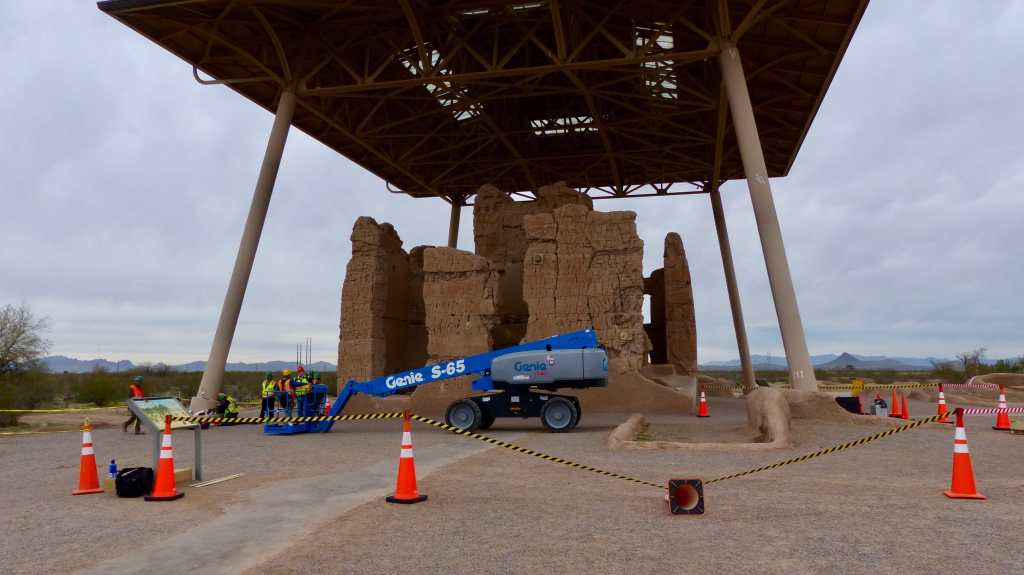
Anyhow, we finally find the onramp and off we go towards Ontario, Oregon. The interstate is very nice to drive taking us from one river valley to the next. It also takes us through some steep walled canyons. We exit the Interstate and head towards Weizer (pop. 5300), pronounced Weezer, Idaho a border farming community located just across the Snake River. From there US Route 95 takes us over rolling hills, through Cambridge (316 souls), Council (800 souls) and up through the Weizer River Canyon finally ejecting us into the New Meadows (477 souls) area. It’s ten miles from New Meadows to McCall and requires another climb through a narrow winding canyon.
Driving through McCall (pop. 3200) can be a pain as the two lane main road will only accommodate so much traffic. It’s heavy today but not unbearable. We turn off on Mission and arrive at the McCall RV Resort, set up and call it a day.
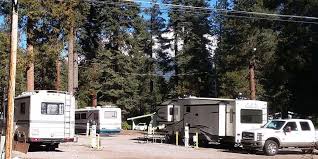
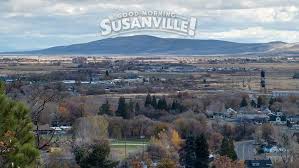
Wednesday, August 24, 2018 (Title is a quote from Ibn Battuta) Ibn Battuta was a geologist and scholar who widely traveled the medieval world for 30 years during the 14th century. Near the end of his life, he dictated an account of his journeys, usually simply referred to as The Travels. […]
Wednesday, August 24, 2018
(Title is a quote from Ibn Battuta)
Ibn Battuta was a geologist and scholar who widely traveled the medieval world for 30 years during the 14th century. Near the end of his life, he dictated an account of his journeys, usually simply referred to as The Travels. This account of his journeys provides a picture of medieval civilization that is still widely consulted today.
My experience mirrors that of Battuta. Jil and I have visited so many wonderful places in our 24 years that I can honestly say that it has turned me into a storyteller. Some of my friends may say that I’ve always had the propensity to blab, but now I do more of it with my blabber fingers. So as not to disappoint here is some more of my finger yammering.
Our five stay in Bend (pop. 77,000) has been as expected- a really nice visit in a really nice city. This part of Oregon is considered high desert at an elevation of 3600 feet. The only drawback- smoke! The smoke from British Columbia fires moved out and immediately replaced by that of the Terwilliger fire burning to the west and the Jenny’s Peak and the Stubblefield fires to the north. Geez!
The Crown Villa RV Resort began as a owner purchased site park meaning that one bought a site within the park. That might work down in the Sun Belt for those who spend six months a year escaping the cold northern winters but it didn’t work here. Hence, the park features wide and deep site pads paved with pavers, and at least 30 feet of green grass and conifer trees in between each site. The site also includes a permanent storage shed. The amenities include a gym, a meeting hall, a hot tub, tennis/pickleball court, a dog park- OK everything a person could want in a beautiful park like setting. We also like it here as it’s dog friendly with lots of green grass to walk the mutzos. The daily rate is not cheap- one gets what they pay for. P.S.- it’s not located on the noisy main drag either.
While in Bend we had a few must do’s: I must get a haircut- done, we must go grocery shopping- done, we must visit the spectacular Tumalo Falls- check, and we must go shopping at the Old Mill Mall.
OK shopping at the Old Mill Mall is not my idea but it is located on the banks of the Deschutes River. Here’s a nice walk that extends from downtown past the Old Mill Mall and around through the Farewell Bend Park. It’s really a fine walk with beautiful scenery. Even the mall is scenic. Three more things are on our “hope we have time” list: 1) clean the front and rear of the very dirty coach, 2) get the car washed, 3) give the mutzos a much needed bath. We score on all three!
Doyle in foreground, Megan behind
The place we didn’t visit this time is Drake Park. I really don’t know why we didn’t visit the park as we really enjoy walking it. This beautiful park is part of downtown Bend.
If one can call a downtown beautiful, downtown Bend would fit the description. The scenery is like eye candy with the mill pond bordering one side while very beautiful homes abut the pond on the other. Life can’t get any better than a visit to downtown Bend and the short walk to Drake Park.
True story: Jil is wearing her Put In Bay (located on South Bass Island, Lake Erie Ohio) sweatshirt that she purchased last fall while visiting the Great Lakes. The locals pronounce the place Putin, so that’s what reads on her sweatshirt. An older fella spots her shirt and gets all huffy as to how Jil can support that pinko commie rat bastard Vladimir Putin? He actually gets a little aggressive in his inquiry until Jil explains that she does NOT support Vladimir, that the sweatshirt is a souvenir from a tourist’s visit. A friend in the belligerent fellow’s party backed Jil up as he knew of Put In Bay, so the fella calmed down and sorta apologized, sorta………..
Tomorrow we are heading north than east towards Baker, Oregon. We will spend the night at Union Creek Campground located about 15 miles from Baker Oregon. We will then take the schlog up to McCall, Idaho and spend another five or so days visiting with Jil’s brother Rob, his wife Kathy and Jil’s sister Kim. That should be a good time- yes?
P.S.- Smoke has diminished to the point where we can actually see blue sky, clouds and even a couple of volcanic peaks! It’s still smokey, but not nearly as bad as the fog like smoke we’ve endured here in Bend………..
Smoke update: It’s still bad. Today is supposed to be the worst. Wind direction is blowing smoke down from British Columbia. Some genius in Spokane is rallying 100,000 people to purchase 5 box fans each. According to plan, they will all be turned on the morning of the 24th. The fella who engineered the plan figures all that fan power will blow the smoke back into Canada. A meteorologist who was apprised of the plan stated that he didn’t think it would work….but……if it did it would draw smoke up from Kali-fornia…….
So we’re off to see the Wizard, the wonderful Wizard of……… the Metoleus River, a.k.a. Wizard Falls Fish Hatchery. We head north on Highway 97 to Highway 20 and head northeast. The first fifteen miles is through dry horse country. A smattering of bovine, goats and alpacas also call this country home.
These volcanic peaks were hiding behind a smoke screen today. This is the view on a clear day.
We pass the Cascade Peaks vista point not only not seeing the peaks nor any portion of the mountains for the smoke. Round trip is over 90 miles- and we must pass through the sphincter of Highway 20, Sisters, once again. Fortunately we leave early and drive slowly through Sisters before most of the stores have opened- no crowds!
We also wanted to visit Camp Sherman since we have to drive right through the little burg. So we continue to climb up the mountain which is now covered in ponderosa pine and douglas fir trees. We pass the Black Butte Resort and turn right towards Camp Sherman.
Camp Sherman is interesting. It’s very small with a year round population of a few hundred. The community includes an elementary school, a post office and a general store and a couple of small restaurants. The draw for many is not only the beauty and serenity of this place but the fishing. In fact, the general store has a huge section dedicated to fly fishing as only that type of fishing is allowed on the Upper Metolius River. This quaint settlement can swell to several thousand during the high season. Several rustic resorts along the banks of the river make for a memorable stay. There are also a couple of RV parks near the river.
About five miles downstream is the Wizard Falls Fish Hatchery. Wizard Spring is just a short ways up river and empties into the Metoleus. It is said that the water temperature is a constant 48 degrees year round, ideal for raising fish.
The hatchery is small compared to that of Bonneville. Due to its somewhat remote location I’m sure the visitor count doesn’t compare to the one million people that visit Bonneville. Today there are six visitors including us. Wizard Falls is wonderful in that it’s rustic, remote and very quiet. Trout and Chinook salmon are currently raised here. A few fish have escaped the hatchery and now dwell in the settling pond…….. and a few of them are lunkers!
We head back following the Metolius. We have one more stop- the Headwaters of the Metolius. Surprisingly, the river begins at Metolius Springs- water comes out the north side of Black Butte. One looks at these little springs, the side of the mountain it originates from and figure there’s not enough water coming out of that spring to create that decent sized river. They say that the source of the springs is in the Black Butte Ranch area located south of Black Butte.
Turning to look downstream, the river is already several feet deep and 20 feet wide. Wow, that’s impressive! During the dry season 50,000 gallons a minute push through that mountain and emerge at this spring. During the wet season 600,000 gallons a minute can be measured here. THAT, is impressive my friend.
We retrace our steps and are now home. One thing that’s been on our minds is the reported abuse of children by priests in several Pennsyvania Catholic Dioceses. Here is a headline that I snipped from the new media:
Wall Street Journal: “Roman Catholic Church officials in Pennsylvania systematically covered up the molestation of more than 1,000 children by more than 300 priests over the past 70 years, according to a report released Tuesday on one of the most exhaustive investigations into the church’s sex-abuse scandal.”
That said, we attended St. Paul Catholic Church Mass in Silverton last Sunday. We both feel that this was in the top 10 Masses that we have ever attended. The choir sang beautifully, and the priests were very reverend and humble. If we lived in this area we would definitely attend Mass here.
Two priests, both of St. Paul’s are presiding. Two presiding is unusual, which usually means somethings up. The Mass in every Catholic Church is almost identical and is steeped in tradition. Part way through the Mass, after the Readings from the Bible and the Gospel of the Lord a homily is given, either by a priest or a deacon of the Church.
In this case, the younger of the two priests gives the homily. It is obviously coming deep from within his heart and not a written statement from the Archdioceses. He explains how the new news of abuse within the Church is so troubling even though it occurred so many miles away. He asks that his parishioners pray for the victims. He explains that although the Church is broken it is still the Lord’s House and will be repaired. He is truly shaken. The older priest has recently requested and has been granted the opportunity to serve in Venezuela. He speaks before Mass is dismissed. As he speaks, his voice breaks. He pauses and tears well in his eyes, with great difficulty continues on with his feeling of sadness, he prays that all the wrongs will be dealt with righteously.
Priests know that they hold the deep power of trust and respect of their parishioners. If they didn’t they are not effectively doing what God has called them to do- shepherd his flock. The young priests of St. Paul’s have shown that they have a profound respect for their flock and Jesus. That is good. God Bless this little parish.
People of authority, of public trust, must acknowledge that power does not entitle one to abuse another, no matter what type of abuse. If they do abuse their authority they must be held accountable.
Another smoky morning in Silverton. More smoky than yesterday. The rising sun is reddish orange. What’s new? We’ve been in nearly constant smoke beginning last month in Reno and every day on this trip thus far.
We packed up, picked up and were on the road by 0830 hours. For you non- RVer’s packing up is self-explanatory. Ya don’t want stuff flying all over the place while traveling in your home on wheels. Picking up means disconnecting and storing all umbilical cords and hoses. You know, the power cord that supplies electricity to the RV, the water hose, the TV cable and the sewer hose. All these things have a specific place in their respective storage bays. Once picked up and packed up the four slide out rooms of the coach come in, then the leveling jacks come up. Believe me when I say the hardest part of this sequence is turning on the key and pushing the “store” button on the leveling jack panel. Oh, please don’t believe it as that is the easiest thing to do!
We head towards town, turn right and head south on the Cascade Highway. This gently undulating highway runs through farmland. We pass grass fields that have been intentionally burned to kill weed seeds in preparation for a new crop, orchards of young fruit trees and farms growing hops. Twelve miles down that road and we turn east onto the Santiam Highway, Route 22 which will take us to within a short distance of Bend.
The Santiam Highway follows the Santiam River for many miles. We travel past two dams, the Cliff Dam and the Detroit Dam. Cliff lake is relatively small while Detroit lake is large- but obviously suffering from drought conditions as its banks are showing. Detroit is very popular with fishermen and outdoors folks. On its banks is the nice Detroit Lakes State Park. The town of Detroit isn’t large but does a bustling business, at least during the high season. Past Detroit lake the mountain sides and forest close in. The canyons get narrower as the we travel higher up into the Cascade mountains. There are not many communities on this portion of Highway 22.
A ways past Detroit Lake we come to one of our favorite rest stops. It has a large grassy Pet area at the end of the horseshoe drive, an ideal spot for the dogs. It’s relatively small parking area features big rig/trailer pull through parking lanes no longer than 35 or 40 feet- just long enough for a small pickup towing a fishing boat but not long enough for our RV and towed. Only one other car is there so we pull across a bunch of diagonal parking stalls at the end of the row. We are out of the way, there are at least 10 spots behind us and 15 on the other side of the loop.
Santiam Rest Stop
Dog Friendly Grass Area
Santiam Rest Area
We are good to go……. HELLO!….. I open the driver’s side window. It’s the worker bee lady that was power washing the benches. She tells me that we are OK to park here for now………. but if it was busy I’d have to move over across the loop to the big rig parking area. I thank her and add that we will only be here about 20 minutes. She adds “Well, remember what I said for the next time you stop here!” Sheesh! I almost said that the last time we were here was four years ago so if I come back in the next four or five please be here to remind me. I look over towards the “big rig” parking area that parallels the curb line and its big enough for one big rig- and it’s occupied. Double Sheesh!
The Non-native Himalaya Blackberry Grows EVERYWHERE!
The Santiam Highway, Highway 22, merges with the McKenzie Highway, Highway 20 and continues east as Highway 20 down to the very artsy fartsy, very, very popular town of Sisters.
Sisters holds the very busy highway hostage as the only good way through town is directly down the two lane Main Street. I really don’t like driving through town behind the wheel of a normal sized vehicle, much less a big rig. Cars are parked on both sides of the highway, people tend to jaywalk between them and others who use the cross walks will just walk out in front of moving traffic. Gads!
These Volcanic Peaks Were Hiding Behind a Smoke Screen Today
Anyway, the 133 mile trip to Bend wasn’t fast. The roads are posted at 55 mph but have many curves ranging from 35, 40 and 45 mph. We weren’t in any hurry and really enjoyed the scenery near the road- the mountain peaks normally seen were hiding behind that danged smoke! It’s supposed to clear out in a couple of days. I sure hope so since we’ll be here for five!
After a refreshing overnight stay at the Deerwood RV Park in Eugene, we again head north up I-5. We are officially in the Willamette Valley, crossing over the Willamette in Eugene (home of the U. of Oregon Ducks). The smoke from the multiple wildfires hasn’t left us but it’s not nearly as bad as that of Grants Pass. The four lane interstate leads us past Coburg where Marathon class A motorhomes are manufactured. We also pass Brownsville, a quaint town just off the main highway that has a very unusual pioneer cemetery, one that has both pioneers and Native Americans buried in the same location.
The “old” road predating Interstate 5 is oriented north/south US 99 basically following the west side of the Willamette river while I-5 follows to the east. US 99 takes one through all of the main population centers and farm towns via surface street. Traveling US 99 is lovely way to visit the towns of the Willamette Valley. It’s also the wrong way to go if one is in a hurry.
So I-5 takes us in proximity of many towns. We bypass Junction City, Corvalis (home of the Oregon State Beavers), drive through the outskirts of Albany, and exit the interstate in Salem. We head northeast on the Silverton Highway Oregon 213. After driving 15 miles through rolling farmland we arrive at the Silver Spur RV Park just outside of the town of Silverton. We check in at the office and set up in the brand new section of the park. The park’s nice clubhouse/laundry facility as well as great location less than a mile from downtown makes it a draw.
It’s also very close to the Oregon Garden. One must drive right through town in order to visit the beautiful nine fall Silver Falls State Park. So the location couldn’t be better. However, the park is a little crowded and a little dusty as the normally green lawns are dry. It seems this part of Oregon is experiencing a drought.
We visit the Oregon Garden for the umpteenth time. We very seldom visit this time of year so it’s a real treat to see most of the plants in bloom. By the way, zinnias are really showy this time of year!
While here we visit one of our favorites, the Mt. Angel Abbey. We really like to attend Lauds- the priests, monks and seminarians sing Gregorian Chants with 1/2 of them in pews on the left side of the Altar and the other half on the right. One side starts the chant and the other responds. It’s really wonderful to listen to. Unfortunately this time there are no Lauds, no chants as the church is closed for repair.
We even had time to visit a most beautiful Silver Falls State Park. Crowds? It’s the middle of summer, on a weekend so we expect the worst. The day use parking lot was pretty full. In the fall when we normally visit maybe a handful of cars are parked. I’d estimate parking capacity at 400 vehicles and it was more than half full. But not many people where we wanted or could go with our mutzos. Dogs aren’t allowed on the Falls Trail. Since foot traffic was fairly light I’d guess that half the visitors are down in the canyon. Silver Fall itself is over 200′ high. The trail goes behind the fall as it does another farther downstream. As one would expect the falls are still active but the volume of water is much lower than the spring runoff.
Bridge at foot of Silver Falls- and close up…..
Well, well. What have we here? Silverton is having itself an art festival this weekend. Jil is in desperate need of the purchase of a couple of gifts for folks we will be visiting on this trip. We arrive at the local park to run the dogs and lo and behold we are greeted with 100 white canopies! Looks like we found the art festival! We arrived while the vendors were still setting up for the day- in fact some were still eating breakfast. But money talks so a few of them opened up shop early just for Jil. We now have our gifts……………….
Drip………drip………drip………. our hard to open single handle kitchen faucet decided to start leaking a few days ago. I decide to buy repair parts while we are in proximity of Salem since we’ll be there for three days………..I take the valve apart and discover the rubber seats have a chunk missing out of them. I use vaseline and coat the seals and put the valve back together……………. drip…..drip…..drip…..drip! The leak is worse! Jil is unhappy as the drip…drip…drip is driving her bananas. I don’t know who manufactured the faucet so I call Tiffin. Hello? Who made my faucet? Moen? OK, thanks for the info. I call a nation wide plumbing supply company and ask if they sell Moen faucet repair kits…….Maybe…… what you mean “maybe”…… well, it depends…… “depends” on what? Well you have to bring the parts in so we can match them.
Okie Dokie, so the plan is to stop on the way to Silverton since the shop is on the way. We MISS The turnoff! The exit to the street we wanted was not labeled as expected. Not Mission but Detroit Lakes. When we realized we missed the turnoff we went straight to Silverton. The next day I decide to head 16 miles back to Ferguson Plumbing Supply. I stay on country roads as far as possible. The place is located on the outskirts of Salem proper……. but I wind up in the friggin’ country! Must go back but now I’m sorta disoriented. I travel north to a street that I know is on the north side of the street I’m looking for and double back. I finally find THE street but traffic is backed up 1/2 mile between stop lights. CRAP. I went home.
So to make a long story a tad longer, I try to find pictures of the parts I need on the internet. I AM SUCCESSFUL! Moen faucet?……naw……..DELTA! Ferguson closed on Saturday….. Home Depot OPEN………. Home depot only has some some of the parts I need but I think they will stop the leak. I try to figure out how to get to Home Depot on Google Maps……… I decide to take Jil’s Smarty Pants phone with me with the maps app loaded up. THIS time the app works great. I find Home Depot fibbed and all of the parts I need are in stock. I’m outa there in no time. Back home I have the faucet apart and new parts installed in less than a 1/2 hour. No leaks YEA!
Tomorrow we are heading over the Cascade Range to another one of our Oregon fav’s, Bend. See you there!
We planned for a shorter drive today of about 150 miles. Our hope was to contact an old friend that had relocated to the Eugene Oregon area. I called his phone number but the lady who answered didn’t know him nor his wife. I cross checked the number with other information and I did have the number listed. Too bad, we would have really liked to visit with him and his wife. Hadn’t seen him for 5 years.
We are getting pretty s……t full of the wildfire smoke. It had been lying in the Truckee meadows for a month and now that we have started our journey the smoke has followed us. It’s thick, yellow brown yuck which is thick enough to hide the hills around Valley of the Rogue State Park. We depart and head north on I-5.
We travel past Rogue River, Grants Pass, Wolf Creek and a bunch of other small communities that the interstate has bypassed. We go over a couple of passes. Although the climb is rather steep and lengthy neither pass is over 2000 feet in elevation. The pine forest becomes more lush as we climb in elevation. The road takes us through steep sided rocky canyons.
Downtown Canyonville, Oregon
Our first stop is the appropriately named community of Canyonville. The town is historically significant as the 3rd oldest town in Oregon. It’s location between mountain passes was an ideal layover location for pioneers traveling the difficult Applegate Trail. More recently it was nothing more than a wide spot in the road with an oddly located and out of place multistory seniors housing community prominently placed next to Interstate 5.
Entrance to Seven Feathers Casino Resort
And then a casino was built somewhat recently- the Seven Feathers Casino Resort. In 1992 the Cow Creek Band of Umpqua Indians opened the Cow Creek Bingo Hall which in now the Seven Feathers Casino Resort. Then the lovely Seven Feathers RV Resort was built on the other side of the interstate, and then the Seven Feathers Travel Stop. Today the travel stop features a large auto fueling station, a 6 bay big rig fueling station with associated huge big rig parking area, a market and food for the famished. This little town of 1900 folks have a good thing going for it!
So we have a rig with a 100 gallon fuel tank. I’ve fueled the rig a few times but never topped it off. The fuel gauge shows between 1/2 and 3/4 of the 100 gallon tank. We decide that the Travel Stop is a good place to fuel up- plenty of room for our rig in the big rig fueling area. The pumps will only take company credit cards so I go inside. The attendant asks how much I wanted to debit on my card. I figured with the price of fuel and less than a half tank I’d get change from a $200 bill. Wrongo cowboy! I put 59.999 gallons of fuel out of in the beast and didn’t top it off. My $200 bill fits entirely into that fuel tank! Gads, I wonder how inaccurate the fuel gauge must be? Well, the fuel gauge needle goes about a 1/4 of a tank past the “F” mark. I really don’t want to find out where on the gauge that needle will be pointing when we run out of fuel………. There is a way to figure a 1/4 tank of fuel. The generator uses the same fuel source as the main engine but cannot access that fuel with the tank less than a quarter filled. So somewhere between a 1/2 and a 1/4 I will attempt to run the generator. When it refuses to run I will know that I have 1/4 tank of fuel or less. Or….. I could take the rig into a shop and have the fuel gauge calibrated for a bazillion dollars! NOT!
Myrtle Creek
After fueling we continue on. We’d like to stop and let the dogs walk a little in a place a little nicer than a noisy asphalt sea surrounding a stucco island. We jump off the interstate and head into Myrtle Creek, pop. 3400. The town was established at the site of a mill in 1851. The mill site is now Mill Park, a grassy multiuse facility boasting a children’s play area, a swimming pool, a baseball field and an RV park. It’s a nice place to walk the mutzos. We leave town and head north passing Round Prairie and Green, driving through Roseburg, passing Wilbur, driving through Sutherlin, Rice Hill, Anlauf, Curtin, Comstock, Veatch, Latham, Cottage Grove, Creswell. Whew!
We turn right onto Oregon 58 in Goshen, travel a quarter of a mile to Deerwood Luxury RV Park, Eugene Oregon. We’ve been to this lovely park in the past and it’s beauty does not disappoint. We snuggle into a pull through spot, Jil fires up the washer and dryer, I fire up the Instant Pot and make a pot roast. Our dirty clothes are now clean and we no longer hunger.
Tomorrow we are going to Silverton Oregon which about 15 miles northeast of Salem, Oregon. See you there!